Start at the top for an easy introduction. Go further down for more detail and scholarship.
- Easy
- Intermediate
- Advanced
For young readers
Imagine finding a note written three times: once in a secret picture code, once in a strange squiggly handwriting, and once in a language you can read. If all three say the same thing, you can use the one you know to crack the other two. That is exactly what the Rosetta Stone is.
More than 2,200 years ago, Egypt was ruled by a family of kings called the Ptolemies, whose ancestors came from Greece. In 196 BC, Egyptian priests met in the old capital, Memphis, and wrote a long message praising their young king, Ptolemy V. They ordered it to be carved on stone in three kinds of writing: hieroglyphs (the picture writing for the gods), Demotic (the everyday Egyptian handwriting) and Greek (the language of the government).
Over the centuries people forgot how to read hieroglyphs. The stone was broken, moved, and finally used as a building block in the wall of a fort near the town of Rosetta (Rashid) by the Mediterranean Sea.
In 1799 French soldiers, who had invaded Egypt with Napoleon, found it while repairing the fort. Scholars saw at once that it might be a key. The British later took it to London, where it has been in the British Museum since 1802.
It took more than twenty years of work by many people. Finally, in 1822, a young French scholar named Jean-François Champollion showed how hieroglyphs worked: some pictures stand for sounds, like letters, and some stand for ideas. After that, people could read the words of ancient Egypt for the first time in about 1,400 years.
At a glance
- Date
- Decree issued 27 March 196 BC (year 9 of Ptolemy V Epiphanes)
- Issued by
- A council (synod) of Egyptian priests assembled at Memphis
- Scripts
- Hieroglyphic (top, 14 surviving lines), Demotic (middle, 32 lines), Greek (bottom, 54 lines)
- Material and size
- Granodiorite, probably from the Aswan region; 112.3 × 75.7 × 28.4 cm; about 760 kg; a fragment of a larger stele
- Original setting
- A temple, possibly at Sais in the Nile Delta (uncertain)
- Found
- July 1799, reused in the walls of Fort Julien near Rosetta (Rashid), by French troops under Pierre-François Bouchard
- Now
- British Museum, London (inv. EA 24), since 1802
- Why it matters
- Provided the parallel texts that enabled Thomas Young, Jean-François Champollion and others to decipher Egyptian scripts (breakthrough announced 1822)
Easy
What is the Rosetta Stone?
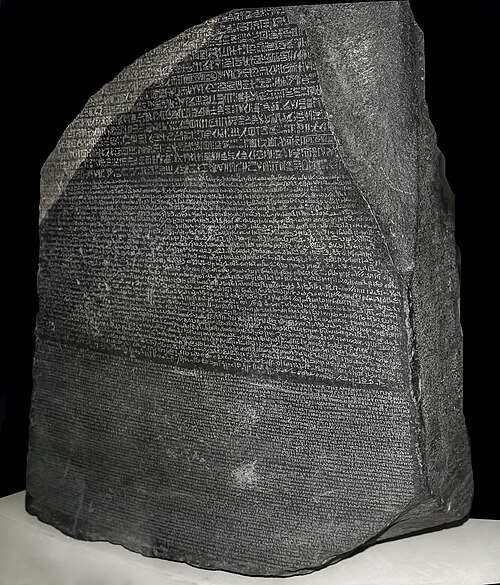
The Rosetta Stone is a large fragment of a stele – an upright stone slab carrying an official text – made of dark grey granodiorite. It is about 1.1 metres high and weighs roughly 760 kilograms. Its front is polished and covered with three blocks of writing, one above the other.
All three blocks record the same decree, issued in 196 BC by Egyptian priests in honour of King Ptolemy V. The top block is written in hieroglyphs, the middle in Demotic, a cursive script used for everyday Egyptian, and the bottom in ancient Greek. The versions are not word-for-word identical, but they say essentially the same thing.
In itself the decree is a fairly routine piece of royal and religious politics. What made the stone famous is its timing. When it was found in 1799, nobody alive could read hieroglyphs or Demotic, but many scholars could read Greek. The stone offered what looked like a translation from a known language into two unknown ones.
The stone has been in the British Museum in London since 1802 and is often said to be the museum’s most visited single object. Its name has also become an everyday expression: a “Rosetta Stone” is any key that unlocks a difficult problem.
Easy
How to look at the stone
The first thing to notice is that the stone is broken. It was once the lower part of a taller stele, which probably had a rounded top decorated with a scene of the king and the gods. The hieroglyphic section at the top suffered most: only the last 14 lines survive, and all are broken on the right. The Demotic section in the middle is the best preserved, with 32 lines. The Greek section at the bottom has 54 lines, the lower ones cut off by a diagonal break.
Look closely at the three scripts. Hieroglyphs are small pictures – birds, snakes, hands, reed leaves – arranged in rows. Some are surrounded by an oval ring called a cartouche, which marks the name of a king. Demotic looks like fast, joined-up handwriting and is hard for a beginner to connect with the pictures above. Greek is written in capital letters that anyone who knows the Greek alphabet can recognise.
The colour of the stone has changed over time. For many years after it came to London, its letters were filled with white chalk to make them easier to read and the surface was coated with wax, which made it look black; it was often wrongly called basalt. Cleaning in 1999 removed these later layers, revealing the original dark grey stone with a pink vein across the top left corner.
On the sides you can still see painted English words added in London: “Captured in Egypt by the British Army in 1801” on one edge and “Presented by King George III” on the other. These words are part of the object’s modern history.
Easy
What does the decree say?
The text is a decree of a synod – a large meeting – of Egyptian priests held at Memphis, the ancient capital where kings were crowned. It is dated to the ninth year of Ptolemy V, corresponding to 27 March 196 BC – the day after the young king’s coronation at Memphis as pharaoh.
The priests list the good deeds of the king. He gave silver and grain to the temples, remitted a number of taxes owed by the temples, and when the Nile flooded unusually high in his eighth year he had the excess waters dammed for the benefit of farmers. He is praised in traditional terms, as a new Horus, for defeating rebels at the Delta town of Lycopolis and restoring order.
In return the priests promised new honours. The king’s birthday and coronation day would be celebrated every year, and priests throughout Egypt would serve his cult alongside the other gods. In other words, the king was made into a god to be worshipped in every temple.
The last lines order that a copy be set up in every temple, inscribed in the “language of the gods” (hieroglyphs), the “language of documents” (Demotic) and the “language of the Greeks.” That order is the reason the Rosetta Stone has three scripts – and why several other copies of the same decree have since been found.
Intermediate
Historical context: a boy king in a divided Egypt
After Alexander the Great conquered Egypt in 332 BC, one of his generals, Ptolemy, founded a dynasty that ruled Egypt for almost 300 years from the new Greek city of Alexandria. The government worked in Greek, while most of the population spoke Egyptian and worshipped the traditional gods in temples run by powerful priesthoods.
Ptolemy V Epiphanes came to the throne in 204 BC at the age of about five, after his parents died in suspicious circumstances. Court factions fought over the regency; one hated regent was killed by a mob in Alexandria. Abroad, the Seleucid king Antiochus III and Philip V of Macedon seized Ptolemaic territories, and in the Fifth Syrian War Egypt lost its lands in the Levant and Asia Minor.
Inside Egypt, a great revolt had broken out in the south around Thebes under two Egyptian rulers, Horwennefer and Ankhwennefer, who claimed to be pharaohs. It lasted from about 206 to 186 BC and cut much of Upper Egypt off from Ptolemaic control. A second group of rebels seized the Delta town of Lycopolis; after a siege, their leaders were taken to Memphis and executed during the coronation festival in March 196 BC, the day before the decree.
In this situation the support of the Egyptian priesthood was vital. It is significant that the decree was issued at Memphis, the old religious capital, rather than Alexandria, and that Ptolemy was crowned there in traditional Egyptian style. The decree is part of a bargain: the crown granted privileges and gifts to the temples, and the priests used their authority to present the young Greek-speaking king as a legitimate pharaoh.
Intermediate
Three scripts, two languages, one decree
Although there are three scripts, there are only two languages. Hieroglyphs and Demotic are both ways of writing Egyptian; Greek is a different language. Hieroglyphs were by then used mainly for sacred and monumental texts, and the hieroglyphic version is written in a deliberately old-fashioned form of the language, sometimes called “neo-Middle Egyptian,” imitating the classical Egyptian of more than a thousand years before. Demotic reflected the Egyptian actually spoken in Ptolemaic times.
Egyptian writing was not an alphabet. All three Egyptian scripts – hieroglyphic, the cursive hieratic, and Demotic – mixed phonetic signs, which stand for one, two or three consonants, with ideographic signs, including logograms for whole words and determinatives, silent signs that show what kind of word is meant. This mixture was the main reason decipherment was so hard.
Such multilingual priestly decrees were a feature of the Ptolemaic period. Three slightly earlier examples are known – the decrees of Alexandria (243 BC), Canopus (238 BC) and Memphis under Ptolemy IV (about 218 BC) – and several other copies of the Rosetta decree itself have been found, including the Nubayrah Stele and an inscription at the temple of Philae. The Rosetta Stone was the first to be discovered in modern times, not the only one.
Which version came first is still debated. In 1841 Antoine-Jean Letronne argued that the Greek text, produced by the government, was the original. Other scholars have argued that all three were composed together, or have stressed the special importance of the hieroglyphic text, meant “for the gods to read.” Because the three versions do not match word for word, early decipherers who expected an exact translation found the task harder than they had hoped.
Intermediate
From temple to fort: the stone’s long journey
The stone was almost certainly not made for Rosetta. It probably stood in a temple further inland, possibly at the royal city of Sais in the western Delta. The later history of Egyptian religion shaped its fate: as Egypt became Christian, temple priesthoods died out, and temples were closed in the late 4th century AD. The last known hieroglyphic inscription was carved at Philae in AD 394, and the last known Demotic text there in 452.
Old temples were often used as quarries. At some point the stele broke, and its largest piece was eventually built into the foundations of a fortress near Rashid (Rosetta) that guarded a branch of the Nile. The fort is usually attributed to the Mamluk sultan Qaitbay in the late 15th century. There the stone lay for at least three centuries.
In 1798 Napoleon Bonaparte invaded Egypt with an army accompanied by more than 150 scholars, engineers and artists. In mid-July 1799 soldiers rebuilding the fort – which the French had renamed Fort Julien – uncovered the slab when demolishing a wall. Lieutenant Pierre-François Bouchard recognised that it might be important. A report to the new Institut d’Égypte in Cairo correctly suggested that the three texts were versions of one decree.
French scholars quickly made copies. The printer and linguist Jean-Joseph Marcel identified the middle script as Demotic, and the artist-inventor Nicolas-Jacques Conté used the stone itself as a printing block to make ink impressions. These prints reached Paris and allowed scholars in Europe to begin work before the stone itself left Egypt.
Intermediate
Capture, London and the British Museum
British and Ottoman forces defeated the French in 1801. Under the Capitulation of Alexandria, the French had to hand over antiquities collected by the expedition. General Menou tried to claim the stone as his private property, and accounts of exactly how it passed into British hands differ. The British officer Tomkyns Hilgrove Turner later said he seized it himself and carried it off on a gun-carriage.
Turner brought the stone to England in February 1802. After being shown at the Society of Antiquaries of London, which made plaster casts for the universities of Oxford, Cambridge, Edinburgh and Trinity College Dublin and circulated prints, it was placed in the British Museum later that year. It was given the number EA 24.
The stone has been on display almost continuously since 1802. In 1917, during the First World War, it was moved for safety to an underground station of the Post Office railway for two years. It has left the museum only once in peacetime: in October 1972 it was shown for a month at the Louvre in Paris beside Champollion’s famous letter, for its 150th anniversary. Since 2004 it has stood in a special case in the Egyptian Sculpture Gallery, and a touchable replica stands in the King’s Library.
The stone’s journey mirrors wider history: an Egyptian monument, reused by a medieval Islamic state, found by one European empire during an invasion and taken by another as a spoil of war. The painted words on its sides – “Captured in Egypt by the British Army in 1801” – openly record that origin.
Intermediate
Cracking the code: from 1799 to 1822
Before 1799, hieroglyphs had been misunderstood for centuries. The Greek writer Horapollo, in the 5th century AD, explained them as symbolic pictures with hidden meanings, and this idea misled later readers. Medieval Arab scholars such as Ibn Wahshiyya compared hieroglyphs with Coptic, the last stage of the Egyptian language, and in the 17th century the Jesuit scholar Athanasius Kircher argued correctly that Coptic descended from ancient Egyptian, even though his translations of hieroglyphs were fanciful.
Work began with the Greek. The first published translations appeared in 1803. Then in 1802 Antoine-Isaac Silvestre de Sacy and the Swedish diplomat Johan David Åkerblad used the Greek names to find their equivalents in the Demotic text. De Sacy identified several names, including Ptolemy and Alexander, and Åkerblad drew up a Demotic alphabet of 29 signs, about half of them correct. But they assumed Demotic was purely alphabetic, and could go no further.
The British polymath Thomas Young, famous also for his work on light, made the next steps from 1814. Following a hint that names in cartouches were written phonetically, he identified the signs spelling Ptolemy in the hieroglyphic text. He also noticed dozens of resemblances between hieroglyphic and Demotic signs and concluded, correctly, that Demotic mixed phonetic and ideographic signs derived from hieroglyphs. He published these results in an encyclopedia article in 1819.
Jean-François Champollion, a scholar from Grenoble who knew Coptic well, made the decisive breakthrough. Using the Ptolemy cartouche from Rosetta and a Cleopatra cartouche from an obelisk from Philae, he built up a list of phonetic signs. Then, in September 1822, looking at copies of inscriptions from Abu Simbel, he read the names of the native pharaohs Ramesses and Thutmose – proving that phonetic signs were used long before Greek rule. On 27 September 1822 he presented his results in Paris in his Lettre à M. Dacier. His Précis of 1824 explained that hieroglyphic writing was “figurative, symbolic and phonetic” all at once.
Intermediate
Legacy: the birth of Egyptology and a household phrase
By 1824 the short hieroglyphic text on the stone had given all it could; Champollion moved on to hundreds of other inscriptions and papyri. He died in 1832, leaving an incomplete grammar and dictionary. Later scholars corrected his system: Karl Richard Lepsius explained signs that stand for two or three consonants in 1837, Heinrich Brugsch advanced Demotic studies, and Emmanuel de Rougé published the first translations of Egyptian literature in the 1850s.
Final confirmation came in 1866, when Lepsius found a well-preserved copy of the Canopus Decree, another trilingual priestly decree. Its hieroglyphs could be compared directly with its Greek, and the results showed beyond reasonable doubt that the method was right. By then Egyptian writing had become a readable language, opening up more than three thousand years of history, religion and literature.
The decipherment of Egyptian, together with the decipherment of cuneiform in the same century, transformed the study of the earliest human history. Texts such as the Pyramid Texts, the Book of the Dead and Egyptian stories and letters could now be read in their own words rather than through Greek and Roman reports.
The phrase “Rosetta Stone” became a metaphor for any crucial key. Other bilingual inscriptions, such as the Behistun Inscription for cuneiform, have been called “Rosetta Stones.” Scientists have used the phrase for the hydrogen spectrum in physics, a plant used in genetics, and much else, and the European Space Agency named its comet probe Rosetta.
Advanced
Debates over credit and method: Young, Champollion and the others
Who deserves credit for the decipherment has been argued since the 1820s. Champollion’s Lettre acknowledged Young’s work on Demotic but did not mention Young’s analysis of the Ptolemy cartouche or his identification of the feminine name ending. Young, believing these had made Champollion’s progress possible, wrote privately that if Champollion had borrowed an English key, “the lock was so dreadfully rusty” that no ordinary arm could have turned it. British reviewers in the 1820s accused Champollion of plagiarism; E. A. Wallis Budge in 1904 again stressed Young’s role.
Modern historians of the decipherment generally see the achievement as cumulative but give Champollion the decisive role. Young’s insights were important, but he could not get beyond names and never grasped that phonetic signs were used throughout native Egyptian words. Champollion’s knowledge of Coptic allowed him to move from reading names to reading the language. Recent accounts note that the Lettre itself was only a modest advance over Young; the real leap came in 1823–24, when Champollion showed that phonetic signs were used throughout the script, not only in royal names.
The story also illustrates the limits of a single “key.” The hieroglyphic part of the stone is badly damaged and contains relatively few signs, and the three versions are not exact translations. Much of the decisive evidence came from elsewhere: the Philae obelisk, copies of inscriptions from Abu Simbel and other temples, the Abydos king list and Coptic vocabulary. How exactly Champollion reached some of his conclusions cannot be fully reconstructed, because contemporary accounts conflict and his famous exclamation “I’ve got it!” comes from a biography written in 1906.
Champollion’s own system had serious errors. He overestimated the similarity between classical Egyptian and Coptic and believed each phonetic sign stood for a single sound. Lepsius, Edward Hincks, de Rougé and others corrected these points. Historians therefore now describe the decipherment as a process lasting from 1799 to the 1860s involving many scholars, including earlier Arab and European work on Coptic, rather than a single moment of genius.
Advanced
Ownership, the colonial past and calls for return
In July 2003 Zahi Hawass, then head of Egypt’s Supreme Council of Antiquities, called for the stone’s return, describing it as an “icon of our Egyptian identity.” In 2005 he included it in a list of key objects Egypt wished to recover, alongside the bust of Nefertiti in Berlin and the Dendera zodiac in the Louvre. He later proposed a three-month loan for the opening of the Grand Egyptian Museum, at one point offering to drop the permanent claim in exchange, and he repeated his demands in 2022.
The British Museum gave Egypt a full-size replica in 2005, first displayed in the Rashid National Museum near the find spot. The museum has not returned the original. Like other large museums, it has argued that objects acquired in earlier times must be viewed in the light of the values of that era and that “universal museums” serve people of every nation – a position set out in a 2002 joint declaration by more than 30 major museums. Critics reply that the idea of the universal museum mainly benefits institutions in former imperial capitals.
The stone’s history raises specific questions. It was not excavated but removed from a military fort; it passed between two foreign armies at war on Egyptian soil; and the legal instrument that transferred it, the 1801 capitulation, was an agreement between European powers and the Ottoman Empire in which Egyptians themselves had no voice. For many Egyptians, the question is less about legal title than about who controls the symbols of their history.
The Egyptologist John Ray has observed that the day may come when the stone has spent longer in the British Museum than it ever did at Rosetta. The debate continues as part of a wider international reassessment of collections formed during the colonial era; the sources consulted here do not record any agreement on a loan or return.
Key ideas
- Parallel text
- The same message written in more than one language or script; comparing a known version with an unknown one is the classic route to decipherment.
- Phonetic and ideographic signs
- Egyptian writing combined signs for sounds with signs for words and meanings; realising that both kinds are used together was the core of the breakthrough.
- Cartouche
- The oval ring around royal names, which let decipherers locate names such as Ptolemy and Cleopatra and work out the sound values of their signs.
- Coptic
- The last stage of the Egyptian language, written in a Greek-based alphabet; knowledge of it let Champollion move from names to words.
- Priestly decree
- The stone records a bargain between the Ptolemaic crown and Egypt’s priests: gifts and privileges in exchange for religious legitimacy.
- Cumulative decipherment
- The reading of Egyptian was the work of many scholars over decades, with Champollion’s insight as the turning point.
- Contested heritage
- Taken as a spoil of war in 1801, the stone is part of debates over colonial-era collections and repatriation.
Records
- 238 BCE — Decree of Canopus, an earlier trilingual priestly decree, is issued under Ptolemy III.
- 204 BCE — Ptolemy V becomes king at about five years old.
- c. 197 BCE — Around October–November 197 BC Ptolemy V, aged about 13, is declared an adult in Alexandria; the decree later names 27 November 197 BC as an official coronation anniversary.
- 196 BCE — 27 March 196 BC: the day after Ptolemy V’s coronation at Memphis, the assembled priests issue the decree inscribed on the Rosetta Stone.
- 394 CE — The last known hieroglyphic inscription is carved at Philae; knowledge of the script fades.
- 1799 — July: French soldiers find the stone in the walls of Fort Julien near Rosetta.
- 1801 — The French surrender in Alexandria; the stone passes to the British.
- 1802 — The stone arrives in England and is placed in the British Museum; Demotic names are identified by de Sacy and Åkerblad.
- 1814 — Thomas Young identifies the phonetic signs of Ptolemy’s name in the hieroglyphic text.
- 1822 — 27 September: Champollion presents his decipherment in the Lettre à M. Dacier.
- 1824 — Champollion publishes the Précis du système hiéroglyphique.
- 1972 — The stone is lent to the Louvre for one month, its only peacetime journey out of the British Museum.
Glossary
- Stele
- An upright stone slab carrying an inscription or image, often set up in public or in a temple.
- Hieroglyphs
- The ancient Egyptian picture script, used especially for sacred and monumental texts.
- Demotic
- A fast, cursive Egyptian script used for everyday documents from about the 7th century BC, and the name of the language stage it recorded.
- Granodiorite
- A hard, grainy igneous rock related to granite; the stone probably came from the Aswan region.
- Ptolemaic dynasty
- The Macedonian Greek royal family that ruled Egypt from after Alexander the Great until Cleopatra VII (30 BC).
- Synod
- A formal assembly of priests; Ptolemaic synods issued decrees honouring the king.
- Cartouche
- An oval ring drawn around a royal name in hieroglyphic writing.
- Determinative
- A silent sign placed after a word to show what category of meaning it belongs to.
- Coptic
- The final stage of the Egyptian language, written with Greek letters plus a few extra signs; still used in the liturgy of the Coptic Church.
- Decipherment
- Working out how an unknown writing system represents a language.
Questions and answers
Does the Rosetta Stone contain a secret or a story?
No. It is an official decree in which priests thank and honour King Ptolemy V. It is famous because it is written in three scripts, not because of what it says.
Why is it called the Rosetta Stone?
Because it was found near the town Europeans called Rosetta, known in Arabic as Rashid, on the Mediterranean coast of Egypt.
Did the stone alone solve hieroglyphs?
No. It gave the starting point, but decipherment also needed Coptic, other inscriptions such as the Philae obelisk, and many years of work by several scholars.
Who deciphered hieroglyphs: Young or Champollion?
Both contributed. Young made important early discoveries, but Champollion showed how the whole system worked and could read Egyptian words; most historians give him the decisive role.
Why are the three versions slightly different?
They were written for different readers and traditions, possibly composed side by side rather than translated from a single original. Scholars still debate which, if any, came first.
Is it the only stone of its kind?
No. Other copies of the same decree and several earlier Ptolemaic trilingual decrees are known, including the better-preserved Decree of Canopus.
Will the Rosetta Stone go back to Egypt?
Egyptian officials have asked for its return or a loan. The British Museum has so far kept it, arguing for its role as a museum for the world. The debate continues.
Sources and further reading
- Rosetta Stone. Wikipedia
- Decipherment of ancient Egyptian scripts. Wikipedia
- Ptolemy V Epiphanes. Wikipedia
- Fort Julien. Wikipedia
- Thomas Young (scientist). Wikipedia
- Decree of Canopus. Wikipedia
- Ptolemaic synodal decrees. Wikipedia
- Richard Parkinson, Cracking Codes: The Rosetta Stone and Decipherment. British Museum Press, 1999
Related
- CuneiformOne of the world’s earliest writing systems, made by pressing a reed into wet clay; invented in southern Mesopotamia and used for more than 3,000 years to write many languages.
- Bust of NefertitiPainted limestone-and-stucco portrait of Queen Nefertiti, wife of the pharaoh Akhenaten, made in the workshop of the sculptor Thutmose at Amarna and found by a German expedition in 1912.
- Library of AlexandriaAn ancient center for collecting and studying texts in Ptolemaic Alexandria.
- Pyramid TextsSpells carved inside the royal pyramids at Saqqara from about 2350 BC, the oldest large body of Egyptian religious writing, meant to raise the dead king to the sky among the gods.
- Battle of GaugamelaA battle in 331 BCE in which Alexander of Macedon's army defeated the forces of the Persian king Darius III.
- Narmer PaletteA shield-shaped ceremonial palette of dark siltstone, about 63 cm tall, showing King Narmer in the crowns of both Upper and Lower Egypt defeating his enemies.
Written with AI assistance from the published sources listed above, and revised as new research appears.