Start at the top for an easy introduction. Go further down for more detail and scholarship.
- Easy
- Intermediate
- Advanced
For young readers
About 2,350 years ago, the biggest empire in the world was the Persian Empire. It stretched from Egypt and Turkey all the way to Afghanistan and the edge of India. Its king was Darius III, who lived in splendid palaces and ruled many different peoples.
A young king from Macedonia, in the north of Greece, named Alexander, marched into this empire with his army. He had already won two big battles. Darius gathered soldiers from every corner of his empire: riders from Central Asia, archers, chariots with sharp blades on their wheels, and even fifteen elephants from India.
Darius chose a wide, flat plain near a village called Gaugamela, which means “the camel’s house”. He had his workers smooth the ground so his chariots could race across it. A few nights before the battle the Moon turned dark red in an eclipse, and people on both sides wondered what it meant.
On the day of the battle, Alexander moved his army sideways, away from the smooth ground. When a gap opened in the Persian line, he charged straight toward Darius with his horsemen. Darius turned and escaped. Many Persian soldiers ran away too, and thousands of people were killed. It was a terrible day for the soldiers and their families.
After Gaugamela, the great Persian cities like Babylon and Susa opened their gates to Alexander. A few months later Darius was killed by his own nobles. The old Persian Empire was over, and a new age began in which Greek and Middle Eastern cultures mixed.
At a glance
- Date
- 1 October 331 BCE (a lunar eclipse on 20–21 September helps fix the date)
- Place
- Plain near Gaugamela in the Nineveh Plains between modern Mosul and Erbil, northern Iraq; exact site debated (Tel Gomel and Karamlesh are leading candidates)
- Sides
- Macedonian army and Greek allies under Alexander III vs. the Achaemenid Persian army under Darius III
- Commanders
- Alexander, Parmenion (Macedonian left); Darius, Bessus (Persian left), Mazaeus (Persian right)
- Forces
- Macedonians about 47,000; Persian numbers unknown (ancient claims of up to a million are exaggerated; modern estimates vary widely)
- Result
- Decisive Macedonian victory; Darius fled and was murdered by his own nobles in 330 BCE
- Consequences
- Surrender of Babylon and Susa, burning of Persepolis, end of the Achaemenid Empire, beginning of the Hellenistic age in the Near East
- Main sources
- Arrian, Diodorus, Quintus Curtius Rufus, Plutarch and Justin (all written centuries later); a contemporary Babylonian astronomical diary
Easy
What happened at Gaugamela?
The Battle of Gaugamela was fought on 1 October 331 BCE between the army of Alexander III of Macedon, later called Alexander the Great, and the army of Darius III, king of the Achaemenid Persian Empire. It took place on a broad plain in northern Mesopotamia, near a village called Gaugamela, in what is now the Kurdistan Region of Iraq.
It was the third and last great battle between the two kings. Alexander had defeated Persian forces at the Granicus River in 334 BCE and Darius himself at Issus in 333 BCE. At Gaugamela Darius brought together the largest army he could raise from across his empire, on ground of his own choosing. Yet again Alexander won, and Darius fled.
The battle is often called the Battle of Arbela, after the city of Arbela (modern Erbil) to which Darius escaped, but ancient writers such as Plutarch and Arrian already pointed out that it was actually fought at Gaugamela, some distance away. Plutarch says the name meant “the camel’s house”.
Easy
Background: two kings and an empire
The Achaemenid Persian Empire, founded by Cyrus the Great in the sixth century BCE, was the largest state the world had yet seen. Its king ruled through governors called satraps over peoples from Egypt and Anatolia to Central Asia and the Indus valley, and royal roads connected capitals such as Susa, Babylon, Ecbatana and Persepolis. In the fifth century Persia had fought the Greek city-states, and later it often intervened in Greek affairs with money and diplomacy.
In the fourth century Macedon, under King Philip II, became the strongest power in Greece. Philip planned a war against Persia, presented as revenge for the Persian invasions of Greece more than a century earlier and as the liberation of the Greek cities of Asia Minor. He was assassinated in 336 BCE, and his twenty-year-old son Alexander took up the plan. In the same year Darius III became king of Persia after a period of palace murders.
Alexander crossed into Asia in 334 BCE. After the Granicus and Issus, where Darius’s mother, wife and children were captured, Alexander did not march straight into the heart of Persia. He first took the eastern Mediterranean coast, including the long siege of Tyre, and then Egypt, where he founded Alexandria. According to Greek sources, Darius offered peace, territory and the hand of his daughter, and Alexander refused. In 331 BCE Alexander turned east toward Mesopotamia.
Intermediate
The two armies
Alexander’s army was built around the Macedonian phalanx: close-packed infantry armed with the sarissa, a pike about 5 to 6 metres long. Beside it fought the hypaspists, elite infantry, and on the flanks the cavalry, above all the Companion cavalry, whom Alexander led personally, and the horsemen of Thessaly. Light troops such as the Agrianian javelin-men and Cretan archers, Greek allied infantry and mercenaries completed the force. Arrian gives about 40,000 infantry and 7,000 cavalry, figures most historians accept as approximately right.
Darius’s army was drawn from all over the empire. Arrian lists Persians, including the royal Kinsmen cavalry and the “Apple-bearers” of the king’s guard; Medes, Bactrians and Sogdians from Central Asia; Saka (Scythian) horsemen; Indians with a small number of elephants; Arachosians, Armenians, Cappadocians, Syrians, Babylonians and others, plus Greek mercenary infantry. Darius also prepared about two hundred scythed chariots, war chariots with blades fixed to their wheels and poles, to break the enemy line.
How large was the Persian army? Ancient writers give impossible figures: Arrian speaks of a million infantry and 40,000 cavalry, Diodorus of 800,000 infantry and 200,000 cavalry, Curtius of about 245,000 in total. Modern historians reject these as exaggerations meant to magnify Alexander’s victory, and their estimates range widely, often between about 50,000 and 120,000. What is generally agreed is that the Persians had many more cavalry than the Macedonians and a longer line, which threatened to outflank Alexander.
Intermediate
Before the battle: the march, the eclipse and the waiting
In the summer of 331 BCE Alexander crossed the Euphrates at Thapsacus. Instead of marching down the river toward Babylon, he took a northern route with better supplies and cooler weather, and crossed the Tigris unopposed. On the night of 20–21 September a lunar eclipse took place. Babylonian astronomers recorded it in their diary, and Greek sources say Alexander’s seer Aristander interpreted it as a sign of victory for the Macedonians.
Darius had chosen a wide, open plain near Gaugamela and had parts of it levelled so that his chariots and cavalry could operate freely. Arrian reports that a written order of battle of the Persian army was captured after the fighting, and it is from this document, via Alexander’s officers, that the detailed Persian dispositions are said to come.
Historians also debate Darius’s strategy. By not defending the Euphrates and Tigris crossings, he allowed Alexander to come to him. Some see this as a deliberate choice: after Issus, where the narrow ground between mountains and sea had cancelled out Persian numbers, Darius wanted a battle on open terrain suited to his cavalry and chariots, close to his supply bases. Others think that Alexander’s unexpected northern route forced the Persians to shift position and fight where they had not originally planned. Either way, both kings seem to have accepted that the war would be decided by a single great battle.
According to the Greek tradition, the veteran general Parmenion advised a night attack, but Alexander refused, saying he would not “steal” a victory. Whether or not this exchange is historical, the Persians, fearing a night attack, reportedly stood under arms all night, and so went into battle tired.
Intermediate
The course of the battle
Alexander drew up his army with the Companion cavalry on the right, which he commanded, the phalanx in the centre and Parmenion with the Thessalian cavalry on the left. Because the Persian line was longer, he placed a second line of infantry behind the first and angled units on the flanks, so that the army could face outward if it was surrounded.
As the battle began, Alexander led his right wing obliquely to the right, off the levelled ground. To stop him, Darius sent cavalry under Bessus to ride around him, and fierce cavalry fighting developed on that flank. The scythed chariots charged the Macedonian centre, but light troops shot down the drivers and horses, and the infantry opened their ranks to let the remaining chariots pass through, where they were dealt with behind the line.
The Persian cavalry’s movement to the flank opened a gap in the Persian left-centre. Alexander formed his Companions and nearby infantry into a wedge and drove through the gap toward Darius himself. In the Greek accounts, Darius turned and fled; the Babylonian diary, by contrast, speaks of the king’s troops abandoning him. Either way, once the king left the field, the Persian centre collapsed.
Meanwhile the Macedonian left was in serious danger. Persian and Indian cavalry broke through a gap in the phalanx and reached the Macedonian baggage camp, and Mazaeus pressed Parmenion hard. Parmenion sent to Alexander for help, and Alexander turned back from the pursuit. By the time he arrived, the Thessalians had largely stabilized the situation. Alexander then resumed the chase, pursuing Darius as far as Arbela, where he captured the king’s baggage, chariot and bow, but not Darius himself.
Intermediate
Aftermath: the fall of an empire
Casualty figures in the ancient sources are unreliable: Arrian gives around a hundred Macedonian dead and a vast number of Persians, while other sources give Macedonian losses in the hundreds or low thousands and Persian losses in the tens of thousands. What is clear is that the Persian army was destroyed as a fighting force. Many of those who died were conscripts from distant provinces with little stake in the war.
Babylon surrendered without a fight. Its governor, Mazaeus, the same general who had commanded the Persian right at Gaugamela, handed the city over and was reappointed as satrap, the first Persian noble to receive such a post from Alexander. Susa and its enormous treasury followed. After forcing the Persian Gates in the Zagros mountains, Alexander took Persepolis, the ceremonial heart of the empire, early in 330 BCE. The city was plundered, and a few months later the great palaces were burned. Whether this was a planned act of revenge for the Persian burning of Athens in 480 BCE or a drunken impulse, as some ancient sources claim, is still debated.
Darius fled to Ecbatana and then eastward, hoping to raise a new army. In July 330 BCE he was arrested and killed by a group of his own nobles led by Bessus, satrap of Bactria, who proclaimed himself king as Artaxerxes V. Alexander gave Darius a royal burial and presented himself as his avenger and successor. Bessus was captured in 329 BCE and executed.
Gaugamela thus marked the end of Achaemenid rule. Alexander went on to campaign in Central Asia and India until his death in Babylon in 323 BCE. His empire soon broke into kingdoms ruled by his generals, among them the Seleucids in Mesopotamia and Iran and the Ptolemies in Egypt, opening the Hellenistic age in which Greek language and institutions spread across the Near East alongside older local traditions.
Intermediate
Memory: Greek, Persian and Babylonian views
Almost everything we know about Gaugamela comes from the victors’ side. Alexander’s court historian Callisthenes wrote a glorifying account, and later writers depended on memoirs by Alexander’s officers. The portrait of Darius as a coward who fled twice, at Issus and Gaugamela, served Macedonian propaganda. Many modern historians argue that Darius was a capable ruler facing an exceptional opponent, and that the Greek sources are unfair to him.
In Iran, Alexander was remembered very differently. Zoroastrian texts written in Middle Persian much later call him “the accursed Alexander” and blame him for killing priests and destroying sacred writings. The Persian epic Shahnameh, completed by Ferdowsi around 1010, takes another path: it makes Iskandar (Alexander) the half-brother of Dara (Darius), so that the conqueror becomes a legitimate Iranian king. These traditions show how the memory of conquest was reshaped to fit later religious and national identities.
For the peoples of Mesopotamia, the battle meant a change of rulers rather than the end of their world. The Babylonian astronomical diary records the defeat, the flight of the king’s troops and Alexander’s entry into Babylon as “king of the world” in the same matter-of-fact style as it records the movements of the planets. Temples, scribes and local elites continued to function under new masters.
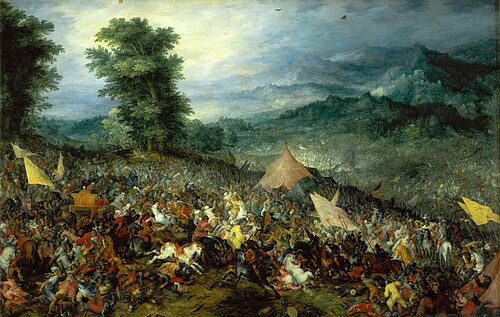
In Europe, Gaugamela became a classic of military history. It has been studied for centuries in military academies as an example of how a smaller, well-trained army can defeat a larger one by manoeuvre, timing and the concentration of force at a decisive point, and it has been depicted in paintings and films celebrating Alexander, which rarely show the Persian side’s perspective.
Advanced
The sources and their problems
No eyewitness narrative survives. The fullest account is in Book 3 of Arrian’s Anabasis of Alexander, written in the second century CE, nearly five hundred years after the battle. Arrian says he relied mainly on Ptolemy, one of Alexander’s generals who later became king of Egypt, and Aristobulus, who accompanied the campaign; both wrote after Alexander’s death and had their own reasons to shape the story.
The other main narratives are Book 17 of Diodorus Siculus (first century BCE), Book 4 of Quintus Curtius Rufus (probably first century CE), Plutarch’s Life of Alexander, and the epitome of Justin. Diodorus, Curtius and Justin are often thought to share a common source, perhaps the historian Cleitarchus, known for dramatic storytelling. These accounts differ on details such as numbers, the timing of Parmenion’s appeal, and the conduct of Darius.
The one contemporary source is Babylonian. An astronomical diary kept by scholars in Babylon, now in the British Museum, records the lunar eclipse, the battle, the desertion of the king’s troops and Alexander’s approach to Babylon. Because it was written close to the events and has no interest in glorifying Alexander, it is invaluable for dating the battle and for correcting the Greek picture of Darius’s behaviour.
Some ancient details should be treated with caution: speeches before the battle, the exchange with Parmenion about a night attack, and Darius’s letters offering peace are literary set pieces that may contain genuine memories but were shaped by the conventions of Greek and Roman history writing.
Advanced
Scholarly debates
Where exactly? The battlefield has never been located archaeologically, and the ancient sources give little precise topography. All the proposed sites lie in the Nineveh Plains between Mosul and Erbil, around the ridge of Jebel Maqlub: among them Tel Gomel, whose name has been linked to “Gaugamela”, and Karamlesh, favoured by the archaeologist Aurel Stein after his reconnaissance of 1938. Recent studies have used terrain and visibility modelling to test these candidates, but no battle debris has been identified.
How big was the Persian army, and why did it lose? With the ancient figures discarded, historians debate the Persian army’s real size and quality. Some stress the tactical brilliance of Alexander’s oblique advance and wedge attack; others emphasize Persian problems: an army assembled from many peoples with limited training together, exhausted by a night under arms, and dependent on the presence of the king. The Babylonian diary’s statement that the troops abandoned the king has encouraged some scholars to see collapse of morale, rather than the king’s personal flight, as decisive.
Darius’s reputation. Pierre Briant, in Darius in the Shadow of Alexander (Harvard University Press, 2015), traced how the image of Darius as weak and cowardly was built in ancient and modern historiography. His work and that of other Achaemenid specialists have encouraged historians to study the empire on its own terms, using Persian, Babylonian and Aramaic evidence, rather than only as Alexander’s victim.
Liberation or conquest? Older European scholarship often presented Alexander as spreading Greek civilization to the East. Many recent historians, such as A. B. Bosworth in Conquest and Empire (Cambridge University Press, 1988), stress instead the violence of the conquest and its cost to local populations, as well as the continuity of Achaemenid administration under Macedonian rule.
Key ideas
- Decisive battle
- A single battle whose outcome transformed the political map; Gaugamela ended the Achaemenid Empire as a power.
- Combined arms
- Alexander coordinated heavy infantry, cavalry and light troops, each with its own role.
- Oblique advance and the gap
- By moving to the right, Alexander drew Persian cavalry after him, opening a gap in the Persian line for his decisive charge.
- Choice of battlefield
- Darius chose open, levelled ground to use his numbers, cavalry and chariots, learning from his defeat on the narrow ground at Issus.
- Royal presence
- In Achaemenid armies the king was the focus of the army; when Darius left the field, the army’s cohesion collapsed.
- Victors’ history
- Nearly all narrative sources are Greek or Roman and favour Alexander; a Babylonian diary offers a rare independent view.
- Continuity after conquest
- Alexander kept Persian governors such as Mazaeus and Achaemenid institutions, blending conquest with continuity.
Records
- 336 BCE — Philip II is assassinated; Alexander becomes king of Macedon. Darius III becomes king of Persia.
- 334 BCE — Alexander crosses into Asia and wins the Battle of the Granicus.
- 333 BCE — Alexander defeats Darius at Issus; Darius’s family is captured.
- 332 BCE — Siege of Tyre; Alexander enters Egypt.
- 331 BCE — Alexander founds Alexandria in Egypt, then marches to Mesopotamia and crosses the Euphrates and Tigris.
- 331 BCE — 20–21 September: a lunar eclipse is recorded by Babylonian astronomers.
- 331 BCE — 1 October: Battle of Gaugamela; Darius flees. Babylon and Susa surrender soon after.
- 330 BCE — Alexander takes Persepolis; the palaces are burned. In July Darius is killed by Bessus and other nobles.
- 329 BCE — Bessus is captured and later executed.
- 323 BCE — Alexander dies in Babylon.
- c. 130 CE — Arrian writes the Anabasis of Alexander, the fullest surviving account of the battle.
- 1938 — Aurel Stein’s reconnaissance in northern Iraq leads him to propose a location for the battlefield.
Glossary
- Achaemenid Empire
- The Persian empire founded by Cyrus the Great (c. 550 BCE) and ended by Alexander’s conquest (330 BCE).
- Satrap
- A provincial governor in the Persian Empire.
- Phalanx
- A dense formation of heavy infantry; the Macedonian version used very long pikes.
- Sarissa
- The long pike, about 5–6 metres, carried by Macedonian phalanx soldiers.
- Companion cavalry
- The elite Macedonian heavy cavalry, led by Alexander in person.
- Scythed chariot
- A war chariot with blades attached to its wheels, used by the Persians to break enemy lines.
- Astronomical diary
- A Babylonian record of nightly observations of the sky, often with notes on prices, weather and political events.
- Hellenistic age
- The period after Alexander (323–31 BCE) when Greek-ruled kingdoms spread across the eastern Mediterranean and Near East.
- Anabasis
- Greek for “march up-country”; the title of Arrian’s history of Alexander’s campaigns.
Questions and answers
Why did Alexander win if the Persians had more soldiers?
His army was highly trained and well coordinated, he chose the moment and place to strike, and when Darius left the field the Persian army lost its centre. Persian soldiers were also tired after standing ready all night.
Did Darius really run away?
Greek writers say he fled, and they present him as a coward. A Babylonian record written at the time says instead that his troops abandoned him. Many historians think the Greek picture is unfair.
What were scythed chariots?
Chariots with sharp blades fixed to the wheels. They were meant to cut through enemy ranks, but at Gaugamela Macedonian light troops shot many drivers and the infantry opened lanes to let them pass.
How do we know the exact date?
Ancient sources say the battle came eleven days after a lunar eclipse. Babylonian astronomers recorded that eclipse, and modern astronomy can date it to the night of 20–21 September 331 BCE.
Has the battlefield been found?
Not with certainty. Scholars place it in the Nineveh Plains between Mosul and Erbil, with Tel Gomel and Karamlesh among the leading candidates, but no archaeological remains of the battle have been identified.
How is Alexander remembered in Iran?
In different ways. Some Zoroastrian texts call him “accursed” for destroying sacred learning, while the Shahnameh turns him into Iskandar, a half-brother of Dara, making him part of the line of Iranian kings.
Why is it also called the Battle of Arbela?
Darius fled to the city of Arbela (Erbil) after the battle, and the name stuck in some ancient and modern accounts, even though the fighting took place at Gaugamela.
Sources and further reading
- Battle of Gaugamela. Wikipedia
- Gaugamela (331 BCE). Livius.org
- Battle of Gaugamela. World History Encyclopedia
- Darius III. Wikipedia
- Arrian. Wikipedia
- Arrian, Anabasis (Greek text, ed. A. G. Roos). Perseus Digital Library, Tufts University
- Pierre Briant, Darius in the Shadow of Alexander. Harvard University Press, 2015
- A. B. Bosworth, Conquest and Empire: The Reign of Alexander the Great. Cambridge University Press, 1988
Related
- PersepolisA ceremonial and administrative center of the Achaemenid Empire in southwestern Iran, begun under Darius I.
- AristotlePlato's student and Alexander's tutor. He founded the Lyceum and wrote on logic, ethics, politics and the natural world.
- Battle of MarathonA battle in 490 BCE in which an Athenian-led Greek force defeated a Persian expedition at Marathon.
- Library of AlexandriaAn ancient center for collecting and studying texts in Ptolemaic Alexandria.
- ShahnamehPersian epic by Ferdowsi recounting Iran's legendary kings and historical past.
Written with AI assistance from the published sources listed above, and revised as new research appears.