Start at the top for an easy introduction. Go further down for more detail and scholarship.
- Easy
- Intermediate
- Advanced
For young readers
About 2,500 years ago, the kings of Persia ruled the biggest empire the world had ever seen. It stretched from Egypt and Greece in the west to the Indus River in the east. Around the year 518 BCE, King Darius the Great decided to build a magnificent new palace city in his homeland, a place called Pārsa. The Greeks later called it Persepolis, “the city of the Persians”.
The builders made a gigantic stone platform at the foot of a mountain, bigger than many football fields. On top they built great halls with forests of tall, thin stone columns. Some columns were about as tall as a six-storey building! At the top of the columns sat carved animals, like pairs of bulls, holding up the wooden roof beams.
The most famous part of Persepolis is its stone pictures, called reliefs. Along the grand staircases, carved people walk in long lines. They come from many different lands, wearing different clothes and hats, and they carry gifts for the king: horses, camels, gold bowls, cloth, even a lion cub. It is like a stone parade showing all the peoples of the empire.
Archaeologists also found thousands of little clay tablets. They are records written in wedge-shaped writing, and they tell us how many rations of grain, wine and beer workers received. They even show that women workers got extra food when they had a baby!
In 330 BCE, Alexander the Great conquered the Persian Empire and his army set fire to Persepolis. The roofs burned and fell. But many stone columns, doorways and carvings survived. Today Persepolis is a UNESCO World Heritage Site, and visitors from Iran and around the world walk up the same wide stairs that ambassadors climbed long ago.
At a glance
- Built
- Begun c. 518–515 BCE under Darius I; expanded by Xerxes I, Artaxerxes I and later Achaemenid kings until 330 BCE
- Place
- Foot of Kuh-e Rahmat (“Mountain of Mercy”), Marvdasht plain, Fars province, Iran, about 60 km northeast of Shiraz
- Builders
- The Achaemenid Persian Empire (c. 550–330 BCE), using workers and craftsmen from many peoples of the empire
- Structure
- A raised stone terrace of about 125,000 m² carrying audience halls, palaces, a treasury and gateways; royal tombs cut into the mountain behind
- Famous features
- Apadana (audience hall) with relief stairways of 23 delegations; Gate of All Nations; Hall of a Hundred Columns
- Archives
- Persepolis Fortification tablets (509–493 BCE) and Treasury tablets (492–457 BCE), mostly in Elamite
- Destruction
- Burned by Alexander the Great’s forces in 330 BCE
- Status
- UNESCO World Heritage Site since 1979
Easy
What is Persepolis?
Persepolis was one of the royal centres of the Achaemenid Persian Empire, the first empire to unite most of the Middle East, Egypt, Anatolia and Central Asia under one dynasty. Its Old Persian name was Pārsa, the same as the name of the region and the people: Persia and the Persians. The Greek name Persepolis simply means “Persian city”. Later Iranians, who no longer knew who had built it, called it Takht-e Jamshid, “the Throne of Jamshid”, after a legendary king of Iranian tradition.
The site stands on a vast terrace built against a mountainside on the Marvdasht plain in Fars, the Persians’ homeland in southwestern Iran. On it rose a group of monumental buildings: audience halls, palaces, a treasury, gatehouses and storerooms. The empire had several capitals, including Susa, Babylon and Ecbatana, and the kings travelled between them. Persepolis was a place for royal display and ceremony in the dynasty’s home province, as well as an important administrative centre.
Today the ruins include standing columns, carved doorways, staircases covered in relief sculpture and the rock-cut tombs of kings. Inscribed on the UNESCO World Heritage List in 1979, Persepolis is one of the most important archaeological sites of the ancient world and a powerful symbol of Iranian history.
Easy
How to “read” Persepolis: a walk across the terrace
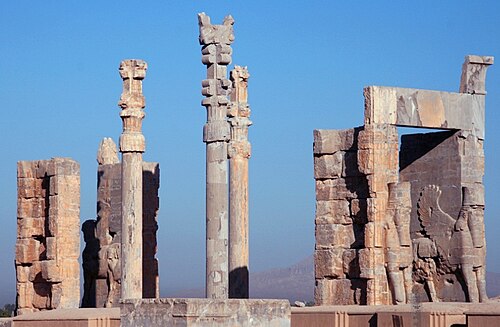
A visitor, then as now, arrives at the northwest corner and climbs a wide double staircase with shallow steps, designed to be climbed with dignity, perhaps even on horseback. At the top stands the Gate of All Nations, built by Xerxes I. Huge stone bulls guard its western doorway and human-headed winged bulls its eastern one, following an Assyrian tradition of protective gate figures. An inscription in three languages, Old Persian, Elamite and Babylonian, names Xerxes as the builder.
To the south rises the Apadana, the great audience hall begun by Darius I and completed by Xerxes. Its central square hall, roughly 60 metres on each side, was filled with 36 columns, and three porches added more, for 72 columns in all. They stood around 20 metres high, topped by capitals carved as the front halves of two bulls, lions or griffins back to back, which held the cedar roof beams. Today only a handful of these columns remain standing.
Further south and east are Darius’s palace (the Tachara), the palace of Xerxes (the Hadish), a central building often called the Tripylon or Council Hall, and the Hall of a Hundred Columns, the largest roofed space on the terrace, begun by Xerxes and completed by Artaxerxes I. In the southeast corner lay the Treasury, where the wealth of the empire was stored. Above the terrace, cut into the mountain, are tombs usually attributed to Artaxerxes II and Artaxerxes III.
The buildings were made of local grey limestone for columns, doorframes, window frames and stairs, while the walls were thick mud brick, now mostly lost. Originally the carvings were painted in bright colours, and some metal fittings and inlays decorated them; scholars have found traces of pigment on the reliefs.
Easy
The stone parade: the Apadana reliefs
The most famous carvings at Persepolis decorate the northern and eastern staircases of the Apadana. On one side, rows of Persian and Median nobles and guards, recognizable by their different hats and clothes, walk and talk, some holding flowers. On the other side, 23 delegations from different lands of the empire approach, each led by an official who takes one member by the hand.
Each delegation wears its own clothing and brings typical gifts: horses, camels, humped bulls, rams, cloth, gold and silver vessels, weapons, jewellery, an okapi-like animal, an antelope or a lion cub. Scholars try to identify the peoples, such as Medes, Elamites, Armenians, Lydians, Ionian Greeks, Babylonians, Egyptians, Bactrians, Indians, Arabians and Nubians, using the Old Persian royal lists of lands, but some identifications remain uncertain.
Between the scenes, carved again and again, a lion attacks a bull. This motif may symbolize the change of seasons, royal power or cosmic order; its exact meaning is debated. What is striking is what is missing: there are no battles, no captives being killed and no bleeding enemies, unlike the war scenes on earlier Assyrian palace walls. Persepolis shows the empire as a peaceful, orderly world gathered around the king.
Intermediate
Who built Persepolis, and how?
Cyrus the Great founded the Achaemenid Empire around 550 BCE and built his capital at Pasargadae, about 40 km to the north. Some scholars think Cyrus or his son Cambyses may already have chosen the Persepolis site, but the main construction began under Darius I (reigned 522–486 BCE), who came to power after a violent succession crisis described in his Behistun inscription. Building continued under Xerxes I (486–465) and Artaxerxes I (465–424); later kings added smaller works, and some parts were still unfinished when Alexander arrived.
In his foundation inscriptions, Darius emphasizes that the empire’s peoples worked together on his buildings. A charter from his palace at Susa lists materials brought from across the empire and workers from Ionia, Sardis, Egypt, Babylon and elsewhere. At Persepolis, gold and silver foundation tablets found in 1933 at the corners of the Apadana describe the extent of Darius’s realm from the Scythians beyond Sogdiana to Kush, and from India to Sardis.
The Persepolis Fortification tablets give an unusually detailed picture of the workforce. They record rations of grain, wine, beer, sheep and other goods paid to workers called kurtaš, who came from many peoples, including Egyptians, Ionians, Lydians, Babylonians, Thracians and others. Men and women received rations; some women were paid as much as men in the same job, and mothers received extra rations after giving birth, more for a boy than a girl. Whether these workers were free labourers, deportees or dependent workers is debated, but the tablets show an organized, state-run system of payment rather than a picture of chained slaves.
Intermediate
The empire behind the stones
At its height under Darius I, the Achaemenid Empire extended from Libya and the Aegean to the Indus valley and Central Asia. It was divided into provinces called satrapies, connected by a royal road network with relay stations, and it collected taxes and gifts in silver and in kind. The Fortification tablets show travellers carrying sealed documents, receiving food rations at stations along the roads as they journeyed to and from places as far away as India, Egypt and Sardis.
The Achaemenids used several languages for administration. Old Persian cuneiform, probably created in Darius’s time, was used mostly for royal inscriptions. Everyday records at Persepolis were kept mainly in Elamite, an older language of southwestern Iran, and many in Aramaic, the common language of the empire. Babylonian (Akkadian) was used in royal inscriptions and in Mesopotamia.
Royal ideology, expressed in the inscriptions, presents the king as chosen by the god Ahuramazda to uphold truth and order against “the Lie”. The Apadana reliefs, with the peoples of the empire bringing gifts in harmony, turn this ideology into a visual programme. Many historians see the empire as notable for allowing local customs, languages and religions to continue under Persian rule, though it also suppressed revolts harshly when they occurred.
Intermediate
Alexander and the burning of Persepolis
After defeating Darius III at Gaugamela in 331 BCE, Alexander of Macedon marched into Persia. He reached Persepolis in early 330 BCE; his troops were allowed to plunder the city, and the enormous treasure was carried away. A few months later, in spring 330 BCE, the palaces on the terrace were set on fire.
The ancient sources disagree about why. Arrian, relying on earlier accounts, presents the burning as a deliberate act of revenge for the Persian burning of Athens’s temples in 480 BCE, and says he himself did not think it wise. Diodorus, Plutarch and Curtius tell a more dramatic story: at a drunken feast, the Athenian courtesan Thaïs urged Alexander to burn the palace, and he threw the first torch. Modern historians debate whether the fire was a calculated political message to the Greeks, a signal to the Persians that their empire had ended, a drunken impulse, or a combination of these.
Archaeologists found thick layers of ash and charred cedar beams, and signs that many objects in the Treasury were smashed. The fire destroyed the roofs and mud-brick walls, but the stone elements survived, and the clay tablets of the Treasury were preserved. For Iranians, the burning has long been remembered as a cultural catastrophe; in Greek and Roman writing it was often told as a story of revenge and of Alexander’s character.
Intermediate
After the fire: memory, legend and rediscovery
Persepolis was never rebuilt as a royal centre, but it was not forgotten. Nearby, the city of Istakhr became important under later Persian dynasties. Rulers of later ages left their own marks on the ruins: inscriptions in Middle Persian from the Sasanian period and Arabic inscriptions of the 10th-century Buyid ruler ‘Adud al-Dawla are carved in the Palace of Darius. In Persian tradition the ruins became associated with the legendary king Jamshid, known from the Shahnameh, hence the name Takht-e Jamshid, and sometimes with King Solomon.
European travellers visited from the 15th century onward and described and drew the ruins. The Danish-German traveller Carsten Niebuhr made careful copies of the inscriptions in 1765. Using these copies, the German scholar Georg Friedrich Grotefend in 1802 correctly identified several royal names in Old Persian cuneiform, a key early step in deciphering cuneiform writing.
Scientific excavation began in 1931 under Ernst Herzfeld for the Oriental Institute of the University of Chicago, and continued under Erich Schmidt from 1935 to 1939. They uncovered the Apadana staircases, the Treasury and the tablet archives, and reconstructed part of the so-called Harem of Xerxes as a working base and museum. Iranian archaeologists and, from the 1960s, an Italian team working on restoration carried out further work. In 1971 Mohammad Reza Shah Pahlavi held lavish celebrations of 2,500 years of Iranian monarchy at Persepolis, which drew criticism for their cost and politics.
Advanced
The tablet archives: an empire’s paperwork
In 1933 Herzfeld’s team found tens of thousands of clay tablets and fragments in the fortification wall at the northeast of the terrace. These Fortification tablets date from 509 to 493 BCE, in the reign of Darius I. Most are in Elamite; around a thousand are in Aramaic, and a few are in other languages, including one in Old Persian, one in Greek and one in Phrygian. They record the movement of food and animals from storehouses to workers, officials, travellers, the royal family and religious offerings. A second, smaller archive of Treasury tablets (492–457 BCE) records payments partly in silver.
The tablets were lent by Iran to the Oriental Institute in 1935 for study. Richard Hallock’s 1969 edition of 2,087 Elamite texts transformed the field, and since 2006 the Persepolis Fortification Archive Project, led by Matthew Stolper, has worked to record and publish the remaining material. Several hundred tablets were returned to Iran over the decades. The archive also became the target of a lawsuit, Rubin v. Islamic Republic of Iran, by victims of a 1997 bombing who sought to seize the tablets to satisfy a judgment against Iran; in 2018 the U.S. Supreme Court ruled unanimously that the artefacts could not be seized under that law.
The archives reveal a world absent from the Greek historians: the religious offerings the state paid for, including to Elamite and Iranian gods, travel along the royal roads, the role of royal women such as Irdabama and Irtašduna (Artystone) as owners of estates and workers, and the everyday functioning of an ancient empire. Thousands of seal impressions on the tablets are also a major source for Achaemenid art.
Advanced
Scholarly debates: function, meaning and perspective
What was Persepolis for? An influential older view held that it was a ceremonial city used mainly for the New Year festival (Nowruz), when delegations came to present gifts, and some interpreted the Apadana reliefs as a record of that event. Many scholars now caution that there is no direct ancient evidence linking Persepolis to Nowruz, and the Fortification tablets show that the area was a busy regional administrative centre throughout the year. The terrace may best be understood as combining royal residence, ceremonial stage, treasury and administrative hub.
What do the reliefs show? Earlier scholars often described the delegations as bringing “tribute”. Others argue that the reliefs are an idealized picture of imperial order rather than a record of an actual event, and that the gifts were symbolic offerings rather than the empire’s regular taxes. The two central audience reliefs, showing an enthroned king and a crown prince receiving an official, were moved in antiquity from the Apadana staircases to the Treasury; which kings they depict is debated.
How should the empire be told? For centuries, Western images of Persia were shaped by Greek authors such as Herodotus, who wrote from the perspective of the Persians’ enemies, and by a later narrative of Persian “decadence” leading to Alexander’s victory. From the 1980s, the Achaemenid History workshops organized by Heleen Sancisi-Weerdenburg and Amélie Kuhrt, and the work of historians such as Pierre Briant, pushed scholars to centre Persian, Elamite, Babylonian and Aramaic sources. Persepolis, with its inscriptions, reliefs and archives, is central to that shift. In Iran, meanwhile, the site carries strong national meaning that has been interpreted differently by the Pahlavi monarchy and the Islamic Republic.
Advanced
Evidence, conservation and open problems
Much of what we know about Persepolis comes from the Chicago excavations of the 1930s, published above all in Erich Schmidt’s three-volume Persepolis (1953–1970). The excavators worked quickly by modern standards, and questions remain about stratigraphy, the sequence of construction and what was removed or reconstructed. Some reliefs and objects left the site through the antiquities trade or in earlier centuries and are now held in museums outside Iran.
Conservation faces continuing challenges: weathering of the limestone, the growth of lichens and other organisms on the reliefs, the effects of rain and temperature changes, and the pressure of tourism. Iranian conservators, sometimes working with international partners, monitor and treat the stones, and have debated how much restoration and protective roofing are appropriate.
Open research questions include the precise building chronology of each structure, the original colour scheme of the reliefs, the identities of the delegations, the relationship between Persepolis and nearby sites such as Pasargadae and Naqsh-e Rostam (where Darius I and three other kings are buried in rock-cut tombs), and how the terrace and the surrounding lower city worked together. New readings of the Fortification tablets continue to change the picture.
Key ideas
- Royal display
- Persepolis was designed to show the power, order and wealth of the Achaemenid king to visitors and subjects.
- Peaceful empire
- The reliefs show the peoples of the empire bringing gifts in harmony, without scenes of war or cruelty.
- Many peoples, one project
- Workers, craftsmen and materials from across the empire contributed to the royal buildings.
- Administrative centre
- The tablet archives show Persepolis as a hub of rations, taxes, travel and record-keeping.
- Multilingual empire
- Old Persian, Elamite, Babylonian and Aramaic were used side by side in inscriptions and records.
- Destruction and memory
- Alexander’s burning of Persepolis has been remembered differently in Greek, Iranian and modern narratives.
- Beyond the Greek view
- Persepolis provides Persian-side evidence that challenges older histories based mainly on Greek writers.
Records
- 522 BCE — Darius I becomes king after a succession crisis (522 BCE).
- c. 518 BCE — Construction of the Persepolis terrace begins under Darius I (c. 518–515 BCE).
- 509 BCE — The earliest Persepolis Fortification tablets are written (509 BCE; they run to 493 BCE).
- 486 BCE — Xerxes I becomes king and continues building, including the Gate of All Nations (486 BCE).
- 480 BCE — Xerxes’ army burns the temples on the Athenian Acropolis (480 BCE), later cited as the motive for revenge.
- 330 BCE — Alexander the Great’s forces loot and burn Persepolis (330 BCE).
- 1802 — Georg Friedrich Grotefend identifies royal names in Old Persian cuneiform.
- 1931 — Ernst Herzfeld begins excavations for the Oriental Institute of Chicago (continued by Erich Schmidt, 1935–39).
- 1933 — The Fortification tablets and the Apadana foundation tablets are discovered.
- 1971 — Celebrations of 2,500 years of Iranian monarchy are held at Persepolis.
- 1979 — Persepolis is inscribed on the UNESCO World Heritage List.
- 2018 — The U.S. Supreme Court rules in Rubin v. Iran that the Persepolis tablets cannot be seized.
Glossary
- Achaemenid
- The Persian royal dynasty (c. 550–330 BCE) named after its legendary ancestor Achaemenes.
- Apadana
- An Old Persian word for a columned audience hall; the largest one at Persepolis was begun by Darius I.
- Terrace
- A raised, flat platform; Persepolis stands on a partly artificial terrace against a mountain.
- Relief
- Sculpture carved so that figures stand out from a flat background.
- Cuneiform
- Wedge-shaped writing pressed into clay or carved in stone, used for many languages of the ancient Middle East.
- Elamite
- An ancient language of southwestern Iran, used for most of the Persepolis administrative tablets.
- Satrapy
- A province of the Achaemenid Empire, governed by a satrap.
- Kurtaš
- The term in the Persepolis tablets for workers who received rations from the royal administration.
- Ahuramazda
- The supreme god invoked by the Achaemenid kings in their inscriptions.
- Takht-e Jamshid
- “Throne of Jamshid”, the Persian name for Persepolis, after a legendary king.
- Nowruz
- The Iranian New Year at the spring equinox; once widely thought to be the main festival held at Persepolis.
Questions and answers
Did the Persian king live at Persepolis all the time?
No. The kings moved between several capitals, such as Susa, Babylon and Ecbatana. Persepolis was one royal centre, used for ceremonies and as an administrative hub.
Was Persepolis built by slaves?
The tablets show workers from many peoples receiving regular rations, including extra food for new mothers. Their exact legal status is debated, but the evidence points to an organized paid workforce rather than simply slaves.
Why did Alexander burn Persepolis?
Ancient writers disagree. Some say it was revenge for the Persian burning of Athens in 480 BCE; others describe a drunken feast. Historians still debate whether it was planned or impulsive.
What language is written at Persepolis?
Royal inscriptions are usually in three languages: Old Persian, Elamite and Babylonian. Most everyday records are in Elamite, with many in Aramaic.
Who are the people carved on the staircases?
They represent 23 delegations from lands of the empire, such as Medes, Lydians, Ionians, Egyptians, Indians and Nubians, bringing gifts to the king. Some identifications are uncertain.
Was Persepolis used for the Nowruz festival?
It is a popular and old theory, but there is no direct ancient evidence for it. Many scholars now see Persepolis as serving several royal and administrative purposes.
Why are the Persepolis tablets important?
They are the largest body of documents from the Persian Empire itself, showing how it fed workers, paid officials and organized travel, which Greek historians did not describe.
Sources and further reading
- Persepolis. UNESCO World Heritage Centre
- Persepolis. Wikipedia
- Apadana. Wikipedia
- Persepolis Administrative Archives. Wikipedia
- Achaemenid Empire. Wikipedia
- Naqsh-e Rostam. Wikipedia
- Erich F. Schmidt, Persepolis I: Structures, Reliefs, Inscriptions. University of Chicago Press, 1953
- Richard T. Hallock, Persepolis Fortification Tablets. University of Chicago Press, 1969
- Pierre Briant (trans. Peter T. Daniels), From Cyrus to Alexander: A History of the Persian Empire. Eisenbrauns, 2002
Related
- Battle of MarathonA battle in 490 BCE in which an Athenian-led Greek force defeated a Persian expedition at Marathon.
- Battle of GaugamelaA battle in 331 BCE in which Alexander of Macedon's army defeated the forces of the Persian king Darius III.
- ParthenonA temple dedicated to Athena on the Athenian Acropolis, built during the fifth century BCE.
- ShahnamehPersian epic by Ferdowsi recounting Iran's legendary kings and historical past.
- Code of HammurabiA collection of legal judgments issued under Hammurabi, king of Babylon, in the eighteenth century BCE.
Written with AI assistance from the published sources listed above, and revised as new research appears.