Start at the top for an easy introduction. Go further down for more detail and scholarship.
- Easy
- Intermediate
- Advanced
For young readers
Socrates lived in Athens, in Greece, about 2,400 years ago. He was not rich or handsome: people joked about his snub nose and bulging eyes, and he often walked around barefoot in an old cloak. But he had one great talent. He asked questions, and he never stopped.
He would stop someone in the market and ask, “What is courage?” or “What is justice?” The person would give an answer, and Socrates would ask another question, and another, until the person realised that they did not really know as much as they thought. Some people loved this. Others found it very annoying.
A friend of his once asked the god Apollo’s famous oracle at Delphi whether anyone was wiser than Socrates. The answer was: no one. Socrates was puzzled. After talking to many people, he decided that he was wiser only in one small way: he knew that he did not know, while others thought they knew things they did not.
When he was 70, some Athenians took him to court. They said he did not respect the city’s gods and was a bad influence on young people. A jury of about 500 citizens found him guilty and sentenced him to death. His friends offered to help him escape, but he refused, and he drank a cup of poison.
Socrates never wrote a book. We know him because his students, especially Plato, wrote conversations in which Socrates is the main speaker. Because of them, people all over the world still ask “Socratic” questions today.
At a glance
- Lived
- About 470/469–399 BCE
- Place
- Athens, Greece (deme of Alopeke)
- Family
- Son of Sophroniscus, a stoneworker, and Phaenarete, a midwife; married Xanthippe; three sons
- Writings
- None; known through Plato, Xenophon, Aristophanes and Aristotle
- Method
- Question-and-answer examination of beliefs (the elenchus)
- Famous sayings (in Plato)
- “The unexamined life is not worth living for a human being” (Apology 38a)
- Death
- Tried for impiety and corrupting the young; executed by drinking poison (usually identified as hemlock) in 399 BCE
- Students and followers
- Plato, Xenophon, Antisthenes, Aristippus, Euclides of Megara and others
Easy
Who was Socrates?
Socrates was a citizen of Athens who lived in the fifth century BCE, the time when Athens was the richest and most powerful city in Greece, a democracy, and a centre of theatre, art and learning. He was born around 470 BCE and died in 399 BCE.
He is one of the most famous philosophers who ever lived, yet he wrote nothing. He did not run a school, did not charge fees, and did not give lectures. Instead he spent his days in public places, the agora (market square), the gymnasia and private houses, talking with anyone who would talk with him, young or old, rich or poor, citizen or foreigner.
What he talked about was how to live. What is a good life? What is virtue, justice, courage, piety or friendship? Should you ever do wrong to someone who has wronged you? He believed that the most important thing a person could do was to care for their soul, their inner self, by trying to understand what is truly good.
Philosophers before him, whom we now call the “Presocratics”, mostly studied nature: what the world is made of and how it works. Socrates turned philosophy toward human life and ethics. For this reason the Roman writer Cicero said that Socrates “called philosophy down from the heavens” and brought it into cities and homes.
Easy
The questioner: how the Socratic method works
Socrates’ way of doing philosophy is called the elenchus, a Greek word meaning “examination” or “testing”. It usually works like this. Socrates asks someone to define an important idea, for example courage. The person gives an answer: “Courage is standing firm in battle.” Socrates then asks more questions, and gets the person to agree to other statements, for example that courage is always a fine thing, or that sometimes retreating is the wise choice. Step by step, it turns out that the first answer does not fit with the other things the person believes.
The person must then try a better definition, which is tested in the same way. Many of Plato’s early dialogues end without a final answer, in a state the Greeks called aporia, “puzzlement” or “being without a way through”. That can feel frustrating, but for Socrates it was progress: it is better to know that you do not know than to go on believing something false.
Socrates often claimed that he himself knew nothing important, and that he was only helping others to think. In Plato’s Theaetetus he compares himself to a midwife, like his mother: he does not give birth to ideas himself, but helps others deliver theirs and checks whether they are healthy. Many readers suspect that this modesty was partly ironic, since Socrates was clearly very clever. This mixture of real humility and teasing is called “Socratic irony”.
The story of the oracle explains his mission. According to Plato’s Apology, his friend Chaerephon asked the oracle at Delphi whether anyone was wiser than Socrates, and the priestess said no. Socrates tested the answer by questioning politicians, poets and craftsmen, and found that they thought they knew important things when they did not. He concluded that his only wisdom was to recognise his own ignorance, and he came to see his questioning as a service to the god.
Easy
The man himself
Socrates’ father, Sophroniscus, was a stoneworker or sculptor, and his mother, Phaenarete, was a midwife. He belonged to the deme (district) of Alopeke, just outside the city walls. He may have worked in his father’s trade when young, but for most of his life he seems to have had little money and no regular job, living simply and depending partly on friends.
He married Xanthippe, and they had three sons: Lamprocles, Sophroniscus and Menexenus, two of whom were still small children when he died. Later writers made Xanthippe into a legendary nagging wife, but this picture comes mostly from stories written long after, not from Plato.
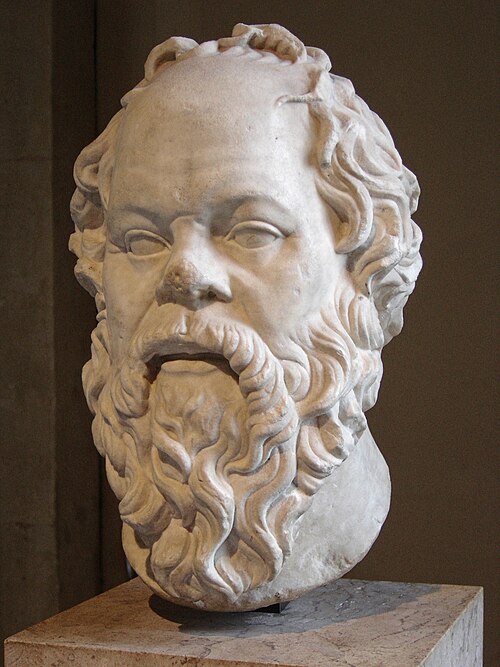
Ancient writers describe his unusual appearance: a flat, snub nose, bulging eyes and thick lips; in Plato’s Symposium, Alcibiades compares him to a statue of a satyr, ugly outside but full of golden images of gods inside. He was famous for his physical toughness, going barefoot even in winter, and for his self-control; he could drink a great deal without becoming drunk.
He also said that since childhood he had experienced a daimonion, a “divine sign” or inner voice, which sometimes stopped him from doing something he was about to do, but never told him what to do.
Intermediate
Athens in Socrates’ lifetime
Socrates was born about twenty years after the Battle of Marathon, into a city growing in power and wealth. As a young man he saw the building of the Parthenon, the tragedies of Aeschylus, Sophocles and Euripides, and the leadership of Pericles. Athens was a direct democracy: citizen men voted in the assembly and sat on large juries chosen by lot.
This world also produced the sophists, travelling teachers such as Protagoras and Gorgias who charged fees to teach rhetoric, the art of persuasive speaking, which was essential for success in a democracy. Many Athenians lumped Socrates together with them, even though he took no money and criticised their claims to teach virtue.
The second half of his life was dominated by the Peloponnesian War between Athens and Sparta (431–404 BCE). Athens suffered a terrible plague in 430 BCE, which killed Pericles, and later disastrous defeats. In 404 BCE Athens surrendered. A Spartan-backed oligarchy, the “Thirty Tyrants”, seized power and killed many citizens before democracy was restored in 403 BCE.
This political background matters for Socrates’ story. Some of the men he talked with became notorious: Alcibiades, the brilliant general who betrayed Athens to Sparta, and Critias and Charmides, leaders of the Thirty. Their association with Socrates helps explain why many Athenians distrusted him.
Intermediate
Soldier and citizen
Socrates served as a hoplite, a heavily armed infantryman, in three campaigns of the Peloponnesian War: at Potidaea in northern Greece (432 BCE onward), where he saved the life of the wounded Alcibiades; at Delium (424 BCE), where he remained calm during the Athenian retreat; and at Amphipolis (422 BCE). Plato’s dialogues praise his courage and endurance.
He rarely took part in politics, saying that his divine sign warned him against it. But twice he refused to go along with actions he thought unjust. In 406 BCE, after the naval battle of Arginusae, the Athenian assembly wanted to try the victorious generals together for failing to rescue shipwrecked sailors. Socrates, serving that day on the presiding committee of the council, objected that a collective trial was illegal. The generals were nevertheless condemned and executed.
In 404 BCE, under the Thirty, Socrates and four others were ordered to arrest Leon of Salamis so that he could be executed and his property seized. The others went; Socrates simply went home. He said later that he might have been killed for this if the regime had not fallen soon after.
These episodes show a man who respected law and the city, but put justice above obedience to any majority or any ruler.
Intermediate
Main ideas
Care of the soul. For Socrates, the soul is what makes us who we are, and it becomes better through virtue and worse through wrongdoing. In the Apology he tells the jury that he spent his life urging Athenians to care less about money, reputation and honour, and more about wisdom, truth and the best possible state of their soul.
Virtue is knowledge. Socrates seems to have held that virtue, being a good person, is a kind of knowledge: knowledge of what is truly good and bad. Closely linked are the so-called “Socratic paradoxes”: that no one does wrong willingly, since everyone wants what is good and does wrong only through ignorance; and that the different virtues, such as courage, justice and wisdom, are in some way one.
It is better to suffer wrong than to do wrong. In Plato’s Gorgias and Crito, Socrates argues that doing injustice harms the soul of the person who does it, so one must never do wrong, even in return for being wronged. This was a startling claim in a culture that often admired helping friends and harming enemies.
The examined life. Socrates believed that everyone should test their beliefs by reasoning with others. In the Apology he says that “the unexamined life is not worth living for a human being.” Asking for definitions, following arguments wherever they lead and admitting ignorance became basic habits of philosophy.
Aristotle, who did not know Socrates personally but was taught by Plato, later credited him with two things: arguments that move from particular cases to general conclusions, and the search for universal definitions. He also said that, unlike Plato, Socrates did not treat these universals as separately existing “Forms”.
Intermediate
The trial and death
In 399 BCE, when Socrates was about 70, a young man named Meletus, supported by Anytus, an important democratic politician, and Lycon, brought a public charge against him. The charge, as later reported, was that Socrates did not acknowledge the gods the city acknowledged, introduced other new divine beings, and corrupted the young. The penalty proposed was death.
The case was heard by a jury of about 500 or 501 citizens in a single day. Two accounts of Socrates’ defence survive, both called the Apology (from the Greek apologia, “defence speech”), one by Plato and one by Xenophon. In Plato’s version Socrates does not beg for mercy. He explains his mission, argues that he is a gift of the god to Athens, like a gadfly that wakes a sluggish horse, and says he will not stop philosophising even to save his life.
He was found guilty by a fairly narrow margin, about 280 votes to 220 or 221. In an Athenian trial of this type, the defendant then proposed an alternative penalty. Plato reports that Socrates first said he deserved free meals in the town hall, like an Olympic champion, and then offered a modest fine, raised with the help of Plato and other friends to 30 minae. The jury voted for death, reportedly by a larger majority.
The execution was delayed for about a month because no one could be executed while a sacred ship was away on its annual mission to the island of Delos. During this time his friend Crito arranged an escape, but in Plato’s Crito Socrates refuses: escaping would break his agreement with the laws of the city under which he had lived all his life. In Plato’s Phaedo, set on his last day, he discusses the immortality of the soul with his friends, then calmly drinks the poison. The Phaedo calls it simply “the drug”; it is usually identified as hemlock. His reported last words were a request to Crito to offer a cockerel to Asclepius, the god of healing.
Intermediate
Influence and legacy
After his death, many of his followers wrote “Socratic conversations” (Sokratikoi logoi), a new literary genre. Only those of Plato and Xenophon survive complete. Through Plato, who founded the Academy around 387 BCE, and Plato’s student Aristotle, Socrates stands at the beginning of the main tradition of Greek philosophy.
Almost every later school of Greek thought claimed him. Antisthenes admired his toughness and indifference to comfort, and was later seen as a forerunner of the Cynics; Aristippus of Cyrene, founder of the Cyrenaic school, drew a very different, pleasure-centred lesson; Euclides founded the Megarian school of logic. The Stoics regarded Socrates as the nearest thing to a true sage.
Later ages reinvented him again and again. Early Christian writers sometimes compared his unjust death to the death of Jesus; Renaissance humanists praised him as a model of moral wisdom; Enlightenment thinkers saw him as a martyr for free thought. In the nineteenth century Søren Kierkegaard wrote his dissertation on Socratic irony, and Friedrich Nietzsche attacked him as a symbol of excessive rationalism.
Today the “Socratic method” is used in law schools, classrooms and therapy, and “Socratic” questioning is taught as a basic skill of critical thinking. Socrates is often mentioned together with Confucius and the Buddha as a great teacher of the same era who did not leave writings of his own and whose words were preserved by followers.
Advanced
The “Socratic problem”: which Socrates?
Because Socrates wrote nothing, everything we know comes from others, and the sources do not agree. This is called the “Socratic problem”. The four main witnesses are Aristophanes, Xenophon, Plato and Aristotle, and each shows a different figure.
Aristophanes’ comedy the Clouds (first performed in 423 BCE, while Socrates was alive) portrays him as a ridiculous teacher who studies the heavens, denies the traditional gods and teaches students to win unjust arguments for money, a caricature that combines features of natural philosophers and sophists. In Plato’s Apology, Socrates blames this kind of image for prejudicing the jury. Xenophon, a soldier and writer, presents a practical, pious and conventional moral adviser, who gives sensible advice on household management and leadership. Plato’s Socrates is the richest and most philosophical, but his views seem to change from dialogue to dialogue, and in the later works he voices theories, such as the Forms, that Aristotle attributes to Plato rather than to Socrates.
One influential solution was developed by Gregory Vlastos (Socrates: Ironist and Moral Philosopher, 1991). He argued that Plato’s early dialogues, such as the Apology, Crito, Euthyphro, Laches and Charmides, represent the historical Socrates’ philosophy, while the middle and late dialogues express Plato’s own. This approach, relying on the order in which the dialogues were written and on Aristotle’s testimony, dominated English-speaking scholarship for decades.
Many scholars now doubt that the dialogues can be dated so securely, or that any of Plato’s writings are meant as historical records. Some prefer to study the “Socrates” of each author as a literary and philosophical creation. Others use all the sources critically to reconstruct at least the outlines of his life and trial. As W. K. C. Guthrie put it, there is, and always will be, a Socratic problem.
Advanced
Why was Socrates really condemned?
Historians still argue about the real reasons behind the trial. The formal charge was religious, and some scholars take it seriously: Socrates’ divine sign and his questioning of traditional stories about the gods may genuinely have seemed dangerous to a community that believed the gods protected or punished the whole city.
Others stress politics. Socrates had criticised aspects of democracy, such as choosing officials by lot and trusting the opinions of the many, and he had been close to Alcibiades and Critias. But an amnesty agreed in 403 BCE, after the fall of the Thirty, forbade prosecutions for acts committed before that date. Some historians think the religious charge was partly a way around this amnesty. The journalist I. F. Stone, in The Trial of Socrates (1988), argued that Socrates was an anti-democrat, a provocative thesis that most specialists rejected but that stimulated debate.
A third view, defended for example by Thomas Brickhouse and Nicholas Smith in Socrates on Trial (1989), is that the charges should be read as they stand, and that Socrates’ defence as reported by Plato is a genuine, serious answer to them, not a provocation. Scholars also debate how far Plato’s Apology reproduces what Socrates actually said, since Plato was writing a literary work after the event, though he was present at the trial.
The medical details of the death have also been examined. The calm, gradual numbness described in the Phaedo has been compared with the symptoms of poison hemlock (Conium maculatum); some doctors have argued that the description is idealised, while others think it is consistent with the plant. Whatever happened, Plato’s account made Socrates’ death one of the most influential scenes in Western literature.
Key ideas
- Elenchus
- Socrates’ method of testing a person’s beliefs by question and answer, to show whether they are consistent.
- Socratic ignorance
- The recognition that one does not know what one thought one knew; for Socrates, the beginning of wisdom.
- Care of the soul
- The idea that the most important task in life is to make one’s inner self good, rather than to seek wealth or fame.
- Virtue is knowledge
- The view that being good depends on knowing what is truly good, so that wrongdoing comes from ignorance.
- Never do wrong
- One should not do injustice even in return for injustice, because wrongdoing harms the doer’s soul.
- The examined life
- A life constantly tested by reasoning and conversation is the only one worth living for a human being.
- Socratic irony
- Socrates’ habit of claiming ignorance while leading others by questions, partly sincere, partly teasing.
Records
- c. 470 BCE — Socrates is born in Athens (470/469 BCE).
- 432 BCE — Serves at the siege of Potidaea, where he saves Alcibiades (432 BCE onward).
- 431 BCE — The Peloponnesian War between Athens and Sparta begins (431 BCE).
- 424 BCE — Fights in the retreat at Delium (424 BCE).
- 423 BCE — Aristophanes’ Clouds mocks Socrates on stage (423 BCE).
- 422 BCE — Last campaign, at Amphipolis (422 BCE).
- 406 BCE — Opposes the illegal collective trial of the generals after Arginusae (406 BCE).
- 404 BCE — Athens surrenders; under the Thirty Tyrants Socrates refuses to arrest Leon of Salamis (404 BCE).
- 403 BCE — Democracy is restored and an amnesty proclaimed (403 BCE).
- 399 BCE — Socrates is tried, condemned and executed (399 BCE).
- c. 387 BCE — Plato founds the Academy in Athens (about 387 BCE).
Glossary
- Agora
- The central public square and market of a Greek city.
- Sophist
- A travelling professional teacher of rhetoric and other skills in fifth-century Greece.
- Aporia
- “Puzzlement”: the state of being unable to find an answer, in which many early Platonic dialogues end.
- Daimonion
- Socrates’ “divine sign”, an inner voice that warned him against certain actions.
- Arete
- “Excellence” or “virtue”: the quality that makes something or someone good of its kind.
- Psyche
- The soul or inner self, which Socrates urged people to care for.
- Asebeia
- “Impiety”: the legal charge of offending against the gods, brought against Socrates.
- Dialogue
- A written conversation between characters; Plato’s works about Socrates are dialogues.
- Thirty Tyrants
- The pro-Spartan oligarchy that ruled Athens in 404–403 BCE.
- Presocratics
- Greek thinkers before or contemporary with Socrates who mainly studied nature and the cosmos.
Questions and answers
Why didn’t Socrates write anything down?
We do not know for sure. In Plato’s Phaedrus, Socrates says written words cannot answer back or defend themselves, unlike live conversation; many think he valued dialogue over books.
Did Socrates say “I know that I know nothing”?
Not in exactly those words. In Plato’s Apology he says that he does not think he knows what he does not know, which later became the famous slogan.
Why did the Athenians kill him?
Officially for impiety and corrupting the young. Historians also point to anger at his association with Critias and Alcibiades, and to his criticism of democracy.
Could he have escaped?
Yes. According to Plato, his friends arranged an escape, but he refused, arguing that he must not break the laws of his city.
What is the Socratic problem?
Because our sources, Plato, Xenophon, Aristophanes and Aristotle, disagree, it is hard to know which views belonged to the historical Socrates.
Was Socrates a sophist?
Many Athenians thought so, but he charged no fees, claimed to teach nothing, and criticised the sophists. Plato presents him as their opposite.
Did Socrates believe in the gods?
In Plato and Xenophon he is religious: he obeys the Delphic oracle, sacrifices and speaks of his divine sign. But his ideas about the gods were more moral than traditional.
Sources and further reading
- Debra Nails, Socrates. Stanford Encyclopedia of Philosophy
- Socrates. Internet Encyclopedia of Philosophy
- Socrates. Wikipedia
- 소크라테스. 위키백과
- Trial of Socrates. Wikipedia
- Socratic problem. Wikipedia
- Plato, Apology (Greek text and English translation by H. N. Fowler). Perseus Digital Library, Tufts University
- Gregory Vlastos, Socrates: Ironist and Moral Philosopher. Cambridge University Press, 1991
- Thomas C. Brickhouse and Nicholas D. Smith, Socrates on Trial. Princeton University Press, 1989
- I. F. Stone, The Trial of Socrates. Little, Brown, 1988
Related
- PlatoStudent of Socrates and founder of the Academy. His dialogues remain a cornerstone of Western philosophy.
- AristotlePlato's student and Alexander's tutor. He founded the Lyceum and wrote on logic, ethics, politics and the natural world.
- ConfuciusTeacher from the state of Lu whose sayings, gathered in the Analects, shaped ethics and government across East Asia.
- Siddhartha Gautama (the Buddha)Founder of Buddhism, who taught a path to liberation from suffering on the Ganges plain. His dates are disputed.
- ParthenonA temple dedicated to Athena on the Athenian Acropolis, built during the fifth century BCE.
- MoziAn early Chinese thinker associated with Mohism, which advocated impartial concern and opposed aggressive war.
Written with AI assistance from the published sources listed above, and revised as new research appears.