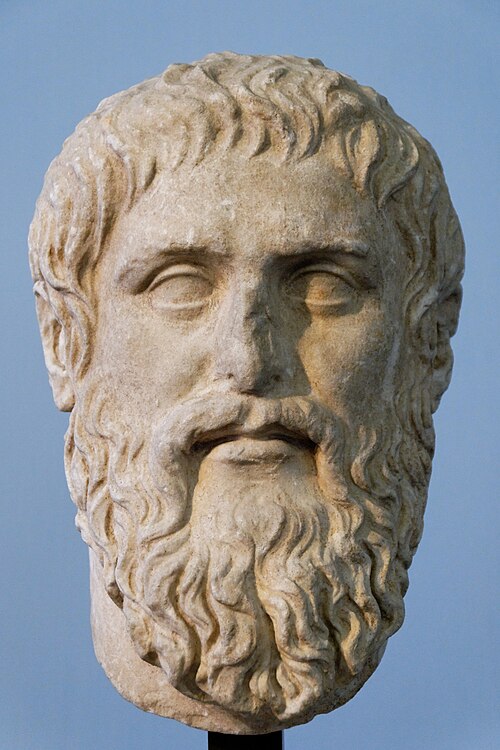
Start at the top for an easy introduction. Go further down for more detail and scholarship.
- Easy
- Intermediate
- Advanced
For young readers
About 2,400 years ago, in the Greek city of Athens, lived a young man named Plato. He had a teacher named Socrates, who walked around the city asking people tricky questions like “What is courage?” and “What does it mean to be a good person?” Plato loved listening to him.
But some powerful people in Athens did not like Socrates’ questions, and they put him on trial and sentenced him to death. Plato was heartbroken and angry. He decided to spend his life thinking about how to make a fairer city, where wise and good people would be in charge.
Plato wrote his ideas as little plays called dialogues, where people talk and argue with each other—usually with Socrates as the main character. Reading them is like listening in on a really clever conversation. Almost all of them still survive today!
One of his most famous ideas is a story about a cave. Imagine people chained in a dark cave all their lives, seeing only shadows on a wall. They think the shadows are the real world. If one of them escaped into the sunshine, he would discover a much bigger, brighter world. Plato said that learning and thinking are like climbing out of the cave into the light.
Plato also started a school called the Academy, where students came to study math, science and philosophy. His most famous student was Aristotle. Plato’s questions are still asked in classrooms all over the world.
At a glance
- Lived
- c. 428/427 – 348/347 BCE
- Place
- Athens, Greece (with journeys to southern Italy and Sicily)
- Language
- Ancient (Attic) Greek
- Form
- Philosophical dialogues (about 35 attributed works, plus 13 letters of disputed authenticity)
- Teacher / student
- Student of Socrates; teacher of Aristotle
- Founded
- The Academy in Athens, c. 387 BCE
- Major works
- Apology, Phaedo, Symposium, Republic, Phaedrus, Theaetetus, Timaeus, Laws
- Significance
- His writings set the agenda for philosophy in metaphysics, ethics, politics, knowledge and education
Easy
Who was Plato?
Plato (c. 428/427–348/347 BCE) was an Athenian philosopher, a follower of Socrates and the teacher of Aristotle. He is one of the most influential thinkers in history: his writings raised questions about justice, knowledge, reality, the soul, love, beauty and the best way to organize society that philosophers still discuss today.
Unlike most ancient authors, Plato’s entire body of work appears to have survived. He wrote dialogues—dramatic conversations between characters, usually led by Socrates. Plato himself never speaks in them, which makes it an intriguing challenge to work out what Plato himself believed.
Around 387 BCE he founded the Academy, a community for study and research in Athens, often described as a forerunner of the university. The twentieth-century philosopher Alfred North Whitehead famously remarked that the European philosophical tradition could be characterized as a series of footnotes to Plato—an exaggeration, but one that shows his importance.
Easy
His life
Plato was born into a wealthy and politically prominent Athenian family. His father was Ariston and his mother Perictione; his brothers Glaucon and Adeimantus appear as characters in the Republic. Relatives on his mother’s side, Critias and Charmides, were leading members of the Thirty, the pro-Spartan oligarchy that ruled Athens briefly and violently in 404–403 BCE. According to the late ancient biographer Diogenes Laertius, “Plato” was a nickname, perhaps meaning “broad,” and his given name was Aristocles; this story is uncertain.
As a young man Plato joined the circle of Socrates. In 399 BCE, under the restored democracy, Socrates was tried on charges of impiety and corrupting the young and was executed by drinking hemlock. The event shaped Plato’s life and work. In the Seventh Letter (whose authenticity is debated), the author explains that he turned away from a political career in disgust at both the oligarchs and the democrats.
After Socrates’ death Plato reportedly spent time in Megara and travelled; stories of visits to Egypt and Cyrene are uncertain. He went to southern Italy, where he likely met the Pythagorean philosopher and statesman Archytas of Tarentum, and to Syracuse in Sicily, the court of the tyrant Dionysius I, where he befriended Dion. He returned to Sicily twice (around 367 and 361 BCE) in the hope of educating Dionysius II as a philosopher-ruler; both visits ended badly.
Plato founded the Academy around 387 BCE and taught there for about forty years. Aristotle arrived in 367 BCE and stayed for twenty years. Plato died in Athens around 348/347 BCE and was succeeded as head of the Academy by his nephew Speusippus.
Intermediate
Historical context: Athens after its golden age
Plato was born during the Peloponnesian War (431–404 BCE) between Athens and Sparta, and grew up as the Athenian democracy—which had built the Parthenon and flourished after the Persian Wars—waged a long and ultimately disastrous war. Athens was defeated in 404 BCE, briefly ruled by the Thirty, then restored as a democracy. These upheavals made questions about justice, leadership and the stability of states urgent.
Athens was also a centre of intellectual life. Sophists—professional teachers who taught rhetoric and argument for pay—travelled through Greek cities, and some claimed that justice and morality were matters of convention or power rather than nature. Earlier philosophers such as Heraclitus, Parmenides and the Pythagoreans had offered competing accounts of change, being and number. Plato’s dialogues respond to all these currents.
In a wider frame, Plato’s century saw the rise of Macedon, the Persian Achaemenid empire at its height, and in China the teachings of Mozi and Mencius. Plato died a decade before Philip II of Macedon’s victory at Chaeronea (338 BCE) and about a generation before Alexander the Great spread Greek culture across the Near East.
Intermediate
The dialogues
The Platonic corpus as arranged in antiquity by Thrasyllus (1st century CE) contains 36 “works” in nine groups of four (tetralogies): 35 dialogues and the Letters counted as one. Modern scholars consider several of these spurious or doubtful (for example Alcibiades II, Hipparchus, Theages), and the authenticity of a few others, such as Alcibiades I and Epinomis, is debated.
Scholars often group the dialogues into three periods. Early or “Socratic” dialogues (such as Euthyphro, Apology, Crito, Laches, Charmides) show Socrates questioning people about a virtue and ending without a definite answer (aporia, “impasse”). Middle dialogues (Phaedo, Symposium, Republic, Phaedrus) present bold theories about the Forms, the soul and the ideal city. Late dialogues (Theaetetus, Parmenides, Sophist, Statesman, Philebus, Timaeus, Critias, Laws) are more technical, sometimes criticize the earlier theory, and often give Socrates a smaller role; the Laws does not include him at all.
The dialogue form is part of the philosophy. Plato shows ideas being tested in conversation, with characters of different ages and views, set in specific places and times—the prison where Socrates awaits death (Crito, Phaedo), a drinking party (Symposium), a walk outside the city walls (Phaedrus). He also uses myths: the ring of Gyges, the myth of Er, Atlantis, and the charioteer of the soul.
Intermediate
The Forms and the allegory of the cave
Plato’s best-known idea is the theory of Forms (or Ideas; Greek eidos, idea). Beautiful things in the world come and go and are beautiful only in some ways; but Beauty itself—what makes them beautiful—is eternal, unchanging and perfectly what it is. The same holds for Justice, Equality, the Good and other Forms. For Plato, the Forms are the most real things, known by reason rather than by the senses.
In the Republic, Plato illustrates this with three linked images. The Sun: as the sun gives light and life to visible things, the Form of the Good gives truth and being to the Forms. The Divided Line: a line divided into sections representing images, physical things, mathematical objects and Forms, each more real and clearly known than the last. And the Cave (Republic Book VII): prisoners who see only shadows cast by firelight; one is freed, climbs painfully into the sunlight, and eventually sees the sun itself—then returns to free the others, who may ridicule or even kill him.
The theory is not presented as a finished system. In the Parmenides, the young Socrates is sharply challenged, including by the “Third Man” argument, which asks whether the Forms lead to an infinite regress. How Plato responded to these difficulties—whether he revised, abandoned or maintained the theory—is one of the great questions of Platonic scholarship.
Intermediate
Soul, knowledge, love and the cosmos
For Plato the soul (psyche) is the true self, distinct from the body and, in the Phaedo, immortal. In the Meno, Socrates helps an untaught slave boy solve a geometry problem through questions alone, which he uses to argue that learning is really “recollection” (anamnesis)—the soul remembering what it knew before birth.
In the Republic and Phaedrus, Plato divides the soul into three parts: reason, spirit (thumos, the part associated with anger and honour) and appetite. In the Phaedrus this is pictured as a charioteer (reason) driving two horses, one noble and one unruly. Justice in the soul is harmony, with reason ruling, spirit supporting it, and appetite kept in check.
In the Theaetetus, Plato examines definitions of knowledge—as perception, as true belief, and as true belief with an “account” (logos)—and finds problems with each. This dialogue remains a foundational text in the theory of knowledge (epistemology).
In the Symposium, guests at a drinking party give speeches praising Eros (love). The comic poet Aristophanes tells a myth of original double humans split in two, each half forever seeking its partner. Socrates recounts the teaching of a wise woman, Diotima: love is a desire for the good and for immortality, and it can lead a person up a “ladder” from love of one beautiful body to love of all beauty, of souls, laws and knowledge, and finally to the vision of Beauty itself. The popular term “Platonic love” derives, loosely, from this dialogue.
The Timaeus offers an account of the creation of the cosmos by a divine craftsman (demiurge), who shapes the world as a living being on the model of the eternal Forms, using mathematical proportions and the elementary triangles of the four elements. It is presented as a “likely story” rather than certain knowledge. The Timaeus and Critias also introduce the story of Atlantis.
Intermediate
Justice, the good life and the ideal city
Plato’s ethics begins with Socrates’ claim, in the Apology, that the unexamined life is not worth living for a human being. The dialogues ask what virtue is, whether it can be taught, and whether it is better to suffer injustice than to do it (as Socrates argues in the Gorgias). Plato consistently holds that virtue is the key to happiness (eudaimonia, flourishing).
The Republic asks: what is justice, and is the just person happier than the unjust, even if no one knows? To answer, Socrates builds an ideal city in words, with three classes—rulers (guardians), auxiliaries (soldiers) and producers—mirroring the three parts of the soul. Guardians receive a long education in music, gymnastics, mathematics and dialectic; they hold no private property; women can be guardians on equal terms with men; and, most famously, there will be no end to troubles until philosophers become rulers or rulers become philosophers (Republic 473c–d).
The Republic also criticizes poetry and art as imitations far removed from truth and capable of corrupting character, and analyses how regimes decline from aristocracy through timocracy, oligarchy and democracy to tyranny. In his last and longest work, the Laws, Plato designs a more practical city, Magnesia, governed by detailed laws with preambles meant to persuade citizens.
Intermediate
The Academy
Plato’s school took its name from the Akademeia, a sacred grove and gymnasium outside the walls of Athens associated with the hero Hekademos (Akademos). There Plato and his associates studied mathematics, astronomy, political theory and philosophy. Tradition says that the entrance bore the inscription “Let no one ignorant of geometry enter,” but this is attested only in late sources.
Members included the mathematicians Eudoxus of Cnidus and Theaetetus, and, for twenty years, Aristotle. Diogenes Laertius mentions two women who studied there, Axiothea of Phlius and Lastheneia of Mantinea. Members of the Academy were reportedly invited to help draft laws for various Greek cities.
After Plato the Academy passed through several phases, including a “skeptical” period under Arcesilaus and Carneades. Its activities at the original site ended around the time of the Roman general Sulla’s siege of Athens in 86 BCE. A Neoplatonist school later flourished in Athens until the sixth century CE; its decline is traditionally linked to a decree of Emperor Justinian in 529 CE.
Intermediate
Transmission and influence across the world
In late antiquity, Neoplatonists such as Plotinus (3rd century CE) and Proclus (5th century CE) developed Plato’s ideas into a comprehensive metaphysical and religious system that profoundly influenced Christian theology (notably Augustine), as well as Jewish and Islamic thought.
For centuries in the Latin West the Timaeus was the only dialogue widely available (in the partial Latin translation of Calcidius, 4th century CE), so medieval European thinkers knew Plato above all as a cosmologist.
In the Islamic world, Plato (Aflāṭūn) was known through Arabic translations and summaries, some made at centres such as Baghdad’s House of Wisdom. Al-Farabi (d. 950) wrote on the philosophy of Plato and summarized the Laws, and his idea of the “virtuous city” draws on the Republic. Averroes (Ibn Rushd, 1126–1198) wrote a commentary on the Republic, which survives in Hebrew translation.
Byzantine scholars preserved Plato’s Greek text. At the Council of Florence (1438–1439), the Byzantine philosopher Gemistos Plethon stirred interest in Plato among Italian humanists. Marsilio Ficino translated the complete dialogues into Latin (printed 1484) under Medici patronage, and the first printed Greek edition was issued by Aldus Manutius in Venice in 1513. Since then Plato has been a constant presence in Western philosophy, political theory, literature and education, and his works are read in translation across the world, including in East Asia since the late nineteenth century.
Advanced
Scholarly debates and open questions
The Socratic problem: Socrates wrote nothing, so our picture of him depends on Plato, Xenophon, Aristophanes’ comedy Clouds and remarks by Aristotle. How much of Plato’s “Socrates” is the historical Socrates? Gregory Vlastos influentially argued that the early dialogues represent the historical Socrates’ philosophy and the middle dialogues Plato’s own; many scholars, including Charles Kahn, have challenged this, arguing that even the “early” dialogues are Plato’s literary and philosophical constructions.
Chronology and development: The order of the dialogues is uncertain. Stylometry—statistical study of style, pioneered by Lewis Campbell in 1867—confirms a group of late works close to the Laws, which ancient testimony says was unfinished at Plato’s death, but it cannot securely order the early and middle dialogues. “Developmentalists” read the corpus as recording changes in Plato’s views; “unitarians” see a largely consistent philosophy presented from different angles.
Unwritten doctrines: Aristotle refers to Plato’s “unwritten teachings” (agrapha dogmata), apparently involving first principles called the One and the Indefinite Dyad. The “Tübingen school” (Hans Joachim Krämer, Konrad Gaiser) and later Giovanni Reale argued that these oral doctrines are the key to Plato’s real philosophy; most Anglophone scholars are skeptical and focus on the dialogues. The authenticity of the Seventh Letter, which criticizes writing philosophy down, is also disputed.
Politics: Karl Popper’s The Open Society and Its Enemies (1945) attacked Plato as a forerunner of totalitarianism; defenders reply that this reads the Republic too literally, ignores its irony and aims, or neglects the Laws. Feminist scholars have debated whether Book V’s female guardians show a proto-feminist position or subordinate women’s interests to the state.
Advanced
Primary sources and the manuscript tradition
Plato’s text comes down to us mainly through Byzantine manuscripts. The oldest complete medieval manuscript of the first six tetralogies is the “Clarke Plato” (Oxford, Bodleian Library, MS E. D. Clarke 39), copied in 895 CE for Arethas of Caesarea. Another key manuscript is Parisinus graecus 1807, from the ninth century, containing the last tetralogies including the Republic and Laws. Papyrus fragments from Egypt, such as those found at Oxyrhynchus, provide older but partial evidence.
Ancient biographical information comes from the Letters (of uncertain authenticity), Aristotle, and later writers, above all Diogenes Laertius’ Lives of Eminent Philosophers (Book III, probably 3rd century CE), which mixes reliable information with anecdote. Many “facts” in popular accounts, such as Plato’s wrestling career or original name, rest on this late testimony.
Plato is cited by Stephanus numbers—page numbers and section letters from Henri Estienne’s (Stephanus’) Greek edition of 1578, such as Republic 514a for the beginning of the cave allegory. The standard modern Greek text is the Oxford Classical Texts edition; a widely used English collection is Plato: Complete Works, edited by John M. Cooper (Hackett, 1997). The Greek text and English translations are also available online through the Perseus Digital Library.
Advanced
Methodological notes: how to read Plato
Because Plato never speaks in his own voice, readers must decide how to relate the arguments to the dramatic context. A claim made by Socrates to a particular person, for a particular purpose, may not be Plato’s settled doctrine. Attention to irony, character, setting and the dialogue’s ending (for example, aporia) is part of philosophical interpretation, not a distraction from it.
Key Greek terms resist translation: eidos/idea (Form, Idea), psyche (soul, mind, life), aretē (virtue, excellence), dikaiosynē (justice, righteousness), eros (love, desire). Modern associations—such as “idea” meaning a mental thought, or “Platonic love” meaning non-physical friendship—can mislead.
Finally, “Platonism” has meant many things across two and a half millennia: Neoplatonic mysticism, Christian and Islamic theology, Renaissance humanism, and modern “mathematical Platonism” (the view that numbers exist independently of minds). Distinguishing Plato’s own texts from later Platonisms is an essential scholarly habit.
Key ideas
- Theory of Forms
- Beyond changing physical things lie eternal, perfect Forms (such as Beauty or Justice), which are known by reason and are most truly real.
- Allegory of the cave
- Prisoners mistake shadows for reality; education is the painful turning of the soul toward the light of truth.
- Form of the Good
- The highest Form, compared to the sun, which makes the other Forms knowable and gives them being.
- Recollection (anamnesis)
- The view, in the Meno and Phaedo, that learning is the soul remembering what it knew before birth.
- Tripartite soul
- The soul has three parts—reason, spirit and appetite; justice is their harmony under reason.
- Philosopher-rulers
- In the Republic, cities will flourish only when those who love wisdom rule.
- Dialectic
- Philosophical method of question and answer that tests definitions and ascends toward knowledge of the Forms.
- Eros
- Love as a desire for beauty and goodness that can lead the soul upward toward Beauty itself (Symposium).
Records
- c. 427 BCE — Plato is born in Athens (428 or 427 BCE) during the Peloponnesian War.
- 404 BCE — Athens surrenders to Sparta; the Thirty, including Plato’s relatives, seize power.
- 399 BCE — Socrates is tried and executed in Athens.
- c. 388 BCE — Plato visits southern Italy and Syracuse for the first time.
- c. 387 BCE — Plato founds the Academy in Athens.
- 367 BCE — Aristotle joins the Academy; Plato’s second journey to Syracuse.
- c. 361 BCE — Plato’s third and last journey to Sicily.
- c. 347 BCE — Plato dies in Athens (348 or 347 BCE); Speusippus succeeds him.
- 86 BCE — Sulla besieges Athens; activity at the original Academy site ends around this time.
- 895 CE — The “Clarke Plato” manuscript is copied in Constantinople.
- 1484 — Marsilio Ficino’s complete Latin translation of Plato is printed in Florence.
- 1578 — Henri Estienne (Stephanus) publishes the Greek edition whose page numbers are still used.
Glossary
- Dialogue
- A written work in the form of a conversation between characters; Plato’s main literary form.
- Form (eidos, idea)
- An eternal, unchanging, perfect reality that ordinary things imperfectly share in.
- Aporia
- Greek for “impasse” or “puzzlement”; the state in which a discussion ends without a solution.
- Elenchus
- Socrates’ method of refutation by questioning, exposing contradictions in someone’s beliefs.
- Sophist
- A paid professional teacher of rhetoric and argument in classical Greece.
- Eudaimonia
- Happiness or human flourishing, the goal of the good life in Greek ethics.
- Demiurge
- The divine craftsman who shapes the cosmos in the Timaeus.
- Stephanus numbers
- The standard reference system for Plato’s works, based on the 1578 edition by Henri Estienne.
- Neoplatonism
- A late ancient philosophical movement (from Plotinus onward) that developed Plato’s ideas into a comprehensive system.
- Stylometry
- Statistical analysis of writing style, used to help determine the order and authenticity of texts.
Questions and answers
What is Plato best known for?
His dialogues featuring Socrates, the theory of Forms, the allegory of the cave, the Republic’s vision of a just city, and founding the Academy.
What is the allegory of the cave in simple terms?
People in a cave see only shadows and think they are real. Leaving the cave and seeing the sun stands for learning the truth through education and philosophy.
Was Plato a real person, and are his books really his?
Yes, he was a real historical person. Most of the dialogues are accepted as his, but a few works in the ancient collection, and some of the Letters, are probably by others.
What is the difference between Socrates, Plato and Aristotle?
Socrates wrote nothing and taught by questioning; Plato, his student, wrote dialogues and developed the theory of Forms; Aristotle, Plato’s student, wrote treatises and grounded knowledge more in observation of the natural world.
What does “Platonic love” mean?
Today it means a close, non-romantic friendship. It comes loosely from the Symposium, where love can lead from attraction to one person toward love of beauty and wisdom itself.
Did Plato believe in Atlantis?
Atlantis appears in the Timaeus and Critias as a story told to illustrate ideas about an ideal city. Most scholars regard it as Plato’s invention rather than a historical report.
Which Plato dialogue should I read first?
Many readers start with the Apology, Crito or Euthyphro, which are short, and then read the Symposium or the Republic.
Did Plato have unwritten teachings?
Aristotle mentions “unwritten doctrines.” Scholars disagree on how important they were; some think they reveal Plato’s core philosophy, others focus on the dialogues.
Sources and further reading
- Plato. Stanford Encyclopedia of Philosophy
- Plato’s Middle Period Metaphysics and Epistemology. Stanford Encyclopedia of Philosophy
- Plato’s Ethics: An Overview. Stanford Encyclopedia of Philosophy
- Plato. Internet Encyclopedia of Philosophy
- Plato. Wikipedia
- Platonic Academy. Wikipedia
- Theory of forms. Wikipedia
- Republic (Plato). Wikipedia
- Plato, Republic (text and translation). Perseus Digital Library, Tufts University
- John M. Cooper (ed.), Plato: Complete Works. Hackett Publishing, 1997
Related
- SocratesAthenian philosopher who wrote nothing himself. Known through Plato and Xenophon, he was tried and executed in 399 BCE.
- AristotlePlato's student and Alexander's tutor. He founded the Lyceum and wrote on logic, ethics, politics and the natural world.
- ParthenonA temple dedicated to Athena on the Athenian Acropolis, built during the fifth century BCE.
- Library of AlexandriaAn ancient center for collecting and studying texts in Ptolemaic Alexandria.
- Al-FarabiPhilosopher of the Islamic world known for works on logic, political thought and music.
- Augustine of HippoA Christian bishop and thinker whose writings shaped Western theology and philosophy.
Written with AI assistance from the published sources listed above, and revised as new research appears.