Start at the top for an easy introduction. Go further down for more detail and scholarship.
- Easy
- Intermediate
- Advanced
For young readers
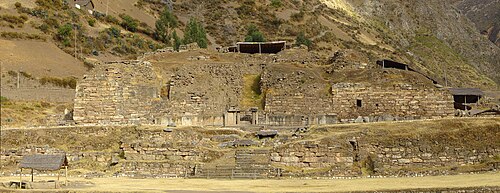
High in the mountains of Peru, where two rivers meet in a green valley, there is a great stone temple called Chavín de Huántar. People built it about 3,000 years ago, long before the Inca. From far away it looks like a big stone platform, but inside it is full of secret tunnels.
The tunnels are narrow, twisting and very dark. At the centre, where two passages cross, stands a tall stone about as high as two and a half grown-ups. It is carved into a strange god with a snarling mouth, big fangs and hair made of snakes. Archaeologists call it the Lanzón, which means “the big lance”, because of its pointed shape.
The builders were clever with sound and water. Channels under the temple carried rushing water, and some scientists think the sound could echo through the tunnels like a roar. Priests also blew trumpets made from big seashells brought all the way from the warm sea far to the north.
The walls outside were once decorated with stone heads that stuck out like pegs. Some look like people, and others look more and more like jaguars with fangs. Many experts think they show priests changing into animal spirits during ceremonies.
People came from far away to visit Chavín, maybe to ask the god questions, like visiting a very wise oracle. The Chavín style of art, with its jaguars, snakes, birds of prey and caymans, spread across much of ancient Peru.
At a glance
- Period
- Main ceremonial use c. 1200–500 BC in recent chronologies; traditionally dated c. 900–200 BC (Early Horizon)
- Place
- Confluence of the Mosna and Huachecsa rivers, Conchucos valley east of the Cordillera Blanca, Áncash Region, Peru; about 3,150–3,180 m above sea level
- Type
- Ceremonial centre of platform temples, plazas and internal stone galleries; probably a pilgrimage and oracle site
- Culture
- Chavín culture, whose art style spread widely across the central Andes and coast
- Famous works
- Lanzón (c. 4.5 m granite monolith, in situ), Tello Obelisk, Raimondi Stela, tenon heads (cabezas clavas)
- First major excavations
- Julio C. Tello, 1919
- Status
- UNESCO World Heritage Site, 1985
Easy
What is Chavín de Huántar?
Chavín de Huántar is a monumental religious centre in the northern highlands of Peru. It lies in the Conchucos valley, on the eastern side of the snow-capped Cordillera Blanca, where the Mosna and Huachecsa rivers meet, at about 3,150 m above sea level. The modern town of Chavín stands beside it.
The site consists of massive stone platform buildings, sunken plazas and, inside the buildings, a network of narrow stone-lined galleries (passages). It was built and remodelled over many centuries during the first millennium BC and probably earlier. It was not a large city but a sacred place, visited by pilgrims who came to take part in rituals and perhaps to consult an oracle.
Chavín is also the name archaeologists give to a whole culture and art style. Objects decorated in the Chavín style, including carved stone, pottery, textiles and gold work, have been found far from the site itself, from the northern coast to the southern coast of Peru. This made Chavín the first art style shared across a large part of the Andes.
The Peruvian archaeologist Julio C. Tello, who excavated here in 1919, called Chavín the “mother culture” of Andean civilization. We now know that complex societies such as Caral existed on the coast much earlier, but Chavín remains one of the great turning points in Andean history. UNESCO inscribed the site on the World Heritage List in 1985.
Easy
How to “read” the temple: from open plazas to hidden galleries
The site has two main phases of building, usually called the Old Temple and the New Temple. The Old Temple is a U-shaped platform complex, its two arms embracing a sunken circular plaza about 20–21 m across. This U-shaped plan, open toward the rising sun, was a common design for ceremonial centres in the Andes at the time. The circular plaza was carefully paved, and the Old Temple’s stone panels were carved in relief with jaguars, caymans and other creatures with human features.
Later, the southern wing of the Old Temple was greatly enlarged to form the New Temple, sometimes called El Castillo (“the castle”), a huge platform about 70 m on a side. Its main entrance, the Portal of the Falcons (Portada de las Falcónidas), also known as the Black and White Portal, is made of stone in two colours: one side black limestone, the other white granite. Carved birds of prey on its columns may express the idea of balanced opposites.
In front of the New Temple lies a large square sunken plaza, the Plaza Mayor, about 50 m on each side, big enough for large crowds. A visitor’s path would lead from these bright open spaces, where many people gathered, into the dark, narrow galleries inside the platforms, where only a few could enter.
The galleries form a maze of passages, small rooms and staircases, lit only by small shafts. Some held offerings of pottery and other objects. At the heart of the Old Temple, where two passages cross, the Lanzón still stands in the place where it was set up about three thousand years ago.
Easy
The Lanzón and other great sculptures
The Lanzón is a granite monolith about 4.5 m tall, carved on all sides in shallow relief. It shows a figure with a human body and a fierce feline face: a snarling mouth with long fangs, claws on hands and feet, and hair and belt made of snakes. One arm is raised and the other lowered. The stone runs from the floor of the gallery up through the ceiling, as if joining the underworld, the earth and the sky. Many scholars see it as an axis mundi, the centre of the world, and as the main deity of the Old Temple.
The Tello Obelisk, a granite pillar about 2.5 m tall found in 1908 and studied by Tello, is carved with two great caymans (a kind of crocodile from the Amazon lowlands). Their bodies are filled with other creatures and plants, including manioc and chilli peppers, crops of the tropical forest. It may express a myth about the origins of cultivated plants or a vision of the cosmos linking sky, earth and water. It is now in the National Chavín Museum near the site.
The Raimondi Stela, a polished granite slab about 2 m tall, shows a standing figure with a fanged face holding a staff in each hand, the earliest well-known version of the “Staff God” who reappears in Andean art for two thousand years. It was recorded by the naturalist Antonio Raimondi in 1873, in a local farmer’s house. Turned upside down, the image changes: the towering headdress becomes a stack of grinning faces. It is now in the national museum in Lima.
The outer walls of the temple were once decorated with tenon heads (cabezas clavas): large stone heads with a long stone peg at the back, set into the masonry so the faces projected from the walls. Some fifty-odd are known, but only one remains in its original position. They range from nearly human faces to fanged, snarling feline ones.
Intermediate
Building Chavín: stone, water and sound
The temples were built of cut and fitted stone, including granite, sandstone and limestone, some brought from considerable distances. Laser-scanning studies by the Stanford archaeologist John Rick and his team suggest that the builders followed consistent rules of layout and construction over centuries, rebuilding and expanding the platforms while preserving older galleries inside.
Water was essential to the design. A network of stone-lined canals runs beneath the temples and plazas, draining heavy highland rain and possibly channelling water from the rivers. Some researchers have proposed that rushing water in these canals could produce loud, roaring sounds inside the galleries, adding to the drama of ritual, though how deliberate this effect was is debated.
Sound was certainly part of Chavín ritual. In 2001 excavators found twenty trumpets made from large Strombus conch shells (pututus), nearly three thousand years old. These shells come from the warm waters of the Pacific off Ecuador, hundreds of kilometres to the north. Acoustic studies of the instruments and galleries have explored how the sound of conch trumpets would have travelled and echoed through the narrow stone passages.
Light was controlled as carefully as sound. The galleries are mostly dark, lit by narrow shafts; some shafts may also have carried air or sound. Moving from bright sunlight into near darkness, perhaps under the influence of drugs, with strange sounds all around, would have been a powerful, disorienting experience, leading up to the sudden sight of the Lanzón.
Intermediate
Religion: oracle, pilgrimage and transformation
Chavín was above all a religious centre. Its imagery is dominated by powerful animals from different environments: the jaguar from the forest, the harpy eagle and other birds of prey from the sky, the cayman from the rivers of the Amazon, and serpents. These animals are combined with human features to create composite supernatural beings.
Many scholars believe Chavín priests used psychoactive substances. The staffs held by the figure on the Raimondi Stela have been compared to the San Pedro cactus, which contains mescaline, and the site has yielded ritual paraphernalia, such as stone mortars and bone tubes, for grinding and ingesting snuff. The tenon heads, which range from human to animal faces, have often been read as showing priests transforming into jaguar-like spirit beings under the influence of these substances. This interpretation is widespread but remains an interpretation.
The Lanzón, deep inside the temple, may have been an oracle, a god who answered questions through priests. Later Andean oracles such as Pachacamac on the central coast worked this way, drawing pilgrims from great distances. Chavín may have been an early example of this tradition, with pilgrims bringing offerings such as pottery, shells and foods from many regions.
The art itself worked like a religious code. Many images can be read in more than one way: a mouth can also be an eye, hair can be snakes, and whole images can change when turned upside down. Such complex designs could be fully understood only by initiates who had been taught to read them, reinforcing the special knowledge and authority of the priests.
Duality runs through Chavín imagery. On the Lanzón, one arm points up and the other down, often read as the sky above and the earth below; the Portal of the Falcons pairs black stone with white; many figures combine human and animal, or creatures of forest, sky and river. Scholars connect this to a long-lasting Andean idea that the world is made of complementary opposites whose meeting, called tinku in Quechua, creates something new. Using a much later Quechua word for a monument three thousand years old is an interpretive choice, but it shows how some themes persisted in Andean thought.
Intermediate
Chavín in its world: trade, herding and the spread of a style
Chavín de Huántar lay at a crossroads. Its valley links the Pacific coast, over the Cordillera Blanca, with the eastern slopes of the Andes that lead to the Amazon lowlands. Goods found at the site, such as obsidian, marine shells from Ecuador, and images of tropical forest animals and plants, show that it was connected to all three zones.
Highland farmers grew potatoes, quinoa and maize, and herded llamas, which provided wool and meat and carried loads over mountain trails. Llama caravans may have helped move goods and ideas between Chavín and other regions.
Between about 900 and 200 BC, the Chavín style spread widely. Similar imagery of fanged deities, feline creatures and staff-bearing figures appears on textiles, pottery, stone carving and gold objects along the coast and in the highlands. Archaeologists once treated this as the first unification of the Andes, a period they call the Early Horizon. Today most see it not as an empire but as the spread of a religious cult and its art, perhaps through pilgrimage, trade and the founding of affiliated shrines.
Chavín was not the only important centre of its time. Other large temples such as Kuntur Wasi and Pacopampa in the northern highlands, and cultures such as Paracas on the south coast, shared elements of the style while keeping their own traditions.
Intermediate
Decline, later history and rediscovery
By around 500–400 BC the temple’s religious role appears to have declined. Across the central Andes, many large ceremonial centres were abandoned, some left unfinished, during a period of social upheaval. At Chavín, a village of ordinary houses grew over parts of the temple, including the circular plaza. The site was never completely forgotten, and people continued to live around and on top of it for centuries.
European travellers and scholars described the ruins from the colonial period onward. In 1873 the Italian-born naturalist Antonio Raimondi recorded the stela that bears his name. In 1919 Julio C. Tello, a Peruvian archaeologist of Quechua-speaking Indigenous origin, carried out the first major excavations. Tello argued that Andean civilization had developed independently in the Andes, with roots in the Amazon, rather than being brought from Mesoamerica, as some foreign scholars had suggested.
On 17 January 1945 a glacial flood (aluvión) from a lake above the valley swept through Chavín, burying much of the site under mud and debris several metres deep and destroying much of the town. Clearing and excavation over the following decades, including work by Marino Gonzales, uncovered structures such as the Portal of the Falcons. Luis Lumbreras excavated the galleries in the 1960s and 1970s, and Richard Burger’s stratigraphic research on pottery in the 1970s established a detailed chronology.
Since the 1990s the Stanford-led project of John Rick, with Peruvian colleagues, has excavated and mapped the galleries in detail. In 2018 his team used small robots to explore narrow passages, finding previously unknown tunnels and burials. In 2008 the National Chavín Museum opened near the site with Japanese support, and the Tello Obelisk was moved there from Lima.
Advanced
Scholarly debates: chronology, “mother culture” and power
Chronology. Burger’s ceramic sequence, based on excavations in the town, divided Chavín into the Urabarriu, Chakinani and Janabarriu phases and placed the site’s florescence around 900–200 BC, with the New Temple and the widest spread of the style late in that span. More recent radiocarbon dating associated especially with Rick’s project has pushed the main construction earlier, suggesting that most major building took place before about 750 BC and that the temple’s primary religious function had ended before 400 BC. The two chronologies imply different histories: in one, Chavín reached its peak as its influence spread; in the other, the influential Chavín style partly postdates the temple’s greatest building.
Mother culture or peer centre? Tello saw Chavín as the source of Andean civilization. The discovery of earlier monumental sites such as Caral, Sechín Bajo and Kotosh showed that many elements once thought to begin at Chavín, including platform mounds, sunken plazas and temple renewal, were already centuries or millennia old. Burger and others now describe Chavín as a centre that synthesized older coastal and highland traditions and spread them in a new, powerful form.
How was power exercised? One influential view, developed by Rick, sees Chavín as a place where a religious elite gradually built authority by manipulating experience: controlling light, sound, water and access, and staging dramatic encounters with the divine. In this view the architecture itself was a tool for creating belief and social inequality. Critics caution against reading too much intentionality into features such as acoustics, and point out that the political organization behind Chavín, whether a theocracy, a set of competing lineages or a pilgrimage community, remains uncertain.
Reading the art. The art historian John H. Rowe described Chavín art as using visual metaphors he called kennings, in which one body part is replaced by another form, such as hair drawn as snakes. Others have emphasized contour rivalry, images that can be read in different ways. These analyses show a deliberate visual language, but interpreting specific myths from them, for example readings of the Tello Obelisk’s caymans and plants, discussed by Rowe and by Donald Lathrap, as a myth about cultivated plants or the cosmos, remains speculative.
Advanced
Evidence and methods
Architecture as archive. The overlapping phases of the platforms, and the galleries preserved within them, provide the core evidence for Chavín’s history. Laser scanning and detailed mapping allow researchers to reconstruct the order of building and the original appearance of spaces hidden inside the later structures.
Offerings and artefacts. Pottery and other offerings found in the galleries, some in styles from other regions, suggest that visitors or affiliated communities brought gifts from far away. Chemical and stylistic analysis of such objects, of obsidian and of marine shells, helps trace exchange networks. The 2001 pututu find shows how excavation can reveal the ritual soundscape.
Iconography. Because Chavín left no writing, interpretation of its religion rests heavily on iconography: the Lanzón, the Tello Obelisk, the Raimondi Stela, the reliefs of the circular plaza and the tenon heads. Comparisons with later Andean religion, recorded by Spanish chroniclers in the sixteenth century, are useful but risky across a gap of two thousand years.
Disturbance and conservation. The 1945 flood, centuries of later occupation, and the removal of sculptures to museums complicate the record. Heavy rains, seismic activity and visitor traffic threaten the galleries, and conservation efforts, supported in part by international heritage organizations since the 2000s, aim to stabilize the structures and protect the drainage system.
Key ideas
- Pilgrimage centre
- Chavín drew visitors from distant regions for ritual, offerings and perhaps oracular consultation, rather than being a large city.
- Hidden galleries
- Dark interior passages that controlled movement, light and sound, leading to the Lanzón at the heart of the temple.
- Composite beings
- Chavín art combines jaguar, eagle, cayman, serpent and human features into supernatural figures.
- Transformation
- Imagery such as the tenon heads is often read as priests changing into animal spirits, perhaps with psychoactive plants.
- Visual puzzles
- Kennings and contour rivalry make images readable in several ways, a code for initiates.
- Horizon style
- The wide spread of Chavín imagery across the Andes, probably through religion and exchange rather than conquest.
- Synthesis of traditions
- Chavín combined older coastal and highland temple forms, such as U-shaped layouts and sunken plazas, into a new religious system.
Records
- c. 1200 BCE — Major temple construction under way at Chavín, according to recent radiocarbon chronologies.
- c. 900 BCE — Start of the Early Horizon in Rowe’s periodization; beginning of Chavín in older chronologies.
- c. 750 BCE — Most major construction completed, according to Rick’s chronology.
- c. 500 BCE — Social upheaval across the central Andes; the temple’s religious role begins to decline (New Temple dated c. 500–200 BC in older chronologies).
- c. 200 BCE — End of the Early Horizon; Chavín-style influence has faded.
- 1873 — Antonio Raimondi records the Raimondi Stela.
- 1908 — The Tello Obelisk is found at the site.
- 1919 — Julio C. Tello carries out the first major excavations.
- 1945 — A glacial flood buries much of the site and the town under mud and debris (17 January).
- 1985 — Chavín is inscribed on the UNESCO World Heritage List.
- 2001 — Twenty conch-shell trumpets (pututus) are excavated.
- 2008 — The National Chavín Museum opens; the Tello Obelisk returns to Chavín.
Glossary
- Early Horizon
- A period in Andean archaeology (c. 900–200 BC) when the Chavín style spread widely.
- Gallery
- A narrow, stone-lined interior passage inside a temple platform.
- Lanzón
- The c. 4.5 m granite monolith at the centre of the Old Temple, carved as a fanged deity.
- Tenon head (cabeza clava)
- A carved stone head with a peg at the back, set into a wall so the face projects.
- Staff God
- A frontal deity holding a staff in each hand, first known from Chavín and common in later Andean art.
- Pututu
- A trumpet made from a large conch shell, used in Andean ritual.
- San Pedro cactus
- A mescaline-containing cactus used in Andean ritual healing, depicted at Chavín.
- Kenning
- In Rowe’s analysis of Chavín art, a visual metaphor in which one form stands for another.
- Contour rivalry
- An image designed to be read in more than one way, depending on orientation or focus.
- Aluvión
- A sudden flood of mud and debris, often from a glacial lake outburst.
- Axis mundi
- The imagined centre of the world, linking sky, earth and underworld.
Questions and answers
Why is the big statue called the Lanzón?
“Lanzón” means “big lance” in Spanish. The name refers to its tall, narrow, pointed shape.
Can visitors see the Lanzón today?
Yes. It still stands in its original place in the galleries of the Old Temple, which visitors can enter through narrow passages.
Was Chavín an empire?
Most archaeologists think not. Its art and religion spread widely, but there is no clear evidence of conquest or a centralized state ruling distant regions.
Did priests at Chavín use drugs?
Many scholars think so, based on images interpreted as the San Pedro cactus and finds of mortars and tubes for snuff, but direct chemical evidence is limited.
How old is Chavín compared to Caral?
Much younger. Caral was built around 2600–2000 BC; Chavín’s main temple phases date roughly from 1200 to 500 BC.
Why do the dates for Chavín differ between books?
Older works follow Richard Burger’s ceramic chronology (c. 900–200 BC); more recent radiocarbon research places the main construction earlier, before about 750 BC.
What happened to the site in 1945?
A glacial flood buried much of Chavín under mud and debris, and the site had to be cleared over the following decades.
Sources and further reading
- Chavín de Huántar. Wikipedia
- Chavín de Huántar. Wikipedia (Spanish)
- Chavín culture. Wikipedia
- Lanzón. Wikipedia
- Tello Obelisk. Wikipedia
- Raimondi Stela. Wikipedia
- Pututu. Wikipedia
- Julio C. Tello. Wikipedia
- Periodization of pre-Columbian Peru. Wikipedia
- Richard L. Burger, Chavín and the Origins of Andean Civilization. Thames & Hudson, 1992
Related
- CaralPlanned preceramic city of stone platform pyramids and sunken circular plazas on the Peruvian coast, built c. 2600–2000 BC and often called the oldest city in the Americas.
- Nazca LinesLarge ground drawings and lines made by ancient communities in the desert of southern Peru.
- Machu PicchuInca settlement in the Andes, probably established in the fifteenth century.
- Olmec Colossal HeadsMonumental basalt heads made by Olmec communities on Mexico's Gulf Coast, probably depicting rulers.
- TeotihuacanA major ancient city in central Mexico, known for its monumental avenues, pyramids and extensive residential compounds.
Written with AI assistance from the published sources listed above, and revised as new research appears.