Start at the top for an easy introduction. Go further down for more detail and scholarship.
- Easy
- Intermediate
- Advanced
For young readers
About 1,500 years ago, long before cars or trains, one of the biggest cities in the world was in the highlands of Mexico. It had wide streets laid out like lines on graph paper, enormous pyramids, painted walls in bright red, green and blue, and around a hundred thousand people. Today we call it Teotihuacan.
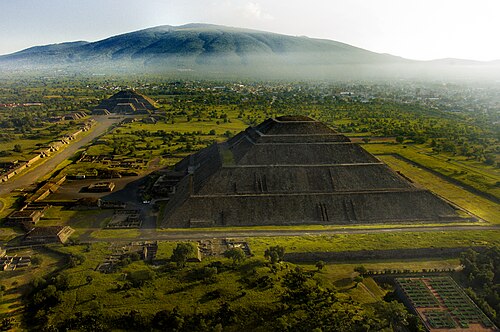
The biggest building is the Pyramid of the Sun. It is about as tall as a twenty-storey building, and its base is wider than two football fields. People built it by carrying earth, rubble and stone, basket by basket, without iron tools, wheels for carts, or big working animals like horses and oxen.
Most people lived in large stone apartment buildings with many rooms around open courtyards, like small villages under one roof. Families from faraway places moved there too. One neighbourhood was home to people from Oaxaca in southern Mexico, and they kept their own customs for hundreds of years.
The strange thing is that nobody knows what the people of Teotihuacan called their city or exactly what language they spoke. They painted signs and pictures, but we cannot read them the way we read books. The name Teotihuacan, which means something like “the place where the gods were made”, was given much later by the Aztecs, who found the ruins and told stories that the Sun and Moon were born there.
Around 1,450 years ago, many of the city’s great buildings were burned and the city shrank. Why this happened is still a puzzle that archaeologists are trying to solve.
At a glance
- Dates
- c. 100 BCE – c. 550 CE as a great city (roughly; settlement continued on a smaller scale afterwards)
- Place
- Teotihuacan Valley, northeastern Basin of Mexico, about 40 km northeast of Mexico City
- Size
- About 20 km² at its height, with perhaps 100,000 or more inhabitants
- Main monuments
- Avenue of the Dead, Pyramid of the Sun, Pyramid of the Moon, the Ciudadela with the Temple of the Feathered Serpent
- Housing
- About 2,000 multi-family apartment compounds
- Economy
- Farming, craft production and long-distance exchange, especially of obsidian
- Unknowns
- The city’s own name, its language(s) and its political system
- Status
- UNESCO World Heritage Site “Pre-Hispanic City of Teotihuacan” (1987)
Easy
What was Teotihuacan?
Teotihuacan was the largest city in the Americas during the first half of the first millennium CE and one of the largest cities in the world at the time. It lay in a side valley of the Basin of Mexico, in the central highlands at about 2,300 m above sea level. At its height, roughly between 200 and 550 CE, it covered some 20 km² and may have had 100,000 inhabitants or more; estimates vary, and some scholars have proposed figures as high as 125,000 or even 200,000.
The city was carefully planned. A great avenue, known today as the Avenue of the Dead, runs through it for several kilometres, lined with platforms, temples and plazas. At its northern end stands the Pyramid of the Moon, along its eastern side the Pyramid of the Sun, and further south the Ciudadela (“citadel”), a vast enclosure containing the Temple of the Feathered Serpent.
Around this ceremonial core lay thousands of residential compounds, craft workshops and neighbourhoods, some of them inhabited by migrants from distant regions. Teotihuacan’s influence, seen in its styles of architecture, pottery and imagery, reached as far as the Maya region of Guatemala and Honduras, more than 1,000 km away.
Despite its size and fame, much about Teotihuacan remains uncertain. Its inhabitants did not leave long written texts that we can read. We do not know what they called their city, which language or languages they spoke, or exactly how they were governed. The name we use was given centuries later by the Nahuatl-speaking Aztecs.
Easy
How to “read” the city: a grid aligned with mountains and sky
Teotihuacan was laid out on a grid oriented about 15.5 degrees east of true north. Almost every building, street and wall follows this orientation. The builders even redirected the San Juan River where it crosses the city so that it too followed the grid. Scholars have proposed that the orientation relates to sunrise and sunset dates important in the Mesoamerican calendar, or to the position of certain stars; the precise reason is debated.
The Avenue of the Dead forms the main north–south axis. Seen from its southern end, the Pyramid of the Moon at the far end appears to echo the shape of Cerro Gordo, the mountain behind it, a visual link between human monument and sacred landscape. The avenue is not flat: it rises toward the north and is divided by cross-walls into a series of sunken plazas.
Many buildings use a distinctive profile called talud-tablero: a sloping base (talud) topped by a vertical rectangular panel with a projecting frame (tablero). Repeated on platform after platform, this profile gives the city its characteristic rhythm, and its appearance at sites far away is one of the clearest signs of Teotihuacan’s influence.
The city was colourful. Walls were covered with lime plaster and painted with murals in reds, greens, blues and yellows, showing deities, priests in feathered costumes, animals such as jaguars and coyotes, and plants and water. Walking along the avenue would have been an experience of colour, height and symbolism, not the grey stone visitors see today.
Easy
The great pyramids and the Temple of the Feathered Serpent
The Pyramid of the Sun is the largest building in the city and one of the largest pyramids in the Americas. Its base measures roughly 220–230 m on each side, and today it rises about 65 m. It was built mostly in the first and second centuries CE from earth, rubble and adobe, faced with stone and originally coated with plaster and paint. In 1971 a tunnel was found beneath it, leading from the foot of the staircase to chambers under the centre of the pyramid. The tunnel may have been a sacred cave, possibly partly artificial, and suggests the pyramid was built over a place already considered holy.
The Pyramid of the Moon, at the north end of the avenue, is smaller, about 43 m high, but was built in at least seven stages between around 100 and 400 CE, each new structure enclosing the previous one. Excavations led by Saburo Sugiyama and Rubén Cabrera between 1998 and 2004 found dedication burials inside, containing sacrificed people and animals such as pumas, wolves, eagles and rattlesnakes, together with rich offerings of obsidian and greenstone.
The Temple of the Feathered Serpent, inside the Ciudadela, was built around 200 CE. Its façades are decorated with sculpted heads of a feathered serpent alternating with another head, variously interpreted as a headdress, a war serpent or a rain god, set against panels carved with serpent bodies and shells. Excavations in the 1980s revealed that more than 200 people, many of them young men buried with weapons and ornaments, had been sacrificed during its construction.
The names “Sun” and “Moon” come from the Aztecs, not from the builders. Which gods the pyramids were actually dedicated to is uncertain; some scholars have associated the Sun Pyramid with water and the storm god, and the Moon Pyramid with a female deity or with the mountain behind it.
Intermediate
Daily life: apartment compounds and immigrant neighbourhoods
Most Teotihuacanos lived in walled apartment compounds, of which about 2,000 have been identified. A typical compound contained many rooms grouped around open patios, with drains, altars and sometimes painted walls, and housed dozens of people who were probably linked by kinship, occupation or both. Some compounds, such as Tetitla, Tepantitla and Atetelco, are famous for their murals; others were modest. Burials beneath the floors kept the dead close to the living.
The compounds suggest a society that was urban in a way unusual for its time in the Americas: people lived densely, worked in specialized crafts, and depended on markets and farming in the surrounding valley. Craft workshops produced obsidian tools, pottery, figurines and ornaments. Obsidian from sources such as Otumba and the green obsidian of the Pachuca area was a major resource, although how far its production and trade were controlled by the state is debated.
Teotihuacan was a multi-ethnic city. In the Tlailotlacan district on the western side, people from the Oaxaca region lived for centuries, using Zapotec-style tombs and pottery. In the so-called Merchants’ Barrio on the east side, round adobe buildings and imported pottery point to links with the Gulf Coast and the Maya lowlands. Studies of isotopes in human bones have shown that a large proportion of people buried in some compounds had grown up elsewhere.
Murals such as the one in Tepantitla, long known as the “Tlalocan” or paradise of the rain god, show many small figures playing, swimming and singing among flowering trees and streams. These scenes give a rare glimpse of Teotihuacano ideas about fertility, water and the afterlife, though their exact meaning is disputed.
Intermediate
Rise, height and decline
In the last centuries BCE, the Basin of Mexico was home to several competing centres, including Cuicuilco in the south. Teotihuacan grew rapidly from about 100 BCE, helped by springs for irrigation, fertile soils and nearby obsidian. Volcanic eruptions in the southern Basin, including that of the Xitle volcano, which buried parts of Cuicuilco under lava, may have encouraged people to move north, although the timing of these eruptions is debated.
Archaeologists divide the city’s history into ceramic phases named after local places: roughly Patlachique (c. 100–1 BCE), Tzacualli (c. 1–150 CE), Miccaotli (c. 150–200), Tlamimilolpa (c. 200–350), Xolalpan (c. 350–550) and Metepec (c. 550–650). Dates vary between researchers and have been revised with radiocarbon dating. By the Tzacualli phase the city may already have had tens of thousands of people, and the main pyramids were built in the first two centuries CE.
Around the fourth century, the Temple of the Feathered Serpent was partly covered by a new platform, the Adosada, and its sculptures were damaged. Many scholars interpret this as a political change, perhaps a turn away from rule associated with the feathered serpent toward a more collective government. In the following centuries the city reached its greatest extent and influence.
Sometime in the sixth century, around 550 CE according to many estimates, many buildings along the Avenue of the Dead and in the Ciudadela were burned, and sculptures were smashed. The burning targeted elite and ceremonial buildings, which suggests an internal revolt rather than a foreign invasion, though outside pressure cannot be ruled out. Skeletons from this period show signs of malnutrition, and some researchers link the crisis to drought or to the global climate disturbances of the 530s. The population fell sharply, but people continued to live on parts of the site for centuries.
Intermediate
Teotihuacan and the wider Mesoamerican world
Teotihuacan’s influence spread far beyond the Basin of Mexico. Talud-tablero architecture, Teotihuacan-style pottery such as cylindrical tripod vessels, and images of Teotihuacan warriors with goggle-eyed storm-god insignia appear at sites across Mesoamerica, from Kaminaljuyu in highland Guatemala to Monte Albán in Oaxaca.
The most dramatic evidence comes from Maya inscriptions. At Tikal, in Guatemala, texts record that on a day in January 378 CE a figure named Sihyaj K’ahk’ arrived, and on the same day the Tikal king Chak Tok Ich’aak died. Soon afterwards a new king, son of a figure known as “Spearthrower Owl”, took the throne. The epigrapher David Stuart and others have argued that this “arrival of strangers” represents an intervention from Teotihuacan, and that Spearthrower Owl may even have been a ruler of Teotihuacan. In 426 a founder with Teotihuacan connections, K’inich Yax K’uk’ Mo’, established a new dynasty at Copán in Honduras.
Whether these events were a conquest, an alliance, or the work of a faction from Teotihuacan rather than the state as a whole is debated. The archaeologist Linda Manzanilla, for example, has suggested that the Tikal intervention may have been carried out by a group linked to the feathered serpent that had been expelled from the city.
Influence also flowed the other way. Maya-style paintings and objects have been found in Teotihuacan, and foreign residents lived in its neighbourhoods. Teotihuacan was thus less an isolated empire than a hub in a network of exchange, diplomacy and conflict.
Intermediate
The Aztec memory: “where the gods were made”
By the time the Mexica (Aztecs) rose to power in the fourteenth and fifteenth centuries, Teotihuacan had been largely in ruins for some 800 years. The Aztecs regarded it with awe. They gave it the Nahuatl name Teōtīhuacān, usually translated as “the place where the gods were made” or “the place where one becomes a god”, and named its main street and pyramids.
In the Aztec creation story recorded after the Spanish conquest, notably by the friar Bernardino de Sahagún, the gods gathered at Teotihuacan in darkness to create a new sun. The humble god Nanahuatzin threw himself into a great fire and rose as the Sun; the proud Tecciztecatl followed and became the Moon. This myth transformed the ruined city into the birthplace of the present age of the world.
The Aztecs made pilgrimages to Teotihuacan and took ancient objects from it. Teotihuacan masks and other artefacts were placed as offerings in the Templo Mayor, the great temple of Tenochtitlan, centuries after they were made. This is an early example of a society treating an older civilization’s remains as heritage.
For modern Mexicans, Teotihuacan is a national symbol and a place of ongoing meaning. Every year large crowds gather at the Pyramid of the Sun around the spring equinox, and indigenous and New Age ceremonies take place alongside tourism, raising questions about how to balance access, belief and conservation.
Intermediate
Rediscovery, excavation and reconstruction
The ruins were never completely forgotten. Spanish chroniclers described them, and the scholar Carlos de Sigüenza y Góngora made an early exploratory excavation there in the 1670s. In the nineteenth century, travellers and early archaeologists mapped and collected at the site.
The first large-scale excavation and reconstruction was led by Leopoldo Batres between 1905 and 1910, to prepare the Pyramid of the Sun for the centenary of Mexican independence. Batres removed large amounts of fill and facing from the pyramid, in some places several metres, in the belief that he was exposing the original structure. His work is now heavily criticized for destroying evidence and altering the pyramid’s shape.
Manuel Gamio’s project of 1917–1922 was a milestone in Mexican anthropology: it studied the valley’s archaeology, history and living population together, and excavated in the Ciudadela. From 1962 to 1964 Jorge Acosta directed a major restoration of the Avenue of the Dead. In the 1960s René Millon’s Teotihuacan Mapping Project surveyed the entire city, recording surface remains in thousands of locations and transforming our understanding of its size and organization.
Later projects have concentrated on specific monuments and neighbourhoods: the Feathered Serpent project of 1980–1982, the excavations of the Moon Pyramid (1998–2004), and, from 2003, the exploration by Sergio Gómez Chávez of a tunnel about 100 m long beneath the Temple of the Feathered Serpent. Sealed around 1,800 years ago, it contained tens of thousands of objects, including greenstone figures, pyrite mirrors, shells and traces of liquid mercury, perhaps evoking an underworld landscape.
Advanced
Debates: government, religion and language
Government. Unlike Maya cities, Teotihuacan has produced no clear royal portraits, named kings or royal tombs. Some scholars, such as Saburo Sugiyama, have argued that the sacrifices and imagery of the Feathered Serpent Temple point to powerful rulers, perhaps a militaristic kingship, at least in the early centuries. Others, including George Cowgill and Linda Manzanilla, have emphasized collective or corporate forms of government, such as a council representing different districts or lineages, especially after the fourth century. Many now see a shift over time from more personalized rule to more collective governance.
Religion. Teotihuacan imagery includes a storm god related to the later Tlaloc, the feathered serpent related to the later Quetzalcoatl, and a female deity. The art historian Esther Pasztory coined the term “Great Goddess” for this figure, whom she saw as central to Teotihuacan religion; other scholars, such as Karl Taube, have called her the “Spider Woman” or questioned whether the images represent a single deity. Projecting later Aztec gods back onto Teotihuacan is methodologically risky, since several centuries separate them.
Language and writing. Teotihuacan used a system of signs, seen in murals and on pottery, and a painted patio at La Ventilla contains dozens of glyph-like signs. Whether this was full writing is debated. Candidate languages for the city include early forms of Nahuatl (an Uto-Aztecan language), Totonac, Otomí and others. In 2025 a proposal was published claiming a partial decipherment pointing to an early Uto-Aztecan language, but it has not yet gained general acceptance.
Collapse. The relative roles of internal conflict, environmental stress, disease and outside pressure in the sixth-century crisis remain disputed, and radiocarbon and stratigraphic studies continue to refine the dates of the burning.
Advanced
Evidence, methods and conservation
Because there are no readable historical texts from Teotihuacan itself, almost everything we know comes from archaeology. Key methods include systematic surface survey (as in the Mapping Project), stratigraphic excavation, ceramic chronology, radiocarbon dating, the analysis of murals and figurines, and the study of human remains through osteology, isotopes and ancient DNA. Maya inscriptions that mention Teotihuacan-linked figures provide rare external written evidence.
Isotope studies of strontium and oxygen in teeth and bones reveal where people grew up, showing the scale of migration into the city. Studies of the sacrificial victims at the Feathered Serpent and Moon pyramids have shown that many were foreigners or people who had moved to the city, possibly captives, which bears on debates about warfare and state power.
Remote-sensing techniques, including lidar and ground-penetrating radar, and robots used to explore the Feathered Serpent tunnel, have added new data without extensive digging. At the same time, earlier reconstructions, especially Batres’s work on the Pyramid of the Sun, complicate interpretation: researchers must distinguish ancient fabric from twentieth-century restoration.
The site, inscribed on the World Heritage List in 1987, faces pressures from urban growth around Mexico City, illegal construction and heavy tourism. In 2004 the construction of a supermarket in the protected zone near the site caused national controversy. Balancing the needs of local communities, visitors and the protection of buried remains is an ongoing challenge for Mexico’s National Institute of Anthropology and History (INAH).
Key ideas
- Planned city
- A grid oriented about 15.5° east of north organized streets, buildings and even the river.
- Sacred landscape
- Pyramids echo mountains and sit over caves and springs, linking the city to the natural and supernatural world.
- Apartment compounds
- Multi-family residential buildings that housed most of the population, an unusual form of urban life.
- Multi-ethnic metropolis
- Migrants from Oaxaca, the Gulf Coast and the Maya region lived in their own neighbourhoods.
- Long-distance influence
- Teotihuacan styles and people intervened in Maya politics, most famously at Tikal in 378 CE.
- Collective government?
- The lack of royal portraits suggests a council or corporate rule, at least in later centuries; the question is debated.
- Afterlife in memory
- The Aztecs reimagined the ruins as the place where the Sun and Moon were created.
Records
- c. 100 BCE — Teotihuacan begins to grow rapidly into a town in the northeastern Basin of Mexico.
- c. 100 CE — The Pyramid of the Sun is largely built; construction of the Moon Pyramid’s first stages begins.
- c. 200 CE — The Temple of the Feathered Serpent is built, with more than 200 sacrificial burials.
- c. 350 CE — The Adosada platform covers the front of the Feathered Serpent Temple, perhaps marking political change.
- 378 CE — Sihyaj K’ahk’, linked to Teotihuacan, arrives at Tikal; the Tikal king dies the same day.
- 426 CE — K’inich Yax K’uk’ Mo’, with Teotihuacan connections, founds a dynasty at Copán.
- c. 550 CE — Major buildings in the city centre are burned; the population declines sharply.
- c. 1450 — The Aztecs revere the ruins as the place where the gods created the Sun and Moon.
- 1905 — Leopoldo Batres begins excavating and reconstructing the Pyramid of the Sun (to 1910).
- 1962 — René Millon’s Teotihuacan Mapping Project begins its survey; Jorge Acosta’s restoration of the avenue begins.
- 1987 — The Pre-Hispanic City of Teotihuacan is inscribed on the UNESCO World Heritage List.
- 2003 — Sergio Gómez Chávez discovers the tunnel beneath the Temple of the Feathered Serpent.
Glossary
- Mesoamerica
- The cultural region of central and southern Mexico and parts of Central America that shared traits such as maize farming, ball games and ritual calendars.
- Basin of Mexico
- The high, enclosed valley where Teotihuacan, and later Tenochtitlan and Mexico City, grew.
- Talud-tablero
- An architectural profile combining a sloping wall (talud) with a vertical framed panel (tablero).
- Apartment compound
- A walled residential building with many rooms and patios, home to several families.
- Obsidian
- Natural volcanic glass that can be chipped into very sharp blades; a key resource of Teotihuacan.
- Ciudadela
- Spanish for “citadel”; the large enclosure containing the Temple of the Feathered Serpent.
- Feathered serpent
- A Mesoamerican deity combining bird and snake, known to the later Aztecs as Quetzalcoatl.
- Storm god
- A rain and lightning deity with goggle eyes, related to the later Aztec Tlaloc.
- Dedication burial
- Burial of sacrificed people, animals or objects to consecrate a new building.
- Isotope analysis
- Chemical study of bones and teeth that can reveal where a person grew up and what they ate.
- INAH
- Mexico’s National Institute of Anthropology and History, which manages the site.
Questions and answers
Who built Teotihuacan?
The people who lived there, whose own name for themselves is unknown. They were not the Aztecs, who arrived centuries later, and probably included speakers of several languages.
How big was the Pyramid of the Sun?
Its base is about 220–230 m on each side and it is about 65 m high today, making it one of the largest pyramids in the Americas.
Did they have kings?
We are not sure. There are no clear royal portraits or tombs. Some scholars think powerful rulers existed early on, while others think a council governed, especially later.
Were there human sacrifices?
Yes. Excavations found more than 200 sacrificed people at the Temple of the Feathered Serpent and many others in the Moon Pyramid, buried when the buildings were dedicated.
Why did Teotihuacan decline?
Around 550 CE many important buildings were burned, probably in an internal uprising. Drought, food shortages and other pressures may also have played a role. The exact causes are still debated.
Can Teotihuacan writing be read?
Not reliably. The city used many signs, and a 2025 study proposed a partial decipherment, but scholars have not agreed on how to read them or whether they formed a full writing system.
Did Teotihuacan really conquer Tikal?
Maya inscriptions record the arrival of Teotihuacan-linked strangers in 378 and a change of dynasty. Whether it was a conquest, an alliance or the action of a faction is debated.
Sources and further reading
- Teotihuacan. Wikipedia
- Pre-Hispanic City of Teotihuacan. UNESCO World Heritage Centre
- Pyramid of the Sun. Wikipedia
- Pyramid of the Moon. Wikipedia
- Temple of the Feathered Serpent, Teotihuacan. Wikipedia
- Great Goddess of Teotihuacan. Wikipedia
- George L. Cowgill, Ancient Teotihuacan: Early Urbanism in Central Mexico. Cambridge University Press, 2015
- Esther Pasztory, Teotihuacan: An Experiment in Living. University of Oklahoma Press, 1997
- Saburo Sugiyama, Human Sacrifice, Militarism, and Rulership: Materialization of State Ideology at the Feathered Serpent Pyramid, Teotihuacan. Cambridge University Press, 2005
Related
- Olmec Colossal HeadsMonumental basalt heads made by Olmec communities on Mexico's Gulf Coast, probably depicting rulers.
- Chichén ItzáA major Maya city on the Yucatán Peninsula, with monuments built and used across several centuries.
- TenochtitlanCapital of the Mexica, founded on an island in Lake Texcoco and conquered in 1521.
- Popol VuhK'iche' Maya narrative of origins, divine figures and ancestral history.
- Nazca LinesLarge ground drawings and lines made by ancient communities in the desert of southern Peru.
Written with AI assistance from the published sources listed above, and revised as new research appears.