Start at the top for an easy introduction. Go further down for more detail and scholarship.
- Easy
- Intermediate
- Advanced
For young readers
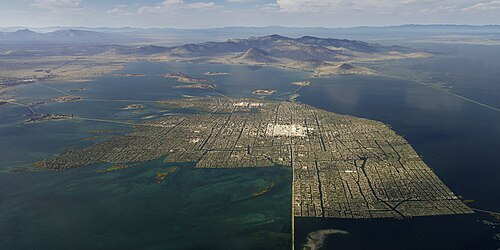
Long ago, in the middle of a big lake in the highlands of Mexico, there was a city built on islands. People travelled through it in canoes along canals, like streets made of water. Three long raised roads, called causeways, crossed the lake to connect the city to the shore.
The people who built it called themselves the Mexica; today we often call them the Aztecs. Their story says their god told them to wander until they saw an eagle standing on a cactus growing from a rock. When they saw it on a small island in the lake, they started their city there. You can still see the eagle and cactus on the flag of Mexico.
The Mexica grew food on clever farm plots called chinampas, which they made by piling mud from the lake bottom into long fields between canals. A stone-and-clay pipe brought fresh drinking water from springs on a hill. In the middle of the city stood a huge pyramid with two temples on top, one for the god of war and the sun and one for the god of rain.
About 200,000 people may have lived there, more than in almost any city in Europe at that time. Its great market was so busy that Spanish visitors said they had never seen anything like it.
In 1519 Spanish soldiers led by Hernán Cortés arrived. Together with many thousands of Indigenous warriors who were enemies of the Mexica, and helped by a terrible disease called smallpox, they besieged the city and destroyed it in 1521. The Spanish built Mexico City on top of the ruins, and today archaeologists are still finding pieces of Tenochtitlan under its streets.
At a glance
- Founded
- Traditionally 1325, the year 2 House (Ome Calli) in most Nahua and Spanish sources
- Fell
- 13 August 1521, after a siege of about 80 days
- Place
- Islands in western Lake Texcoco, Valley of Mexico; today the historic centre of Mexico City
- People
- The Mexica, a Nahuatl-speaking people; leading power of the Triple Alliance (“Aztec Empire”) from 1428
- Size
- Roughly 8–13.5 km² with its twin city Tlatelolco; population often estimated at around 200,000 (estimates vary widely)
- Key monument
- The Templo Mayor, a twin pyramid-temple for Huitzilopochtli and Tlaloc, rebuilt in seven major stages
- Status
- Part of the UNESCO World Heritage Site “Historic Centre of Mexico City and Xochimilco” (1987)
Easy
What was Tenochtitlan?
Tenochtitlan was the capital city of the Mexica, a people who spoke Nahuatl and who, in the fifteenth and early sixteenth centuries, led the most powerful state in Mesoamerica. The city lay on a group of islands near the western shore of Lake Texcoco, part of a system of shallow, interconnected lakes that then filled the floor of the Valley of Mexico at about 2,240 m above sea level. Its full name, Mēxihco Tenōchtitlan, gave its name to Mexico City and to the country of Mexico.
At its height in 1519, Tenochtitlan and its twin city Tlatelolco, on an adjoining island to the north, formed one of the largest cities in the world. Estimates of its population vary widely, but many historians suggest something in the region of 200,000 people, a size matched in Europe at that time only by a handful of cities such as Paris, Naples and Constantinople.
The city was destroyed in a long siege in 1521 by Spanish conquistadors and their much larger Indigenous allied armies. The Spanish then built the capital of New Spain directly on its ruins. For centuries Tenochtitlan was known mainly from texts and pictures; since the 1970s archaeology beneath the streets of Mexico City has revealed its central temple and many other buildings.
Easy
An eagle on a cactus: the founding story
According to Mexica tradition, their ancestors left a homeland called Aztlan, somewhere to the north, and migrated for generations, guided by their patron god Huitzilopochtli. When they reached the crowded Valley of Mexico, the best land was already held by older city-states. The Mexica lived for a time near Chapultepec and then as subjects of the city of Culhuacan, before they were driven into the marshes of the lake.
There, the story says, they saw the sign Huitzilopochtli had promised: an eagle perched on a prickly-pear cactus (nōchtli) growing from a rock. On that spot they founded their city. The name Tenochtitlan is usually explained as “place of the prickly pear cactus on the rock”; it has also been linked to Tenoch, a leader of the Mexica at the time of the founding. The image of the eagle on the cactus appears on the frontispiece of the sixteenth-century Codex Mendoza and on the national flag of modern Mexico.
Most Nahua and Spanish sources that give a founding date name the year 2 House (Ome Calli), equivalent to 1325, without specifying a day. In 2021 the Mexican government held commemorations for a “700th anniversary” based on a date of 1321, which historians and INAH anthropologists criticized as lacking support in the sources or in archaeology. Archaeology cannot pin down the exact year, and the islands may have been occupied before the traditional date. What is clear is that the Mexica began as a small, marginal group on unpromising land and turned it into the centre of an empire within about 150 years.
Easy
A city on the water: how to “read” its plan
The city was carefully planned around a centre. In the middle lay a walled sacred precinct containing dozens of temples, schools, ball courts and other ritual buildings; the Franciscan friar Bernardino de Sahagún’s Nahua informants listed 78 structures in and around it. From the precinct, the city was divided into four great quarters, known in Nahuatl as Moyotlan, Teopan (Zoquiapan), Atzacoalco and Cuepopan. Each quarter was made up of neighbourhoods called calpolli, with their own temples, local leaders and communal land.
Three main causeways linked the island to the mainland: to Tepeyac in the north, to Iztapalapa in the south and to Tlacopan in the west. The causeways had gaps crossed by removable wooden bridges, which let canoes pass and allowed the city to be defended. A network of canals, some alongside earthen streets, carried most of the traffic; tens of thousands of canoes moved people, food, building materials and even waste.
Water was a constant challenge. The waters of Lake Texcoco were salty, so fresh drinking water came from springs at Chapultepec along a stone-and-mortar aqueduct built in the fifteenth century; it had two channels so that one could be cleaned while the other was in use. After a disastrous flood in the mid-fifteenth century, a long dike, attributed to the ruler-poet Nezahualcoyotl of Texcoco, was built across the lake to hold back floods and to separate the fresher water around the city from the saltier water to the east.
The market of Tlatelolco astonished the Spanish. Hernán Cortés wrote that some 60,000 people came each day; later estimates are lower but still very large. Goods were arranged by type, from maize, beans and chillies to cotton cloth, feathers, obsidian blades, gold and enslaved people, and judges settled disputes on the spot. Cacao beans and lengths of cotton cloth served as forms of currency.
Easy
Feeding a great city: chinampas and tribute
Much of the valley’s food came from chinampas: long, narrow fields built up in shallow lake water by piling layers of mud and vegetation within frameworks of stakes, and anchored by planting willow trees along their edges. Canals between the plots supplied water and fertile mud, and allowed canoes to carry harvests to the city. Chinampas could produce several crops a year of maize, beans, squash, chillies, amaranth and flowers.
The largest chinampa zones were in the freshwater southern lakes, around Xochimilco and Chalco, where some chinampas are still farmed today. Within Tenochtitlan itself, many households had small chinampa gardens as well.
Tenochtitlan also lived on tribute. Conquered provinces sent regular payments of maize, beans, cotton cloth, warriors’ costumes, cacao, feathers, gold, jade and other goods. The Codex Mendoza, painted by Indigenous artists for the Spanish administration around 1541, lists tribute owed by dozens of provinces, and is one of the key sources for understanding how the city’s wealth was gathered.
Intermediate
The Templo Mayor: a mountain at the centre of the world
At the heart of the sacred precinct stood the Huei Teocalli, now called the Templo Mayor (“Great Temple”). It was a stepped pyramid about 100 by 80 m at its base, with two staircases leading to two shrines at the top. The southern shrine honoured Huitzilopochtli, god of the sun and war and patron of the Mexica; the northern honoured Tlaloc, god of rain and agricultural fertility. War and tribute on one side, water and maize on the other: the two shrines expressed the twin foundations of Mexica life.
The temple also represented sacred mountains. Huitzilopochtli’s side stood for Coatepec (“serpent hill”), where, in Mexica myth, the newborn god defeated his sister Coyolxauhqui and her brothers, dismembering her and throwing her body down the hill. At the foot of his staircase lay a great stone disc showing Coyolxauhqui’s broken body. Tlaloc’s side evoked the rain-bringing mountains of the valley.
The temple was enlarged at least seven times, each new structure encasing the old one like layers of an onion, usually under new rulers. The most famous enlargement was dedicated in 1487 under the ruler Ahuitzotl, with ceremonies that included large-scale human sacrifice. Spanish and later colonial sources give huge figures for the victims, which modern historians regard as exaggerated, but archaeology confirms that sacrifice was central to Mexica state religion.
In Mexica thought, the gods had sacrificed themselves to set the sun in motion, and human beings owed them nourishment in return. Sacrificial victims were most often war captives, and their skulls were displayed on a great skull rack (huei tzompantli). Since 2015 archaeologists of Mexico’s National Institute of Anthropology and History (INAH) have excavated remains of this rack and associated towers of skulls, which include men, women and children.
Intermediate
From tributary to empire: the Triple Alliance
For its first century, Tenochtitlan was a subordinate city, paying tribute to and fighting for the powerful Tepanec kingdom centred at Azcapotzalco. In the 1370s the Mexica established a royal dynasty, beginning with the ruler (tlatoani) Acamapichtli, who claimed descent from the prestigious rulers of Culhuacan. In 1428, under Itzcoatl, Tenochtitlan joined with Texcoco, led by Nezahualcoyotl, and with Tlacopan to overthrow Azcapotzalco. This coalition is known as the Triple Alliance, and its dominion is what later writers called the Aztec Empire.
Under rulers such as Moctezuma I (Motecuhzoma Ilhuicamina), Axayacatl and Ahuitzotl, the alliance extended its power across central and southern Mexico, from the Gulf coast to the Pacific and as far as the border of Guatemala. In 1473 Tenochtitlan conquered its neighbour Tlatelolco and absorbed it. Tenochtitlan gradually became the dominant partner in the alliance.
The empire was not a territorial state with a centralized bureaucracy in every province. Most conquered city-states kept their own rulers so long as they paid tribute and recognized Mexica supremacy. Some powerful neighbours, above all Tlaxcala to the east, were never conquered; the Mexica fought ritualized “flower wars” (xochiyaoyotl) with them, which supplied captives for sacrifice. This patchwork of tributaries and enemies helps explain why so many Indigenous peoples later joined the Spanish against Tenochtitlan.
Tenochtitlan was also a centre of learning and art. Nobles’ sons trained in schools called calmecac, commoners’ sons in the telpochcalli; specialist craftspeople produced featherwork, goldwork and stone sculpture of great refinement; and poets composed songs that were later written down in collections such as the Cantares mexicanos. The Sun Stone, often wrongly called the “Aztec calendar”, and the colossal statue of Coatlicue are masterpieces of Mexica sculpture.
Intermediate
The fall of Tenochtitlan, 1519–1521
In 1519 Hernán Cortés landed on the Gulf coast with several hundred Spanish soldiers. Through the Nahua woman Malintzin (known to the Spanish as Doña Marina and later as La Malinche) and a Spaniard who spoke Maya, he could communicate with local peoples. He won allies among the Totonacs and, after fierce fighting, among the Tlaxcalans, the Mexica’s bitter enemies. On 8 November 1519 the Spanish and their allies entered Tenochtitlan, where the ruler Moctezuma II (Motecuhzoma Xocoyotzin) received them.
Within days the Spanish took Moctezuma captive in his own city. In May 1520, while Cortés was away, his lieutenant Pedro de Alvarado attacked unarmed nobles celebrating the festival of Toxcatl in the sacred precinct, killing many of them. The city rose in revolt. Moctezuma died in Spanish custody at the end of June; Spanish accounts say he was killed by stones thrown by his own people, while several Indigenous accounts say the Spanish killed him. On the night of 30 June to 1 July 1520, the Spanish tried to escape along the Tlacopan causeway and lost many men and much of their gold, a disaster they called La Noche Triste (“the Sad Night”).
Then an epidemic of smallpox, a disease new to the Americas, swept through the valley in late 1520, killing large numbers of people, including Moctezuma’s successor Cuitláhuac. Regrouping in Tlaxcala, Cortés built thirteen brigantines (small sailing ships) to control the lake and gathered tens of thousands of Indigenous allies from Tlaxcala, Texcoco, Huexotzinco, Chalco and other communities. The siege began in late May 1521. The attackers cut the aqueduct from Chapultepec, blockaded the causeways and fought street by street, demolishing buildings as they advanced.
The defenders, led by the young ruler Cuauhtémoc, resisted for about eighty days amid starvation, thirst and disease. The final resistance took place in Tlatelolco. On 13 August 1521 Cuauhtémoc was captured while trying to escape by canoe, and the city fell. Many tens of thousands of people died during the siege; estimates for Indigenous deaths range from about 100,000 to more than 200,000. Nahua accounts written down later describe the dead in the streets and the grief of the survivors.
Intermediate
Mexico City on top of Tenochtitlan
After the conquest, Cortés decided to build the Spanish capital on the ruins, making use of the city’s symbolic power. The sacred precinct was levelled; its stones were reused in churches and houses, and the main plaza (today the Zócalo) and the Metropolitan Cathedral were laid out over part of it. Indigenous residents were concentrated in separate districts, but Indigenous labour built the new city, and Nahuatl-speaking communities and their governments continued to function there for centuries.
The lake itself gradually disappeared. After repeated floods, colonial authorities began a drainage project in 1607 to channel water out of the valley, a project continued after Mexican independence. Over the following centuries the lakes were largely drained. Today Mexico City sits on soft former lakebed, which contributes to its sinking and to its vulnerability to earthquakes; the remaining canals and chinampas of Xochimilco are a surviving fragment of the old lake landscape.
Tenochtitlan never vanished from memory. In 1790 workers repaving the main plaza found the Sun Stone and the statue of Coatlicue. In 1978 electricity workers digging near the cathedral struck the great Coyolxauhqui disc, leading to the Templo Mayor Project directed by the archaeologist Eduardo Matos Moctezuma. Excavations since then have uncovered the temple’s successive stages, thousands of offerings and, in 2006, the huge monolith of the earth deity Tlaltecuhtli. The Templo Mayor Museum opened in 1987, the same year that UNESCO inscribed the Historic Centre of Mexico City on the World Heritage List.
Intermediate
Remembering the conquest: many perspectives
For a long time the story of Tenochtitlan’s fall was told mainly from the viewpoint of the conquerors: Cortés’s own letters to Charles V, the memoir of the soldier Bernal Díaz del Castillo, and the Spanish chronicles. In this version a few hundred brave Spaniards overthrew a mighty empire. Modern historians emphasize instead that the war was fought mainly by Indigenous armies, that Tlaxcalans and others had their own reasons for joining it, and that disease played a decisive role.
Indigenous perspectives survive in Nahuatl texts and pictorial manuscripts. In 1959 the Mexican historian Miguel León-Portilla published Visión de los vencidos (in English, The Broken Spears), an anthology of Nahua accounts that brought the “vision of the vanquished” to a wide public. Tlaxcalan documents, by contrast, present their people as loyal allies of the Spanish Crown who deserved privileges. There was never a single Indigenous view of the conquest.
In modern Mexico, Tenochtitlan is a founding symbol of the nation, and the Mexica past is central to national identity. The conquest remains politically sensitive: in 2019 Mexico’s president asked Spain and the Vatican to apologize for abuses committed during the conquest, a request that Spain’s government rejected. In 2021 Mexico marked 500 years since the fall of the city with commemorations that emphasized Indigenous resistance.
Advanced
Scholarly debates: myths, numbers and names
Did the Mexica think Cortés was a god? A famous story holds that Moctezuma believed Cortés to be the returning god Quetzalcoatl. Many historians, including Matthew Restall and Camilla Townsend, argue that this idea appears only in sources written decades after the conquest and was shaped by Spanish and post-conquest Indigenous concerns. Similarly, the claim that Moctezuma “surrendered” his empire, found in Cortés’s letters, is widely regarded as a legal and political fiction designed to justify Cortés’s actions to the Spanish king.
How many people lived there, and how many died? Population estimates for the city range from about 60,000 to more than 300,000, depending on assumptions about household size, the area of dense settlement and the reliability of Spanish reports. Estimates for the population of central Mexico before contact vary even more, and the scale of the demographic collapse caused by epidemics in the sixteenth century remains debated, although all agree that it was catastrophic.
How big was human sacrifice? Some twentieth-century writers doubted Spanish accounts of mass sacrifice as colonial propaganda; others accepted enormous figures. Archaeological finds at the Templo Mayor and the huei tzompantli have confirmed that sacrifice was real and extensive, while the precise numbers given in chronicles are not reliable. Scholars now try to interpret sacrifice within Mexica cosmology and politics rather than simply as evidence of cruelty or of Spanish bias.
“Aztec” or “Mexica”? The Mexica did not call themselves Aztecs; the term, derived from Aztlan, was popularized by eighteenth- and nineteenth-century writers. Many scholars now prefer “Mexica” for the people of Tenochtitlan and “Triple Alliance” for the empire, reserving “Aztec” for general use.
Advanced
Evidence and methods
Spanish sources include Cortés’s letters (Cartas de relación, written 1519–1526), which are vivid but self-serving; the True History of the Conquest of New Spain by Bernal Díaz del Castillo, written decades later by a veteran; and chronicles by writers who never saw the city. All describe Tenochtitlan in terms of European comparisons, and all served particular interests.
Indigenous and mixed sources are equally essential. The Florentine Codex, compiled between the 1540s and 1570s under Sahagún with Nahua scholars and elders, contains, in Nahuatl with Spanish translation and hundreds of images, an encyclopaedic description of Mexica society, and its Book 12 gives a Nahua account of the conquest from the viewpoint of Tlatelolco. The Codex Mendoza (c. 1541) records the history of Tenochtitlan’s rulers, tribute and daily life. Annals written in Nahuatl in the Roman alphabet, such as the Annals of Tlatelolco, and the works of later Indigenous and mestizo historians like Chimalpahin and Fernando de Alva Ixtlilxóchitl, preserve local traditions. These sources were all produced after the conquest, under colonial conditions, and must be read with attention to who wrote them and why.
Archaeology provides independent evidence. Because the ancient city lies beneath one of the world’s largest modern cities, excavation is possible mainly during construction work, in the Templo Mayor zone and through INAH’s urban archaeology programme. Stratigraphy of the temple’s successive stages, analysis of offerings, human remains and isotopes, and studies of the lake’s environmental history continue to transform our understanding of the city.
Key ideas
- City on a lake
- Tenochtitlan was built on islands linked by causeways and canals, supported by aqueducts, dikes and chinampa fields.
- Chinampa
- A raised field built in shallow lake water, highly productive and still farmed at Xochimilco.
- Triple Alliance
- The coalition of Tenochtitlan, Texcoco and Tlacopan formed in 1428, commonly called the Aztec Empire.
- Tribute empire
- Conquered city-states kept their rulers but sent goods to Tenochtitlan, as recorded in the Codex Mendoza.
- Templo Mayor
- The twin temple of Huitzilopochtli and Tlaloc, representing sacred mountains at the centre of the Mexica world.
- Conquest as an Indigenous war
- The fall of the city was achieved mainly by Indigenous armies allied with a few Spaniards, amid a smallpox epidemic.
- Vision of the vanquished
- Nahua texts preserve Indigenous perspectives on the conquest, balancing Spanish accounts.
- Layered city
- Mexico City sits directly on Tenochtitlan, so modern construction and archaeology are closely linked.
Records
- c. 1325 — Traditional date for the founding of Tenochtitlan on an island in Lake Texcoco.
- c. 1337 — Traditional date for the founding of Tlatelolco on a neighbouring island.
- 1428 — Tenochtitlan, Texcoco and Tlacopan defeat Azcapotzalco and form the Triple Alliance.
- 1473 — Tenochtitlan conquers and absorbs Tlatelolco.
- 1487 — A major enlargement of the Templo Mayor is dedicated under Ahuitzotl.
- 1502 — Moctezuma II becomes ruler of Tenochtitlan.
- 1519 — On 8 November, Hernán Cortés and his Indigenous allies enter the city.
- 1520 — The Toxcatl massacre (May), the death of Moctezuma and La Noche Triste (30 June–1 July); smallpox spreads in the autumn.
- 1521 — After a siege of about 80 days, the city falls on 13 August and Cuauhtémoc is captured.
- 1790 — The Sun Stone and the statue of Coatlicue are found beneath the main plaza of Mexico City.
- 1978 — Workers discover the Coyolxauhqui stone, beginning the Templo Mayor Project.
- 1987 — The Templo Mayor Museum opens; the Historic Centre of Mexico City and Xochimilco becomes a World Heritage Site.
Glossary
- Mexica
- The Nahuatl-speaking people who founded Tenochtitlan, often called Aztecs.
- Nahuatl
- The language of the Mexica and many other peoples of central Mexico, still spoken by over a million people.
- Tlatoani
- “Speaker”; the ruler of a Nahua city-state. The ruler of Tenochtitlan was the huey tlatoani, “great speaker”.
- Calpolli
- A neighbourhood or kin-based community with its own temple, leaders and land.
- Chinampa
- A raised agricultural field built in shallow lake water.
- Causeway
- A raised road across water or marshland.
- Tzompantli
- A rack for displaying the skulls of sacrificial victims.
- Codex
- A manuscript book; in Mesoamerica, often painted in pictographic writing on bark paper or deerskin.
- Mesoamerica
- The cultural region of central and southern Mexico and Central America that shared traits such as maize farming, ball games and calendars.
- Brigantine
- A small sailing and rowing vessel; Cortés built thirteen to fight on Lake Texcoco.
Questions and answers
Why did the Mexica build their city in a lake?
Their tradition says their god showed them the eagle on the cactus there. In practice, the better land was already taken, and the lake offered protection, fish, birds and fertile mud for farming.
How did people get around?
Mostly by canoe along canals, and on foot along streets and three causeways that connected the island to the shore.
Is Tenochtitlan the same place as Mexico City?
Yes. The Spanish built Mexico City on top of Tenochtitlan, and the Zócalo and cathedral stand over part of its sacred precinct.
How could a few hundred Spaniards defeat such a large city?
They didn’t do it alone. Tens of thousands of Indigenous allies, especially Tlaxcalans, fought the Mexica, and a smallpox epidemic killed many defenders and leaders.
Did the Aztecs really believe Cortés was the god Quetzalcoatl?
Probably not. Many historians think this story was created after the conquest; it does not appear in the earliest sources.
What do we actually know about human sacrifice there?
Archaeology at the Templo Mayor and the great skull rack confirms that it was real and large-scale, but the numbers given by chroniclers are unreliable.
Where did the lake go?
From 1607 onward colonial and later Mexican authorities drained the lakes to prevent flooding; only small remnants such as Xochimilco survive.
Sources and further reading
- Historic Centre of Mexico City and Xochimilco. UNESCO World Heritage Centre
- Tenochtitlan. Wikipedia
- Templo Mayor. Wikipedia
- Fall of Tenochtitlan. Wikipedia
- Florentine Codex. Wikipedia
- Codex Mendoza. Wikipedia
- Aztec Triple Alliance. Wikipedia
- Chinampa. Wikipedia
- Camilla Townsend, Fifth Sun: A New History of the Aztecs. Oxford University Press, 2019
- Matthew Restall, When Montezuma Met Cortés: The True Story of the Meeting that Changed History. Ecco, 2018
Related
- TeotihuacanA major ancient city in central Mexico, known for its monumental avenues, pyramids and extensive residential compounds.
- Chichén ItzáA major Maya city on the Yucatán Peninsula, with monuments built and used across several centuries.
- Olmec Colossal HeadsMonumental basalt heads made by Olmec communities on Mexico's Gulf Coast, probably depicting rulers.
- Columbus's First VoyageChristopher Columbus's 1492 Atlantic voyage for the Spanish Crown reached islands inhabited by Indigenous peoples.
- Machu PicchuInca settlement in the Andes, probably established in the fifteenth century.
- Popol VuhK'iche' Maya narrative of origins, divine figures and ancestral history.
Written with AI assistance from the published sources listed above, and revised as new research appears.