Start at the top for an easy introduction. Go further down for more detail and scholarship.
- Easy
- Intermediate
- Advanced
For young readers
Almost 600 years ago, people in Korea spoke Korean, but they wrote with Chinese characters. Chinese characters were made for a different language, and there are thousands of them. Only people with many years of study could read and write. Most farmers, craftspeople and women never had the chance to learn.
King Sejong, a ruler of the Joseon kingdom, felt sorry that ordinary people could not write down what they wanted to say. So he and his scholars made a brand-new set of letters just for the Korean language. There were only 28 letters, and they were easy to learn.
The letters are very clever. The consonants are drawn to look like the parts of your mouth when you say them. The letter ㄱ shows the back of the tongue lifting up, and ㅁ looks like the shape of your closed lips. The vowels are made from a dot for the sky, a flat line for the earth, and a standing line for a person.
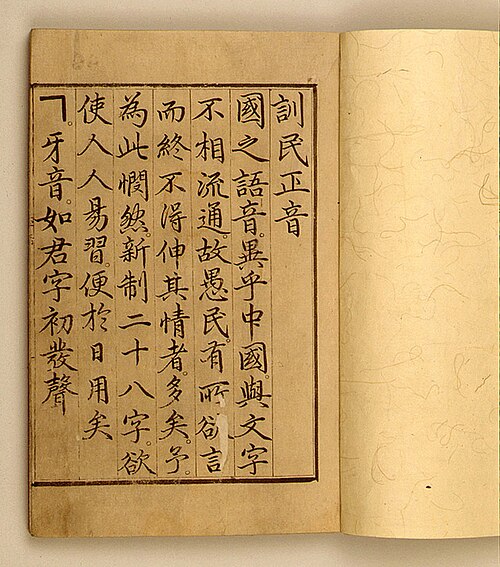
In 1446 the king published a book explaining the new letters. It was called Hunminjeongeum, which means “the correct sounds for teaching the people”. One of the scholars wrote that a clever person could learn the letters in one morning, and even a slow learner in ten days.
Today we call these letters Hangeul. Korean children learn them quickly, and Korea celebrates Hangeul Day every year on 9 October. One of the very first copies of the 1446 book still survives and is one of Korea’s greatest treasures.
At a glance
- Created
- Announced in the 12th lunar month of 1443 (late 1443 or early 1444 in the Western calendar)
- Published
- Explanatory book (Haerye edition) completed in the 9th lunar month of 1446
- Place
- Hanseong (modern Seoul), capital of the Joseon kingdom
- Creator
- King Sejong (r. 1418–1450); the commentary was written by eight scholars led by Jeong In-ji
- Letters
- 28 original letters: 17 consonants and 11 vowels (24 are in standard use today)
- Type of script
- An alphabet whose shapes reflect how sounds are made; letters are grouped into syllable blocks
- Surviving copy
- Haerye edition in the Kansong Art Museum, Seoul; National Treasure (1962); UNESCO Memory of the World (1997)
- Modern name
- Hangeul (South Korea), Chosŏn’gŭl (North Korea)
Easy
What is Hunminjeongeum?
The word Hunminjeongeum (訓民正音) means “the correct sounds for the instruction of the people”. It has two meanings. First, it is the original name of the Korean alphabet, which King Sejong of the Joseon dynasty presented to his court at the end of 1443. Second, it is the title of the book, completed in 1446, that announced and explained the new letters.
The book exists in two main forms. The Haerye edition (“edition with explanations and examples”) of 1446 contains the king’s own short preface and rules, followed by a detailed commentary written by his scholars. A shorter Eonhae edition (“vernacular translation”) translated the king’s part into Korean using the new letters; its best-known copy was printed in 1459 at the front of the Buddhist book Worin seokbo.
The alphabet created in 1443 became the basis of Hangeul, the script that Koreans use today. That is why the story of Hunminjeongeum is both the story of a book and the story of one of the most carefully designed writing systems in the world.
Easy
Why did King Sejong make new letters?
Before 1443 Koreans wrote in Classical Chinese, the shared written language of East Asia. To write Korean words and grammar, clerks used systems such as idu, which borrowed Chinese characters for their sound or meaning. These systems were clumsy and still required knowing many characters. Reading and writing were therefore mostly limited to the yangban, the educated elite.
King Sejong explained his reason in a famous preface of only 54 Chinese characters. In our own translation, it says: “The sounds of our country’s speech differ from those of China and do not fit Chinese characters. So among the ignorant people there are many who have something to say but in the end cannot express their feelings. Pitying this, I have newly made twenty-eight letters, wishing only that everyone may learn them easily and use them conveniently every day.”
Historians also point to practical and political aims. The king wanted to spread Confucian moral teaching, help ordinary people understand laws and court cases, and fix the correct Korean pronunciation of Chinese characters. These goals were not in conflict: a script everyone could read would serve both the people and the state.
Easy
How the letters were designed
The consonants start from five basic shapes that picture the speech organs. ㄱ (g/k) shows the back of the tongue blocking the throat; ㄴ (n) shows the tip of the tongue touching the ridge behind the upper teeth; ㅁ (m) shows the mouth; ㅅ (s) shows a tooth; and ㅇ shows the round throat. Other consonants were made by adding strokes to show a stronger or breathier sound: from ㄱ comes ㅋ, from ㄴ come ㄷ and ㅌ, from ㅁ come ㅂ and ㅍ, and so on. A few letters, such as ㄹ, were formed differently.
The vowels start from three symbols with cosmic meaning: a round dot (ㆍ) for heaven, a flat line (ㅡ) for earth, and an upright line (ㅣ) for humankind. Combining the dot with the lines produces the other vowels, such as ㅗ, ㅏ, ㅜ and ㅓ.
Letters are not written in one long row as in English. They are grouped into syllable blocks: an initial consonant, a vowel and sometimes a final consonant, stacked into a square, like 한 (h + a + n). Final consonants do not need separate letters; the book says the initial consonants are reused as finals. This block shape lets Hangeul sit comfortably beside Chinese characters on the same page.
The original system also marked pitch with dots beside each syllable, and it included four letters that are no longer used: ㆍ, ㅿ, ㆁ and ㆆ. These changes reflect how the Korean language itself has changed since the fifteenth century.
Intermediate
Inside the 1446 book
The Haerye edition is a woodblock-printed book of 33 leaves. It opens with the king’s part, called Yeui (“examples and meanings”): the preface and short rules giving the sound of each letter, usually by comparing it with a Chinese character, and explaining how letters combine.
The larger second part, the Haerye (“explanations and examples”), was written by eight scholars of the Hall of Worthies (Jiphyeonjeon): Jeong In-ji, Choe Hang, Bak Paeng-nyeon, Sin Suk-ju, Seong Sam-mun, Gang Hui-an, Yi Gae and Yi Seon-ro. It has six sections: the principles of letter design (Jejahae), explanations of initial, medial and final sounds, the combining of letters (Hapjahae), and a list of example words (Yongjarye). It ends with a postface by Jeong In-ji.
In that postface Jeong In-ji wrote, in our own translation, that “a wise man can master them before the morning is over, and even a foolish one can learn them within ten days.” The postface is dated to the first ten days of the ninth lunar month of 1446. When this date was converted to the solar calendar, it became the basis for Hangeul Day, 9 October, in South Korea.
What makes the book remarkable is not only the alphabet itself but the fact that its creators explained, in writing, the theory behind each letter. Very few writing systems anywhere have a surviving document from the time of their creation that sets out their design principles.
Intermediate
Phonology and philosophy behind the design
Sejong’s scholars were experts in Chinese phonology, the traditional science of classifying the sounds of Chinese characters. They classified consonants by where they are made in the mouth (molar, tongue, lip, tooth, throat) and by their manner (clear, aspirated, voiced, and so on). This framework allowed them to build a consonant system in which related sounds have related shapes.
The commentary also places the letters within Neo-Confucian cosmology. The five places of articulation correspond to the Five Phases (wood, fire, earth, metal, water), the seasons and directions; the three basic vowels represent heaven, earth and humankind, the three powers of the cosmos; and vowels are divided into “yang” and “yin” groups, which reflects the vowel harmony of Middle Korean. For the scholars, a script that matched the patterns of nature was a correct script.
Modern linguists especially admire the fact that the shapes of the letters encode phonetic features, such as the added stroke for aspiration. The linguist Geoffrey Sampson described Hangeul as a “featural” writing system for this reason. Some modern scholars add that the philosophical explanations of the vowels may partly be a justification added after the design, rather than its starting point.
Intermediate
Opposition at court and the first books in the new script
The new letters were not welcomed by everyone. In the second lunar month of 1444, a group of scholars led by Choe Man-ri, deputy head of the Hall of Worthies, submitted a memorial against them. They argued that serving China meant using Chinese writing, that only peoples such as the Mongols, Jurchens and Japanese had their own scripts, that an easy script would discourage serious study, and that existing methods like idu were sufficient. Sejong rebuked them and briefly detained them.
Sejong then used the script in important projects. Yongbieocheonga (Songs of the Dragons Flying to Heaven), a cycle of songs praising the founders of the dynasty, was compiled in 1445 and printed in 1447. Seokbo sangjeol, a biography of the Buddha, and Worin cheongang jigok, songs about the Buddha written by Sejong himself, appeared in the late 1440s. Dongguk jeong-un (1448) used the letters to prescribe standard Korean readings of Chinese characters.
These first texts show that the script was used from the start for royal legitimacy, Buddhism and Confucian learning, not only for “the ignorant people” mentioned in the preface.
Intermediate
From eonmun to Hangeul: five centuries of use
For most of the Joseon period, official documents and serious scholarship remained in Classical Chinese. The new script was often called eonmun (“vernacular writing”) or, by some, amgeul (“women’s writing”), names that reflected its lower status. Yet it spread widely among women, Buddhist monks, and commoners. It was used for letters, poetry such as sijo and gasa, novels, translations of Confucian and Buddhist classics, and royal proclamations meant for the people.
Letters written in the Korean script offer a rare window onto the lives of people who otherwise left few records. Surviving letters from the sixteenth and seventeenth centuries include messages between husbands and wives, mothers and children, and even a letter found in a sixteenth-century tomb in Andong in which a widow mourns her husband. Queens and royal women also used the script for political letters and memoirs, such as the Hanjungnok of Lady Hyegyeong in the late eighteenth century.
There were setbacks. In 1504 King Yeonsangun, angered by anonymous posters written in the script that criticised him, banned its teaching and use, although the ban did not last beyond his reign. The script survived because it was simply useful.
In the late nineteenth century, reformers promoted it as a symbol of national modernisation. The Gabo Reform of 1894 declared that laws and decrees should be written in the Korean script. The linguist Ju Si-gyeong popularised the name Hangeul, meaning “great script” or “Korean script”, around 1912.
Under Japanese colonial rule (1910–1945), Korean language education was increasingly restricted. The Korean Language Society published the Unified Hangeul Orthography in 1933 and worked on a dictionary; in 1942 many of its members were arrested in what is known as the Korean Language Society Incident. After liberation Hangeul became the main script of both Koreas; North Korea calls it Chosŏn’gŭl.
Intermediate
The rediscovery of the Haerye edition
For centuries the Haerye edition was thought to be lost. Scholars knew only the king’s part and its vernacular translation, and so the design principles were a matter of guesswork; some even speculated that the letters imitated lattice windows. Then, in 1940, a copy surfaced in Andong in North Gyeongsang Province. The collector Jeon Hyeong-pil (known as Gansong) bought it, reportedly for a very large sum, and kept it hidden during the colonial period and the Korean War.
The copy was missing its first two leaves, which were restored by hand soon after its discovery; scholars have pointed out errors in these restored pages. Its earlier ownership history in Andong is also disputed. The Kansong copy was designated a National Treasure in 1962 and inscribed on UNESCO’s Memory of the World Register in 1997.
In 2008 a second, incomplete copy, called the Sangju copy, was announced by an antiques dealer. Courts, most recently the Supreme Court in 2019, ruled that it belongs to the state, but its holder has not handed it over, and it was reportedly damaged in a house fire in 2015. Its present condition is not publicly known.
Advanced
Scholarly debates: who made it, and from what?
Who created the letters? The Annals of King Sejong say that in the 12th month of 1443 “the king personally created” 28 letters, and Jeong In-ji’s postface credits Sejong alone. Some scholars have argued that the Hall of Worthies scholars must have done much of the work; others point out that the Annals record no preparatory work by them and that Choe Man-ri, deputy head of that institution, opposed the project, which suggests a small circle around the king and his family. Most scholars today accept that Sejong was deeply and personally involved, while the exact division of labour remains unclear. Popular claims crediting a particular monk or royal relative lack firm documentary support.
What models were used? The Annals and Choe Man-ri’s memorial both say that the letters “imitate the ancient seal script” (字倣古篆). Scholars disagree about what this means: it may refer to the square, geometric style of the letters, to seal-script shapes, or to the Mongol ’Phags-pa script, which Choe’s memorial may be hinting at. Gari Ledyard argued that a few basic consonant shapes were adapted from ’Phags-pa, which Korean scholars knew from Yuan-era rhyme books, while the system as a whole was original. Other scholars reject any borrowing and emphasise the articulatory explanation in the Haerye. Theories deriving Hangeul from Indian scripts or from supposed ancient Korean scripts have little evidential basis.
What was the purpose? Some historians emphasise the humanitarian aim stated in the preface; others emphasise statecraft, such as standardising the pronunciation of Chinese characters (a goal evident in Dongguk jeong-un) and spreading Confucian morality. These readings are not mutually exclusive, and much current work tries to combine them.
Advanced
Evidence and methods
The key documents are the Annals of King Sejong (Sejong sillok), which record the creation, Choe Man-ri’s memorial and the completion of the book; the Haerye edition itself; and the first books printed in the script. Because the Annals were compiled after Sejong’s death from court records, they present the official view and say little about the working process.
Linguists reconstruct fifteenth-century Korean by comparing the spellings in these early texts with later Korean and with Sino-Korean readings of Chinese characters. The pitch marks, obsolete letters and spelling conventions of the 1440s–60s are therefore a precious record of Middle Korean, the language of the time.
The Haerye edition raises its own textual problems. Its first two leaves are later restorations, so scholars must be careful when quoting the opening of the preface from the Kansong copy and compare it with the Annals and the Eonhae edition. Debates about the exact date behind Hangeul Day also depend on how one converts lunar dates to the Western calendar.
Intermediate
Legacy
Hangeul is now the everyday script of about 80 million people in the two Koreas and the Korean diaspora. Its simplicity is a major reason why literacy in South Korea is almost universal and why learners of Korean around the world can usually read it within days.
Hunminjeongeum is also a symbol of Korean identity. Hangeul Day (9 October) is a public holiday in South Korea, and North Korea marks its own Chosŏn’gŭl Day on 15 January, based on the 1443/1444 creation date. UNESCO has awarded the King Sejong Literacy Prize since 1989 to organisations working for literacy. Linguists worldwide study the script as a rare example of a writing system consciously designed on phonetic principles.
The same features that made the script easy to learn in the fifteenth century have made it well suited to modern technology. Because every syllable is built from a small set of letters, Korean can be typed quickly on a standard keyboard or a phone keypad, and Unicode includes both the individual letters and more than 11,000 precomposed syllable blocks. The design choices of 1443 thus continue to shape how Koreans read and write on screens today.
Key ideas
- Correct sounds for the people
- The title states the goal: a script that ordinary people could learn easily to write their own language.
- Shapes of the speech organs
- The five basic consonants picture the tongue, lips, teeth and throat as the sound is made.
- Adding strokes
- Stronger or aspirated sounds are written by adding strokes to a basic letter, so similar sounds look similar.
- Heaven, earth and humankind
- The basic vowels are a dot, a horizontal line and a vertical line, representing the three powers of the cosmos.
- Syllable blocks
- Letters are combined into square blocks of initial, medial and final sounds.
- A script with a manual
- The 1446 book records the design principles of the letters at the time they were made, which is extremely rare.
- Language and state
- The script served both ordinary people and royal aims such as moral teaching and standard pronunciation.
Records
- 1418 — Sejong becomes king of Joseon.
- 1443 — In the 12th lunar month, the Annals record that Sejong has created 28 letters.
- 1444 — Choe Man-ri and others submit a memorial opposing the new script.
- 1446 — The Hunminjeongeum Haerye edition is completed in the 9th lunar month.
- 1447 — Yongbieocheonga, the first major work in the new script, is printed.
- 1459 — The Eonhae edition appears at the start of Worin seokbo.
- 1504 — King Yeonsangun bans the teaching and use of the script.
- 1894 — The Gabo Reform makes the Korean script the basis of official writing.
- 1933 — The Korean Language Society publishes the Unified Hangeul Orthography.
- 1940 — A copy of the Haerye edition is found in Andong and bought by Jeon Hyeong-pil.
- 1962 — The Kansong copy is designated a National Treasure.
- 1997 — The Haerye edition is inscribed on UNESCO’s Memory of the World Register.
Glossary
- Joseon
- The Korean dynasty that ruled from 1392 to 1897 (then as the Korean Empire until 1910).
- Hall of Worthies (Jiphyeonjeon)
- A royal research institute of scholars established under Sejong.
- Haerye
- “Explanations and examples”; the scholars’ commentary on the letters, and the name of the 1446 edition that contains it.
- Eonhae
- A translation of a Chinese text into Korean using the Korean script.
- Idu
- A system of writing Korean using Chinese characters for their sound or meaning, used mainly by clerks.
- Classical Chinese
- The written language of Chinese classics, shared by educated people across East Asia.
- Syllable block
- A square unit in Hangeul combining an initial consonant, a vowel and sometimes a final consonant.
- Aspiration
- A puff of breath after a consonant, as in the difference between ㄱ and ㅋ.
- Featural script
- A writing system in which parts of the letter shapes represent features of the sound.
- ’Phags-pa script
- A script created in the 13th century for the Mongol Yuan dynasty, proposed as a partial model for some Hangeul letters.
Questions and answers
Is Hunminjeongeum the same as Hangeul?
Hunminjeongeum is the original name of the letters and the title of the 1446 book. Hangeul is the modern name for the same writing system.
How many letters were there?
There were 28: 17 consonants and 11 vowels. Four of them are no longer used, so modern Korean uses 24 basic letters.
Why is Hangeul Day on 9 October?
The 1446 book is dated to the first ten days of the ninth lunar month; converted to the solar calendar, that gives 9 October.
Did King Sejong really make it himself?
The official records say he did, and most scholars believe he was deeply involved, but how the work was shared with his scholars and family is still debated.
Why did some officials oppose the new letters?
They believed Chinese writing was the mark of civilisation, feared that an easy script would weaken learning, and thought the existing methods were enough.
Was Hangeul copied from another alphabet?
The system as a whole is original. Some scholars think a few consonant shapes were influenced by the Mongol ’Phags-pa script; others reject this.
Where is the original book today?
The best-known copy of the Haerye edition is in the Kansong Art Museum in Seoul. A second, damaged copy found in Sangju has not been handed over to the state.
Sources and further reading
- 훈민정음 (Hunminjeongeum, the 1446 book). Encyclopedia of Korean Culture, Academy of Korean Studies
- 훈민정음(訓民正音). Encyclopedia of Korean Culture, Academy of Korean Studies
- Hunminjeongeum. Wikipedia
- Hunminjeongeum Haerye. Wikipedia
- Hangul. Wikipedia
- Choe Manri. Wikipedia
- 훈민정음. 위키백과 (Korean Wikipedia)
- 훈민정음 해례본. 위키백과 (Korean Wikipedia)
- Young-Key Kim-Renaud (ed.), The Korean Alphabet: Its History and Structure. University of Hawaiʻi Press, 1997
- Gari Ledyard, The Korean Language Reform of 1446. Singu Munhwasa, 1998
Related
- Samguk sagiHistory of Korea's Three Kingdoms compiled under Kim Busik and presented to the Goryeo court in 1145.
- Tripitaka KoreanaGoryeo Buddhist canon carved on woodblocks in the thirteenth century.
- Gutenberg BibleLatin Bible printed in Mainz in the 1450s using movable metal type.
- Jeong Yak-yongJoseon scholar and reform thinker who wrote extensively about government, law and the practical responsibilities of officials.
- Cai LunAn Eastern Han court official traditionally credited with presenting an improved method of making paper in 105 CE.
Written with AI assistance from the published sources listed above, and revised as new research appears.