Start at the top for an easy introduction. Go further down for more detail and scholarship.
- Easy
- Intermediate
- Advanced
For young readers
Long ago, the Korean peninsula and the lands to its north were divided among three kingdoms: Goguryeo in the north, Baekje in the southwest and Silla in the southeast. They were neighbours and rivals for about 700 years, until Silla became the strongest.
Hundreds of years later, in a new kingdom called Goryeo, the king asked a wise and powerful minister named Kim Busik to write down the history of those three old kingdoms. Kim Busik was about seventy years old, and he worked with a team of eleven people. In 1145 they finished a history in 50 volumes (scrolls), called the Samguk sagi, which means “Historical Records of the Three Kingdoms”.
The book is like a giant family album of the three kingdoms. One part lists what each king did, year by year. Another part is a timeline. Another explains how people dressed, what music they played and how the government was organised. The last part tells the life stories of famous people: generals like Kim Yusin, a clever general called Eulji Mundeok who defeated a huge Chinese army, the loyal Baekje general Gyebaek, and a girl called Jieun who worked hard to care for her mother.
Many older books that Kim Busik read have since been lost, so the Samguk sagi is the oldest Korean history book we still have. Without it, we would know much less about ancient Korea.
People still argue about the book. Some say Kim Busik praised China too much and paid most attention to Silla. Others say he was proud of Korean history and wanted Koreans to know it better. Reading it carefully, like a detective, is part of the fun of history.
At a glance
- Completed
- 1145 (23rd year of King Injong of Goryeo)
- Compilers
- Kim Busik (1075–1151) as chief compiler, with eight assistant compilers and two editorial officers
- Place
- Gaegyeong (modern Kaesong), the Goryeo capital
- Language
- Classical Chinese (hanmun)
- Form
- Annals-and-biographies (gijeonche) history modelled on Chinese dynastic histories
- Length
- 50 gwon (scrolls): 28 of annals, 3 of tables, 9 of treatises, 10 of biographies
- Coverage
- Goguryeo, Baekje and Silla, from Silla's traditional founding in 57 BCE to the end of Silla in 935
- Significance
- Korea's oldest surviving history and the basic source for the Three Kingdoms and Unified Silla
Easy
What is the Samguk sagi?
The Samguk sagi (三國史記, “Historical Records of the Three Kingdoms”) is a history of the three ancient Korean kingdoms of Goguryeo, Baekje and Silla, including the period after Silla unified most of the peninsula. It was compiled by order of King Injong of the Goryeo dynasty by a team headed by Kim Busik and presented to the king in 1145.
It is the oldest Korean history that survives complete. Earlier histories certainly existed, and the compilers used them, but those works are now lost. Written in Classical Chinese, the shared written language of East Asia at the time, the Samguk sagi is therefore the starting point for almost every study of early Korean history.
The book was an official project of the Goryeo state. That means it reflects the views and interests of the court and of Confucian scholar-officials, and modern readers have to take this into account. But it also preserves a huge amount of information found nowhere else.
Easy
The three kingdoms it describes
According to the dates in the Samguk sagi, Silla was founded in 57 BCE by Bak Hyeokgeose, Goguryeo in 37 BCE by Jumong (King Dongmyeong), and Baekje in 18 BCE by Onjo. Many historians think these traditional founding dates, especially Silla's early date, are not literally accurate, but they show how the kingdoms remembered their own beginnings.
Goguryeo, based in the north and in what is now northeastern China, grew into a powerful state that fought against Chinese dynasties such as Sui and Tang. Baekje, in the southwest, was known for its refined culture and its links with Japan and southern China. Silla, in the southeast, was at first the smallest and most remote, but it grew stronger over time.
In the 660s Silla, in alliance with Tang China, conquered Baekje (660) and Goguryeo (668), and then pushed Tang forces out of most of the peninsula by 676. The Samguk sagi continues with the history of this larger Silla state until its last king surrendered to Goryeo in 935.
Easy
How the book is organised
The Samguk sagi follows the “annals and biographies” (gijeonche) format created by the Chinese historian Sima Qian in his Records of the Grand Historian. It has four parts. The annals (bongi, 28 gwon) record the reigns of the kings year by year: 12 gwon for Silla, 10 for Goguryeo and 6 for Baekje.
The tables (yeonpyo, 3 gwon) set out the reigns of the three kingdoms side by side with Chinese dynasties. The treatises (ji, 9 gwon) describe institutions: rituals and music; clothing, carriages, utensils and houses; geography, including place names; and official posts.
The biographies (yeoljeon, 10 gwon) tell the lives of about 69 people. The general Kim Yusin, who led Silla's wars of unification, alone fills three gwon. Others include generals such as Eulji Mundeok of Goguryeo and Gyebaek of Baekje, scholars such as Seol Chong and Choe Chiwon, loyal subjects, and examples of filial piety. The final two gwon deal with people the compilers judged as rebels or traitors, such as the Goguryeo strongman Yeon Gaesomun and the late-Silla warlords Gungye and Gyeon Hwon.
Scattered through the annals and biographies are 31 historians' comments (saron), in which Kim Busik steps out of the narrative to judge events and people from a Confucian point of view.
Easy
Stories from the biographies
The biographies are the part of the Samguk sagi that most people remember. In 612 an enormous army of the Chinese Sui dynasty invaded Goguryeo. The Goguryeo general Eulji Mundeok lured the invaders deep into the country, sent their commander a mocking poem, and then attacked them as they retreated across the Salsu River. The Samguk sagi says only a small fraction of the Sui soldiers made it home.
In 660, as the armies of Silla and Tang closed in on Baekje, the Baekje general Gyebaek led 5,000 soldiers to Hwangsanbeol to make a last stand. The story says that he first killed his own family so that they would not be enslaved, then fought off the much larger Silla army four times before he fell. On the Silla side, the teenage hwarang Gwanchang charged the Baekje lines alone and was killed, and his courage inspired the Silla troops. The book honours brave people on both sides.
Other stories are gentler. The foolish-looking Ondal of Goguryeo marries Princess Pyeonggang, who has left the palace for him, and with her help becomes a great general. The Silla scholar Seol Chong tells the king a parable about a Flower King who must choose between a beautiful rose and an honest old white-haired flower, a lesson about listening to good advice rather than flattery. The girl Jieun sells herself as a servant to feed her mother, and the king rewards her devotion.
These stories were chosen to teach loyalty, courage, filial piety and wise government. They are not neutral reports, but they tell us what Goryeo's scholars thought a good person should be.
Intermediate
Kim Busik and the Goryeo court
Kim Busik (1075–1151) belonged to the Gyeongju Kim clan, which traced its descent from the Silla royal house. He passed the civil service examination in 1096, served in the Hallim Academy and other literary posts, travelled as an envoy to Song China, and rose to the highest ministerial offices. He and his brothers are said to have been named after the famous Song writer Su Shi and his brother Su Zhe. A Song envoy to Goryeo, Xu Jing, praised his learning and literary skill.
In 1135 the monk Myocheong and his supporters, who wanted to move the capital to Pyongyang (the Western Capital) and adopt a more aggressive stance towards the Jurchen Jin dynasty, rebelled. Kim Busik led the government forces that crushed the rebellion in 1136 and became the dominant figure at court. He retired from office in 1142, and it was in retirement that he directed the compilation of the Samguk sagi.
The work was not his alone. The encyclopedia of the Academy of Korean Studies lists eleven officials: Kim Busik as chief compiler, eight assistant compilers (chamgo) and two officers (gwangu) responsible for supervision and editing. Kim Busik's role was nevertheless decisive, especially in the historians' comments and in the overall conception.
Intermediate
Why was it written? The memorial to the king
Kim Busik explained his purpose in a memorial presented with the book (Jin Samguk sagi pyo). Three main reasons appear in it: Korean scholars knew the Chinese classics and histories well but were ignorant of their own country's past; Chinese histories said too little about the three kingdoms; and the existing old records were crude and incomplete, so that the good and bad deeds of rulers and subjects could not serve as lessons for later generations.
The book was thus meant both to preserve national memory and to teach Confucian political morality. Writing an official history of earlier dynasties was also a way for a ruling house to present itself as a legitimate, civilised state, following Chinese practice.
The political setting mattered. In the early twelfth century Goryeo faced the rise of the Jurchen Jin dynasty, which conquered northern China in the 1120s, and it had just weathered the Myocheong rebellion and earlier power struggles at court. Many historians see the Samguk sagi as part of an effort to restore order and royal authority on Confucian lines after these crises.
Intermediate
What sources did the compilers use?
The compilers drew on Korean records that no longer survive, which they cite under names such as Gogi (“Old Records”), Samhan gogi, Silla gosa and Haedong gogi, as well as works by the Silla writers Kim Daemun and Choe Chiwon. An earlier history of the three kingdoms, usually called the Gu Samguk-sa (“Old History of the Three Kingdoms”), is known from the poet Yi Gyu-bo, who quoted it in his poem on King Dongmyeong in 1193; its relationship to the Samguk sagi is debated.
They also used many Chinese histories, including the Records of the Three Kingdoms, the Book of the Later Han, the Book of Jin, the Book of Wei, the Book of Song, the Histories of the Southern and Northern Dynasties, the Old and New Books of Tang, and the Comprehensive Mirror to Aid in Government (Zizhi tongjian).
Where Korean and Chinese records disagreed, the compilers often preferred the Korean material, and they frequently noted variant accounts. Some passages copy Chinese sources almost word for word, however, especially for the wars between the Korean kingdoms and the Sui and Tang empires. Separating native Korean records from Chinese material in the text is one of the main tasks of modern research.
Intermediate
How the text survived
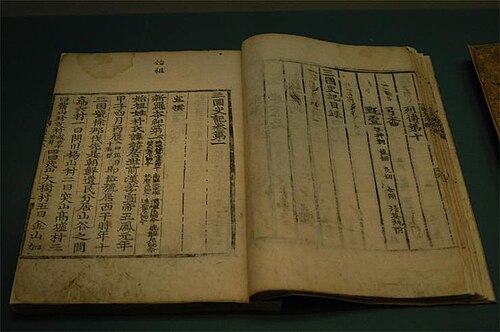
No copy from 1145 survives. The book was printed from woodblocks, and a single volume containing seven gwon from a Goryeo-period printing, kept at the Seongam Old Books Museum in Seoul, is the oldest surviving witness; it is designated a Treasure of Korea.
In the early Joseon dynasty the book was reprinted in Gyeongju in 1394, and a new printing was made in Gyeongju in 1512 under the magistrate Yi Gye-bok. This 1512 edition, known as the Jeongdeok edition, became the basis of most later texts. Early Joseon printed copies held at Oksan Seowon in Gyeongju and at the Seongam Old Books Museum were designated National Treasures of Korea in 2018.
In the twentieth century the Samguk sagi was edited, annotated and translated into modern Korean many times, and partial translations have appeared in English and other languages. Digital editions now make the text widely available.
Advanced
Debate: “Sinocentric” history or Goryeo patriotism?
The most famous criticism came from the independence activist and historian Sin Chae-ho (1880–1936). He accused Kim Busik of sadaejuui, subservience to China, and in an essay of 1925 called the Myocheong rebellion, which Kim Busik had suppressed, the greatest event in Korean history for a thousand years, arguing that its failure marked the victory of a Confucian, Sinocentric outlook over an independent spirit. Critics pointed to historians' comments that judge the kingdoms by Chinese standards of propriety, to the Silla-centred viewpoint, and to omissions such as Gojoseon, Gaya (which has no annals of its own) and Balhae, the kingdom that succeeded Goguryeo in the north.
Since the 1970s many historians, including specialists such as Shin Hyung-sik, the author of the Academy of Korean Studies encyclopedia article on the book, have offered a more balanced view. They note that the book calls the Korean kings' records bongi, “basic annals”, a term that in Chinese histories was reserved for emperors; that it gives the three kingdoms equal formal status as independent states; that Kim Busik explicitly wanted Koreans to know their own history; and that the compilers kept native royal titles and Korean traditions. On this view the Samguk sagi expresses the Confucian nationalism of twelfth-century Goryeo, not simple servility.
The criticism of Silla-centrism is also debated. Silla lasted longest and left the most records, and Goryeo saw itself partly as Silla's successor, so the imbalance may reflect the sources as much as bias. On the other hand, the book gives Goguryeo ten gwon of annals and treats its resistance to Sui and Tang with evident admiration.
Advanced
How reliable are the early annals?
The trustworthiness of the annals for the first centuries of each kingdom is a long-standing problem. In the early twentieth century some Japanese scholars, notably Tsuda Sōkichi, argued that the early records of Silla and Baekje were largely fabricated. This view, known in Korean as the theory of distrust of the early records (chogi girok bulsillon), was influential in colonial-era scholarship.
Later Korean and international scholarship has moved towards a position of critical use. Archaeological evidence for the growth of early states on the peninsula, and comparisons with Chinese records such as the account of the Eastern Barbarians in the Records of the Three Kingdoms, suggest that the early annals preserve genuine traditions, though often with compressed or adjusted chronology. Proposals to correct the chronology, for example by treating some early reigns as overlapping, remain debated.
Methodologically, historians analyse the Samguk sagi in layers: native Korean records, Chinese material, and the compilers' own editorial choices and comments. They compare it with inscriptions such as the Gwanggaeto Stele of Goguryeo (414) and Silla stone monuments, with wooden tablets (mokgan) excavated in recent decades, and with Japanese and Chinese texts. Each new excavation can confirm, correct or complicate the picture the book gives.
Advanced
The treatises as a research resource
The nine gwon of treatises are brief compared with those of Chinese histories, and the compilers admitted that much information on Goguryeo and Baekje institutions was lost. Nevertheless they are invaluable. The treatise on official posts preserves Silla's bone-rank-based system of titles; the treatise on clothing and carriages records sumptuary rules that differed by bone rank; and the treatise on music names instruments such as the gayageum and geomungo and explains their origins.
The geography treatise is especially important for linguists. In 757 King Gyeongdeok of Silla replaced many native place names with two-character Chinese-style names, and the treatise frequently records both the new names and the older ones. Because many of the old names were written by using Chinese characters for their sound or meaning, scholars have used these pairs to reconstruct words of the languages spoken in the three kingdoms, including fragments of the Goguryeo language. How to interpret these data, and what they reveal about the relationship between the languages of the peninsula, remains contested.
Advanced
Legacy, the Samguk yusa and East Asian historiography
The Samguk sagi is often read together with the Samguk yusa (“Memorabilia of the Three Kingdoms”), compiled around 1281 by the Buddhist monk Iryeon, more than a century later. The two works are very different. The Samguk sagi is an official, Confucian history; the Samguk yusa is a private collection of legends, Buddhist miracle stories, folk traditions and songs.
The Samguk yusa includes material the Samguk sagi omits, such as the foundation myth of Dangun and Gojoseon, the history of the Gaya confederacy, and fourteen hyangga, Silla vernacular songs. Iryeon wrote in part to supplement what the official history had left out.
The Samguk sagi established the tradition of state-sponsored history writing in Korea. The Joseon dynasty later compiled the History of Goryeo (Goryeosa) in the same annals-and-biographies form, as well as vast chronicles of its own reigns. Later private historians, such as An Jeong-bok in the eighteenth century, reworked and criticised the Samguk sagi, and the call by Yu Deuk-gong (Balhaego, 1784) to write Balhae into Korean history can be read partly as a reply to its omissions.
In the wider East Asian context, it can be compared with Japan's Nihon shoki (720), an earlier official history in Classical Chinese that also combined native traditions with Chinese models, and with the Chinese dynastic histories that were its template. Comparing these works reveals how different states adapted a shared historiographical form to their own political needs.
Today the Samguk sagi remains indispensable, but readers treat it as a twelfth-century interpretation of a much older past. Its stories, such as those of Ondal and Princess Pyeonggang, Seol Chong, and the Hwarang warriors, are also a living part of Korean culture, retold in schoolbooks, novels and television dramas.
Key ideas
- Official history
- A history compiled by royal order and state officials, reflecting court and Confucian values.
- Annals and biographies (gijeonche)
- The format, created by Sima Qian, that combines rulers' annals, tables, treatises and individual biographies.
- History as moral lesson
- Kim Busik wanted the deeds of rulers and subjects to serve as examples and warnings for later generations.
- Historians' comments (saron)
- 31 passages in which the compiler judges events and people from a Confucian standpoint.
- Lost sources
- The book preserves material from earlier Korean records that no longer survive.
- Sadae debate
- The modern argument over whether the book is Sinocentric or an expression of Goryeo patriotism.
- Source criticism
- Modern readers separate native records, Chinese material and the compilers' interpretations.
Records
- 57 BCE — Traditional founding date of Silla (57 BCE) according to the Samguk sagi.
- 37 BCE — Traditional founding date of Goguryeo (37 BCE).
- 18 BCE — Traditional founding date of Baekje (18 BCE).
- 668 CE — Silla and Tang conquer Goguryeo, after Baekje's fall in 660.
- 935 CE — Silla's last king surrenders to Goryeo; the Samguk sagi's narrative ends.
- 1075 — Kim Busik is born.
- 1135 — The Myocheong rebellion breaks out; Kim Busik suppresses it by 1136.
- 1145 — Kim Busik and his team present the Samguk sagi to King Injong.
- 1151 — Kim Busik dies.
- c. 1281 — The monk Iryeon compiles the Samguk yusa, supplementing the official history.
- 1512 — The Jeongdeok edition is printed in Gyeongju, the basis of most later texts.
- 2018 — Early Joseon printed copies are designated National Treasures of Korea.
Glossary
- Three Kingdoms
- Goguryeo, Baekje and Silla, the rival kingdoms of ancient Korea.
- Goryeo
- The Korean dynasty (918–1392) that commissioned the Samguk sagi; the name “Korea” comes from it.
- Gwon
- A “scroll” or book-division of a traditional East Asian text.
- Bongi (annals)
- Year-by-year records of rulers' reigns.
- Yeoljeon (biographies)
- Life stories of notable individuals.
- Ji (treatises)
- Topical chapters on institutions such as rites, geography and offices.
- Classical Chinese
- The written language shared by educated people across premodern East Asia.
- Sadaejuui
- “Serving the great”: a modern critical term for subservience to China.
- Myocheong rebellion
- A revolt of 1135–1136 led by the monk Myocheong, based in Pyongyang and suppressed by Kim Busik.
- Samguk yusa
- A private collection of history and legends compiled by the monk Iryeon around 1281.
Questions and answers
Is the Samguk sagi the first Korean history ever written?
No, but it is the oldest one that survives. Earlier histories existed and were used by the compilers, but they have been lost.
Why is it written in Chinese characters?
Korea had no alphabet of its own until Hangeul was created in the 1440s, so educated Koreans wrote in Classical Chinese, the shared written language of East Asia.
Who is the most famous person in the biographies?
Probably General Kim Yusin, whose biography fills three of the ten gwon of biographies.
Did Kim Busik really look down on Korea?
Sin Chae-ho and others accused him of subservience to China, but many modern historians argue that he wanted Koreans to know their own history and treated the three kingdoms as independent states. Both readings point to real features of the text.
Can we trust the early founding dates?
Historians treat them with caution. The dates of 57, 37 and 18 BCE reflect later traditions, and the early chronology, especially for Silla, is widely thought to have been adjusted.
What is the difference between the Samguk sagi and the Samguk yusa?
The Samguk sagi is an official Confucian history made by royal order in 1145; the Samguk yusa is a private collection of legends and Buddhist stories made by the monk Iryeon around 1281.
Why is Balhae not included?
The compilers limited themselves to the three kingdoms and Silla. Later historians, such as Yu Deuk-gong in 1784, criticised this and argued that Balhae belonged in Korean history.
Sources and further reading
- 신형식 (Shin Hyung-sik), 삼국사기 (三國史記). Encyclopedia of Korean Culture, Academy of Korean Studies
- 정구복 (Chung Ku-bok), 김부식 (金富軾). Encyclopedia of Korean Culture, Academy of Korean Studies
- 옥영정 (Ok Young-jeong), 삼국유사 (三國遺事). Encyclopedia of Korean Culture, Academy of Korean Studies
- Samguk sagi. Wikipedia
- Kim Busik. Wikipedia
- 삼국사기. 위키백과 (Korean Wikipedia)
- Samguk yusa. Wikipedia
Related
- Sima QianA Han dynasty historian who compiled the Records of the Grand Historian, a broad history of the ancient Chinese world.
- SeokguramEighth-century Buddhist grotto near Gyeongju, known for its granite Buddha and surrounding sculptures.
- Tripitaka KoreanaGoryeo Buddhist canon carved on woodblocks in the thirteenth century.
- KojikiA Japanese compilation completed in 712 CE that brings together accounts of deities, origins and early rulers.
- ConfuciusTeacher from the state of Lu whose sayings, gathered in the Analects, shaped ethics and government across East Asia.
Written with AI assistance from the published sources listed above, and revised as new research appears.