Start at the top for an easy introduction. Go further down for more detail and scholarship.
- Easy
- Intermediate
- Advanced
For young readers
About 900 years ago in what is now Germany, a girl named Hildegard was born into a noble family. She was often ill. From the time she was very small, she said she saw a strange, bright light and pictures that other people could not see.
When she was a child, her parents gave her to a monastery to live a life of prayer. There a woman named Jutta taught her to read, to sing the Psalms and to care for the sick. When Jutta died, the nuns chose Hildegard as their leader.
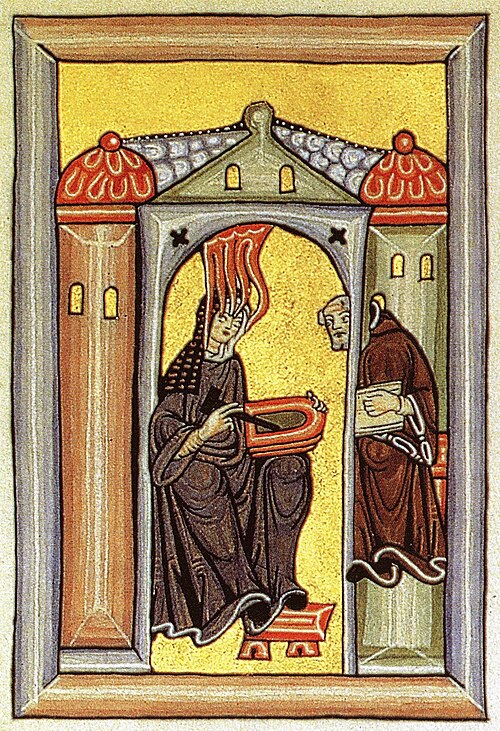
At the age of forty-two, Hildegard believed God told her to write down what she saw and heard. She was afraid at first, but she began to write. Her first great book was called Scivias, which means “Know the Ways.” It describes her visions and explains what she believed they meant.
Hildegard also wrote music. More of her songs survive than those of any other composer of the Middle Ages. Her melodies soar high and low, and she wrote both the words and the tunes. She even wrote a musical play in which virtues such as Humility and Hope fight the Devil for a human soul.
She loved plants and nature. She wrote books about herbs, stones, fish, animals and the human body, and about how to treat illnesses. She used the word viriditas, “greenness,” for the life force she saw in growing things.
Hildegard was brave. She moved her nuns to a new convent when an abbot did not want her to, travelled to preach, and wrote letters to popes and emperors telling them how to behave. The Catholic Church honours her as a saint, and in 2012 it named her a Doctor of the Church, a title given to only a few great teachers.
At a glance
- Lived
- c. 1098 – 17 September 1179
- Born
- In the Rhineland (Holy Roman Empire): traditionally Bermersheim near Alzey; some recent research favours Niederhosenbach, the family’s residence at the time
- Main places
- Disibodenberg (enclosed there as a girl); Rupertsberg at Bingen (founded 1150); Eibingen near Rüdesheim (founded 1165)
- Role
- Benedictine magistra and abbess, visionary writer, theologian, composer, poet, writer on medicine and natural history, preacher
- Visionary works
- Scivias (1141–1151), Liber vitae meritorum (1158–1163), Liber divinorum operum (c. 1163–c. 1174)
- Other works
- Symphonia (liturgical songs), Ordo Virtutum (music drama), Physica and Causae et curae (nature and medicine), Lingua ignota, about 400 letters
- Language
- Latin, with a few German glosses; an invented vocabulary in the Lingua ignota
- Recognition
- Venerated as a saint for centuries; sainthood extended to the whole Catholic Church and named Doctor of the Church in 2012
Easy
Who was Hildegard?
Hildegard of Bingen was a Benedictine nun and later abbess who lived in the Rhineland, in what is now western Germany, in the 12th century. She is sometimes called the “Sibyl of the Rhine” because people of her time regarded her as a prophet. She is remembered today for an unusually wide range of achievements: books describing and explaining her visions, a large body of music, writings on plants, animals and medicine, an invented language, and hundreds of letters.
She was born in 1098 into a family of the lower nobility, traditionally counted as the youngest of ten children. Hildegard wrote that she experienced visions from early childhood. As a girl she was dedicated to religious life and grew up in a small community of women attached to the monastery of Disibodenberg. In 1136 she became its leader, and later she founded her own convents at Rupertsberg, beside the town of Bingen, and at Eibingen across the Rhine.
Hildegard lived at a time when women had very limited roles in public life and in the Church. Yet she wrote theology, preached in public and advised popes, emperors, bishops and ordinary people. Believers see her authority as coming from God; historians study how she built and used that authority in the world of the 12th century.
Easy
Childhood in the monastery
Hildegard’s parents, Hildebert and Mechtild, belonged to the free lower nobility. Her birthplace is not recorded by her or her early biographers: tradition names Bermersheim near Alzey, where the family held land, while more recent research has suggested Niederhosenbach. She was traditionally counted as their tenth child, though records survive for only seven older siblings. Sickly from birth, she later said she first saw what she called “the shade of the living light” at the age of three and understood by the age of five that she was having visions.
Her parents offered her to religious life as an oblate, a child dedicated to God. She was placed with Jutta of Sponheim, a young noblewoman about six years older, who lived as an enclosed religious woman at the Benedictine monastery of Disibodenberg on the river Nahe. The exact dates are debated. Her later Life says she was eight when she joined Jutta; Jutta’s enclosure is dated to 1112, when Hildegard would have been fourteen. Some scholars think Hildegard was placed in Jutta’s care at eight and enclosed with her six years later.
Jutta taught Hildegard to read and to sing the Psalms in Latin, and the community cared for the sick and worked in the garden. A monk named Volmar, who later became Hildegard’s secretary and lifelong friend, may have taught her simple musical notation. Hildegard always insisted that she was “unlearned,” meaning that she had not studied the formal Latin curriculum of the schools.
Easy
The living light
For most of her life Hildegard told almost no one about her visions, except Jutta and Volmar. In 1141, when she was forty-two, she experienced a vision that she understood as a command from God to “write down that which you see and hear.” She hesitated and fell seriously ill, which she took as a sign that she must obey. With the support of Volmar and the nun Richardis von Stade, she began to write.
Hildegard described her visions carefully. In a letter written in old age to the monk Guibert of Gembloux, she said that she saw them not in dreams or ecstasy but wide awake, with her eyes open, “in my soul alone.” She called the brightness she saw “the reflection of the living Light” and said it was far brighter than a cloud lit by the sun.
In 1147–48, at a church synod in Trier, Pope Eugenius III heard parts of her unfinished book read aloud and sent her a letter of blessing. This papal approval, supported by the influential abbot Bernard of Clairvaux, gave her writing great authority and made her famous.
Intermediate
Founding her own convents
When Jutta died in 1136, the nuns elected Hildegard as their magistra, or leader. The women still lived under the authority of the abbot of the men’s monastery at Disibodenberg. Hildegard wanted independence for her community, and she announced that a vision had shown her a new site at Rupertsberg, a crag where the Nahe meets the Rhine at Bingen. Abbot Kuno refused. Hildegard appealed over his head to the Archbishop of Mainz and fell ill again, lying paralysed until the abbot relented.
Around 1150 she moved with about twenty nuns to Rupertsberg, a poorer and less comfortable site than the well-established stone monastery they had left. The convent church was consecrated in 1152. Volmar went with them as provost and confessor. In 1165 Hildegard founded a second house at Eibingen, near Rüdesheim across the Rhine, and she led both communities.
Hildegard was a practical and sometimes controversial leader. She accepted only women of noble birth into Rupertsberg, arguing that mixing social classes would cause conflict. She fought fiercely when her beloved assistant Richardis was elected abbess of a distant convent in 1151, writing to Richardis’s family, to church officials and even to the pope to try to keep her; Richardis died soon after leaving.
Intermediate
Three books of visions
Hildegard’s major theological works are three large books of visions. In each, she first describes what she saw, often in strange and vivid images, and then gives an explanation which she presents as the words of “the voice of the living Light.” Scivias (“Know the Ways [of the Lord]”), written between 1141 and 1151, contains twenty-six visions in three parts: the order of creation, the order of redemption through Christ and the Church, and the history of salvation pictured as a great building adorned with virtues. It ends with songs and an early form of her music drama.
The Liber vitae meritorum (“Book of Life’s Merits”), written 1158–1163, stages dramatic confrontations between vices and virtues. Each vice makes a seductive speech, and a virtue answers it. The book also contains one of the earliest detailed descriptions of purgatory as a place of purification after death.
The Liber divinorum operum (“Book of Divine Works”), begun about 1163 and finished around 1172–74, is her most cosmic work. Its visions show the universe as a set of spheres with a human figure at the centre, linking the human being as a small world (microcosm) with the great world of the universe (macrocosm). Much of it is an extended meditation on the opening of the Gospel of John, “In the beginning was the Word,” and on the seven days of creation in Genesis.
Intermediate
Music and the Ordo Virtutum
Hildegard is one of the best-known composers of the Middle Ages and among the few of that era whose names are attached to both words and music. Besides the Ordo Virtutum, sixty-nine musical compositions survive, each with her own poetic text, collected in a cycle called the Symphonia armoniae celestium revelationum (“Symphony of the Harmony of Heavenly Revelations”). They include antiphons, responsories, hymns and sequences written for worship in her convent.
Her music is monophonic: a single melodic line without harmony, like Gregorian chant. But her melodies often have an unusually wide range, with soaring leaps and long flowing passages on single syllables (melismas). Scholars such as Margot Fassler and Marianne Richert Pfau have stressed how closely her music follows the meaning of her texts.
The Ordo Virtutum (“Order of the Virtues”), composed around 1151, is a sung allegorical drama in which a human soul, Anima, is tempted away by the Devil and then returns in repentance, helped by sixteen Virtues. All the characters sing except the Devil, who can only speak or shout, cut off from divine harmony. It is often described as the earliest known morality play, and it may have been performed by her nuns, perhaps at the consecration of the Rupertsberg church in 1152.
Intermediate
Nature, medicine and greenness
Two works, known as Physica and Causae et curae, deal with the natural world and medicine. Unlike her visionary books, they do not claim divine inspiration. They draw on her experience in the convent garden and infirmary and on traditional Latin medical learning. Physica describes the properties and uses of plants, trees, stones, fish, birds, reptiles and other animals; it is often cited for an early reference to hops being used in beer as a preservative.
Causae et curae (“Causes and Cures”) explains the human body, the causes of disease and their treatment, including bloodletting and many home remedies. Hildegard used the ancient theory of the four humours but gave it her own shape, linking the humours to the four elements and explaining illness as an imbalance that entered humanity with the Fall of Adam and Eve.
A key idea in her thought is viriditas, “greenness” or “greening power,” the life and fruitfulness that God gives to plants and, by analogy, to human bodies and souls. For Hildegard, caring for a patient was a little like tending a garden. These books are historically valuable because they record kinds of practical medicine that were rarely written down. Whether all of the medical texts that survive under her name are entirely her own work is discussed by scholars, since they reached their present form after her death.
Intermediate
Letters, preaching and public voice
Nearly four hundred letters survive from Hildegard’s correspondence, one of the largest collections from the Middle Ages. She wrote to popes Eugenius III and Anastasius IV, to the emperor Frederick Barbarossa, to Bernard of Clairvaux, to abbots, abbesses, bishops and lay people who asked her for advice and prayers. She often wrote in the voice of the living Light, rebuking the powerful when she thought they were failing.
Remarkably for a woman of her time, she made several preaching journeys in the 1160s and 1170s, speaking to clergy and lay people in chapter houses and public places. She denounced corruption among the clergy and called for reform. The Vatican’s 2012 letter notes that she preached “in public squares and in various cathedral churches.”
Near the end of her life, she refused to let the clergy of Mainz remove from her convent cemetery the body of a man who had been excommunicated, insisting that he had been reconciled with the Church before he died. The dispute with the church authorities of Mainz over this burial overshadowed the last months of her life. She died at Rupertsberg on 17 September 1179.
Advanced
Sources and self-presentation
Much of what we know about Hildegard’s life comes from the Vita Sanctae Hildegardis, compiled after her death by the monk Theoderic of Echternach. It incorporates an earlier account begun by Godfrey of Disibodenberg and material gathered by her last secretary, Guibert of Gembloux, as well as autobiographical passages attributed to Hildegard herself. Like all saints’ lives, the Vita was written to show holiness and was prepared in part to support her canonisation, so historians read it alongside her letters and other documents.
Manuscripts made during or shortly after her lifetime are unusually important. The illustrated Rupertsberg manuscript of Scivias, with its 35 miniatures, was lost after being sent to Dresden for safekeeping in 1945; its images survive through a hand-painted facsimile made by the nuns of Eibingen in 1927–1933. The huge Riesencodex (“giant codex”) in Wiesbaden, weighing about 15 kilograms, gathers most of her works and letters. Scholars debate how much the letters were edited and polished by her secretaries, though Hildegard seems to have approved the collection.
Scholars have also examined Hildegard’s repeated description of herself as a weak and “unlearned” woman. Feminist historians have argued that this language of humility worked to her advantage: by insisting that her words came not from her own learning but from God, she gained the right to speak in a Church that normally denied women authority to teach.
Advanced
How should her visions be understood?
For the Catholic Church and many believers, Hildegard was a true prophet whose visions were a gift from God. Pope Benedict XVI, naming her a Doctor of the Church, praised “her holiness of life and the originality of her teaching.” Historians, who work with evidence open to all regardless of faith, do not try to prove or disprove divine inspiration; instead they study how the visions were described, recorded, illustrated and received.
Some modern writers have proposed medical explanations. The neurologist Oliver Sacks, in The Man Who Mistook His Wife for a Hat (1985), argued that the patterns of light she described resembled the visual aura of migraine. Others caution that retrospective diagnosis of a medieval person is uncertain and that such an explanation does not account for the theological content and literary artistry of her work. Hildegard herself described her visions as occurring while fully awake, not in ecstasy, which distinguishes her from many other medieval mystics.
Scholars also debate how her images were created. The Scivias miniatures were probably produced under her supervision, but whether she designed them herself, and how closely they reflect her descriptions, remains unclear. Similarly, her invented Lingua ignota, a glossary of about 1,000 made-up nouns with Latin and German glosses, has been read by Barbara Newman as a way to build solidarity among her nuns and by Sarah Higley as a mystical project reflecting the whole order of creation.
Advanced
Canonisation, revival and legacy
Hildegard was among the first people for whom the formal Roman process of canonisation was attempted, but several attempts were never completed. Nevertheless she was venerated as a saint locally, and from the late 16th century she was listed in the Roman Martyrology with a feast on 17 September. On 10 May 2012 Pope Benedict XVI extended her cult to the whole Church by “equivalent canonisation,” and on 7 October 2012 he declared her a Doctor of the Church, one of only a handful of women to hold that title. Her relics are kept in the pilgrimage church at Eibingen.
Rupertsberg was destroyed in 1632 during the Thirty Years’ War; the Eibingen house was dissolved in 1804 and refounded as a Benedictine abbey in 1904. Modern interest in Hildegard grew rapidly from the late 20th century. Since 1979, the 800th anniversary of her death, recordings of her music have multiplied, and she has become an important figure for historians of women, of music and of medicine.
Her popularity has taken many forms, from scholarly editions in the Corpus Christianorum series to films such as Margarethe von Trotta’s Vision (2009) and the so-called “Hildegard medicine” of alternative healers. Historians caution that some of these modern uses owe more to present-day interests than to the 12th-century abbess, whose thought was rooted in Benedictine monastic life, the Bible and the liturgy.
Key ideas
- Visio (vision)
- Hildegard’s word for her experience of seeing and hearing in “the living Light” while fully awake. She presented her theology as interpretation of these visions.
- Viriditas (greenness)
- The life-giving, fruitful power God gives to creation, seen in plants and, by analogy, in bodily health and spiritual vigour.
- Microcosm and macrocosm
- The human being is a small world that mirrors the structure of the universe; body, soul and cosmos are connected.
- Symphonia (harmony)
- Music reflects the harmony of heaven and creation. In the Ordo Virtutum, the Devil alone cannot sing.
- Virtues versus vices
- The moral life is a drama in which personified virtues defend the soul against seductive vices.
- Authority through humility
- By calling herself unlearned and weak, Hildegard presented her teaching as God’s, which gave her a public voice rare for women of her time.
- Reform of the Church
- In letters and sermons she denounced clerical corruption and urged clergy and rulers to renew their lives.
Records
- c. 1098 — Hildegard is born into a family of the lower nobility, at Bermersheim near Alzey or possibly Niederhosenbach.
- 1112 — Hildegard and Jutta of Sponheim are enclosed at the monastery of Disibodenberg (by other accounts she had been in Jutta’s care since about age eight).
- 1136 — After Jutta’s death, Hildegard is elected magistra of the women’s community.
- 1141 — A vision commands her to write down what she sees and hears; she begins Scivias.
- 1148 — At the Synod of Trier (1147–48), Pope Eugenius III hears parts of Scivias and sends his blessing.
- c. 1150 — She moves with about twenty nuns to her new convent at Rupertsberg near Bingen.
- 1151 — Scivias is completed; the Ordo Virtutum is composed around this time.
- 1158 — She begins the Liber vitae meritorum (completed 1163).
- 1160 — She preaches publicly, the first of several preaching journeys.
- 1165 — She founds a second convent at Eibingen across the Rhine.
- 1179 — Hildegard dies at Rupertsberg on 17 September.
- 2012 — Pope Benedict XVI extends her cult to the whole Church (10 May) and names her a Doctor of the Church (7 October).
Glossary
- Benedictine
- Belonging to the monastic tradition that follows the Rule of St Benedict, balancing prayer, work and community life.
- Oblate
- A person, often a child, offered by their family to God and to a monastery.
- Magistra
- Latin for “mistress” or “teacher”; the title of the leader of a women’s religious community.
- Abbess
- The head of an abbey of nuns.
- Monophony
- Music consisting of a single melodic line without accompanying harmony, as in Gregorian chant.
- Antiphon
- A short chant sung before and after a psalm or canticle in the liturgy.
- Morality play
- A drama in which personified virtues and vices struggle over a human soul.
- Humoral theory
- The ancient medical idea that health depends on a balance of four bodily fluids: blood, phlegm, yellow bile and black bile.
- Doctor of the Church
- A title the Catholic Church gives to saints whose teaching is considered especially important.
- Interdict
- A church penalty that forbids a community from celebrating certain services or sacraments.
Questions and answers
Did Hildegard really see visions?
She said she did, from early childhood, and described them carefully. Believers accept them as gifts from God. Historians cannot test that claim; they study how she described and used her visions. Some modern writers, such as Oliver Sacks, have suggested migraine as one factor.
Can I listen to her music?
Yes. Many recordings exist, and her songs are sung by choirs and ensembles around the world. Her music was mostly written for her nuns to sing in church.
Was she a scientist?
Not in the modern sense, but she wrote detailed works on plants, animals, stones and the human body, based on observation, experience and older learning. Some scholars have called her a founder of natural history in Germany.
What language did she write in?
Mostly Latin, the language of learning and the Church. She also created the Lingua ignota, a list of about 1,000 invented words for things such as God, angels, plants and household objects.
Why was it unusual for her to preach?
In the 12th-century Church, public preaching was normally reserved for ordained men. Hildegard’s reputation as a prophet and papal approval of her writings allowed her to preach to clergy and lay people.
Is she officially a saint?
She was venerated as a saint for centuries without completing the formal process. In 2012 Pope Benedict XVI extended her veneration to the whole Catholic Church and named her a Doctor of the Church.
How reliable are the stories about her life?
The main biography, the Vita, was written after her death to show her holiness, so it contains miracle stories and a particular point of view. Her own letters and writings, and documents about her convents, help historians check and balance it.
Sources and further reading
- Hildegard of Bingen. Wikipedia
- 힐데가르트 폰 빙엔. Wikipedia (Korean)
- Pope Benedict XVI, Apostolic Letter proclaiming Saint Hildegard of Bingen, professed nun of the Order of Saint Benedict, a Doctor of the Universal Church. The Holy See, 2012
- Hildegard von Bingen. Wikipedia (German)
- Scivias. Wikipedia
- Ordo Virtutum. Wikipedia
- Rupert of Bingen (section: Rupertsberg). Wikipedia
- Eibingen Abbey. Wikipedia
- Riesencodex. Wikipedia
- Barbara Newman, Sister of Wisdom: St. Hildegard’s Theology of the Feminine. University of California Press, 1987
Related
- Augustine of HippoA Christian bishop and thinker whose writings shaped Western theology and philosophy.
- Thomas AquinasDominican theologian and philosopher whose writings became central to medieval Christian thought.
- AvicennaPhysician and philosopher whose writings shaped medicine and philosophy across the Islamic world and Europe.
- Divine ComedyItalian narrative poem by Dante Alighieri describing a journey through Hell, Purgatory and Paradise.
- Book of KellsLavishly illuminated Latin Gospel book made by Columban monks around 800, the high point of Insular art.
Written with AI assistance from the published sources listed above, and revised as new research appears.