Start at the top for an easy introduction. Go further down for more detail and scholarship.
- Easy
- Intermediate
- Advanced
For young readers
About 700 years ago, a man named Dante lived in the city of Florence in Italy. He loved poetry, and he also got mixed up in city politics. One day his enemies won, and he was told he could never come home again. For the rest of his life he moved from city to city, missing home.
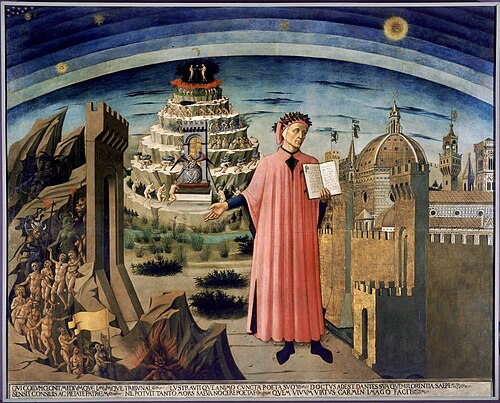
While he was far from home, Dante wrote an enormous poem. In it, he pretends that he gets lost in a dark forest. A famous poet from long ago, Virgil, appears and says: follow me, I will show you the way out, but it is a long trip.
First they go down into Hell, which is shaped like a giant funnel dug into the Earth, with rings getting smaller and smaller. People who did bad things are there, and each punishment matches the wrong they did, a bit like a riddle. Then Dante and Virgil climb a huge mountain called Purgatory, where people work on becoming better, step by step, like climbing a staircase.
At the very top, Dante meets Beatrice, a girl he loved when he was young. She guides him up through the Moon, the Sun, the planets and the stars, all the way to a place of pure light. The poem ends with Dante seeing a love so big that it moves the Sun and all the other stars.
The poem is called a 'Comedy' not because it is funny, but because it starts in a scary place and ends happily. Dante wrote it in the everyday language people spoke in Florence, not in Latin, and that helped turn his way of speaking into the Italian language used today.
At a glance
- Author
- Dante Alighieri (1265–1321), Florentine poet, thinker and exiled politician
- Composed
- c. 1308–1321 (start date debated; Paradiso finished shortly before Dante's death)
- Where written
- In exile, mainly in northern Italy (probably Lunigiana, Verona and finally Ravenna), not in Florence
- Language
- Florentine (Tuscan) vernacular Italian, not Latin
- Form
- Narrative poem of 100 cantos in three parts (Inferno, Purgatorio, Paradiso), 14,233 lines in terza rima
- Fictional date of the journey
- Easter week of the year 1300
- Earliest printed edition
- Foligno, 11 April 1472
- Significance
- A founding work of Italian literature and one of the most influential poems in world literature
Easy
What is the Divine Comedy?
The Divine Comedy is a long narrative poem written in Italian by Dante Alighieri in the early fourteenth century. It tells, in the first person, the story of an imaginary journey that Dante himself makes through the three realms of the afterlife as medieval Latin Christianity pictured them: Hell (Inferno), Purgatory (Purgatorio) and Paradise (Paradiso).
Dante simply called the poem his Commedia, meaning 'comedy'. In medieval literary theory a comedy was not a funny story but one that begins in misery and ends in happiness, told in a relatively humble style; a tragedy did the reverse. The adjective 'Divine' was added later by admirers: Giovanni Boccaccio praised the poem as 'divine' in the 1350s, and the full title Divina Commedia first appeared on a printed edition in Venice in 1555.
The poem is huge: 100 cantos (a canto is a chapter-like section of a long poem) containing 14,233 lines. Yet it is tightly organised, full of real people from history and from Dante's own day, and packed with theology, philosophy, astronomy and politics. It can be read as an adventure story, as a spiritual autobiography, as a work of political protest and as an encyclopedia of medieval knowledge, all at once.
Easy
The story: from a dark wood to the stars
The poem opens with its most famous lines: midway through the journey of life, Dante finds himself lost in a dark wood, having strayed from the straight path. Three beasts (a leopard, a lion and a she-wolf) block his way up a sunlit hill. Then the shade (ghost) of the Roman poet Virgil appears. Virgil explains that Beatrice, a Florentine woman Dante had loved and who died in 1290, has asked from Heaven that he be rescued. The only way out is the long way round: through the afterlife.
In Inferno, Virgil leads Dante down through nine circles of Hell, a vast funnel beneath Jerusalem. The upper circles hold those whose sins came from lack of self-control, such as the lustful lovers Francesca and Paolo, blown about forever by a storm. Lower down are the violent, and lowest of all the fraudulent and the traitors. At the frozen bottom, Lucifer is stuck in ice, chewing the traitors Judas, Brutus and Cassius. The travellers climb down Lucifer's body, pass through the centre of the Earth and emerge on the other side of the world.
In Purgatorio, they climb a mountain rising from the ocean in the southern hemisphere. Here souls who repented before death are cleansed of their faults on seven terraces, each dealing with one of the seven capital sins (pride, envy, wrath, sloth, avarice, gluttony and lust). Unlike Hell, Purgatory is full of hope, prayer and song, and souls move upward. At the summit lies the Earthly Paradise, the Garden of Eden. There Beatrice appears, Virgil quietly vanishes, and Dante confesses and is purified.
In Paradiso, Beatrice guides Dante upward through the nine heavenly spheres of medieval astronomy: the Moon, Mercury, Venus, the Sun, Mars, Jupiter, Saturn, the Fixed Stars and the Primum Mobile (the outermost moving sphere). Saints and philosophers explain questions of faith, free will and justice. Finally, beyond space and time in the Empyrean, Dante sees the blessed arranged like a great white rose. Guided now by St Bernard of Clairvaux, he receives a brief vision of God, and the poem ends with his will turning with 'the love that moves the sun and the other stars'.
Easy
Who was Dante?
Dante Alighieri was born in Florence in 1265 into a family of modest nobility. As a young man he wrote love poetry and belonged to a circle of poets whose new, refined style he himself later called the 'sweet new style' (dolce stil novo). His early book Vita nuova ('New Life', c. 1293–1295) tells in prose and verse of his love for Beatrice, usually identified with Beatrice Portinari, who died in 1290.
Dante was also active in politics. Florence was divided between factions, and in 1300 he served for two months as one of the city's priors, its highest officials. In 1301–1302 a rival faction, backed by Pope Boniface VIII, seized power. Dante, who was away at the time, was sentenced in January 1302 and then condemned to death if he returned. He never saw Florence again.
In exile Dante depended on patrons in other cities, including the Della Scala lords of Verona and, at the end of his life, Guido Novello da Polenta of Ravenna. During these years he wrote the philosophical Convivio, the Latin treatise De vulgari eloquentia on the dignity of vernacular language, the political treatise Monarchia, and the Commedia. He died in Ravenna in September 1321, shortly after completing Paradiso, and he is buried there, not in Florence.
Intermediate
Historical context: Italy and the wider world around 1300
Around 1300 the Italian peninsula was not one country but a patchwork of city-republics, lordships, the Kingdom of Naples and the Papal States. Florence was one of Europe's richest cities, a centre of banking and the wool and cloth trade, with its gold florin used across the Mediterranean. Its politics were violent: the long struggle between Guelphs (broadly pro-papal) and Ghibellines (broadly pro-imperial) had been followed by a split among the victorious Guelphs into Whites and Blacks. Dante belonged to the Whites.
The poem is soaked in this politics. Dante places popes, including the still-living Boniface VIII (by a clever prophecy), among the damned, attacks the greed of Florence, and longs for a Holy Roman Emperor who could bring peace to Italy. When Emperor Henry VII came to Italy in 1310, Dante hoped for exactly that; Henry's death in 1313 ended those hopes. In 1309 the papacy had moved to Avignon in France, which also fed Dante's anger at the corruption of the Church.
Intellectually, Dante lived at the height of scholasticism, the university-based method of reasoning about theology and philosophy. The works of Aristotle, many of which had reached Latin Europe in the twelfth and thirteenth centuries through translations from Greek and Arabic, together with the commentaries of Muslim philosophers such as Avicenna and Averroes, had been absorbed into Christian thought by figures like Albert the Great and Thomas Aquinas. Dante honours this shared heritage: in Limbo, the first circle of Hell, where virtuous non-Christians dwell without torment, he places Avicenna and Averroes alongside Aristotle, Plato and Euclid, as well as the Muslim sultan Saladin.
Elsewhere in the world, the early fourteenth century saw the Mongol successor states stretching across Eurasia, the Mamluk sultanate ruling Egypt and Syria, the Mali Empire at its height under Mansa Musa (whose famous pilgrimage to Mecca took place in 1324–1325), and the Yuan dynasty ruling China. Dante knew little of these distant places, but the trade and scholarship that linked the Mediterranean to the Islamic world shaped the learning that fills his poem.
Intermediate
Form and structure: a cathedral of numbers
Dante built the poem with almost architectural symmetry. There are three cantiche (the three great parts), each with 33 cantos, plus one introductory canto, giving 100 in total: a number medieval readers saw as perfect (10 × 10). The number three, recalling the Christian Trinity, runs through everything, including the verse form.
That verse form, which Dante invented, is terza rima ('third rhyme'). The poem is written in tercets, stanzas of three lines, usually of eleven syllables each (hendecasyllables). The rhymes interlock in the pattern ABA BCB CDC and so on: the middle line of each tercet supplies the rhyme for the next. This chain pulls the reader constantly forward, like footsteps on a journey, and it made the text harder to alter or interpolate, because a changed line breaks the chain.
Each of the three cantiche ends with the same word, stelle ('stars'), marking every stage of the journey as a step toward the heavens. The moral geography is equally designed. Hell's structure broadly follows Aristotle's ethics (incontinence, violence, fraud) interpreted through Christian categories; Purgatory follows the seven capital sins, understood as forms of disordered love; Paradise follows the Ptolemaic cosmos, in which the Earth sits at the centre of nested spheres. Moral order, physical order and poetic order mirror one another.
Intermediate
Key ideas and themes
Justice and contrapasso. In Hell, punishments fit sins through contrapasso ('counter-suffering'), a term used in the poem itself (Inferno 28). The lustful, who let passion sweep them away, are swept forever by a whirlwind; fortune-tellers, who tried to see too far ahead, walk with their heads twisted backwards. The punishments are not arbitrary cruelty but visible images of what the sin already was.
Love and free will. The deepest idea of the poem is that all human action springs from love, and that sin is love gone wrong: love aimed at the wrong object, too weak or too strong. This is explained at the very centre of the poem, in Purgatorio 17–18. Because humans have free will, they are responsible for where their love is directed, and the journey is Dante's re-education of his own desires, ending with his will moved in harmony with divine love.
Reason and faith. Virgil, the pagan poet, represents the best of human reason and classical culture, and he can guide Dante through Hell and up Purgatory. But he cannot enter Paradise; there Beatrice, associated with grace, revelation and theology, must take over. The poem thus honours classical learning deeply while insisting on its limits, a balance that has fascinated readers for centuries.
The individual in history. Unlike many earlier visionary texts, the Comedy is crowded with specific, named individuals, many of whom Dante knew or had heard about, each speaking in a distinct voice. The literary critic Erich Auerbach argued that Dante's figures are presented at the decisive, eternal truth of their earthly lives, so that the afterlife becomes a way to show real human character with unprecedented intensity. Politics, too, is a theme: Dante argues that Church and Empire should each keep to their own sphere, an idea developed in his Monarchia.
Intermediate
Why the language matters
In Dante's time, serious learning in Western Europe was written in Latin. Choosing to write a theological and philosophical epic in the Florentine vernacular (the spoken local language) was a bold statement that ordinary speech could carry the highest ideas. Dante had already argued for the dignity of the vernacular in De vulgari eloquentia, ironically written in Latin to reach scholars.
The Commedia mixes registers freely: coarse and comic words in the lower depths of Hell, tender lyric language in Purgatory, and abstract, even invented words in Paradise, where Dante coins verbs such as trasumanar ('to go beyond the human') to describe experiences that ordinary language cannot capture.
Because the poem became so widely read, copied and recited, its Florentine language became a model. In the sixteenth century, scholars such as Pietro Bembo promoted fourteenth-century Tuscan, especially Petrarch and Boccaccio, as the standard for literary Italian, and Dante's vocabulary entered the common language. For this reason Dante is often called the 'father of the Italian language', a simplification, but one that reflects his real influence.
Intermediate
Manuscripts, printing and editions
No manuscript in Dante's own hand survives; in fact, not a single line of his handwriting is known. The poem circulated in copies: roughly 800 manuscripts from the fourteenth and fifteenth centuries survive, making it one of the most copied vernacular texts of the European Middle Ages. Inferno was apparently circulating before the whole poem was finished; verses from it were copied by notaries in Bologna in the 1310s.
Soon after Dante's death, commentaries began to appear, first by his sons Jacopo and Pietro Alighieri and by other early readers. In 1373–1374 Florence, the city that had exiled Dante, hired Boccaccio to give public lectures on the poem, a sign of how quickly it had become a civic classic. Boccaccio also copied the poem several times, and his copies influenced later textual tradition.
The first printed edition appeared in Foligno on 11 April 1472, and editions quickly followed in Venice and elsewhere, often with commentary and later with woodcut illustrations. The standard modern critical edition was prepared by Giorgio Petrocchi and published in 1966–1967; it reconstructs the text from the manuscripts copied before about 1355, the so-called antica vulgata ('ancient common text'). Later editors have proposed different approaches, so the exact wording of some lines remains debated.
Intermediate
Influence and legacy
In Italy the Commedia became a foundation of literature, education and later national identity; during the nineteenth-century movement for Italian unification, Dante was celebrated as a prophet of the nation. Early Renaissance artists illustrated it, most famously Sandro Botticelli in a series of drawings from the late fifteenth century.
Its reach extends far beyond Italy. In English, Chaucer adapted passages; in the nineteenth century the poet Henry Wadsworth Longfellow produced an influential American translation (1867), and the illustrations of William Blake and Gustave Doré shaped how later generations visualised Hell and Heaven. Auguste Rodin's sculpture The Gates of Hell, including the figure later known as The Thinker, grew out of Inferno. In the twentieth century T. S. Eliot, Samuel Beckett, Jorge Luis Borges, Primo Levi and many others engaged closely with Dante; Levi's memory of reciting the Ulysses canto in Auschwitz is one of the most moving testimonies to the poem's power.
The poem has been translated into dozens of languages, including multiple Korean, Japanese and Chinese translations, and it continues to inspire novels, films, music, comics and video games. Everyday phrases such as calling a terrible place 'Dantesque', or the idea of 'circles of Hell', come from it. At the same time, modern readers also reflect critically on parts of the poem, for example its placement of the Prophet Muhammad and Ali among the 'sowers of discord' in Inferno 28, which many Muslims find deeply offensive and which scholars read as a product of medieval Christian polemic about schism.
Advanced
Scholarly debates and open questions
Dating. Scholars broadly agree that Dante wrote the poem during his exile and completed Paradiso near his death in 1321, but the starting point is contested. Many place the beginning of Inferno around 1306–1308; others argue for an earlier start around 1304, and Boccaccio preserved a story that the first seven cantos were written before the exile, which most modern scholars treat as legend. When each cantica was 'published' (released for copying) is also debated, with Inferno probably circulating by around 1314–1317.
The Letter to Cangrande. A Latin letter addressed to Cangrande della Scala, lord of Verona, explains the poem's title and describes a fourfold way of reading it (literal, allegorical, moral and anagogical, meaning spiritual or mystical), and says its subject is 'the state of souls after death'. Whether Dante wrote all, part or none of this letter has been disputed for more than a century, and the answer affects how much weight one gives to allegorical readings.
Allegory, fiction and truth. Readers disagree about how the poem claims to be true. Charles Singleton influentially argued that Dante adopts the 'allegory of theologians', presenting the journey as literally real in the fiction, like biblical events that also carry spiritual meaning. Auerbach's idea of figura (people and events as real in themselves yet also fulfilling a deeper pattern) is related. Teodolinda Barolini, in The Undivine Comedy (1992), urged readers to see the narrative techniques by which Dante makes his invented world feel authoritative, rather than simply accepting the poem's theology as a key.
Islamic sources. In 1919 the Spanish scholar Miguel Asín Palacios argued that Dante was influenced by Islamic accounts of the Prophet Muhammad's night journey and ascension (isra' and mi'raj). The discovery and publication in 1949 of Latin and French versions of the Book of the Ladder (Liber scale Machometi), a mi'raj narrative translated in thirteenth-century Castile, showed that such material did circulate in Latin Christendom. Whether Dante knew it directly remains unproven, and scholars remain divided between those who see real influence and those who see parallel development within a shared Mediterranean visionary tradition.
Philosophy and orthodoxy. How 'orthodox' Dante's thought is remains a live question. The placing of Siger of Brabant, a controversial Aristotelian, among the wise in Paradise, and Dante's views on the separation of Church and Empire (Monarchia was later condemned and placed on the Index of Prohibited Books), have led some scholars to stress his independence from Thomas Aquinas, while others emphasise his broad Thomist framework. The influence of Latin Averroism on Dante is described in the Stanford Encyclopedia of Philosophy as an active subject of debate.
Advanced
Primary sources and methodological notes
Primary evidence for the poem consists of the manuscripts (none autograph), the early commentaries (Jacopo and Pietro Alighieri, Graziolo Bambaglioli, Jacopo della Lana, the Ottimo commento, Benvenuto da Imola and others), documents on Dante's life such as the Florentine sentences of 1302, and Dante's other works. For Dante's biography, Boccaccio's Trattatello in laude di Dante is early but mixes fact with legend, and must be used with care.
Because the textual tradition is 'contaminated' (scribes copied from several exemplars and corrected against others), the classic genealogical method of reconstructing a family tree of manuscripts works imperfectly. Petrocchi's decision to restrict himself to the antica vulgata was a practical response to this problem. Students should be aware that line numbers and readings in different editions may differ slightly.
The commentary tradition is itself a primary source for reception. Digital resources such as the Dartmouth Dante Project, which gathers the texts of many centuries of commentaries, allow researchers to trace how particular lines have been interpreted from the fourteenth century to today. Finally, reading the poem in translation always involves trade-offs: most translators must choose between reproducing terza rima and staying close to Dante's literal meaning, which is why comparing several translations, or a facing-page Italian edition, is recommended.
Key ideas
- Journey as conversion
- The outward journey through the afterlife mirrors Dante's inner change from confusion and sin to clarity and love.
- Contrapasso
- The principle that each punishment in Hell reflects the nature of the sin, making sin visible.
- Love as the root of action
- Every human act comes from love; sin is misdirected, excessive or deficient love, and virtue is rightly ordered love.
- Reason and grace
- Virgil (human reason, classical culture) can guide Dante only so far; Beatrice (grace and revelation) leads him to Paradise.
- Cosmic order
- Moral, physical and poetic orders mirror each other through numbers, the Ptolemaic cosmos and the structure of the three realms.
- Vernacular dignity
- Dante showed that the everyday Italian language could express the highest philosophy and theology.
- Poet as witness and prophet
- Dante presents himself as sent to report what he saw, to judge the corruption of his world and to call it to reform.
Records
- 1265 — Dante Alighieri is born in Florence.
- 1290 — Death of Beatrice (usually identified as Beatrice Portinari).
- 1300 — Dante serves as a prior of Florence; the poem's fictional journey is set in Easter week of this year.
- 1302 — Dante is sentenced and exiled from Florence; he never returns.
- c. 1308 — Probable period in which Dante begins writing the Commedia (start date debated).
- c. 1314 — Inferno is probably circulating by now; verses are copied in Bologna in 1317.
- 1321 — Dante completes Paradiso and dies in Ravenna in September.
- 1373 — Boccaccio begins public lectures on the poem in Florence.
- 1472 — First printed edition, in Foligno.
- 1555 — A Venetian edition first uses the title 'Divina Commedia'.
- 1867 — Longfellow's English translation is published in the United States.
- 1966 — Giorgio Petrocchi's critical edition begins to appear (1966–1967).
Glossary
- Canto
- A major section of a long poem, somewhat like a chapter. The Comedy has 100.
- Cantica (plural cantiche)
- One of the poem's three large parts: Inferno, Purgatorio, Paradiso.
- Terza rima
- Dante's rhyme scheme of linked three-line stanzas: ABA BCB CDC, and so on.
- Hendecasyllable
- The standard eleven-syllable line of Italian poetry.
- Limbo
- The first circle of Hell, where virtuous people who were not baptised dwell without torment, but without the vision of God.
- Purgatory
- In Latin Christian teaching, a state in which saved souls are cleansed before entering Heaven; Dante pictures it as a mountain.
- Empyrean
- The highest heaven, beyond the physical spheres, where God and the blessed dwell.
- Guelphs and Ghibellines
- Rival political factions in medieval Italy, broadly aligned with the papacy and the Holy Roman Emperor respectively.
- Scholasticism
- The method of medieval university thinkers who used logic and Aristotle's philosophy to explore theology.
- Vernacular
- The everyday spoken language of a place, as opposed to a learned language like Latin.
Questions and answers
Why is it called a 'comedy' if it isn't funny?
In Dante's time a comedy meant a story that starts badly and ends happily, told in an everyday style. The Commedia begins in a dark wood and in Hell and ends in Paradise.
Is the Divine Comedy a true story?
No. It is a work of imagination, though Dante presents it as a real vision and fills it with real people and events. The journey is set in 1300, but Dante wrote it years later.
How many circles of Hell are there?
Nine. The upper circles punish sins of weakness (like greed or anger), the middle ones violence, and the lowest ones fraud and treachery, with Lucifer at the very bottom.
Who was Beatrice?
A Florentine woman Dante loved from youth, generally identified with Beatrice Portinari, who died in 1290. In the poem she becomes a guide from Heaven and a symbol of grace and divine wisdom.
Which translation should I read?
There is no single best one. Verse translations keep more of the music; prose or line-by-line translations stay closer to the meaning. Many readers use an edition with the Italian on facing pages and notes.
Did Dante borrow from Islamic sources?
It is possible but unproven. A Latin version of an Islamic ascension narrative, the Book of the Ladder, circulated in Dante's century, and scholars disagree on whether he knew it.
Why did Dante put real people, even popes, in Hell?
To make moral and political judgements about his own world. Placing contemporaries in the afterlife let him denounce corruption, honour friends and teachers, and show how individual choices have eternal meaning.
Sources and further reading
- Divine Comedy. Wikipedia
- Dante Alighieri. Wikipedia
- Dante Alighieri. Stanford Encyclopedia of Philosophy
- Inferno (Dante). Wikipedia
- Purgatorio. Wikipedia
- Paradiso (Dante). Wikipedia
- Terza rima. Wikipedia
- Dartmouth Dante Project. Dartmouth College
- Erich Auerbach, Mimesis: The Representation of Reality in Western Literature. Princeton University Press, 1953
- Teodolinda Barolini, The Undivine Comedy: Detheologizing Dante. Princeton University Press, 1992
Related
- VirgilA Roman poet whose Aeneid became one of the most influential works of Latin literature.
- Thomas AquinasDominican theologian and philosopher whose writings became central to medieval Christian thought.
- AverroesAndalusian philosopher, jurist and physician renowned for his commentaries on Aristotle.
- AvicennaPhysician and philosopher whose writings shaped medicine and philosophy across the Islamic world and Europe.
- Augustine of HippoA Christian bishop and thinker whose writings shaped Western theology and philosophy.
- HomerThe poet tradition credits with the Iliad and the Odyssey, the founding epics of Greek literature. Whether one person composed both is debated.
Written with AI assistance from the published sources listed above, and revised as new research appears.