Start at the top for an easy introduction. Go further down for more detail and scholarship.
- Easy
- Intermediate
- Advanced
For young readers
More than 650 years ago, on the island of Java, there was a powerful kingdom called Majapahit. Its young king, Hayam Wuruk, liked to travel around his country with a huge procession of carts, officials and priests, visiting villages, temples and the graves of his ancestors.
A retired court poet who called himself Prapañca wrote a long poem about the king. He described the royal palace with its red brick walls, the festivals, the ceremonies for the king’s grandmother, and the long journeys through the countryside. He even made a list of islands and kingdoms, from Sumatra to New Guinea, that he said looked up to Majapahit.
The poem is written in a special kind of verse called kakawin, with strict rules about long and short syllables, a bit like music. Each verse has four lines. Prapañca named his book “Description of the Districts”, but people today usually call it by another name that a later copyist wrote at the end: Nagarakretagama.
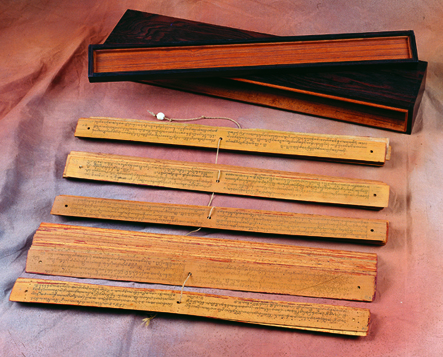
For hundreds of years the poem was copied by hand onto palm leaves on the islands of Bali and Lombok. In 1894 a Dutch scholar saved one of these palm-leaf books from a palace library during a colonial war. Later the Netherlands gave it back to Indonesia, and today it is kept in the National Library in Jakarta.
Indonesians see the poem as a treasure because it tells them so much about their past, and because its picture of many islands linked together inspired people who worked for Indonesia’s independence. But historians also remember that a poem of praise may make a king look grander than he really was.
At a glance
- Composed
- Completed in the month of Aśwayuja, Śaka year 1287 (September–October 1365 CE)
- Author
- Mpu Prapañca, a pen name; a Buddhist cleric formerly connected with the Majapahit court
- Language and form
- Old Javanese (Kawi), in kakawin verse using Sanskrit-derived metres
- Length
- 98 cantos (pupuh) in two halves of 49; each canto has one to ten four-line stanzas
- Subject
- Praise of King Hayam Wuruk (Rājasanagara, r. 1350–1389): his family, capital, royal tours, ancestral rites, religious foundations and realm
- Original title
- Deśawarṇana, “Description of the Districts”; “Nāgarakṛtāgama” comes from a Balinese copyist’s colophon of 1740
- Manuscripts
- Palm-leaf (lontar) copies from Lombok and Bali; the Lombok manuscript is now in the National Library of Indonesia
- Recognition
- UNESCO Memory of the World (Asia-Pacific register 2008; International Register 2013)
Easy
What is the Nagarakretagama?
The Nagarakretagama is an Old Javanese poem completed in 1365 CE (Śaka 1287) during the reign of Hayam Wuruk, king of Majapahit, the most powerful kingdom of fourteenth-century Java. Its author used the pen name Prapañca. The poem is a eulogy of the king, but it is also a vivid description of his court, his capital and the countryside of East Java, and it is the most important written source for the history of Majapahit at its height.
The poem belongs to the genre of kakawin, long poems in Old Javanese composed according to the rules of Sanskrit metre, a literary tradition that had flourished in Java since the ninth century. Unlike most kakawin, which retell Indian epics such as the Ramayana or the Mahabharata, the Nagarakretagama is about contemporary events and real places. That is why historians value it so highly.
The author himself called the work Deśawarṇana, “Description of the Districts”, a title that appears near the end of the poem. The more familiar name Nāgarakṛtāgama, usually translated as “the state perfect in tradition” or “perfect doctrine of the state”, is found only in the colophon of one manuscript copied in Bali in 1740. The Dutch scholar J. L. A. Brandes used it for the first edition in 1902, and it has remained the common name.
The poem survives in palm-leaf manuscripts from Lombok and Bali, islands where Javanese court literature continued to be copied after Majapahit’s fall. The manuscript found in Lombok in 1894 is now in the National Library of Indonesia. UNESCO recognized the Nagarakretagama as documentary heritage in its Memory of the World programme.
Easy
What is in the poem? A map of 98 cantos
The Nagarakretagama has 98 cantos (pupuh), divided into two equal halves of 49. Each canto contains one to ten stanzas of four lines. The organization is careful, and scholars have noted its symmetry.
The first half opens with praise of the king and his family, then describes the capital of Majapahit and the lands of the realm, including the famous lists of overseas regions. The longest part of this half follows the king on a great royal progress through East Java to Lumajang, with stops at villages, shrines and the estates of nobles. It ends with the genealogy of the kings, from Rājasa (Ken Angrok), founder of the Singhasari dynasty, to Kṛtanagara, and from Kṛtarājasa, founder of Majapahit, to Hayam Wuruk.
The second half describes a royal hunt in the forest of Nandawa and the return to the capital; the king’s care for his ancestors, above all the great memorial ceremony (śrāddha) for his grandmother, the Rājapatnī; the death of the chief minister Gajah Mada; lists of religious foundations in Java and Bali; and the annual cycle of court assemblies, processions and festivals.
The last cantos turn to the poet himself: praise from other poets for the king, and Prapañca’s account of his own situation, living away from the court in a mountain village, hoping that the king will remember his faithful servant. This personal ending is unusual and gives the poem a human voice.
Easy
Travelling with the king
One of the liveliest parts of the poem describes the king’s journeys through his lands. Majapahit’s kings made royal tours, visiting the corners of the realm, receiving local lords, inspecting temples and paying homage at the shrines of their ancestors. Prapañca, who travelled with the court, describes the long procession of carts and followers, the landscapes of mountains, rivers and rice fields, and the villages where the king stopped.
The poet names dozens of places along the way, many of which can still be identified with villages and archaeological sites in East Java. This makes the poem a kind of historical geography, and modern researchers have retraced the routes on the ground.
The tours also had a religious purpose. The king visited Candi Singhasari, where he worshipped his great-grandfather Kṛtanagara, and Kagenengan, the shrine of Rājasa, founder of the Singhasari line. By honouring his ancestors, who had been deified after death, the king strengthened the spiritual power believed to protect the kingdom.
Such journeys were also political theatre. By appearing in person in the provinces, the king reminded local rulers of their loyalty, and the gifts and hospitality offered to him were signs of their submission. The poem presents these scenes as joyful harmony between the king and his people.
Intermediate
Historical context: Majapahit at its height
Majapahit was founded in 1292 by Raden Wijaya in the aftermath of a Mongol expedition to Java sent by the Yuan dynasty. Wijaya, son-in-law of Kṛtanagara, the last king of Singhasari, first allied with the Mongol forces against the usurper Jayakatwang and then drove them out. His new capital, near present-day Trowulan in East Java, grew into the centre of a kingdom based on the rich rice lands and trade of the Brantas River valley.
The kingdom reached its peak in the mid-fourteenth century under Queen Tribhuwanā and her son Hayam Wuruk, who came to the throne in 1350 at the age of sixteen, with the chief minister Gajah Mada. According to later tradition, Gajah Mada swore the Palapa oath in 1336, vowing not to rest until the islands of the archipelago were united under Majapahit. Military expeditions and diplomacy extended Majapahit’s influence far beyond Java.
The Nagarakretagama describes this moment of power and confidence. It says nothing, however, about some painful events. Other sources, such as the later chronicle Pararaton and the Kidung Sunda, tell of the Bubat incident of 1357, when the Sundanese royal party, which had come to Majapahit for a planned marriage between Hayam Wuruk and the Sundanese princess, was killed in a clash with Majapahit troops. The poem’s silence on this is a reminder of its character as praise poetry.
After Hayam Wuruk’s death in 1389, a succession dispute and the Regreg war of 1405–06 weakened the kingdom. Majapahit declined during the fifteenth century as Muslim port states grew on Java’s north coast, and it came to an end in the early sixteenth century. Many nobles, priests and artists moved to Bali, which is one reason why Majapahit literature survived there.
Intermediate
The capital and the court
The poem gives the only detailed contemporary description of the Majapahit capital. The royal compound was surrounded by a thick, high wall of red brick. The main gate, in the north wall, had great doors of decorated iron; outside it were a long hall where courtiers assembled once a year, a market and a sacred crossroads. Inside were courtyards with religious buildings, pavilions surrounded by canals for bathing, houses for palace servants and a great hall for those waiting to be received.
The king’s own quarters had pavilions on decorated red-brick bases, carved wooden pillars and roofs decorated with clay ornaments. Around the palace lay the quarters of the Shaiva priests, the Buddhists and members of the nobility, and further away, separated by open fields, other royal compounds, including that of Gajah Mada.
Archaeology at Trowulan has confirmed that Majapahit was a brick-building civilization, with canals, reservoirs such as the Segaran pool, split gateways (candi bentar) and large amounts of terracotta sculpture and household objects. Aerial and satellite images have revealed a network of canals around the site. The poem and the excavations complement each other, though matching particular descriptions to particular ruins is often difficult.
Court life, as the poem presents it, was organized around an annual cycle of ceremonies. Representatives from the territories came to the capital to pay homage, and there were processions, games, dances and feasts. The poem’s descriptions of pavilions and courtyards have been compared with the layout of later Javanese palaces (kraton) and Balinese temple and palace compounds.
Intermediate
Religion: Shiva, Buddha and the deified ancestors
Majapahit was officially both Hindu (Shaiva, and to a lesser extent Vaishnava) and Buddhist, and the poem shows the court supporting both communities. Prapañca lists religious foundations of each kind and describes officials responsible for Shaiva and Buddhist affairs. The poem does not mention Islam, although Muslim tombstones of the 1360s and 1370s at Troloyo, within the capital area, show that there were already Muslims close to the court.
A striking idea in the poem is the unity of Shiva and the Buddha. Prapañca describes the deceased king Kṛtanagara as having been deified in several forms, including a Jina (Buddha) and a Shiva–Buddha, whom he praises as protector of the world. This fusion of the two religions at the highest level is also expressed in the contemporary poem Sutasoma by Mpu Tantular, from which Indonesia’s national motto Bhinneka Tunggal Ika, usually translated “Unity in Diversity”, is taken.
The worship of royal ancestors was central. The poem’s long account of the śrāddha ceremony for the Rājapatnī (Gāyatrī), the king’s grandmother and the daughter of Kṛtanagara, describes how priests called her soul down into a flower effigy placed on a lion throne, amid seven days of pageants. She was then honoured in a new shrine as Prajñāpāramitā, the Buddhist goddess of wisdom.
For Prapañca, such rites were not only acts of piety but also sources of the kingdom’s welfare. The king was presented as a manifestation of the divine, and the proper performance of ritual ensured prosperity and order in the realm.
Intermediate
The art of kakawin
Kakawin is the Javanese form of the Sanskrit kāvya, ornate court poetry. Each stanza has four lines in the same metre, and the metres are based on the Sanskrit system of long and short syllables. Poets had to fit Old Javanese, a language with many Sanskrit loanwords, into these patterns, which demanded great technical skill. The Nagarakretagama uses many different metres, changing from canto to canto.
Kakawin were meant to be read aloud or sung, and they were valued as acts of devotion as well as entertainment. A poet’s work could be understood as a kind of yoga, and the beauty of the verse as a way of making the divine present. Prapañca’s dedication of the poem to the king fits into this idea of poetry as an offering.
The earlier classics of the tradition, such as the Old Javanese Ramayana of the Mataram period and the eleventh-century Arjunawiwaha, took their stories from Indian epics. In fourteenth-century Majapahit the tradition continued with works such as Tantular’s Sutasoma and Arjunawijaya. The Nagarakretagama stands out because it turns the conventions of the genre, such as descriptions of nature, love and battle, toward real contemporary life.
Because the language is highly literary and full of allusion, interpretation depends on careful philology. Translators have had to decide, for example, whether a list of place names describes actual control or poetic praise, and whether a word refers to a kind of building or a ritual. Different translations sometimes give quite different impressions.
Intermediate
From palm leaf to national treasure
No manuscript from Prapañca’s own time survives. The text was copied again and again on palm leaves (lontar) by scribes in Bali and Lombok, where Javanese court culture had spread. One copyist, Artha Pamasah, finished his copy in East Bali in 1740 and added the colophon that gave the poem the name Nāgarakṛtāgama.
In 1894 the Dutch colonial army attacked the palace of Cakranegara in Lombok. The philologist J. L. A. Brandes, who accompanied the expedition, is credited with saving the royal library’s manuscripts before the palace was burnt; the manuscripts were taken as part of the war booty known as the Lombok treasure. The Nagarakretagama manuscript went to Leiden University Library (code L Or 5.023), and Brandes published the first edition in 1902 under the belief that it was the only copy.
In the 1970s the Netherlands returned the manuscript to Indonesia; sources give different dates for the handover, between 1970 and 1974. It is kept in the National Library of Indonesia under the code NB 9. From 1978 further manuscripts were found in Bali, including one from Amlapura in Karangasem titled Deśawarṇana, and others from priestly houses (geria) and palace collections. They have allowed scholars to improve the text.
The Lombok episode shows that the survival of the poem is entangled with colonial violence: a text saved from fire by a scholar was also a trophy of conquest. The later repatriation made the manuscript a symbol of Indonesian cultural sovereignty. UNESCO placed the Nagarakretagama on its Asia-Pacific Memory of the World register in 2008 and on the International Register in 2013.
Intermediate
Legacy: Majapahit and the idea of Indonesia
Once it had been translated in the early twentieth century, the Nagarakretagama gave Indonesians a vivid picture of a great indigenous state that had linked the islands of the archipelago before European colonial rule. Nationalist leaders drew on this image of Majapahit as a precursor of a united Indonesia, and the poem became an inspiration for the independence movement.
The influence continues in modern symbols. Gajah Mada’s Palapa oath gave its name to Indonesia’s first series of communication satellites, launched from 1976, which were meant to unite the archipelago by telecommunication. The national motto Bhinneka Tunggal Ika comes from the Sutasoma, a poem of the same Majapahit literary world.
For historians of Southeast Asia, the poem is also a key source for the mandala model of political power, in which a kingdom is defined by its centre and by relationships of loyalty and tribute rather than by fixed borders. Its lists of regions in Sumatra, Borneo, the Malay Peninsula, Sulawesi, the Lesser Sunda Islands, Maluku and western New Guinea, and its references to relations with Siam, Champa and Cambodia, are central to debates about the nature of Majapahit’s power.
In other countries of the region, the same lists can be read differently. Places named in the poem now lie in Malaysia, Singapore, Brunei, the Philippines and Timor-Leste, and the claim that they were Majapahit dependencies is treated with caution by historians outside Indonesia. The poem therefore sits at the meeting point of shared regional history and national narratives.
Advanced
Debate: how reliable is a poem of praise?
The Nagarakretagama is a pujasastra, a literary work of praise, and it was written by a court insider hoping for favour. Everything in it is shaped to glorify the king and the dynasty. Scholars therefore read it critically: events that did not reflect well on the court, such as the Bubat incident, are omitted, and the king’s qualities are described in the idealized language of divine kingship.
The most discussed passages are cantos 13–15, which name dozens of lands outside Java. Earlier historians often read them as a map of a Majapahit empire covering most of modern Indonesia and beyond. Many scholars now argue that Majapahit’s direct administration did not extend far beyond East Java and Bali, and that the outer lands were connected by trade, tribute, occasional military expeditions or only the poet’s geographical knowledge. The poem itself distinguishes some foreign lands, such as Siam, Champa and Cambodia, as friendly or “protected” rather than subject.
At the opposite pole, the Dutch scholar C. C. Berg questioned the historical value of Javanese chronicles in general and read them largely as ritual and magical texts intended to strengthen royal power. Most historians today take a middle position: the poem is a genuine contemporary witness to the court, its geography and its rituals, but its political claims must be tested against inscriptions, Chinese records, archaeology and later sources such as the Pararaton.
The dating of events in the poem is comparatively secure, because Prapañca gives many dates in the Śaka era, sometimes in chronograms, and because it was composed during the lifetime of people it describes. Historians therefore generally prefer it to the much later Pararaton where the two disagree, for example on details of the royal genealogy.
Advanced
Editions, translations and the question of the title
The scholarly history of the poem began with Brandes’s 1902 edition based on the single Lombok manuscript. H. Kern’s Dutch translation, with commentary by N. J. Krom, appeared in 1919. The Indonesian historian Slamet Muljana published an Indonesian version in 1953 and later a historical commentary. Theodore Pigeaud’s five-volume Java in the Fourteenth Century (1960–63) provided a transcription, English translation and extensive commentary, and remains a standard reference. Stuart Robson’s English translation Deśawarṇana (Nāgarakṛtāgama), published in 1995, made use of the Balinese manuscripts discovered after 1978.
Robson and others have argued for using the author’s own title, Deśawarṇana, because it describes what the poem actually is: a description of the realm and its districts. The name Nāgarakṛtāgama, attested only in a later colophon, reflects how a Balinese copyist understood the work. The Indonesian scholar Poerbatjaraka had already pointed out the original title in 1914, but the later name remains dominant in public use.
The discovery of additional manuscripts shows that the text did not survive by a single thread, as Brandes thought, but in a living Balinese manuscript culture. Comparing the copies helps to correct scribal errors and reveals how Balinese readers valued the poem as part of their inheritance from Majapahit.
Open questions remain: the identity of the poet, the precise dates of some royal tours, the identification of many place names, and the meaning of technical terms for offices, buildings and rituals. Because Old Javanese vocabulary is only partly understood, new work on the language, including the great Old Javanese–English dictionary compiled by P. J. Zoetmulder, continues to change readings of the poem.
Key ideas
- Pujasastra (praise poetry)
- The poem glorifies King Hayam Wuruk; its information is rich but selective and idealized.
- Kakawin
- Old Javanese court poetry in Sanskrit metres; the Nagarakretagama applies this learned form to contemporary life.
- Royal progress
- The king’s journeys through his realm combined religious homage, political display and inspection.
- Deified ancestors
- Dead kings and queens were worshipped in shrines as gods, and their rites sustained the kingdom.
- Shiva–Buddha unity
- The court honoured Hindu and Buddhist forms as aspects of one highest reality.
- Mandala power
- Majapahit’s ‘empire’ is best understood as a centre with circles of allegiance and tribute, not fixed borders.
- Text and nation
- Rediscovered under colonial rule, the poem became a symbol of Indonesia’s pre-colonial unity and cultural heritage.
Records
- 1292 — Raden Wijaya founds Majapahit after the fall of Singhasari and the Mongol expedition to Java.
- 1334 — Birth of Hayam Wuruk, according to the Nagarakretagama, in the year Mount Kelud erupted.
- c. 1336 — Gajah Mada becomes chief minister and, according to later tradition, swears the Palapa oath.
- 1350 — Hayam Wuruk becomes king at sixteen with the regnal name Rājasanagara.
- 1357 — The Bubat incident, recorded in later sources but not mentioned in the poem.
- c. 1364 — Death of Gajah Mada, described in the poem.
- 1365 — Prapañca completes the poem in the month of Aśwayuja, Śaka 1287.
- 1389 — Death of Hayam Wuruk; a succession struggle follows.
- 1740 — A Balinese copyist finishes a manuscript with the colophon naming the work Nāgarakṛtāgama.
- 1894 — J. L. A. Brandes saves the manuscript from the palace library of Cakranegara, Lombok, during the Dutch attack.
- 1902 — Brandes publishes the first edition.
- 1978 — Further manuscripts are found in Bali, beginning with one at Amlapura.
- 1995 — Stuart Robson’s English translation, Deśawarṇana, is published.
- 2013 — The poem is inscribed on UNESCO’s Memory of the World International Register.
Glossary
- Kakawin
- A long Old Javanese poem composed in Sanskrit-derived metres.
- Old Javanese (Kawi)
- The literary language of Java from about the 9th to the 15th century, with many Sanskrit loanwords.
- Pupuh
- A canto, a section of a poem in one metre.
- Lontar
- Palm leaves prepared as writing material; the poem survives on lontar manuscripts.
- Colophon
- A note at the end of a manuscript giving information such as the copyist, date or title.
- Śaka era
- A calendar era used in Java and India; Śaka 1287 corresponds to 1365 CE.
- Śrāddha
- A memorial rite for the dead; the poem describes a grand śrāddha for the Queen Grandmother.
- Pujasastra
- A literary work written to praise a ruler.
- Mandala
- A model of political power centred on a ruler, with surrounding circles of dependent or allied states.
- Majapahit
- A Hindu-Buddhist kingdom of East Java (1292–early 16th century), at its height under Hayam Wuruk.
Questions and answers
Who wrote the Nagarakretagama?
A poet who called himself Prapañca, a Buddhist cleric who had served at the Majapahit court. His real name is not known for certain.
Why does the poem have two names?
The poet called it Deśawarṇana, “Description of the Districts”. The name Nāgarakṛtāgama was written by a later copyist in Bali and became popular after the first printed edition used it.
Is it a history book?
Not exactly. It is a poem of praise, but because it describes real people, places and events of its own time, historians treat it as a very important source.
Did Majapahit really rule all the lands listed in the poem?
Probably not directly. Many historians think Majapahit governed East Java and Bali directly and had looser ties of trade, tribute or alliance with more distant places.
How did the poem survive?
It was copied by hand on palm leaves in Bali and Lombok for centuries. A copy was taken from Lombok in 1894 and later returned to Indonesia, and more copies were found in Bali from 1978.
Why is it important to Indonesians today?
It shows a great kingdom that linked many islands before colonial rule, which inspired the independence movement, and it is part of Indonesia’s documentary heritage recognized by UNESCO.
Why doesn’t the poem mention the Bubat incident?
As praise poetry it leaves out events that reflected badly on the king and court; the incident is known from later sources such as the Pararaton and Kidung Sunda.
Sources and further reading
- Nagarakretagama. Wikipedia
- Kakawin Nagarakretagama. Wikipedia bahasa Indonesia
- Empu Prapañca. Wikipedia bahasa Indonesia
- Majapahit. Wikipedia
- Hayam Wuruk. Wikipedia
- Gajah Mada. Wikipedia
- Theodore G. Th. Pigeaud, Java in the 14th Century: A Study in Cultural History (5 vols.). Martinus Nijhoff, 1960–1963
- Stuart Robson (trans.), Deśawarṇana (Nāgarakṛtāgama) by Mpu Prapañca. KITLV Press, 1995
Related
- PrambananNinth-century Hindu temple complex dedicated to Shiva, Vishnu and Brahma, the largest of ancient Java, famous for its 47-metre central tower and Ramayana reliefs.
- BorobudurLarge Buddhist monument in Central Java, built around the eighth and ninth centuries.
- RamayanaA Sanskrit epic about Rama, Sita and their exile, preserved in many versions across South and Southeast Asia.
- MahabharataA vast Sanskrit epic centered on a conflict between related royal families, with the Bhagavad Gita among its parts.
- Samguk sagiHistory of Korea's Three Kingdoms compiled under Kim Busik and presented to the Goryeo court in 1145.
- Ibn BattutaMoroccan traveler whose account describes journeys across Africa, Asia and parts of Europe.
Written with AI assistance from the published sources listed above, and revised as new research appears.