Start at the top for an easy introduction. Go further down for more detail and scholarship.
- Easy
- Intermediate
- Advanced
For young readers
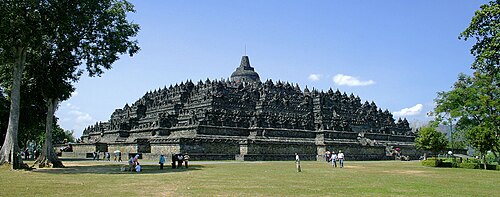
Borobudur is on the island of Java in Indonesia. It was built about 1,200 years ago out of about two million blocks of volcanic stone. It has no rooms inside. Instead, it is like an enormous stone mountain with steps and terraces going up and up.
If you visit, you walk around each level before you climb to the next one. On the walls of the lower levels there are more than 2,600 carved stone pictures. Some show the life of the Buddha, from his birth as a prince to his first teaching. Others tell stories of his earlier lives, when he was born as animals and people and did kind and brave things. Some show a young man named Sudhana travelling to meet many teachers in search of wisdom.
As you go higher, the pictures stop. The top is round and open, with 72 bell-shaped stone stupas. Each one has holes like a lattice, and inside sits a stone Buddha. In the middle is one big stupa. Climbing to the top is meant to be like a journey from our busy everyday world to calm and wisdom.
For hundreds of years, Borobudur was covered by volcanic ash and jungle, and people nearby stopped using it. In 1814 it was cleared and shown to the wider world. Later, engineers took much of it apart stone by stone, cleaned the stones and put them back together, a little like a giant puzzle.
Today Borobudur is a World Heritage Site and one of the most visited places in Indonesia. Every year, on the festival of Vesak, Buddhists walk in procession from two smaller temples nearby to Borobudur to celebrate the Buddha’s birth, enlightenment and passing.
At a glance
- Built
- About 780–830s CE, in several stages; construction probably ended around the 830s
- Place
- Kedu Plain, near Magelang, Central Java, Indonesia, about 40 km north-west of Yogyakarta
- Builders
- The Sailendra dynasty of the Mataram kingdom (Medang), followers of Mahayana Buddhism
- Form
- Stepped stupa-mountain: six square platforms topped by three circular platforms and a central stupa; no interior space
- Size
- Base about 123 × 123 m; height today about 35 m; roughly 55,000 m³ of andesite stone
- Decoration
- 2,672 relief panels (1,460 narrative, 1,212 decorative); originally 504 Buddha statues; 72 perforated stupas
- Rediscovery and restoration
- Cleared from 1814; restored by Theodoor van Erp 1907–1911 and by Indonesia with UNESCO 1975–1982
- Status
- UNESCO World Heritage Site “Borobudur Temple Compounds” (with Mendut and Pawon), inscribed 1991
Easy
What is Borobudur?
Borobudur is the largest Buddhist monument in the world. It stands on a low hill in the fertile Kedu Plain of Central Java, surrounded by volcanoes and between two rivers, the Progo and the Elo. It was built in the late eighth and early ninth centuries, during the rule of the Sailendra dynasty.
Although it is often called a temple, Borobudur has no hall or chamber inside where people gather. It is a solid structure of stone built over a natural hill. Its whole shape is a kind of stupa, a Buddhist monument that represents the Buddha and his enlightenment, and it is also designed as a sacred mountain that visitors climb.
The monument is famous for its reliefs, stone carvings that cover the walls and balustrades of its galleries. Together they form one of the largest and most complete sets of Buddhist relief sculpture anywhere, and they also offer a rich picture of life in ninth-century Java: its houses, ships, clothing, musical instruments, plants and animals.
Easy
How to “read” Borobudur: a path upward
Borobudur is meant to be experienced on foot. A pilgrim enters from the east and walks clockwise around each level, keeping the monument on the right, an act of respect called pradakshina. Only after completing a level does the pilgrim climb the stairs to the next. The walls and balustrades of the four square galleries carry the narrative reliefs, which are arranged in eleven series over a total length of about 3 km.
The upward journey is often explained with three “realms” from Buddhist cosmology. At the bottom is the world of desire (Kamadhatu), represented by the hidden foot with reliefs about karma. Next come the square galleries, the world of form (Rupadhatu), filled with stories. At the top the circular terraces, open to the sky and without narrative carvings, represent the formless world (Arupadhatu). This explanation is popular and helpful, although some scholars now question whether the builders thought in exactly these terms.
The Buddha statues also change as one climbs. On the square levels, niches hold seated Buddhas whose hand gestures (mudras) differ by direction: touching the earth on the east side, giving on the south, meditating on the west and reassuring (no fear) on the north; on the highest square level they make a teaching gesture. On the three circular terraces, 72 stupas (32, 24 and 16 on each ring) enclose Buddhas turning the wheel of the Dharma. The great central stupa crowns the monument.
Easy
The stories in stone
The reliefs tell several different Buddhist texts. On the upper row of the main wall of the first gallery, 120 panels follow the Lalitavistara, the story of the Buddha’s last life: his descent from heaven, his birth as Prince Siddhartha, his life in the palace, his departure, his search, his enlightenment and his first sermon in the Deer Park at Sarnath.
Other panels on the first and second galleries illustrate Jataka and Avadana tales, stories of the Buddha’s former lives and of other holy figures. In one popular Jataka, the future Buddha, born as a hare, offers his own body as food to a hungry traveller. Such tales teach generosity, patience and compassion.
The upper galleries are dominated by the Gandavyuha, the final part of the Avatamsaka Sutra, in which the young pilgrim Sudhana travels to meet dozens of teachers, from monks and kings to a night goddess, in search of perfect wisdom, and finally enters the vision of the bodhisattva Samantabhadra. The pilgrim who walks the galleries mirrors Sudhana’s journey.
Intermediate
How it was built
Borobudur was built over a natural hill, which was shaped and filled with earth. Around and over this core, the builders laid about 55,000 cubic metres of andesite, a grey volcanic stone taken from nearby rivers. The blocks were fitted without mortar, held together by knobs, indentations and dovetail joints, and then carved in place. Drains and about a hundred spouts shaped like monster heads carried away the heavy tropical rain.
Archaeologists, especially Jacques Dumarçay, have identified several building phases. Work seems to have begun around 780 and to have changed plan more than once: for example, the base was enlarged and the lowest level of reliefs covered, and the top may originally have been planned differently. Construction probably ended around the 830s.
The design appears to follow careful proportions; researchers have noted a ratio of 4 : 6 : 9 in the foot, body and head of the monument, also found in the related temples of Mendut and Pawon. Tradition names the architect as Gunadharma, but this name comes from local legend, not from any inscription, and nothing is known of him historically.
Intermediate
A window on ninth-century Java
Although the reliefs illustrate Indian Buddhist texts, the sculptors filled them with the world they knew. Houses stand on posts with steep, saddle-shaped roofs; markets, kitchens and farms appear in the background; people wear Javanese clothing and jewellery. Scenes include musicians with drums, lutes, flutes and bells, dancers, hunters, soldiers, traders weighing goods, and parents caring for children.
The natural world is shown in rich detail: elephants, monkeys, peacocks, fish, turtles and many kinds of trees, including the wish-granting tree (kalpataru) surrounded by birds and heavenly beings. The ship reliefs show large vessels with outriggers, multiple sails and steering oars, evidence of the seafaring technology that linked Java with the Indian Ocean world.
The hidden Karmavibhanga panels are particularly valuable because they show everyday actions, good and bad: fishing and butchering, gossip and quarrels, giving alms and caring for the sick, and the rewards or punishments that follow. For historians of Southeast Asia, Borobudur is therefore not only a religious monument but also one of the most important visual records of early Javanese society, technology and material culture.
Intermediate
The Sailendras and ninth-century Java
Borobudur was created by the Sailendra (“Lord of the Mountain”) dynasty, which ruled much of Central Java from the mid-eighth century. The Sailendras were patrons of Mahayana Buddhism and built many monuments, including Kalasan, whose inscription of 778 is the earliest clear evidence of the dynasty. Their origins are debated: older theories linked them to India or to Funan in Cambodia, but many scholars now think they were Javanese.
The Sailendras shared power in Central Java with another line, often called the Sanjaya dynasty, which favoured Hinduism. Samaratungga is thought to have been the Sailendra ruler when Borobudur was completed. His daughter Pramodhawardhani married Rakai Pikatan of the Hindu line; the great Hindu temple complex of Prambanan, not far away, was built soon after. The two religions coexisted, and Borobudur itself may have been completed under this mixed court.
This was a period of wide maritime connections. Java traded with India, China and the rest of Southeast Asia, and the Sailendras had close links with the Sumatran kingdom of Srivijaya, a major centre of Buddhist learning. The reliefs, which show large outrigger ships, reflect this seafaring world; in 2003–04 a replica of one of these ships, the Samudra Raksa, sailed from Indonesia to Africa.
Intermediate
Religious meaning: mountain, stupa and mandala
Borobudur combines several Buddhist ideas. As a stupa it stands for the Buddha’s body and his enlightened mind. As a stepped mountain it recalls Mount Meru, the centre of the world in Indian cosmology, and perhaps also older Javanese traditions of terraced sacred sites on hills, which honoured ancestors.
Seen from above, its plan of squares and circles forms a mandala, a sacred diagram used in meditation and ritual in esoteric (Vajrayana) Buddhism. The arrangement of Buddhas facing the four directions around a centre fits such a scheme. Scholars debate how far the monument follows a particular esoteric text.
Borobudur was part of a ritual landscape. It lies on a straight line with the smaller temples of Pawon and Mendut, about 3 km to the east. Mendut still contains three large stone statues: a seated Buddha flanked by two bodhisattvas. Today, during Vesak, the procession of Indonesian and foreign Buddhists from Mendut through Pawon to Borobudur revives this connection.
Intermediate
Abandonment and rediscovery
In the early tenth century the centre of Javanese power moved from Central to East Java, around 928–929 under King Mpu Sindok, perhaps partly because of volcanic eruptions from Mount Merapi. Borobudur gradually lost its royal patrons. It was not completely forgotten: the fourteenth-century Old Javanese poem Nagarakretagama mentions a Buddhist sanctuary at “Budur”, and later Javanese chronicles told stories of misfortune connected with the hill. But the monument became covered by ash and vegetation, and Islam, which spread in Java from the fifteenth century, became the majority religion.
In 1814, during the brief British occupation of Java, Lieutenant-Governor Thomas Stamford Raffles heard of a great monument in the area and sent the Dutch engineer H. C. Cornelius to investigate. His team of about 200 men spent two months cutting trees, burning vegetation and removing earth. Work continued under the Dutch, and by 1835 the monument was largely exposed.
Clearing it brought new dangers. Visitors carried away heads of Buddhas and pieces of reliefs, and in 1896 the Dutch colonial government gave the visiting King Chulalongkorn of Siam a large collection of sculptures, including relief panels, Buddha images, lions and a guardian figure, which are now in the National Museum in Bangkok. Rain drained through the exposed structure and the monument began to subside.
Intermediate
Restorations and threats
In 1885 the engineer J. W. IJzerman discovered that the base of the monument hid an earlier foot carved with 160 panels illustrating the Karmavibhanga, a text about karma: good and bad deeds and their consequences in this life and the next. The panels were photographed in 1890–91 and covered again; today only a few on the south-east corner are exposed.
Between 1907 and 1911 the Dutch army engineer Theodoor van Erp carried out the first major restoration. He rebuilt the circular terraces and stupas, and reconstructed the chattra (parasol) on top of the main stupa before removing it because he could not prove its original form. But drainage problems continued, and by the 1960s the galleries were leaning and the stones decaying.
From 1975 to 1982 the Indonesian government and UNESCO, with support from many countries, carried out a huge restoration led by the archaeologist R. Soekmono. About a million stones were removed, cleaned, catalogued and replaced on new concrete foundations with modern drainage. Borobudur was inscribed as a World Heritage Site in 1991. It has since faced new threats: bombs damaged nine stupas in 1985; ash from the 2010 eruption of Merapi and the 2014 eruption of Kelud covered the monument; and heavy tourism has worn the steps, leading to wooden covers on stairways and limits on visitors climbing to the top.
Intermediate
Borobudur today: pilgrimage, nation and tourism
Indonesia today has a Muslim majority, but Borobudur is valued across the country as a symbol of the nation’s long history and artistic achievement. At the same time, it is a living religious site for Indonesia’s Buddhist minority and for Buddhists from abroad, who come to meditate, circumambulate and celebrate Vesak. Balancing the needs of worshippers, tourists and conservation is an ongoing challenge.
Tourism has grown enormously since the 1970s. Millions of visitors have brought income to the region but also wear on the stone, litter and crowding. After studies showed serious erosion of the stairs, the authorities covered some stairways with wood, and in recent years they have limited the number of people allowed to climb onto the monument each day and required guides and special footwear.
The surrounding landscape is part of the heritage. Villages, rice fields and the views of the volcanoes Merapi, Merbabu, Sumbing and Sindoro frame the monument, and planners have tried to protect this setting through zoning and parks. Local communities, many of whom depend on tourism, have sometimes felt excluded from decisions about the site, a debate familiar at many World Heritage Sites.
Advanced
Scholarly debates: name, date and design
The name. The word Borobudur does not appear in early inscriptions. Raffles thought it meant “great Buddha”; others have linked “budur” to a Javanese word for “ancient” or to Sanskrit bhudhara, “mountain”. The epigrapher J. G. de Casparis proposed, from inscriptions of 824 (Karangtengah) and 842 (Tri Tepusan), that the original name was Bhumisambhara-bhudhara, “the mountain of accumulated virtues of the ten stages [of the bodhisattva]”. This reading has been influential but is not universally accepted.
The hidden foot. Why was the Karmavibhanga base covered? A practical explanation is that the builders feared the monument would slide outwards and added a buttress of stone around the foot; a religious explanation is that the depictions of desire and hell were meant to be concealed, or that covering was part of consecration. The structural explanation is widely favoured, but the question remains open.
The original plan. Scholars disagree about whether the building was begun as something else, perhaps a Hindu or indigenous terraced structure later converted into a Buddhist stupa, and about what the summit originally looked like. The three-realm interpretation (Kamadhatu, Rupadhatu, Arupadhatu), proposed by W. F. Stutterheim in the early twentieth century, has also been criticized as not grounded in any text found at the site.
Advanced
Evidence, hypotheses and conservation science
In 1931 the Dutch artist and scholar W. O. J. Nieuwenkamp proposed that the Kedu Plain had once been a lake and that Borobudur represented a lotus flower floating on it. Later pollen analysis found no trace of the water plants a lake would have left, and field studies in the 1980s concluded that no lake surrounded the monument when it was built, so the idea is generally rejected.
The main sources for Borobudur’s history are the monument itself (its structure, masonry marks, relief styles and short inscriptions on the hidden foot, which help date it by the form of the script), a handful of stone and copper-plate inscriptions from Central Java, comparisons with other temples, and the records of nineteenth- and twentieth-century clearing and restoration. Photographs by Isidore van Kinsbergen (1870s) and Kassian Cephas (who photographed the hidden foot) are valuable evidence of the monument’s earlier state.
Conservation has become a research field of its own. Scientists monitor the stone for salt crystallization, lichen and moss, study how volcanic ash and acid rain affect andesite, and measure the impact of visitor numbers. As at other great monuments, the restoration decisions of 1907–11 and 1975–82 are now part of the evidence, and scholars must distinguish original work from reconstruction.
Key ideas
- Stupa-mountain
- Borobudur is both a stupa, a symbol of the Buddha, and a sacred mountain that pilgrims climb.
- Ascent as teaching
- Walking up through the galleries leads from stories of karma and past lives to the calm, open summit, a path toward enlightenment.
- Mandala
- Seen from above, the plan forms a sacred diagram of squares and circles centred on the main stupa.
- Narrative reliefs
- More than 1,400 narrative panels teach Buddhist texts and preserve images of daily life in ninth-century Java.
- Religious coexistence
- Buddhist Borobudur and Hindu Prambanan were built by related courts within a few decades of each other.
- Ritual landscape
- Borobudur, Pawon and Mendut lie on one line and were probably used together in ritual.
- Restoration as history
- Colonial clearing, van Erp’s restoration and the UNESCO project have shaped the monument we see today.
Records
- 778 CE — The Kalasan inscription gives the earliest clear evidence of the Sailendra dynasty.
- c. 780 CE — Construction of Borobudur begins.
- 824 CE — The Karangtengah inscription records a Buddhist sanctuary founded under Samaratungga’s line.
- c. 833 CE — Construction is probably completed.
- 842 CE — The Tri Tepusan inscription grants tax-free land for a sanctuary called Bhumisambhara.
- c. 929 CE — The Javanese court moves to East Java under Mpu Sindok.
- 1365 — The Nagarakretagama mentions a Buddhist sanctuary at Budur.
- 1814 — Raffles sends H. C. Cornelius to clear the monument.
- 1885 — J. W. IJzerman discovers the hidden foot with its Karmavibhanga reliefs.
- 1907 — Theodoor van Erp begins the first major restoration (to 1911).
- 1975 — The Indonesian–UNESCO restoration begins (to 1982).
- 1991 — Borobudur Temple Compounds are inscribed on the UNESCO World Heritage List.
Glossary
- Stupa
- A dome-shaped Buddhist monument, originally containing relics, that represents the Buddha and enlightenment.
- Candi
- The Indonesian word for an ancient temple or shrine.
- Relief
- Sculpture carved so that figures project from a flat background.
- Mudra
- A symbolic hand gesture in Buddhist and Hindu art.
- Mandala
- A sacred diagram representing the cosmos, used in ritual and meditation.
- Pradakshina
- Walking clockwise around a sacred object as an act of devotion.
- Jataka
- Stories of the Buddha’s previous lives, teaching moral virtues.
- Mahayana
- The “Great Vehicle”, a major branch of Buddhism emphasizing bodhisattvas and compassion for all beings.
- Andesite
- A grey volcanic rock used to build Borobudur and many other Javanese temples.
- Anastylosis
- A restoration method that reassembles a monument from its original pieces, adding new material only where necessary.
- Sailendra
- The Buddhist royal dynasty of Central Java that built Borobudur.
Questions and answers
Is Borobudur a temple you can go inside?
No. It has no rooms. It is a solid stone monument built over a hill, and visitors walk around and up its open galleries and terraces.
How many Buddha statues are there?
There were originally 504. Many have lost their heads or been damaged or taken away since the monument was rediscovered.
Why was Borobudur abandoned?
The royal court moved to East Java in the early tenth century, possibly partly because of volcanic eruptions, and the monument slowly lost its patrons. Later, most of Java became Muslim.
Who discovered Borobudur?
Local people always knew of the hill. In 1814 Raffles sent the engineer H. C. Cornelius to clear it, which brought it to international attention.
Is Borobudur still used for worship?
Yes. It is a major pilgrimage site, especially at Vesak, when Buddhists walk in procession from Mendut and Pawon to Borobudur.
Why is the base with the karma reliefs hidden?
Probably to strengthen the monument and stop it from sliding, though some scholars suggest religious reasons. Photographs of the hidden reliefs are shown in the Karmawibhangga Museum.
Was Borobudur built in the middle of a lake?
This was proposed in 1931, but later research found no evidence that a lake surrounded the monument when it was built.
Why do so many of the Buddha statues have no heads?
Many heads were broken off or stolen after the monument was cleared in the nineteenth century and sold to collectors or taken as souvenirs. Some are now in museums outside Indonesia, and others have never been traced.
Sources and further reading
- Borobudur Temple Compounds. UNESCO World Heritage Centre
- Borobudur. Wikipedia
- 보로부두르. 위키백과
- Borobudur Temple Compounds. Wikipedia
- Shailendra dynasty. Wikipedia
- Karmawibhangga Museum. Wikipedia
- Mendut. Wikipedia
- Gandavyuha Sutra. Wikipedia
- Jataka tales. Wikipedia
- John Miksic, Borobudur: Golden Tales of the Buddhas. Periplus Editions, 1990
Related
- Angkor WatMonumental temple complex built in the Khmer Empire under King Suryavarman II.
- SeokguramEighth-century Buddhist grotto near Gyeongju, known for its granite Buddha and surrounding sculptures.
- Ajanta CavesA group of Buddhist rock-cut caves in western India, known for monasteries, shrines and paintings.
- Siddhartha Gautama (the Buddha)Founder of Buddhism, who taught a path to liberation from suffering on the Ganges plain. His dates are disputed.
- AshokaA Mauryan emperor whose inscriptions describe his commitment to dhamma after a devastating conquest of Kalinga.
- NāgārjunaA Buddhist philosopher associated with the Madhyamaka school and its analysis of emptiness.
Written with AI assistance from the published sources listed above, and revised as new research appears.