Start at the top for an easy introduction. Go further down for more detail and scholarship.
- Easy
- Intermediate
- Advanced
For young readers
Imagine a school where students live for years, sleeping in small brick rooms around a courtyard, getting up to the sound of a bell, bathing in big pools and then spending the day reading, listening to teachers and arguing about big questions. That was Nalanda, a Buddhist monastery in what is now the state of Bihar in India.
Nalanda began about 1,600 years ago, around the year 427, when a king of the Gupta dynasty gave land and money to build it. Later kings kept adding more buildings: more monasteries, more temples, and a great library that people said was many storeys tall.
Students came from very far away. A Chinese monk named Xuanzang walked and rode for years across deserts and mountains to get there, and stayed for about two years. Monks also came from Korea, Tibet, Indonesia and other lands. They learned Buddhist teachings, but also grammar, logic, medicine and more.
Getting in was said to be hard. According to Xuanzang, the gatekeepers asked difficult questions, and many people who wanted to join were turned away.
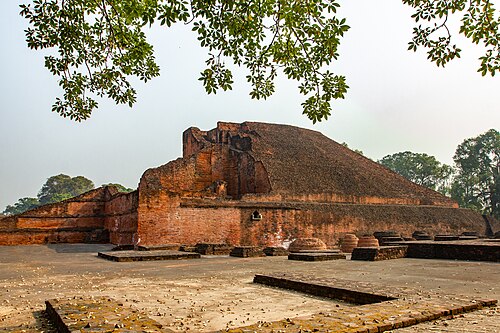
Around the year 1200, soldiers attacked the region and Nalanda was badly damaged by fire. Slowly it was abandoned and covered by earth. In the 1800s and 1900s archaeologists dug it out again, and today visitors can walk among its red-brick ruins, which are a UNESCO World Heritage Site.
At a glance
- What
- Buddhist mahāvihāra (great monastery) and centre of learning
- Where
- Near Rajgir, about 90 km southeast of Patna, Bihar, India (ancient Magadha)
- Founded
- c. 427 CE; a seal names the founder Śakrāditya, usually identified with the Gupta emperor Kumaragupta I
- Main patrons
- Gupta kings, Harsha of Kannauj (7th century), the Pala dynasty (8th–12th centuries), and foreign donors such as the Shailendra king Balaputradeva
- Famous visitors
- Xuanzang (630s–640s), Yijing (670s–680s), Korean and Tibetan monks
- Decline
- Raided around 1200 during the Turkic conquest of Bihar associated with Bakhtiyar Khalji; activity on a small scale continued for some decades
- Excavated area
- About 488 × 244 m (around 12 ha): eleven monasteries and six major brick temples
- Status
- UNESCO World Heritage Site “Archaeological Site of Nalanda Mahavihara” (2016)
Easy
What was Nalanda?
Nalanda was a Buddhist mahāvihāra, a “great monastery” made up of many individual monasteries (vihāras), temples and shrines, in the ancient region of Magadha in eastern India. It stood near Rajagriha (modern Rajgir), an old royal capital, and about 90 kilometres southeast of Pataliputra (modern Patna). From the fifth century until around 1200 it was one of the leading centres of Buddhist scholarship in Asia.
Nalanda is often called “the world’s first residential university”. The comparison helps to explain its scale and its role: thousands of monks lived there, studied under famous teachers and debated with rival schools. But scholars caution that it was not a university in the modern sense. It was a monastic community with religious rules and duties, and learning was part of monastic life rather than a path to a degree.
The name Nalanda is older than the monastery. Early Buddhist and Jain texts mention a place called Nalanda near Rajagriha, which both the Buddha and Mahavira, the great teacher of Jainism, are said to have visited. Buddhist tradition also holds that Shariputra, one of the Buddha’s chief disciples, was born and died there. Archaeologists, however, have found no monastic buildings older than the fifth century CE.
Today the excavated ruins, with their long rows of red-brick monasteries and the great stepped temple known as Temple 3, form a World Heritage Site. Nearby are a museum of finds and a modern university that has taken Nalanda’s name.
Easy
Life inside the monastery
A monastery at Nalanda was a rectangular brick building with a central courtyard surrounded by a veranda and a ring of small cells where monks lived and studied. Opposite the entrance was a shrine with an image of the Buddha. Many buildings had two or more storeys. Monks slept on stone or brick beds built into the walls, and each cell had niches for lamps and books.
The Chinese monk Yijing, who lived at Nalanda for about ten years in the late seventh century, described daily routines in detail. The day began with the ringing of a bell; monks went to one of the ten large pools to bathe, following precise rules about how to wrap their bathing cloths. Meals, ceremonies, chanting and study followed a fixed timetable. Decisions about the community were taken in assembly, and a single monk’s objection could block a proposal.
The monastery was supported by land grants. According to Xuanzang, the king had given the revenues of about a hundred villages; Yijing, a few decades later, spoke of two hundred. Villagers supplied rice, butter and milk so that monks did not have to work in the fields and could devote themselves to learning and practice.
Numbers are uncertain. Later retellings of Xuanzang’s account speak of about 10,000 monks and 1,500 teachers, while Yijing gives a figure of over 3,000. Archaeologists note that the excavated cells could not have housed ten thousand people, unless the monastery was much larger than what has been dug up so far.
Easy
What was studied at Nalanda?
Nalanda was above all a centre of Mahayana Buddhism, the “Great Vehicle” tradition that spread to China, Korea, Japan, Vietnam and Tibet. According to the biography of Xuanzang, all students studied Mahayana works as well as the texts of the eighteen early Buddhist schools. Tibetan tradition later summarised the main philosophies taught there as four systems: two schools of the Sarvāstivāda (Vaibhāṣika and Sautrāntika), the Madhyamaka or “Middle Way” school associated with Nagarjuna, and the Yogācāra or “Mind-only” school of Asanga and Vasubandhu.
Students also studied subjects outside Buddhist doctrine: Sanskrit grammar, logic and the art of debate, medicine, and texts from the Brahmanical tradition such as the Vedas and the Sāṃkhya philosophy. Skill in logic was essential, because monks had to defend Buddhist positions in public debates with rival schools, including Hindu and Jain thinkers.
Xuanzang recorded that about a thousand teachers could explain twenty collections of sutras and treatises, five hundred could explain thirty, and only ten could explain fifty. The abbot at the time, Śīlabhadra, was said to have mastered them all. Such figures express how knowledge was measured: by the ability to explain and defend texts.
Many of the most important thinkers of later Indian Buddhism were associated with Nalanda, including Dharmapāla, Śīlabhadra, Chandrakīrti, Dharmakīrti, Śāntideva and Śāntarakṣita. Earlier figures such as Nagarjuna, Asanga and Vasubandhu were later claimed as Nalanda masters by tradition, although whether they actually taught there is uncertain because they probably lived before the monastery was founded.
Intermediate
Foundation and patrons
The Chinese pilgrim Faxian, who travelled in India between about 399 and 412, visited the area but mentions no great monastery at Nalanda, which suggests it did not yet exist. A seal found at the site names a king Śakrāditya as founder, and Xuanzang’s account agrees. Scholars generally identify Śakrāditya with the Gupta emperor Kumaragupta I (r. c. 415–455), and coins found at Nalanda support a foundation in his reign. The conventional date is about 427 CE.
Later Gupta rulers added monasteries and temples. The Gupta kings were followers of Hindu gods, and many other donors whose seals have been found at Nalanda were not Buddhists either: their seals show deities such as Lakshmi, Ganesha and Durga. Supporting a famous monastery brought prestige and religious merit regardless of one’s own faith.
In the seventh century the emperor Harsha of Kannauj became a major patron. Xuanzang, who visited during his reign, described Nalanda as the creation of a long succession of kings, surrounded by a brick wall and crowded with richly decorated towers and pavilions. Other Indian rulers and foreign kings contributed too.
From the mid-eighth century the Pala dynasty of Bengal and Bihar, who were Buddhists, supported Nalanda for about four centuries. A copper-plate inscription of about 860, found in Monastery 1, records that Balaputradeva, a Shailendra king of Suvarnadvipa (Sumatra and Java), built a monastery at Nalanda and asked the Pala king Devapala to grant five villages for its upkeep. The Palas also founded new monasteries nearby, such as Vikramashila and Odantapuri, which eventually competed with Nalanda for scholars.
Intermediate
Pilgrims from China, Korea and Tibet
Much of what we know about Nalanda comes from Chinese pilgrims. Xuanzang left China in 629, travelled overland through Central Asia and reached India in the early 630s. He studied at Nalanda under the aged abbot Śīlabhadra, especially the Yogācāra teachings that were only partly known in China, as well as logic and Sanskrit. He spent about two years there in total, later lecturing to the community. He returned to China in 645 with hundreds of Sanskrit texts and spent the rest of his life translating them. His journey later inspired the Chinese novel Journey to the West.
Yijing took the sea route through Southeast Asia, arriving in India in 673 and spending about ten years at Nalanda. His account, translated into English by J. Takakusu in 1896, focuses on monastic discipline and daily life. He brought back some 400 Sanskrit texts.
Korean monks also made the long journey. Yijing’s writings mention monks from Silla, such as Hyeon-jo and Hye-ryun, who stayed at Nalanda and took Sanskrit names. Several died far from home. In the same period Tibetan students came to study Sanskrit and Buddhism; Tibetan tradition credits the minister Thonmi Sambhota, who studied in India, with creating the Tibetan script.
The flow of people and texts ran in both directions. Nalanda scholars were invited abroad, and its teachings shaped Buddhism in East Asia and Tibet, while gifts from rulers in Southeast Asia and elsewhere helped to maintain it.
Intermediate
The library and the buildings
Nalanda was famous for its library, which Tibetan sources call Dharmagañja, “Treasury of the Dharma”. According to these later traditions it occupied three great buildings named Ratnasāgara (“Ocean of Jewels”), Ratnodadhi (“Sea of Jewels”) and Ratnarañjaka (“Jewel-adorned”), one of them nine storeys high. These descriptions come from much later Tibetan works and cannot be checked against archaeology, but the huge numbers of texts carried away by pilgrims show that manuscript collections were large. Copying palm-leaf manuscripts was a constant task in the humid climate.
The excavated area measures about 488 metres from north to south and 244 metres from east to west. A broad passage runs north to south, with temples on its western side and monasteries on its eastern side. Most monasteries face west. Many buildings show several phases of construction, with new structures built on top of older ruins, and signs of fire.
Monastery 1 is considered the oldest and most important of the monastery group and shows as many as nine levels of construction. Its lower levels are thought to be the monastery sponsored by Balaputradeva. Temple 3, the so-called Sariputta Stupa, is the most striking monument: a massive stepped brick structure enlarged at least seven times, surrounded by small votive stupas and decorated with stucco images of the Buddha and bodhisattvas.
Other finds include a temple (Temple 2) with over two hundred sculpted panels showing Hindu deities, musicians, couples and scenes of daily life; the only surviving fragment of mural painting at Nalanda at Temple 14; a metal-working furnace at Temple 13; and thousands of seals, inscriptions, bronzes and stone sculptures now kept in the Nalanda Archaeological Museum, which opened in 1917.
Intermediate
Raids, fire and decline
Nalanda suffered several disasters. Later traditions say it was damaged by raids in earlier centuries, and a Pala-period inscription records a fire that destroyed manuscripts and the support given to restore them. The most serious blow came around 1200, when Turkic forces led by Muhammad Bakhtiyar Khalji conquered Bihar and Bengal on behalf of the new Delhi Sultanate. Monasteries in the region, which contained wealth and were sometimes fortified, were attacked, and many monks were killed or fled.
Excavators in the 1920s found a thick layer of ash on the upper levels of many buildings, evidence of a catastrophic fire. The chronicle Ṭabaqāt-i Nāṣirī by Minhaj-i Siraj, often quoted as describing the sack of Nalanda, actually describes the capture of a fortified monastery that most historians identify with nearby Odantapuri. Nevertheless, other evidence shows that Nalanda too was raided.
The Tibetan monk Dharmasvāmin visited Nalanda around 1235. He found it largely damaged and deserted, but a ninety-year-old teacher, Rāhula Śrībhadra, was still teaching about seventy students with support from a local ruler and a lay patron. During his stay, soldiers from a nearby garrison threatened the community, and the monks fled while he and his teacher hid. Small-scale activity may have continued later still, but Nalanda never recovered its former role.
Historians also point to longer-term causes of decline: the rise of rival monasteries under the Palas, the loss of royal patronage after the Pala dynasty fell, and broader changes in Indian religion as Buddhism lost ground to Hindu devotional movements. Many monks carried texts and traditions to Tibet and Nepal, where Nalanda’s intellectual heritage lived on.
Intermediate
Rediscovery, excavation and revival
After centuries of neglect, the mounds at the village of Bargaon attracted the attention of Francis Buchanan-Hamilton, who surveyed the area in 1811–1812 but did not connect it with Nalanda. The identification was made by Markham Kittoe in 1847, and Alexander Cunningham, the first head of the Archaeological Survey of India (ASI), surveyed the site in 1861–1862 using Xuanzang’s description as a guide.
Systematic excavation by the ASI began in 1915 and continued, season by season, until 1937, when budget cuts stopped the work. Archaeologists such as D. B. Spooner, Hirananda Sastri and J. A. Page uncovered the monasteries and temples, conserved exposed walls and recorded inscriptions and seals. A second phase of excavation and restoration took place between 1974 and 1982. The excavators noted that the monastic complex continues beyond the excavated area under the modern village.
Nalanda also became a symbol. In 1951 the government of Bihar founded the Nava Nalanda Mahavihara, an institute for Pali and Buddhist studies near the ruins. A memorial hall to Xuanzang was built with Chinese participation. In 2010 the Indian Parliament passed an act to establish a new Nalanda University at nearby Rajgir, supported by countries of the East Asia Summit; it began teaching in 2014.
In 2016 UNESCO inscribed the ruins on the World Heritage List as the “Archaeological Site of Nalanda Mahavihara”, recognising the site as an outstanding testimony to monastic learning and to the long history of Buddhist scholarship in Asia. The site is protected and managed by the ASI.
Intermediate
Nalanda’s legacy in Tibet and East Asia
Nalanda’s influence is clearest in Tibet. In the eighth century the Tibetan king invited Śāntarakṣita, a scholar of Nalanda, who founded Samye, the first Buddhist monastery in Tibet; his student Kamalaśīla continued his work. Later the teacher Atiśa, associated with Vikramashila, brought the Pala-period tradition to Tibet in the eleventh century. Tibetan Buddhists regard their philosophical and monastic curriculum as a continuation of Nalanda’s, and the Dalai Lama often speaks of “the Nalanda tradition” and of seventeen Nalanda masters.
In East Asia, translations made by Xuanzang and others transmitted Yogācāra philosophy, logic and many sutras. The Chinese Faxiang school and its Japanese successor Hossō, based on Xuanzang’s translations, drew directly on Nalanda’s teachings. Esoteric Buddhist masters such as Śubhakarasiṃha and Vajrabodhi, associated with Nalanda, travelled to Tang China in the eighth century and helped to found the esoteric tradition that later reached Japan.
Nalanda’s relationship with Southeast Asia is visible in art. Bronzes and votive tablets from Sumatra, Java and southern Thailand share styles and themes with those from Nalanda and nearby Pala sites, reflecting close contacts with the Shailendra and Srivijaya kingdoms.
Finally, Nalanda has become a powerful idea in modern times: a symbol of Asian intellectual exchange, of a golden age of Indian learning, and of loss. That symbolic weight sometimes leads to exaggerated claims, which makes careful reading of the evidence all the more important.
Advanced
Debates: “university”, numbers and the story of destruction
Was Nalanda a university? The label goes back to nineteenth- and twentieth-century writers who compared it with Oxford or Bologna. Scholars such as Hartmut Scharfe have described large monastic institutions like Nalanda as India’s nearest equivalent to universities, while others stress their fundamentally religious and monastic character. There were no degrees, and admission meant entering a monastic community. The comparison is useful for scale and organisation but can mislead about purpose.
How big was it? The figures of 10,000 students and 1,500 teachers derive from the biography of Xuanzang and are often repeated uncritically. Yijing gives a much smaller figure, and archaeologists such as Frederick Asher have pointed out that the excavated cells could not house so many people. Either the numbers are exaggerated or much of the complex remains unexcavated; both may be partly true.
What caused its end? A popular story holds that Bakhtiyar Khalji burned Nalanda’s library, which smouldered for months. Historians note that the key Persian source describes Odantapuri rather than Nalanda, that the vivid details of the burning library come from later retellings, and that Dharmasvāmin’s eyewitness account shows a reduced community still active decades later. At the same time, the archaeological fire layer and Tibetan testimony confirm violent destruction in the region. Many historians therefore see the raids as a decisive blow to an institution already weakened by the loss of patronage and by competition from other monasteries.
The story has become politically charged in modern India, where it is sometimes used in debates about religion and history. A careful account keeps several points in view: the sources’ limitations, the reality of violence against monasteries in the conquest of Bihar, and the longer religious and economic changes that shaped Buddhism’s decline in India.
Advanced
Evidence: pilgrims’ accounts, inscriptions and archaeology
Our sources for Nalanda are of three main kinds. The first are the Chinese pilgrim records: Xuanzang’s travel record and the biography of him written by his disciple Huili, and Yijing’s accounts of Indian monastic practice and of Chinese monks who travelled to India. They are precious eyewitness testimonies, but they were written for Chinese Buddhist readers and sometimes idealise what they describe.
The second are inscriptions and seals found at the site. They record donations, land grants and building works by kings and private donors over several centuries, including the copper plate of Devapala recording Balaputradeva’s gift, inscriptions from the time of Yashovarman, and records of monks who built or repaired monasteries in the twelfth century. Clay seals of the “community of monks of Nalanda” confirm the institution’s name and corporate identity.
The third is archaeology: the plans of the excavated buildings, successive building phases, the fire layers, sculptures, bronzes and manuscripts carried away to Tibet and Nepal. A few manuscripts copied at or associated with Nalanda survive in museums and monasteries, such as an illustrated Prajñāpāramitā manuscript whose colophon traces its use in Tibet.
Tibetan histories, such as those of Tāranātha (seventeenth century), add stories about Nalanda’s library and its masters but were written long after the events and mix history with legend. Historians use them cautiously, alongside the earlier and more direct sources.
Key ideas
- Mahāvihāra
- A “great monastery” made up of many monasteries, temples and shrines within one complex.
- Royal and lay patronage
- Nalanda depended on grants of village revenues from kings of different faiths and on gifts from foreign rulers and private donors.
- Mahayana scholarship
- Nalanda was a centre of Madhyamaka and Yogācāra philosophy, logic and debate, shaping Buddhism across Asia.
- International community
- Monks from China, Korea, Tibet, Southeast Asia and Central Asia studied there, carrying texts and ideas home.
- Debate and logic
- Monks trained to defend Buddhist positions against other schools, making logic a core subject.
- Transmission to Tibet
- Tibetan Buddhism regards itself as the direct heir of the Nalanda tradition.
- Myth and evidence
- Popular images of Nalanda, from student numbers to the burning library, need to be checked against the sources.
Records
- 399 CE — Faxian begins his travels in India (399–412) and mentions no monastery at Nalanda.
- c. 427 CE — Foundation of the monastery, traditionally attributed to Kumaragupta I (Śakrāditya).
- 606 CE — Harsha becomes king at Kannauj and later becomes a major patron.
- c. 637 CE — Xuanzang studies at Nalanda under Śīlabhadra.
- 673 CE — Yijing arrives in India and later spends about ten years at Nalanda.
- c. 750 CE — The Pala dynasty rises in eastern India and patronises Nalanda for four centuries.
- c. 860 CE — Copper plate of Devapala records a monastery built by Balaputradeva of Suvarnadvipa.
- c. 1200 — Turkic forces associated with Bakhtiyar Khalji conquer Bihar; Nalanda is raided and burned.
- c. 1235 — Dharmasvāmin finds Nalanda damaged but with a small community still teaching.
- 1847 — Markham Kittoe identifies the ruins at Bargaon with Nalanda.
- 1915 — The Archaeological Survey of India begins systematic excavations (until 1937).
- 2016 — The Archaeological Site of Nalanda Mahavihara is inscribed on the UNESCO World Heritage List.
Glossary
- Vihāra
- A Buddhist monastery, usually a building with cells around a courtyard.
- Stupa
- A mound-shaped monument containing relics, circled by worshippers.
- Mahayana
- “Great Vehicle”: a major branch of Buddhism emphasising the bodhisattva path.
- Madhyamaka
- The “Middle Way” philosophy associated with Nagarjuna, centred on emptiness (śūnyatā).
- Yogācāra
- A school of Buddhist philosophy that analyses consciousness, associated with Asanga and Vasubandhu.
- Vajrayana
- Esoteric or tantric Buddhism, influential in the Pala period and in Tibet.
- Pala dynasty
- A Buddhist dynasty that ruled Bengal and Bihar from about 750 to the twelfth century.
- Colophon
- A note at the end of a manuscript recording who copied it, when and why.
- Archaeological Survey of India (ASI)
- The government body responsible for excavating and protecting India’s monuments.
Questions and answers
Was Nalanda really the world’s first university?
It is often called that, and it was one of the largest centres of learning of its time. But it was a monastery, without degrees, so scholars prefer to call it a great monastic centre of learning.
How many students were there?
Nobody knows exactly. Sources give figures from about 3,000 to 10,000, and archaeology suggests the higher numbers may be exaggerated.
Did only Buddhists study there?
The residents were Buddhist monks, but they also studied grammar, logic, medicine and Brahmanical texts, and many patrons were Hindu.
Did the library burn for months?
That is a popular story from later retellings. The site was burned around 1200, but the dramatic details are not supported by the earliest sources.
Who was Xuanzang?
A Chinese monk who travelled to India in the seventh century, studied at Nalanda and brought hundreds of texts back to China. His journey inspired the novel Journey to the West.
Did monks from Korea go there?
Yes. Yijing records Korean monks from Silla who studied at Nalanda in the seventh century, some of whom died in India.
Can you visit Nalanda today?
Yes. The excavated ruins, a museum and a memorial hall to Xuanzang are open to visitors near Rajgir in Bihar.
Sources and further reading
- Nalanda mahavihara. Wikipedia
- Xuanzang. Wikipedia
- Yijing (monk). Wikipedia
- Pala Empire. Wikipedia
- Muhammad Bakhtiyar Khalji. Wikipedia
- Nalanda University. Wikipedia
- Hartmut Scharfe, Education in Ancient India. Brill, 2002
- Samuel Beal (trans.), The Life of Hiuen-Tsiang, by the Shaman Hwui Li (translation). Kegan Paul, Trench, Trübner, 1911
- J. Takakusu (trans.), A Record of the Buddhist Religion as Practised in India and the Malay Archipelago (A.D. 671–695), by I-Tsing (translation). Clarendon Press, 1896
- George Roerich (trans.), Biography of Dharmasvamin (Chag lo-tsa-ba Chos-rje-dpal). K. P. Jayaswal Research Institute, 1959
Related
- Siddhartha Gautama (the Buddha)Founder of Buddhism, who taught a path to liberation from suffering on the Ganges plain. His dates are disputed.
- NāgārjunaA Buddhist philosopher associated with the Madhyamaka school and its analysis of emptiness.
- Journey to the WestMing novel that turns a Buddhist pilgrimage into a journey of adventure and satire.
- AryabhataAn Indian mathematician-astronomer whose Āryabhaṭīya gave π ≈ 3.1416, a sine table and the idea that the Earth rotates daily.
- BorobudurLarge Buddhist monument in Central Java, built around the eighth and ninth centuries.
- AshokaA Mauryan emperor whose inscriptions describe his commitment to dhamma after a devastating conquest of Kalinga.
Written with AI assistance from the published sources listed above, and revised as new research appears.