Start at the top for an easy introduction. Go further down for more detail and scholarship.
- Easy
- Intermediate
- Advanced
For young readers
About 1,500 years ago, in a big city in India called Kusumapura, near today’s Patna, there lived a young man named Aryabhata who loved numbers and stars. When he was only 23, he wrote a book about mathematics and astronomy. The whole book is just 121 short verses long, like a poem, so that students could learn it by heart.
In those verses he explained how to find the area of shapes, how to work with very large numbers and how to solve tricky puzzles about remainders. He also gave a number for pi, the number that tells you how much bigger the edge of a circle is than the line across it. His value, 3.1416, is extremely close to the true one.
Aryabhata also said something surprising: the stars do not really race around the sky every night. Instead, the Earth is turning, like a spinning top. He compared it to sitting in a boat: when the boat moves forward, the trees on the shore seem to move backward.
Many people then believed that eclipses happened because a demon swallowed the Sun or the Moon. Aryabhata explained that a lunar eclipse happens when the Moon moves into the Earth’s shadow, and a solar eclipse happens when the Moon blocks the Sun.
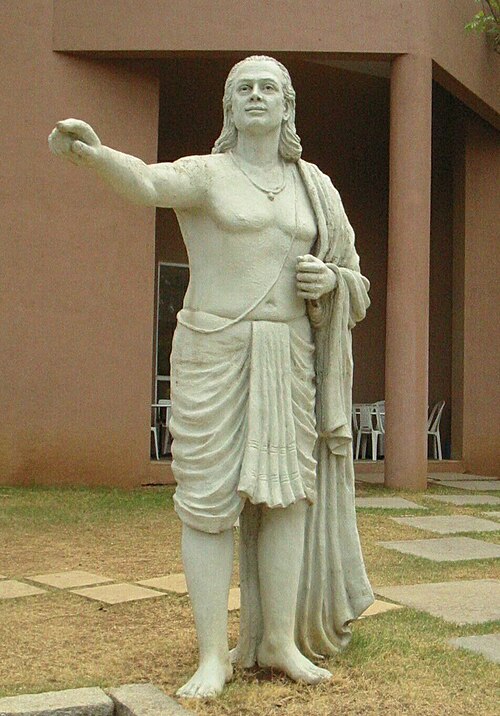
Nobody knows what Aryabhata looked like; no picture of him survives. But India named its very first satellite after him in 1975, and a crater on the Moon carries his name too.
At a glance
- Lived
- Born 476 CE (worked out from his own statement that he was 23 in the year 3600 of the Kali Yuga, 499 CE); date of death unknown
- Place
- He calls himself a native of Kusumapura, identified with Pataliputra (modern Patna, Bihar); a commentator calls him “of Ashmaka”, and other regions have been proposed
- Period
- Late Gupta era, the classical age of Indian mathematics and astronomy
- Main work
- Āryabhaṭīya: 121 Sanskrit verses in four chapters on mathematics, time-reckoning and the celestial sphere
- Lost work
- An astronomical system using midnight day-reckoning, known only through later authors
- Known for
- π ≈ 3.1416; a sine table; the kuṭṭaka method for indeterminate equations; the Earth’s daily rotation; the shadow theory of eclipses
- Legacy
- Founder of the Āryapakṣa school of astronomy; influenced Indian calendars, Islamic astronomy and the word “sine”
Easy
Who was Aryabhata?
Aryabhata, often called Aryabhata I to distinguish him from a later astronomer of the same name, is the earliest Indian mathematician-astronomer whose own work survives in full. He is the author of the Āryabhaṭīya, a compact treatise in Sanskrit verse that shaped Indian astronomy for more than a thousand years.
Almost everything we know about his life comes from a few lines in his own book and from remarks by later commentators. In the third chapter he says that when 3,600 years of the Kali Yuga, the current age in Indian cosmology, had passed, he was 23 years old. That year corresponds to 499 CE, which means he was born in 476. Some scholars think 499 was the year he wrote the book; others think it is simply an astronomical reference point he chose.
His name is correctly spelled Aryabhata, not “Aryabhatta”. Later astronomers such as Brahmagupta mention him by name many times, and the spelling with one “t” also fits the metre of Sanskrit verse.
No portrait of Aryabhata exists. Statues and pictures made in modern times, such as the statue at the Inter-University Centre for Astronomy and Astrophysics in Pune, are works of imagination.
Easy
Where and when he lived
Aryabhata worked in a period that historians often call the Gupta era, when much of northern India was ruled by the Gupta dynasty from its heartland in Magadha (modern Bihar). The age is remembered for Sanskrit literature, sculpture, temple building and scientific writing. Pataliputra, the old imperial capital on the Ganges, was a major centre of learning and trade.
In the Āryabhaṭīya he says that he is presenting knowledge honoured at Kusumapura. Both Hindu and Buddhist traditions, and the seventh-century commentator Bhaskara I, identify Kusumapura with Pataliputra. A later verse describes him as a kulapa, the head of an institution, at Kusumapura. Because the great monastery of Nalanda was not far away, it is sometimes claimed that he led Nalanda, but there is no evidence for this in his own writings, and most historians treat it as speculation.
His birthplace is less certain. Bhaskara I calls him āśmakīya, “belonging to Ashmaka”, a region usually placed in the Deccan between the Narmada and Godavari rivers. Some writers have argued for Kerala in the far south, noting that many later commentaries on his work were written there. Others think he was born near Pataliputra. The evidence does not settle the question.
A local tradition in Bihar links him with an observatory at the Sun temple of Taregana, south of Patna. This too is a later tradition rather than documented history.
Easy
The Āryabhaṭīya: a whole science in 121 verses
The Āryabhaṭīya is astonishingly short. It has four chapters (pādas). The first, the Gītikāpāda, has 13 verses: an invocation, a clever system for writing numbers with syllables, and tables of astronomical constants, including the number of revolutions of the planets in a great cycle of 4,320,000 years and a table of sines packed into a single verse.
The second chapter, the Gaṇitapāda, has 33 verses on mathematics: squares and cubes and their roots, areas and volumes, properties of circles and triangles, shadows cast by a gnomon (a vertical stick used as a sundial), arithmetic series, interest, and methods for solving equations. The third, the Kālakriyāpāda, has 25 verses on units of time and the motions of the planets. The fourth, the Golapāda, has 50 verses on the celestial sphere, the shape of the Earth, day and night, and eclipses.
The book is written in the terse style of Indian technical literature. Each verse is a memory aid, packing a rule into a few words that a student would learn by heart and a teacher would then explain. That is why the Āryabhaṭīya has always been read together with commentaries. The earliest surviving one, by Bhaskara I, dates to 629 CE.
Aryabhata also wrote at least one other work, an astronomical system in which the day begins at midnight instead of sunrise. It is lost, but later astronomers such as Varahamihira, Brahmagupta and Bhaskara I quote or describe it, and it included descriptions of instruments such as the gnomon and water clocks.
Intermediate
Mathematics: pi, sines and the “pulveriser”
The most famous verse of the Gaṇitapāda gives a rule for the circumference of a circle. It can be translated: “Add four to one hundred, multiply by eight, and add sixty-two thousand: this is the approximate circumference of a circle whose diameter is twenty thousand.” The result, 62,832 divided by 20,000, gives π ≈ 3.1416, correct to four decimal places. Aryabhata used the word āsanna, “approaching” or “near”, which some historians read as a sign that he knew the value could only be approximated.
Aryabhata worked with the half-chord of a circle rather than the full chord used by Greek astronomers. This half-chord, called ardha-jyā or simply jyā, is essentially our sine. His table gives values for 24 angles at intervals of 3° 45′ across a quarter circle, and he describes a way of computing the table from differences between successive values. The later history of the word is remarkable: Sanskrit jyā became Arabic jība, which was later read as jayb (“fold” or “pocket”) and translated into Latin as sinus, the origin of the English word “sine”.
Another important contribution is a method for finding whole-number solutions to equations such as ax − by = c, known as indeterminate or linear Diophantine equations. Indian mathematicians called the technique kuṭṭaka, “the pulveriser”, because it breaks the numbers down step by step into smaller ones, much like the Euclidean algorithm. Such problems mattered for astronomy, where one had to find when several cycles would line up. Bhaskara I and later mathematicians refined the method.
The book also gives rules for the sums of arithmetic series and for the sums of squares and cubes of the first n numbers, formulas for areas and volumes, and methods for extracting square and cube roots. These root methods only work within a place-value system of numbers with ten digits. Aryabhata did not write the digits themselves; instead he used his own system in which syllables stood for numbers, which allowed long numbers to fit into verse.
Intermediate
Astronomy: a spinning Earth and the cause of eclipses
Aryabhata’s most daring claim concerns the Earth. In the first chapter he gives the number of rotations of the Earth in a great cycle, and in the Golapāda he explains the daily movement of the stars with an image: just as a person in a boat moving forward sees motionless objects on the shore moving backward, so people at Lanka (a reference point on the equator) see the motionless stars moving westward. Most astronomers of his time, in India and elsewhere, believed that the Earth was fixed and the heavens turned around it.
The idea was not widely accepted. Later Indian astronomers, including Brahmagupta, rejected it, and some commentators even altered the wording of the verses so that the heavens moved instead. Centuries later the Persian scholar al-Biruni reported that followers of Aryabhata held that the Earth rotates.
Aryabhata also gave a clear physical explanation of eclipses. He stated that the Moon and planets shine by reflected sunlight, and that a lunar eclipse occurs when the Moon enters the shadow of the Earth, while a solar eclipse occurs when the Moon covers the Sun. In popular belief, eclipses were blamed on Rahu, a demon who swallows the Sun or Moon. Aryabhata’s verses calculate the size of the Earth’s shadow and the part of the Moon or Sun that will be darkened.
His numerical values were impressively precise. His figure for the time it takes the Earth to rotate once relative to the stars is equivalent to 23 hours, 56 minutes and about 4 seconds, very close to the modern value. His length of the sidereal year is about 365 days, 6 hours and 12 minutes, only a few minutes longer than the modern figure.
Intermediate
Time, cycles and the planetary model
Indian astronomy was closely tied to the calendar and to ritual. Priests and astrologers needed to know the positions of the Sun, Moon and planets to fix festivals, auspicious times and the lunar days called tithis. Aryabhata’s Kālakriyāpāda gives methods for calculating the mean positions of the planets for any given day, for adding intercalary months to keep lunar and solar calendars in step, and for naming the days of the week.
Earlier Indian cosmology divided time into enormous ages. Aryabhata kept the great cycle of 4,320,000 years but divided it into four equal parts, instead of the unequal ages of traditional Puranic cosmology. This departure from tradition was one reason Brahmagupta criticised him sharply.
Aryabhata’s model of the planets is geocentric: the Sun, Moon and planets move around the Earth. To reproduce their irregular movements, each planet is given two epicycles, a slower one (manda) and a faster one (śīghra). The order of the planets outward from the Earth is Moon, Mercury, Venus, Sun, Mars, Jupiter and Saturn, followed by the stars. Similar models appear in other Indian texts of the period, and many historians think they preserve elements of Greek astronomy from before Ptolemy.
The Āryabhaṭīya opens its time-reckoning with a moment when all the planets were supposed to be aligned at the start of the Kali Yuga, in 3102 BCE. This epoch, shared with other Indian systems, provided a fixed starting point for computing planetary positions.
Intermediate
Followers, critics and commentators
Aryabhata founded what later became known as the Āryapakṣa, the “school of Aryabhata”, one of the main traditions of Indian astronomy. Bhaskara I, writing about a century later, produced a detailed commentary in 629 and praised him as the master who had reached the far shore of the ocean of mathematics, kinematics and spherics. Brahmagupta, writing in 628, criticised many of his ideas yet discussed them at length, which shows how influential he was.
The Āryabhaṭīya was especially important in South India. In Kerala, astronomers and mathematicians produced a long series of commentaries, culminating in the work of Nilakantha Somayaji, whose commentary was written around 1500. The Kerala school of mathematics, famous for its work on infinite series, saw itself as continuing Aryabhata’s tradition.
Calendar makers throughout India used computations in the Aryabhata tradition to prepare the pañcāṅga, the traditional almanac. His numeral system with syllables was widely imitated in South Indian astronomical works.
A later astronomer, known as Aryabhata II, wrote a work called the Mahāsiddhānta around the tenth century. He should not be confused with the author of the Āryabhaṭīya.
Intermediate
Aryabhata beyond India
Indian astronomical works travelled west in the eighth century, when scholars at the Abbasid court in Baghdad translated Sanskrit texts into Arabic. Through these translations, Indian sine tables and methods for calculating planetary positions entered Islamic astronomy, which later transmitted them to Europe. The exact route by which Aryabhata’s own ideas travelled is not always clear, and the Arabic sources often speak of Indian astronomy in general rather than naming him.
Al-Biruni, who wrote a famous book on India in the eleventh century, knew of Aryabhata and his followers and discussed their view that the Earth rotates. The history of the word “sine”, from Sanskrit jyā through Arabic to Latin sinus, is a small but vivid trace of this chain of transmission.
In modern India Aryabhata became a national symbol of scientific achievement. India’s first satellite, built by the Indian Space Research Organisation and launched on a Soviet rocket on 19 April 1975, was named Aryabhata. The satellite appeared on the back of the Indian two-rupee note. A lunar crater, a research institute for observational sciences near Nainital and a university in Patna also bear his name.
Aryabhata is often presented in popular accounts as the inventor of zero or as someone who anticipated the heliocentric system of Copernicus. Both claims go beyond the evidence, as the advanced sections explain.
Advanced
Debates: zero, irrationality and heliocentrism
Did Aryabhata know zero? The Āryabhaṭīya uses no symbol for zero, and its numbers are written with syllables. However, his methods for extracting square and cube roots operate digit by digit in a decimal place-value system, and his numeration scheme assigns syllables to powers of ten, some of which may have null coefficients. Georges Ifrah and others argue that the concept of zero as a place-holder was therefore implicit. Most historians agree that decimal place-value arithmetic was in use; the question of when zero became an explicit number with its own rules is usually traced to Brahmagupta in 628.
Did he know π was irrational? The word āsanna, “approaching”, can be read as a simple admission that 3.1416 is approximate, or, more ambitiously, as an insight that no exact fraction exists. The irrationality of π was only proved in Europe by Johann Heinrich Lambert in 1761. Because Aryabhata gives no argument, most historians treat the stronger interpretation as possible but unproven. MacTutor notes, too, that in practical calculations Aryabhata’s tradition often used √10 rather than 3.1416.
Was his system secretly heliocentric? The historian B. L. van der Waerden argued that features of Aryabhata’s planetary model, especially the role of the śīghra epicycle linked to the Sun’s mean motion, betray an underlying heliocentric theory, perhaps inherited from lost Greek sources. Noel Swerdlow and others strongly rejected this reading, noting that the text is explicitly geocentric and that similar corrections occur in systems that are not heliocentric. The general consensus is that Aryabhata proposed a rotating Earth, not an Earth orbiting the Sun.
Where do his parameters come from? Scholars such as David Pingree traced many elements of Indian mathematical astronomy to Babylonian and Hellenistic sources adapted in India, while others emphasise independent Indian developments. The relationship between Aryabhata’s system and the earlier Paitāmaha-siddhānta and Sūrya-siddhānta traditions remains an active research topic.
Advanced
Evidence: manuscripts, editions and commentaries
The Āryabhaṭīya survives in many manuscripts, mostly from South India, and usually together with commentaries. Because the verses are so compressed, the commentaries are essential for understanding them. Bhaskara I’s commentary of 629 is the oldest and most detailed; later commentaries in Kerala, including those by Parameshvara and Nilakantha Somayaji, show how the text was used and sometimes reinterpreted.
Modern scholarship on the text began in the nineteenth century. The Dutch scholar Hendrik Kern published the Sanskrit text with Parameshvara’s commentary in Leiden in 1874. Walter Eugene Clark’s English translation appeared in 1930. The standard critical edition with translation and notes is that of K. S. Shukla and K. V. Sarma, published by the Indian National Science Academy in 1976, which also edited Bhaskara I’s commentary.
Biographical evidence is thin and partly legendary. Apart from the verse giving his age, we rely on commentators writing a century or more later, and on regional traditions that have their own interests: claims for Kerala, Bihar and the Deccan all have champions. Historians therefore separate what the text says from later attributions.
The lost midnight system is reconstructed from later works, especially Varahamihira’s Pañcasiddhāntikā and Brahmagupta’s Khaṇḍakhādyaka, which follows Aryabhata’s midnight reckoning. A work preserved in Arabic that claims to be a translation of Aryabhata has also been discussed, but its connection to him is uncertain.
Key ideas
- π ≈ 62,832 / 20,000
- Aryabhata’s value for pi, 3.1416, is correct to four decimal places. He called the circumference “approaching”, meaning approximate.
- Jyā (sine)
- The half-chord of a circle. Aryabhata’s table of 24 half-chords is one of the earliest sine tables, and the word itself travelled into Arabic and Latin as “sine”.
- Kuṭṭaka
- “The pulveriser”: a step-by-step method for finding whole-number solutions of equations like ax − by = c, used for astronomical cycles.
- Rotating Earth
- The daily motion of the stars is explained by the Earth turning on its axis, illustrated by the image of a moving boat.
- Shadow theory of eclipses
- Eclipses are caused by the Earth’s shadow falling on the Moon or the Moon hiding the Sun, not by a demon.
- Syllabic numerals
- A system in which consonants and vowels of Sanskrit stand for digits and powers of ten, allowing large numbers to be written in verse.
- Commentary tradition
- Short verses were meant to be explained by teachers; the commentaries of Bhaskara I and later Kerala scholars are key to understanding the text.
Records
- 3102 BCE — Traditional start of the Kali Yuga (3102 BCE), the epoch from which the Āryabhaṭīya counts time.
- 476 CE — Aryabhata is born, according to his statement that he was 23 in 499.
- 499 CE — Year 3600 of the Kali Yuga, when Aryabhata was 23; often taken as the date of the Āryabhaṭīya.
- 628 CE — Brahmagupta completes the Brāhmasphuṭasiddhānta, which criticises many of Aryabhata’s views.
- 629 CE — Bhaskara I writes his commentary on the Āryabhaṭīya, the oldest surviving.
- c. 1030 — Al-Biruni writes his book on India, mentioning Aryabhata’s followers and their belief in a rotating Earth.
- c. 1500 — Nilakantha Somayaji of the Kerala school writes an extensive commentary on the Āryabhaṭīya.
- 1761 — Lambert proves in Europe that π is irrational.
- 1874 — Hendrik Kern publishes the Sanskrit text with Parameshvara’s commentary in Leiden.
- 1930 — Walter Eugene Clark publishes an English translation.
- 1975 — India’s first satellite, Aryabhata, is launched on 19 April.
- 1976 — K. S. Shukla and K. V. Sarma publish the critical edition and translation.
Glossary
- Siddhānta
- A comprehensive treatise of mathematical astronomy in Sanskrit.
- Pāda
- A chapter or “quarter”; the Āryabhaṭīya has four.
- Gnomon
- A vertical stick whose shadow is measured to find time, latitude and direction.
- Epicycle
- A small circle whose centre moves along a larger circle, used to model irregular planetary motions.
- Sidereal day
- The time for the Earth to turn once relative to the distant stars, about 23 hours 56 minutes.
- Kali Yuga
- In Indian cosmology, the present and last of four ages; traditionally said to have begun in 3102 BCE.
- Place-value system
- A way of writing numbers in which the position of a digit shows its value (ones, tens, hundreds).
- Kusumapura
- “City of flowers”, a name identified with Pataliputra, near modern Patna.
- Commentary (bhāṣya)
- An explanatory work that interprets a short technical text line by line.
Questions and answers
Did Aryabhata invent zero?
Not exactly. He did not use a zero symbol, but his calculations rely on the decimal place-value system, in which zero is implied as a place-holder. Explicit rules for zero as a number appear in Brahmagupta’s work a century later.
How accurate was his pi?
Very accurate: 3.1416, correct to four decimal places. The true value begins 3.14159.
Did he say the Earth goes around the Sun?
No. He said the Earth spins on its axis each day, but his model of the planets places the Earth at the centre. Claims that he was secretly heliocentric are disputed.
Why is his book so short?
Indian technical works were composed in memorable verse so students could learn them by heart. Teachers and written commentaries supplied the explanations.
Was he the head of Nalanda?
There is no evidence for that in his own writings. A verse calls him the head of an institution at Kusumapura, and the link with Nalanda is modern speculation.
Why was India’s first satellite named after him?
He is a national symbol of India’s scientific heritage. The satellite Aryabhata was launched in 1975.
How do we know his birth year?
He wrote that he was 23 when 3,600 years of the Kali Yuga had passed, which corresponds to 499 CE. Counting back gives 476.
Sources and further reading
- Aryabhata. Wikipedia
- Aryabhatiya. Wikipedia
- J. J. O’Connor and E. F. Robertson, Aryabhata the Elder. MacTutor History of Mathematics Archive, University of St Andrews, 2000
- Aryabhata (satellite). Wikipedia
- Walter Eugene Clark, The Āryabhaṭīya of Āryabhaṭa: An Ancient Indian Work on Mathematics and Astronomy. University of Chicago Press, 1930
- K. S. Shukla and K. V. Sarma, Āryabhaṭīya of Āryabhaṭa (critical edition with translation and notes). Indian National Science Academy, 1976
- Kim Plofker, Mathematics in India. Princeton University Press, 2009
Related
- Al-KhwarizmiNinth-century mathematician, astronomer and geographer of Abbasid Baghdad whose books gave the world the words “algebra” and “algorithm.”
- House of WisdomName associated with Abbasid scholarly collections and translation activity in Baghdad.
- Nalanda MahaviharaA great Buddhist monastery and centre of learning in eastern India that drew monks from across Asia for some 800 years.
- Zhang HengEastern Han astronomer, inventor and poet who built the earliest recorded seismoscope and a water-powered armillary sphere.
- EuclidGreek mathematician of Alexandria, active around 300 BCE, whose Elements built geometry and number theory from a few definitions and postulates and became the most influential mathematics textbook in history.
- Nicolaus CopernicusRenaissance astronomer and church canon who argued that the Earth spins daily and orbits the Sun, launching the Copernican Revolution.
Written with AI assistance from the published sources listed above, and revised as new research appears.