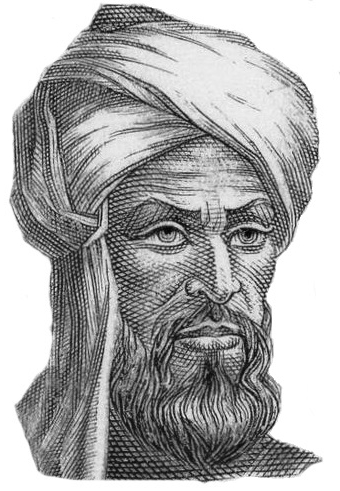
Start at the top for an easy introduction. Go further down for more detail and scholarship.
- Easy
- Intermediate
- Advanced
For young readers
About 1,200 years ago, in the big city of Baghdad in what is now Iraq, there lived a man named Muhammad, the son of Musa. People called him al-Khwarizmi, which means “the man from Khwarazm,” a land far to the east near the Aral Sea. We do not know much about his life—not even his exact birthday—but we do know the books he wrote.
The ruler of Baghdad, a caliph called al-Ma’mun, loved learning. He gathered clever people who read old books from Greece, Persia and India and translated them into Arabic. Al-Khwarizmi was one of these scholars. He studied the stars, made tables for the calendar, and drew lists of places on the map of the world.
His most famous book was about puzzles with a missing number. Imagine a riddle: “I think of a number, multiply it by itself, add ten times the number, and I get 39. What is my number?” Al-Khwarizmi showed step by step how to find the answer (it is 3). He even drew squares and rectangles to prove his method worked, like building with tiles.
One of the steps in his method was called al-jabr, which means “putting back together” or “restoring.” When his book was later translated into Latin, that word became “algebra.” So every time a student learns algebra today, they are using a word from al-Khwarizmi’s book.
He also wrote a book on how to calculate with the ten digits that came from India—including a special sign for “nothing,” which we call zero. When Europeans read this book in Latin, they turned his name into “Algoritmi.” That is where our word “algorithm” comes from: a clear list of steps to solve a problem, just like the instructions computers follow.
At a glance
- Lived
- c. 780 – c. 850 CE (both dates approximate; most of his known work falls between 813 and 833)
- Origin
- His name points to Khwarazm, south of the Aral Sea (today Uzbekistan and Turkmenistan); one medieval epithet has been read as linking him to Qutrubbul near Baghdad, which scholars dispute
- Worked in
- Baghdad, capital of the Abbasid Caliphate, under the patronage of Caliph al-Ma’mun (r. 813–833), associated with the House of Wisdom
- Language
- Arabic (he was of Persian or Khwarazmian background)
- Fields
- Algebra, arithmetic, astronomy, trigonometry, geography, calendar calculation, history
- Main works
- Al-Kitāb al-mukhtaṣar fī ḥisāb al-jabr wa’l-muqābala (algebra, c. 820); a treatise on Indian arithmetic (c. 825, Latin only); Zīj al-Sindhind (astronomical tables); Kitāb ṣūrat al-arḍ (geography, finished 833)
- Words from his work
- “Algebra” (from al-jabr) and “algorithm” / “algorism” (from the Latin form of his name, Algoritmi)
Easy
Who was al-Khwarizmi?
Muhammad ibn Musa al-Khwarizmi was a mathematician, astronomer and geographer who worked in Baghdad in the first half of the ninth century. Baghdad was then the capital of the Abbasid Caliphate, an empire that stretched from North Africa to Central Asia, and one of the largest and richest cities in the world. His name tells us three things: his own name was Muhammad, his father was Musa, and he or his family came from Khwarazm, a fertile region on the lower Amu Darya river south of the Aral Sea.
He is famous for four books. The first explained how to solve equations and gave its name to algebra. The second taught how to calculate with the Indian decimal digits, including zero; its Latin title began with his name and gave us the word algorithm. The third was a set of astronomical tables for predicting the positions of the Sun, Moon and planets. The fourth was a geography listing the latitudes and longitudes of more than two thousand places.
None of these books was written for specialists only. Al-Khwarizmi said he wrote his algebra to explain what was “easiest and most useful” in calculation, the kind of thing people needed for inheritances, legacies, dividing property, lawsuits and trade. This practical, clear style is one reason his books were copied, studied and translated for centuries.
Easy
A city of books and translators
Baghdad was founded in 762 by the Abbasid caliph al-Mansur as a new round capital on the Tigris river. Merchants, scholars and officials came there from Arabia, Persia, Central Asia, India and the old Greek-speaking lands. Paper, which had recently spread into the Islamic world, made books cheaper to produce than ever before.
The Abbasid rulers paid for the translation of scientific and philosophical works from Greek, Syriac, Persian and Sanskrit into Arabic. Around the early 770s an Indian astronomical text was brought to al-Mansur’s court and translated. Under Caliph al-Ma’mun (813–833), who had a strong personal interest in science, translation and research were supported on a large scale. Arabic became the shared language of science from Spain to Central Asia.
Al-Khwarizmi is traditionally linked with the Bayt al-Ḥikma, the “House of Wisdom,” a palace library and centre of learning in Baghdad. Later accounts say he was an astronomer there and even that he headed its library. He dedicated both his algebra and his astronomical tables to al-Ma’mun, which shows that he worked close to the caliph’s court.
Easy
What we know—and don’t know—about his life
Very little is known for certain about al-Khwarizmi’s life. There is no surviving biography written by someone who knew him. Our main information comes from a short entry in the Fihrist, a catalogue of Arabic books compiled by the Baghdad bookseller Ibn al-Nadim in the late tenth century, from a few mentions by the historian al-Tabari, and from the prefaces of his own books.
His birth year is usually given as about 780 and his death as about 850, but these are estimates. Most of his datable work was done between 813 and 833, the reign of al-Ma’mun. One report says that under a later caliph, al-Wathiq (r. 842–847), he took part in an embassy to the Khazars, a people living north of the Caucasus; this is uncertain.
He wrote in Arabic, though he was of Persian or Khwarazmian background. The preface of his algebra opens with Islamic praise of God and the Prophet, which shows that he presented himself as a Muslim. Beyond these points, much of what is sometimes said about him—his teachers, his family, his daily work—is not supported by early sources.
Intermediate
The book of al-jabr and al-muqābala
His most famous work is al-Kitāb al-mukhtaṣar fī ḥisāb al-jabr wa’l-muqābala, “The Compendious Book on Calculation by Restoration and Balancing,” written in Baghdad around 820 with the encouragement of al-Ma’mun. It is the earliest surviving book that treats the solving of equations as a subject in its own right rather than as a collection of individual problems.
Al-Khwarizmi worked with three kinds of quantity: “numbers” (what we would call constants), “roots” (the unknown, also called shayʾ, “thing”) and “squares” (the unknown multiplied by itself). He showed that every linear or quadratic problem with positive quantities can be reduced to one of six standard types: squares equal roots; squares equal numbers; roots equal numbers; squares and roots equal numbers; squares and numbers equal roots; and roots and numbers equal squares. For each type he gave a rule for finding the answer.
Two operations bring a problem into standard form. Al-jabr, “restoration,” removes a subtracted quantity by adding it to both sides: in modern notation, x² = 40x − 4x² becomes 5x² = 40x. Al-muqābala, “balancing,” removes the same quantity from both sides: x² + 14 = x + 5 becomes x² + 9 = x. The first of these words, carried into Latin as algebra, became the name of the whole discipline.
Crucially, al-Khwarizmi did not use symbols. Everything, including numbers, is written out in words. His famous example asks for a number whose square plus ten times itself equals thirty-nine, and he solves it by “completing the square.” He then proves the rule with a geometric figure: a square is surrounded by rectangles, and small corner squares are added until a larger square is completed. The answer, three, can be read off the diagram.
The book continues with rules for multiplying and handling expressions, a section on measuring areas and volumes (giving three approximations for π, including 3 1/7 and 3.1416), and a long final part—about half of the book—applying arithmetic and simple equations to the Islamic law of inheritance, which divides an estate among many heirs in fixed shares.
Intermediate
Indian numerals and the birth of the “algorithm”
Al-Khwarizmi also wrote a treatise, written around 825, explaining how to calculate with the nine Indian digits and a sign for zero in a place-value system—the system we now call Hindu–Arabic numerals. It covered writing numbers, addition, subtraction, doubling, halving, multiplication and division, and it seems also square roots. Calculations were done on a dust board (takht), a tray covered with fine sand on which figures could be written and quickly rubbed out.
The Arabic original is lost. What survives are twelfth-century Latin adaptations, none of them a literal translation. The best known begins Dixit Algorizmi—“Al-Khwarizmi said”—and is preserved in a single manuscript at Cambridge; it was printed in 1857 under the title Algoritmi de numero Indorum. Other Latin works, such as the Liber Ysagogarum Alchorismi and the Liber Alchoarismi de practica arismetice, also developed his methods.
In Latin, al-Khwarizmi’s name became Algorismus or Algoritmi. “Algorism” came to mean the new way of calculating with written digits, as opposed to the older abacus; the English word appears already in the early thirteenth century. Later, under the influence of the Greek arithmos (“number”), it was reshaped into algorithmus, and English “algorithm” is recorded by the end of the sixteenth century. Today the word means any precise step-by-step procedure, especially one carried out by a computer.
The Spanish word guarismo and Portuguese algarismo, both meaning “digit,” also come from his name. In this way a single scholar’s name travelled from Central Asia to Baghdad, from Baghdad to Spain and Latin Europe, and finally into the vocabulary of modern computing.
Intermediate
Tables of the sky: the Zīj al-Sindhind
A zīj is an astronomical handbook: a set of tables, with instructions, for calculating the positions of the Sun, Moon and planets, the times of eclipses, the visibility of the new moon and calendar dates. Al-Khwarizmi’s Zīj al-Sindhind is one of the earliest Arabic works of this kind. According to the description that survives, it had about 37 chapters and 116 tables, including a table of sines.
Its name, Sindhind, comes from the Sanskrit word siddhānta, meaning an astronomical treatise. The mean motions of the planets in his tables derive from Indian astronomy, particularly the Brāhmasphuṭasiddhānta of Brahmagupta, which had been translated at the Abbasid court decades earlier. He also used Persian and some Ptolemaic material. This mixture shows how Baghdad scholars combined traditions that had developed separately.
The original Arabic text is lost. It survives in a revision made around 1000 by the Andalusian astronomer Maslama al-Majriti, which was translated into Latin in the twelfth century, most likely by Adelard of Bath (a date of 1126 is associated with this translation). Four manuscripts of the Latin version are known. Al-Khwarizmi also wrote on the astrolabe and the sundial, on finding the direction of Mecca, and on the Jewish calendar and its 19-year cycle.
Intermediate
The Image of the Earth
Al-Khwarizmi’s Kitāb ṣūrat al-arḍ, “The Book of the Image of the Earth,” was finished in 833. It is a thorough reworking of the second-century Geography of Claudius Ptolemy. After a short introduction it lists the coordinates of 2,402 places—cities, mountains, seas, islands and rivers—arranged by climatic zones (bands of latitude) and within each zone by longitude.
He did not simply copy Ptolemy. He corrected Ptolemy’s great overestimate of the length of the Mediterranean Sea, from about 63 degrees of longitude to close to 50, and he showed the Atlantic and Indian Oceans as open waters rather than enclosed seas. His data for the Islamic lands, Africa and Asia were generally better than Ptolemy’s, while for Europe he relied more on the older material.
Only one Arabic manuscript of the work survives, now in Strasbourg, and it contains no world map. In the twentieth century the scholar Hubert Daunicht plotted the coordinates onto graph paper and reconstructed the coastlines, rivers and towns that the lost map must have shown. Al-Khwarizmi is also reported to have taken part in al-Ma’mun’s projects to measure the Earth and to produce a world map.
Intermediate
From Baghdad to Toledo and beyond
In the Islamic world al-Khwarizmi’s algebra started a long tradition. Later mathematicians such as Abu Kamil in Egypt wrote their own books with the same title, extending his methods; centuries later, Omar Khayyam solved cubic equations geometrically in a treatise that also belongs to this line. His prime meridian and coordinates were used by many later Muslim geographers.
In the twelfth century, scholars in Spain and elsewhere translated Arabic science into Latin. Robert of Chester translated the algebra at Segovia in 1145, and Gerard of Cremona made another version. The algebra remained a principal mathematical textbook in European universities into the sixteenth century. The arithmetic texts spread the Hindu–Arabic numerals in Europe; later writers, including Leonardo of Pisa (Fibonacci), built on this tradition.
In 1831 Frederic Rosen published the first English translation of the algebra, based on the unique Arabic manuscript kept at Oxford. A crater on the far side of the Moon and two asteroids are named after al-Khwarizmi, and he is commemorated widely in Iran, Uzbekistan and the Arab world.
Advanced
Name, origin and religion: reading thin evidence
Al-Tabari’s chronicle gives the name Muḥammad ibn Mūsā al-Khwārizmī al-Majūsī al-Quṭrubbullī. The historian of science G. J. Toomer took al-Majūsī (“the Magian,” i.e. Zoroastrian) to suggest Zoroastrian ancestry, and al-Quṭrubbullī to point to Qutrubbul, a district near Baghdad. Since the preface to the algebra is piously Muslim, Toomer suggested that the epithet might describe his forebears or his youth.
Roshdi Rashed rejected this reading. He argued that the passage originally named two different people—“al-Khwārizmī and al-Majūsī al-Quṭrubbullī”—and that the Arabic word wa (“and”) had dropped out in an early copy. On this view the epithets tell us nothing about al-Khwarizmi. Other scholars, such as David A. King, have accepted the link with Qutrubbul. The disagreement shows how much of the biography depends on the interpretation of a single manuscript tradition.
Another suggestion, made by D. M. Dunlop, is that al-Khwarizmi might be identical with Muḥammad ibn Mūsā ibn Shākir, the eldest of the Banū Mūsā brothers, who were also leading scientists in Baghdad. This identification is not widely accepted. The safest statement is that we have a small number of late reports and the author’s own prefaces, and that popular accounts often fill the gaps with invention.
Advanced
How original was the algebra? Greek, Babylonian, Indian and Hebrew roots
Historians disagree sharply about the sources and originality of al-Khwarizmi’s algebra. Babylonian scribes had solved quadratic problems two thousand years earlier, Diophantus of Alexandria had written the Arithmetica, and Indian mathematicians such as Brahmagupta had rules for quadratic equations and used negative numbers and abbreviated notation. Al-Khwarizmi, by contrast, wrote entirely in words and avoided negative quantities.
Some scholars, including Toomer and Rashed, think the geometric proofs show familiarity with Euclid’s Elements, especially Book II, which his Baghdad colleague al-Hajjaj had translated. Solomon Gandz argued the opposite: the algebra has no definitions, axioms or Euclidean-style demonstrations, and its geometry is closer to practical mensuration. Gandz and later Karen Parshall pointed to parallels with the Mishnat ha-Middot, a Hebrew geometrical text, although the date of that text is itself debated.
Opinions on his achievement range widely. Gandz called him more deserving than Diophantus of the title “father of algebra,” because he taught algebra “in an elementary form and for its own sake.” Rashed stressed the novelty of treating the equation itself, classified exhaustively, as the object of study. Carl Boyer noted that his work was more elementary and more “rhetorical” than Diophantus or Brahmagupta, yet closer in spirit to modern elementary algebra. Toomer, in contrast, judged his mathematics in itself fairly modest, while acknowledging its enormous influence.
A useful way to frame the debate is to separate techniques from organisation. Many individual techniques existed before him; what was new was a systematic, teachable framework—standard forms, general operations and proofs—presented in a language that became the international medium of science. The influence of that framework, rather than any single discovery, explains his place in the history of mathematics.
Advanced
Manuscripts, translations and the “House of Wisdom” question
Al-Khwarizmi’s works survive very unevenly. The algebra exists in Arabic, in a unique manuscript at Oxford used by Rosen, and in medieval Latin versions (one Latin copy is at Cambridge). The arithmetic survives only in Latin adaptations that diverge from the lost original, so reconstructing what he himself wrote requires comparing several Latin texts. The Zīj survives only through al-Majriti’s revision in Latin. The geography survives in one Arabic manuscript at Strasbourg. Other short works on sundials, the astrolabe and the qibla are preserved in manuscripts in Berlin, Istanbul, Tashkent, Cairo and Paris; some attributions are uncertain.
His Kitāb al-taʾrīkh, a book of annals, is lost, but it was quoted in the eleventh century by the Syriac bishop Elias of Nisibis. This reminds us that his contemporaries also knew him as a historian and chronologer, not only as a mathematician.
The role of the House of Wisdom also needs care. Nineteenth- and twentieth-century writers often described it as a great academy or university with departments of research. Some recent historians argue that the early sources describe something more modest—a palace library and a place where scholars worked—and that the grander picture is a later projection. Al-Khwarizmi’s connection with the caliph’s court is clear from his dedications; the precise institutional setting is less certain.
Key ideas
- Al-jabr (restoration)
- Removing a subtracted quantity by adding it to both sides of an equation; the origin of the word “algebra.”
- Al-muqābala (balancing)
- Cancelling equal quantities of the same kind on both sides, so that each kind appears only once.
- Six standard forms
- Every linear or quadratic problem with positive terms can be reduced to one of six types built from squares, roots and numbers.
- Geometric proof
- Rules for solving equations are justified by completing squares made of rectangles and smaller squares.
- Place-value decimal numerals
- Nine digits plus zero, whose value depends on position, allow written calculation without an abacus.
- Synthesis of traditions
- Indian astronomy and numerals, Greek geography and geometry, and Persian learning are combined in Arabic.
- Practical purpose
- Mathematics written for trade, surveying, inheritance and the calendar, not only for experts.
Records
- 762 CE — Caliph al-Mansur founds Baghdad as the new Abbasid capital.
- c. 771 CE — An Indian astronomical treatise is brought to al-Mansur’s court and translated into Arabic as the Sindhind.
- c. 780 CE — Probable birth of al-Khwarizmi.
- 813 CE — Al-Ma’mun becomes caliph and supports translation and science in Baghdad.
- c. 820 CE — Al-Khwarizmi writes his algebra, dedicated to al-Ma’mun.
- c. 825 CE — He writes his treatise on calculation with Indian numerals.
- 833 CE — The geography Kitāb ṣūrat al-arḍ is completed; al-Ma’mun dies.
- c. 850 CE — Approximate death of al-Khwarizmi.
- c. 1000 — Maslama al-Majriti in al-Andalus revises al-Khwarizmi’s astronomical tables.
- 1126 — A Latin translation of the revised tables is associated with Adelard of Bath.
- 1145 — Robert of Chester translates the algebra into Latin at Segovia.
- 1831 — Frederic Rosen publishes the Arabic text of the algebra with an English translation.
Glossary
- Abbasid Caliphate
- The Muslim dynasty that ruled from Baghdad from 750; its early centuries saw a great flowering of science.
- Caliph
- The title of the ruler of the Islamic community, seen as successor to the Prophet Muhammad.
- House of Wisdom (Bayt al-Ḥikma)
- A palace library and centre of learning in Abbasid Baghdad, associated with translation and science.
- Khwarazm
- A region on the lower Amu Darya south of the Aral Sea, today in Uzbekistan and Turkmenistan.
- Root (jidhr) / thing (shayʾ)
- Al-Khwarizmi’s words for the unknown quantity in an equation.
- Completing the square
- A method of solving quadratic equations by adding a quantity so that one side becomes a perfect square.
- Zīj
- An astronomical handbook of tables and rules for calculating positions of heavenly bodies.
- Siddhānta
- Sanskrit term for an astronomical treatise; source of the Arabic name Sindhind.
- Algorism
- Medieval term for calculating with Hindu–Arabic numerals; from the Latin form of al-Khwarizmi’s name.
- Dust board (takht)
- A board spread with sand or dust on which figures were written and erased during calculation.
Questions and answers
Did al-Khwarizmi invent algebra?
He did not invent every technique—Babylonian, Greek and Indian mathematicians solved similar problems earlier. But his book is the earliest surviving work to treat equations systematically as a subject of their own, and it gave the field its name.
Did he invent zero or our numbers?
No. The decimal place-value system with zero was developed in India. Al-Khwarizmi wrote an influential book explaining it, which helped spread it in the Islamic world and, through Latin translations, in Europe.
Why is a computer “algorithm” named after him?
Latin translations of his arithmetic began “Dixit Algorizmi” (“al-Khwarizmi said”). His Latinised name came to mean calculation with digits, and later any step-by-step method.
Was he Arab or Persian?
He wrote in Arabic, but his name links him to Khwarazm in Central Asia, and he is generally described as being of Persian or Khwarazmian background.
Did he use x and y?
No. He wrote everything in words, even numbers. Letters for unknowns became standard in Europe many centuries later.
How reliable is the biography of al-Khwarizmi?
It rests on a few later reports (Ibn al-Nadim, al-Tabari) and his prefaces. Key details, such as the epithets al-Majūsī and al-Quṭrubbullī, are disputed, so only a few facts are secure.
What evidence tells us his algebra was used in Europe?
Twelfth-century Latin translations by Robert of Chester and Gerard of Cremona survive, and the work was studied in European universities into the sixteenth century.
Sources and further reading
- Al-Khwarizmi. Wikipedia
- J. J. O'Connor and E. F. Robertson, Abu Ja'far Muhammad ibn Musa Al-Khwarizmi. MacTutor History of Mathematics Archive, University of St Andrews
- Al-Jabr. Wikipedia
- House of Wisdom. Wikipedia
- Algorithm. Wikipedia
- Zij as-Sindhind. Wikipedia
- 콰리즈미. Wikipedia (Korean)
- Frederic Rosen (ed. and trans.), The Algebra of Mohammed ben Musa. Oriental Translation Fund, London, 1831
Related
- House of WisdomName associated with Abbasid scholarly collections and translation activity in Baghdad.
- AryabhataAn Indian mathematician-astronomer whose Āryabhaṭīya gave π ≈ 3.1416, a sine table and the idea that the Earth rotates daily.
- EuclidGreek mathematician of Alexandria, active around 300 BCE, whose Elements built geometry and number theory from a few definitions and postulates and became the most influential mathematics textbook in history.
- Omar KhayyamPersian mathematician, astronomer and philosopher of the Seljuk era who solved cubic equations geometrically and led the calendar reform of 1079; famous quatrains of uncertain authorship bear his name.
- Al-FarabiPhilosopher of the Islamic world known for works on logic, political thought and music.
- AvicennaPhysician and philosopher whose writings shaped medicine and philosophy across the Islamic world and Europe.
Written with AI assistance from the published sources listed above, and revised as new research appears.