Start at the top for an easy introduction. Go further down for more detail and scholarship.
- Easy
- Intermediate
- Advanced
For young readers
About 2,300 years ago, in the new city of Alexandria in Egypt, there lived a Greek teacher of mathematics named Euclid. We know almost nothing about his life, not even what he looked like or where he was born. But we know his book.
His book is called the Elements. It starts with a few very simple ideas, such as “a point is that which has no part” and “you can draw a straight line from any point to any other point.” From those tiny beginnings, Euclid proves bigger and bigger ideas, one after another, like building a tall tower out of blocks.
Each new idea, called a proposition, is proved using only the ideas that came before. Nothing is allowed just because it looks true in a picture. This way of thinking, called proof, is still how mathematicians work today.
The Elements is not only about shapes. It also shows how to find the biggest number that divides two numbers, and it proves that the prime numbers (like 2, 3, 5, 7, 11…) never run out, no matter how far you count.
For about two thousand years, students in Europe, the Middle East and later China and many other places learned mathematics from Euclid’s book. It was copied by hand, translated into Arabic, Latin, Chinese and many other languages, and printed more than a thousand times.
One of Euclid’s starting rules, about lines that never meet, puzzled people for centuries. In the 1800s mathematicians discovered that if you change that rule you get new kinds of geometry, which later helped scientists describe curved space. So Euclid’s book even helped lead to ideas he never imagined.
At a glance
- Active
- Around 300 BCE (traditionally under Ptolemy I, r. 305/304–282 BCE); birth and death dates unknown
- Place
- Alexandria, Egypt, under the Ptolemaic dynasty; perhaps associated with the Musaeum
- Language
- Ancient Greek
- Main work
- Elements (Stoicheia), 13 books: plane geometry, proportion, number theory, incommensurables, solid geometry
- Other surviving works
- Data, Optics, Phaenomena, On Divisions of Figures (in Arabic); Catoptrics (authorship doubted)
- Lost works
- Conics, Porisms, Pseudaria (Fallacies), Surface Loci
- Main ancient sources for his life
- Proclus (5th century CE) and Pappus of Alexandria (4th century CE); earliest mention in Apollonius’ Conics (c. 200 BCE)
- Known for
- The axiomatic-deductive method, Euclidean geometry, Euclid’s theorem on primes, the Euclidean algorithm
Easy
Who was Euclid?
Euclid was an ancient Greek mathematician, often called the “father of geometry.” He lived and taught in Alexandria, the city in Egypt founded by Alexander the Great and ruled by the Greek-speaking Ptolemaic kings. He is usually dated to around 300 BCE.
He is famous for one book above all: the Elements. In it he gathered the geometry and arithmetic that Greek mathematicians had developed over the previous centuries and arranged it into a single logical chain, in which every result is proved from earlier ones. Many of its theorems were discovered by others, but the organisation, many of the proofs and the overall design made it the standard textbook of mathematics for more than two thousand years.
Together with Archimedes and Apollonius of Perga, Euclid is generally ranked among the greatest mathematicians of antiquity. Today “Euclidean geometry” is the name for the ordinary geometry of flat space that most people learn at school.
Easy
What we know, and don’t know, about his life
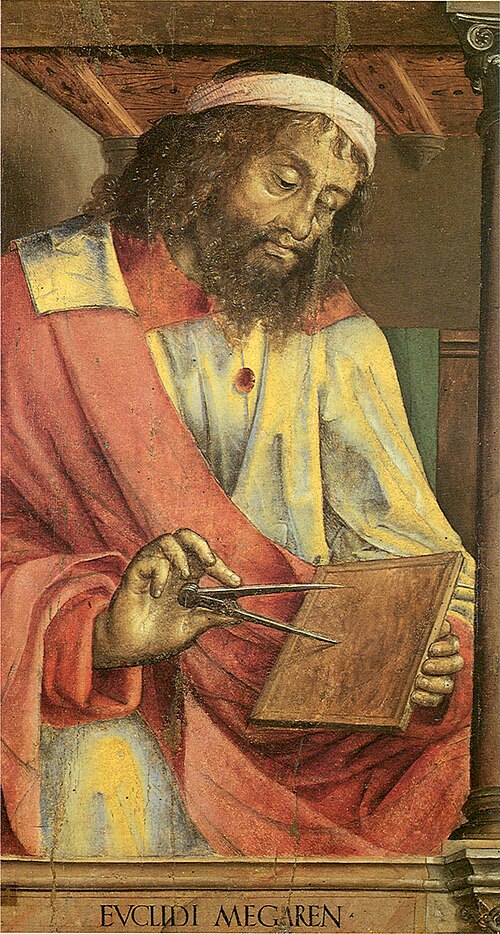
Almost nothing about Euclid’s life is certain. No writer of his own time describes him, and no portrait from life exists; images of Euclid in later art are imaginary. Most of what is said about him comes from two scholars who lived six or seven centuries later: Pappus of Alexandria (early 4th century CE) and Proclus (5th century CE).
Proclus says Euclid lived after the pupils of Plato and before Archimedes, in the time of the first King Ptolemy. That places him roughly around 300 BCE. Pappus mentions that the later mathematician Apollonius studied with Euclid’s pupils in Alexandria, which suggests that Euclid founded a school of mathematics there. It is often supposed that he had studied in Athens with followers of Plato, because his work builds on the geometry of Plato’s circle, but this is a guess.
Two famous stories are told about him. In one, King Ptolemy asks for a shortcut to geometry and Euclid replies that “there is no royal road to geometry.” In another, a student asks what he will gain from learning geometry, and Euclid tells a servant to give him a coin, “since he must make gain out of what he learns.” Both stories were written down centuries later, and a nearly identical version of the first is told about a different mathematician and Alexander the Great, so historians treat them as legends.
Easy
Alexandria: a new city of learning
Alexandria was founded in 331 BCE. After Alexander’s death his general Ptolemy took control of Egypt, and from about 306 BCE his rule brought a stability that was rare in the wars between Alexander’s successors. The Ptolemies built great institutions, including the Musaeum (“shrine of the Muses”), a centre of research and teaching, and the famous Library.
Scholars from across the Greek world were drawn to Alexandria. Euclid is often imagined as one of the Musaeum’s first scholars, although no ancient source says so directly. What is clear is that Alexandria became the leading centre of Greek mathematics and science for centuries, home to later figures such as Eratosthenes, Hero, Ptolemy the astronomer, Pappus and Theon.
Euclid thus stands at a meeting point: he inherited the mathematics developed in Athens by the generation of Plato and Aristotle, and his work became the foundation of the Alexandrian tradition that followed.
Easy
The Elements: thirteen books
The Elements (Greek Stoicheia) is divided into thirteen “books,” which are more like long chapters. Books 1 to 6 deal with plane geometry: triangles, parallel lines, areas, circles, regular polygons and similar figures. Book 5 presents a general theory of ratio and proportion, probably based on the work of Eudoxus of Cnidus.
Books 7 to 9 are about whole numbers: divisibility, prime numbers and numbers in continued proportion. Book 10, the longest and hardest, classifies incommensurable (in modern terms, irrational) lengths. Books 11 to 13 turn to solid geometry and end with the construction of the five regular solids (the cube, tetrahedron, octahedron, dodecahedron and icosahedron) and the proof that there are no others.
Two further books, 14 and 15, were added to many later copies but were written by other authors; Book 14 is attributed to Hypsicles. The Elements contains no introduction, no historical remarks and almost nothing personal: it is a sequence of definitions, assumptions, statements and proofs, each with its diagram.
Intermediate
The method: definitions, postulates and proof
Book 1 opens with 23 definitions, such as “A point is that which has no part” and “A line is breadthless length.” These are followed by five postulates and five common notions. The postulates allow the basic constructions of geometry with straight-edge and compass: to draw a straight line between two points, to extend a line, to draw a circle with any centre and radius; they also state that all right angles are equal. The common notions are general truths about quantities, such as “things equal to the same thing are equal to each other” and “the whole is greater than the part.”
Everything else is a proposition: either a problem (a construction to be carried out) or a theorem (a statement to be proved). Each proposition is stated in general terms, illustrated with a diagram, proved step by step using only what has been established earlier, and closed with a formula; Latin translations later rendered it as “which was to be demonstrated” (quod erat demonstrandum, QED).
This axiomatic-deductive structure, in which a whole field grows from a small set of explicitly stated starting points, is Euclid’s most lasting legacy. Later writers in philosophy, physics and mathematics repeatedly borrowed its form. Aristotle had already discussed first principles and demonstration, and Euclid’s terms echo such discussions, but the Elements is the oldest surviving large-scale example of the method put into practice.
Intermediate
Famous results in the Elements
Book 1 ends with the Pythagorean theorem (proposition 47) and its converse (48). This is the earliest surviving proof of the theorem, based on a figure sometimes nicknamed the “windmill” or “bride’s chair.” Earlier in the same book, proposition 5 (the base angles of an isosceles triangle are equal) became known in medieval Europe as the pons asinorum, the “bridge of asses,” which weaker students could not cross.
Book 7 begins with the procedure now called the Euclidean algorithm: to find the greatest common divisor of two numbers, repeatedly subtract (or divide) the smaller from the larger until the remainder is zero. It is one of the oldest algorithms still in everyday use, including in computer cryptography. Book 9, proposition 20 proves that there are more primes than any given number, in other words that the primes never end, with an argument still taught today.
Book 2, proposition 11 and later propositions construct the division of a line in “extreme and mean ratio,” now called the golden ratio, used to build the regular pentagon, dodecahedron and icosahedron. Book 12 uses the method of exhaustion, a forerunner of integral calculus, to show, for example, that a cone is one third of the cylinder with the same base and height.
Intermediate
Euclid’s other works
Euclid wrote much more than the Elements. The Data explains what can be deduced when certain elements of a figure are “given,” a kind of guide to problem-solving. The Optics is the earliest surviving Greek treatise on perspective: it treats vision as straight lines (visual rays) spreading from the eye in a cone and proves, for example, why objects further away look smaller. The Phaenomena applies spherical geometry to astronomy, describing the motions of the heavens as seen from Earth.
On Divisions of Figures, which survives only partly in an Arabic translation, deals with cutting figures into parts with given ratios. The Catoptrics, on mirrors, is attributed to him, but many scholars doubt it is his.
Several works are lost and known only from later descriptions: the Conics, a four-book treatment of conic sections later superseded by Apollonius; the Porisms, a collection of about two hundred propositions of a special kind; the Pseudaria, a book on geometrical fallacies to help beginners avoid mistakes; and the Surface Loci.
Intermediate
How the Elements travelled the world
The oldest evidence for the Elements is a set of six ostraca (inscribed pottery fragments) from Elephantine in Egypt, from the 3rd century BCE, dealing with propositions from Book 13. The earliest surviving papyrus with its text, Papyrus Oxyrhynchus 29, dates from about 75–125 CE. In the 4th century CE Theon of Alexandria prepared an edition that became the basis of nearly all later Greek manuscripts.
Around 800 CE, under the caliph Harun al-Rashid, al-Hajjaj ibn Yusuf ibn Matar translated the Elements into Arabic; a later translation by Ishaq ibn Hunayn was revised by Thabit ibn Qurra. Mathematicians of the Islamic world studied, commented on and extended the work, including attempts to prove the parallel postulate. In about 1120 the English monk Adelard of Bath translated it from Arabic into Latin, and Campanus of Novara’s thirteenth-century Latin version became standard in the West.
The first printed edition, by Erhard Ratdolt in Venice in 1482, was one of the earliest mathematical books ever printed; more than a thousand editions have followed. The first English translation, by Henry Billingsley with a preface by John Dee, appeared in 1570. In 1607 the Jesuit Matteo Ricci and the scholar Xu Guangqi published a Chinese translation of the first six books, Jihe yuanben, which introduced Euclidean geometry to East Asia and gave Chinese the word jihe for geometry.
Intermediate
The fifth postulate and non-Euclidean geometry
Euclid’s fifth postulate says, in effect, that if a straight line crossing two other lines makes the interior angles on one side add up to less than two right angles, those two lines, if extended far enough, will meet on that side. It is equivalent to saying that through a point outside a line there is exactly one parallel to that line. Compared with the other postulates it is long and not self-evident, and Euclid avoids using it until proposition 29 of Book 1.
For two thousand years mathematicians, including Ptolemy, Proclus, Ibn al-Haytham, Omar Khayyam, Nasir al-Din al-Tusi and later Europeans such as Saccheri, tried to prove it from the other four. All failed, although their efforts uncovered many equivalent statements.
In the early nineteenth century Nikolai Lobachevsky (published 1829), János Bolyai and, privately, Carl Friedrich Gauss showed that a consistent geometry can be built in which the fifth postulate is false. Bernhard Riemann later developed further kinds of curved geometry. These non-Euclidean geometries proved that the postulate is independent of the others, and they later became the mathematical language of Einstein’s general relativity. Ironically, Euclid’s decision to state the postulate as an assumption, rather than pretend to prove it, is now seen as a mark of his logical insight.
Intermediate
Legacy
The Elements is often described as the most successful textbook ever written and, after the Bible, one of the most frequently translated, published and studied books in history. In Europe it remained the core of mathematical education into the twentieth century; the phrase “to study Euclid” simply meant to study geometry.
Its influence reached far beyond mathematics. Thinkers who admired its certainty tried to present philosophy, ethics and physics “in the geometrical manner”: Spinoza’s Ethics is written as definitions, axioms and propositions, and Newton’s Principia follows a similar pattern. Printed editions inspired Renaissance artists such as Piero della Francesca, and Oliver Byrne’s 1847 edition replaced letters with coloured diagrams to help learners.
Euclid’s name lives on in Euclidean geometry, the Euclidean algorithm, Euclid’s theorem on primes, a lunar crater and the European Space Agency’s Euclid space telescope, launched in 2023 to map the geometry of the dark universe.
Advanced
Who was “Euclid”? Evidence, confusion and hypotheses
The earliest firm reference to Euclid is in the preface to Book 1 of Apollonius’ Conics (early 2nd century BCE), which criticises Euclid’s treatment of the locus on three and four lines. Archimedes and Apollonius take propositions of the Elements for granted, suggesting it circulated by the 3rd century BCE, though Archimedes uses an older theory of proportion than Book 5. A single mention of Euclid in Archimedes’ On the Sphere and Cylinder, on which Proclus based his dating, was argued by Johannes Hjelmslev to be a later insertion. Firm citations of the Elements in securely dated works begin only with Galen and Alexander of Aphrodisias in the 2nd century CE.
Later traditions multiplied confusion. The Roman compiler Valerius Maximus put Euclid’s name in a story about Plato and the doubling of the cube, and medieval Byzantine and Latin writers conflated the mathematician with Euclid of Megara, a philosopher and pupil of Socrates a century earlier; the 1482 printed Elements calls him “Megarensis.” Renaissance scholars, notably Peter Ramus, exposed the error. Medieval Arabic sources give him a father, Naucrates, and a birthplace in Tyre, details historians regard as invented.
Given the thin evidence, the historian Jean Itard set out three hypotheses: that Euclid was a single historical author; that he led a team at Alexandria whose members contributed to the works and continued writing under his name; or that “Euclid” was a collective pseudonym, as “Nicolas Bourbaki” was for a group of twentieth-century mathematicians. Most historians accept the first, while recognising that Euclid drew heavily on predecessors and that his school may have shaped the texts; differences of style between books can be explained by his sources.
Advanced
Recovering the text and reading it without anachronism
The Elements we read is a reconstruction. For centuries all Greek copies descended from Theon’s 4th-century edition. In 1808 François Peyrard identified in the Vatican Library a manuscript (Vat. gr. 190, copied in the 10th century) that does not derive from Theon; J. L. Heiberg’s critical edition (1883–1888) treated it as the most authentic witness while correcting it from the others, and Thomas Heath’s English translation (1908) followed Heiberg. The Arabic translations lack many explanatory additions found in both Greek versions, which prompted debate over whether they preserve an earlier, leaner text; the question remains open.
Interpretation raises its own problems. The idea that Book 2 contains a “geometric algebra,” algebraic identities dressed in geometric form, was standard in the early twentieth century; since the 1970s, historians such as Sabetai Unguru have criticised it as anachronistic, arguing that Greek magnitudes, ratios and numbers must be understood on their own terms. Similar cautions apply to reading Book 5 as a theory of real numbers or Book 10 as a treatise on irrational numbers in the modern sense.
Finally, the Elements is not logically flawless. Euclid often relies on what diagrams show, for instance that two circles drawn in proposition 1 of Book 1 actually intersect, or on unstated assumptions about order and betweenness. In the late nineteenth century Moritz Pasch identified such gaps, and David Hilbert’s Foundations of Geometry (1899) supplied a complete axiom system; Alfred Tarski later gave another, and in 2017 Michael Beeson and colleagues used computer proof assistants to check the propositions of Book 1 against a Euclid-like axiom set. Some recent scholars argue that Euclid’s diagrammatic reasoning follows its own consistent rules rather than being a mere lapse.
Key ideas
- Axiomatic-deductive method
- Starting from explicitly stated definitions, postulates and common notions, and proving every further statement strictly from them.
- Proof
- A chain of reasoning that shows a statement must be true, without relying on measurement or appearance.
- Construction with straight-edge and compass
- Euclid’s postulates allow only drawing lines and circles; many propositions are constructions using these tools.
- Theory of proportion
- Book 5’s general treatment of ratios between magnitudes, able to handle incommensurable quantities, probably building on Eudoxus.
- Infinitude of primes
- Euclid’s theorem (Book 9.20): for any list of primes there is always another prime not on the list.
- Euclidean algorithm
- A procedure of repeated subtraction or division to find the greatest common divisor of two numbers.
- The parallel postulate
- The fifth postulate, whose independence led in the nineteenth century to non-Euclidean geometries.
Records
- c. 331 BCE — One modern estimate for Euclid’s birth (others give c. 325 BCE or decline to guess).
- 331 BCE — Alexandria is founded by Alexander the Great (331 BCE).
- c. 300 BCE — Euclid active in Alexandria under Ptolemy I; the Elements is composed.
- c. 200 BCE — Apollonius’ Conics contains the earliest surviving reference to Euclid (early 2nd century BCE).
- c. 100 CE — Papyrus Oxyrhynchus 29, the oldest surviving papyrus with text of the Elements (c. 75–125 CE).
- c. 370 CE — Theon of Alexandria produces his edition of the Elements.
- c. 450 CE — Proclus writes his Commentary on the First Book of Euclid’s Elements.
- c. 800 CE — Al-Hajjaj ibn Yusuf ibn Matar translates the Elements into Arabic under Harun al-Rashid.
- c. 1120 — Adelard of Bath translates the Elements from Arabic into Latin.
- 1482 — Erhard Ratdolt prints the first edition of the Elements in Venice.
- 1607 — Matteo Ricci and Xu Guangqi publish a Chinese translation of Books 1–6.
- 1829 — Lobachevsky publishes a geometry in which the parallel postulate fails.
Glossary
- Elements (Stoicheia)
- Euclid’s thirteen-book work; the Greek word means the basic components, like letters of the alphabet.
- Definition
- A statement of what a term means, such as “a point is that which has no part.”
- Postulate
- A basic assumption accepted without proof; Euclid has five, mostly about what may be constructed.
- Common notion
- A general truth about quantities, such as “the whole is greater than the part”; now usually called an axiom.
- Proposition
- A problem to construct or a theorem to prove; Book 1 contains 48.
- Incommensurable
- Describes two magnitudes that have no common unit of measure, like the side and diagonal of a square.
- Method of exhaustion
- A way of finding areas and volumes by filling a figure with ever-smaller known shapes, a forerunner of calculus.
- Platonic solids
- The five regular polyhedra whose construction ends the Elements.
- Non-Euclidean geometry
- Geometry in which the parallel postulate is replaced, for example hyperbolic or elliptic geometry.
- QED
- Latin quod erat demonstrandum, “which was to be demonstrated,” rendering the Greek formula that closes Euclid’s proofs.
Questions and answers
Did Euclid invent geometry?
No. Egyptians, Babylonians and earlier Greeks such as Thales, Hippocrates of Chios, Theaetetus and Eudoxus knew much geometry. Euclid organised it into one logical system and added proofs.
Do we know what Euclid looked like?
No. No portrait from his lifetime survives. Statues and paintings of Euclid are later artists’ imaginations.
Is the Elements only about triangles and circles?
No. It also covers ratios, whole numbers, prime numbers, irrational lengths and three-dimensional solids.
Did Euclid really say “there is no royal road to geometry”?
Probably not in those words. The story is first told by Proclus about 750 years later, and a very similar story is told about the mathematician Menaechmus and Alexander the Great.
Why was the fifth postulate so important?
It seemed less obvious than the others, so people tried to prove it for 2,000 years. When mathematicians showed it could be replaced, they discovered non-Euclidean geometries, later used in Einstein’s theory of gravity.
Is the Greek text we have exactly what Euclid wrote?
Not exactly. It comes through later editions, especially Theon’s, and one manuscript outside Theon’s line. Editors such as Heiberg reconstruct the text, and scholars still debate how much was added later.
Was Euclid perhaps a group rather than one person?
Some historians have raised this possibility because evidence about him is so thin, but most accept that Euclid was a real individual who drew on earlier work and may have had a school of pupils.
Sources and further reading
- Euclid. Wikipedia
- Euclid's Elements. Wikipedia
- Parallel postulate. Wikipedia
- J. J. O'Connor and E. F. Robertson, Euclid of Alexandria. MacTutor History of Mathematics Archive, University of St Andrews
- David E. Joyce, Euclid's Elements (online edition with commentary). Clark University
- J. L. Heiberg (ed.), Euclidis Opera omnia. Teubner, Leipzig, 1883–1888
- Thomas L. Heath (trans.), The Thirteen Books of Euclid's Elements. Cambridge University Press, 1908
- Glenn R. Morrow (trans.), Proclus: A Commentary on the First Book of Euclid's Elements. Princeton University Press, 1970
Related
- PlatoStudent of Socrates and founder of the Academy. His dialogues remain a cornerstone of Western philosophy.
- AristotlePlato's student and Alexander's tutor. He founded the Lyceum and wrote on logic, ethics, politics and the natural world.
- Library of AlexandriaAn ancient center for collecting and studying texts in Ptolemaic Alexandria.
- Antikythera mechanismHand-cranked Greek bronze gear device of the second or early first century BCE that modelled the Sun, Moon and probably the planets, predicted eclipses and tracked calendars — the oldest known analogue computer.
- Al-KhwarizmiNinth-century mathematician, astronomer and geographer of Abbasid Baghdad whose books gave the world the words “algebra” and “algorithm.”
- Omar KhayyamPersian mathematician, astronomer and philosopher of the Seljuk era who solved cubic equations geometrically and led the calendar reform of 1079; famous quatrains of uncertain authorship bear his name.
Written with AI assistance from the published sources listed above, and revised as new research appears.