Start at the top for an easy introduction. Go further down for more detail and scholarship.
- Easy
- Intermediate
- Advanced
For young readers
Long ago, a Greek-speaking family of kings called the Ptolemies ruled Egypt from a new city by the sea named Alexandria. They wanted their city to be the smartest place in the world, so they decided to collect every book they could find.
Books then were not like ours. They were long rolls of papyrus, a paper made from a plant that grows along the river Nile. A single long book could fill many rolls, and the library kept them on shelves or in cupboards.
The kings paid scholars to live near the library. These scholars got free meals, a salary and time to think. They made lists of books, fixed mistakes in old poems, measured the size of the Earth and studied the stars and the human body.
One story says that when ships sailed into Alexandria's harbour, the king's men took any books on board, copied them, and sometimes kept the originals and gave the owners the copies! Stories like this may be exaggerated, but they show how hungry the kings were for books.
Many people think the library burned down in one giant fire. The truth is more complicated. It was damaged more than once and slowly faded away over hundreds of years as money, peace and scholars disappeared. Today a new library, the Bibliotheca Alexandrina, stands in the same city to remember it.
At a glance
- Founded
- Early 3rd century BCE, probably under Ptolemy II Philadelphus (r. 283–246 BCE); Ptolemy I may have planned it
- Place
- The royal quarter (Brucheion) of Alexandria, Egypt, as part of the Mouseion; exact site unknown
- Rulers and patrons
- The Ptolemaic dynasty, Macedonian Greek kings of Egypt
- Collection
- Papyrus scrolls; ancient figures range from about 40,000 to 700,000 and cannot be checked
- Famous scholars
- Zenodotus, Callimachus, Apollonius of Rhodes, Eratosthenes, Aristophanes of Byzantium, Aristarchus of Samothrace
- Daughter library
- A second collection in the Serapeum, the temple of Serapis, from the reign of Ptolemy III
- End
- Gradual decline; damaged in 48 BCE, probably destroyed in the fighting of the 270s CE; the Serapeum was demolished in 391 CE
- Legacy
- A model for later libraries and for the scholarly editing of texts; revived symbolically by the Bibliotheca Alexandrina (2002)
Easy
What was the Library of Alexandria?
The Library of Alexandria was the royal library of the Ptolemies, the Macedonian Greek dynasty that ruled Egypt after the death of Alexander the Great. It stood in Alexandria, the port city Alexander had founded on the Mediterranean coast of Egypt in 331 BCE, which the Ptolemies made their capital.
The library was not a separate building in the way a modern public library is. It was part of a larger royal institution called the Mouseion, the “shrine of the Muses”, the goddesses of the arts and learning. The word museum comes from it. The Mouseion housed a community of scholars who were paid by the king, ate together and did research, and the library was their most important tool.
Its goal was astonishing for its time: to gather copies of all the books in Greek and, according to later reports, important works of other peoples too. No one knows how many scrolls it really held, but it was certainly the largest collection of the Greek world, and its scholars shaped how Greek literature and science were studied for centuries.
Very little about the library is certain. No ancient description of it survives in detail, no building has been securely identified by archaeologists, and many famous stories about it were written down centuries later. Learning about the Library of Alexandria therefore also means learning how historians separate evidence from legend.
Easy
How did it work? Scrolls, shelves and a hunger for books
Ancient books were written by hand on papyrus, a writing material made from strips of a reed that grew in abundance along the Nile. Sheets were glued into long rolls. A long work such as Homer’s Iliad filled many rolls, and dividing a text into “books”, each fitting on one roll, was part of a librarian’s work. Egypt’s control of papyrus gave Alexandria a great advantage.
The Ptolemies bought books aggressively. Royal agents are said to have visited book markets such as Athens and Rhodes. The doctor Galen, writing in the second century CE, reports that under a royal order books found on ships arriving in Alexandria were taken and copied, and that the library kept the originals, labelled “from the ships”. He also tells how Ptolemy III borrowed the official Athenian copies of the plays of Aeschylus, Sophocles and Euripides, paying a deposit of fifteen talents, then kept the originals and returned copies, giving up his deposit.
Older copies were prized because scholars thought they were closer to what the author had written. For the Homeric poems the library acquired many different copies from different cities and labelled each by origin, so that they could be compared.
To find anything in such a collection, the books had to be organised. Zenodotus, the first known head librarian, seems to have arranged works alphabetically by the first letter of the author’s name, and the poet-scholar Callimachus compiled the Pinakes (“Tables”), a catalogue in 120 books listing authors by genre, with short biographies and lists of their works. It is often called the first library catalogue of its kind.
Easy
The scholars of the Mouseion
According to the geographer Strabo, who visited around 20 BCE, the scholars of the Mouseion lived as a community with a shared dining hall, a covered walkway for strolling and talking, and a priest appointed by the king at their head. They received salaries and free board. The satirist Timon of Phlius mocked them as well-fed “bookworms” squabbling in the “birdcage of the Muses”.
The head librarian was a scholar appointed by the king, often also tutor to the royal heir. The traditional list includes Zenodotus of Ephesus, who produced an edition of Homer; Apollonius of Rhodes, author of the epic Argonautica; Eratosthenes of Cyrene, who estimated the circumference of the Earth by comparing the angle of the sun at two places in Egypt; Aristophanes of Byzantium, who helped develop Greek accent marks and ways of laying out verse; and Aristarchus of Samothrace, the most admired ancient critic of Homer.
Mathematicians, astronomers and doctors also worked in Alexandria in this period. The physician Herophilus carried out studies of human anatomy there, including dissection, and Euclid is traditionally said to have taught in the city. Their exact connection to the library is often uncertain, but the royal collection and patronage made Alexandria the leading centre of Greek learning in the third and second centuries BCE.
Intermediate
Founding: kings, philosophers and the politics of knowledge
After Alexander died in 323 BCE, his generals divided his empire. Ptolemy, son of Lagus, took Egypt and in 305 BCE declared himself king (Ptolemy I Soter). Like the other Hellenistic kings, he ruled a mostly non-Greek population and competed with rival Greek courts for prestige. Patronage of culture was part of kingship: a great library showed wealth, attracted talent, and gave the dynasty a claim to be the heir of Greek civilisation.
The oldest surviving account of the founding is the Letter of Aristeas, a Jewish Greek text probably written in the second century BCE. It describes Demetrius of Phalerum, an Athenian statesman and pupil of Aristotle’s school, advising the king to collect all the world’s books, and it tells how seventy-two Jewish elders translated the Hebrew Law into Greek for the library, the origin legend of the Septuagint. The Letter is not reliable history: it was written long afterwards to glorify the translation, and it mixes up reigns.
Most modern historians think that Ptolemy I may have begun collecting books and planning an institution, possibly with Demetrius’ advice, but that the library and Mouseion became a working institution under his son Ptolemy II Philadelphus (r. 283–246 BCE). Aristotle’s school in Athens, the Lyceum, with its own collection of books and its interest in organising all knowledge, was likely an important model.
The library also had Near Eastern predecessors, such as the great tablet collections of Assyrian kings at Nineveh. Whether the Ptolemies consciously imitated them is unknown, but the idea of a king gathering the knowledge of the world was not new; what was new was the scale and the community of paid scholars attached to it.
Intermediate
Where was it, and what did it look like?
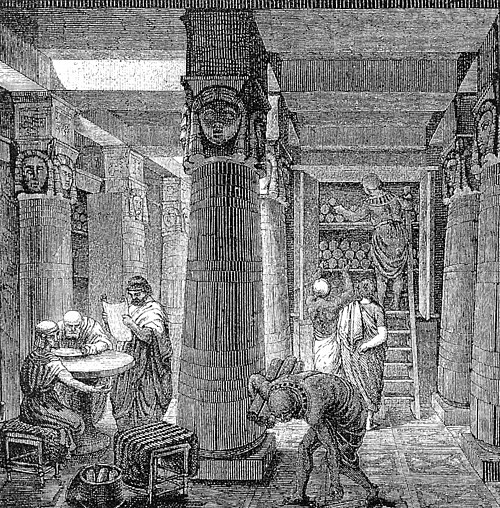
The library stood in the Brucheion, the palace district of ancient Alexandria near the eastern harbour. Strabo’s description of the Mouseion mentions a walkway (peripatos), a hall with seats (exedra) and a large building with the scholars’ common dining room, but he does not describe the library itself. Later writers imagined grand halls, but no surviving ancient text gives a floor plan.
Ancient libraries usually stored scrolls in wooden cupboards or niches in the walls of rooms opening onto colonnades; readers took scrolls out into the light to read. It is reasonable to imagine something like this in Alexandria, but it is an inference from other sites, such as the library of Pergamon, not a description of Alexandria.
Archaeology has not solved the question. The ancient royal quarter lies under the modern city and partly under the sea, as the coastline has sunk since antiquity. Excavations by a Polish mission at Kom el-Dikka uncovered a group of lecture halls from late antiquity, showing that Alexandria remained a place of teaching, but these are centuries later than the Ptolemaic library. At the Serapeum site, some rooms have been suggested as storage for the daughter library, but this remains uncertain.
Readers should therefore be cautious with reconstructions, paintings and films. They are informed guesses, and the most honest answer to the question “what did it look like?” is that we do not know.
Intermediate
What was in the collection, and how big was it?
The core of the collection was Greek literature: epic, drama, lyric poetry, history, philosophy, medicine, mathematics and astronomy. Scholars there worked especially on Homer, on the dramatists and on the lyric poets, establishing texts that were copied throughout the Greek and later the Roman world. Many of the texts of Greek classics that survive today descend from editions and commentaries made by Alexandrian scholars.
Non-Greek works were also of interest. Besides the Greek translation of the Hebrew scriptures reported by the Letter of Aristeas, the Egyptian priest Manetho wrote a history of Egypt in Greek under the early Ptolemies, and the Babylonian priest Berossus did the same for Babylonia at the Seleucid court. How much literature in Egyptian or other languages the library actually held is unknown.
Numbers are a notorious problem. Ancient and Byzantine writers give figures from 40,000 to 700,000 scrolls: the later writer Aulus Gellius says 700,000 were burned, and the twelfth-century Byzantine scholar John Tzetzes gives separate totals for the palace library and for the Serapeum collection. Because one work could fill many scrolls, and because these figures were written long after the fact, they cannot be treated as counts. Many historians think a collection in the tens or low hundreds of thousands of scrolls is plausible.
Alexandria had a rival. The Attalid kings of Pergamon in Asia Minor built their own great library in the second century BCE. The Roman writer Pliny, citing Varro, reports that the Ptolemies stopped exporting papyrus and that Pergamon therefore developed parchment (the word derives from Pergamon). Parchment was in fact used earlier, so the story is at best a simplification, but it reflects a real competition between royal libraries.
Intermediate
Decline and destruction: many blows, not one fire
The first serious blow was political. In 145 BCE Ptolemy VIII, after seizing power, purged his opponents, and scholars were among those who fled. The head librarian Aristarchus left for Cyprus, and students such as Dionysius Thrax taught elsewhere. From then on, the post of head librarian was sometimes given to courtiers rather than scholars, and Alexandria lost some of its leading role.
In 48 BCE Julius Caesar, besieged in Alexandria during the civil war between Cleopatra and her brother Ptolemy XIII, set fire to ships in the harbour. The fire spread to buildings near the docks. Later writers disagree about what burned: Seneca, quoting Livy, speaks of 40,000 books; Plutarch says the fire destroyed “the great library”; Cassius Dio mentions warehouses of grain and books near the docks. Many historians conclude that stored books near the harbour were lost but that the library as an institution survived, because Strabo visited the Mouseion about two decades later and scholars continued working in Alexandria.
Under Roman rule the Mouseion continued, but emperors sometimes gave membership as an honour to people who were not scholars. The last known references to members of the Mouseion date to the 260s CE. In 272 CE the emperor Aurelian recaptured Alexandria from the forces of Queen Zenobia of Palmyra, and the fighting devastated the Brucheion; Diocletian’s siege of 297–298 caused further destruction. Whatever remained of the main library probably did not survive these wars.
The Serapeum, the great temple of Serapis that had held a daughter collection since Ptolemy III, survived longer. In 391 CE, after imperial laws against pagan cults and violent clashes between pagans and Christians in the city, the temple was demolished under the bishop Theophilus. Whether it still held a significant library at that time is unclear; the sources that describe its destruction focus on the temple and its cult statue.
Intermediate
Myths about the library’s end
Because the library became a symbol of all lost knowledge, its end has often been told as a single dramatic crime, and different ages have blamed different villains: Caesar, Christians, or Muslims.
The most famous story blames the Arab conquest. Alexandria surrendered to the army of Amr ibn al-As in 641–642 CE. Writers of around 1200 and later, including Abd al-Latif al-Baghdadi, Ibn al-Qifti and Bar Hebraeus, tell that the caliph Umar ordered the books destroyed, saying that if they agreed with the Qur’an they were unnecessary and if they disagreed they were harmful, and that they fuelled the city’s bathhouses for six months. None of the sources close to the conquest mentions this. Most historians, from Edward Gibbon in the eighteenth century onward, regard the story as a legend; some have suggested it arose in the Ayyubid period, when the Fatimid palace library in Cairo was broken up and sold.
Another modern myth links the library to Hypatia, the mathematician and philosopher killed by a Christian mob in 415 CE. Her murder was real and terrible, but she taught in her own school, and there is no evidence that she was a librarian or that the Ptolemaic library still existed in her time. The connection was popularised in modern works, notably Carl Sagan’s television series Cosmos (1980).
Historians today prefer a less dramatic but better-supported picture: the library declined over centuries because of the loss of royal patronage, political violence, war damage and the slow decay of papyrus, which needs recopying to survive. Knowledge was lost not only by burning but by neglect.
Intermediate
Legacy: from Alexandrian scholarship to the Bibliotheca Alexandrina
The library’s greatest legacy is a method. Alexandrian scholars compared manuscripts, marked doubtful lines with critical signs, wrote commentaries explaining difficult words and allusions, and produced standard editions. This is the ancestor of textual criticism and philology, which later scholars applied to the Bible, to Latin classics and, much later, to texts in many languages.
Much of what was studied in Alexandria survived because it was copied elsewhere: in Roman and Byzantine libraries, in Christian centres such as Caesarea, and through the translation of Greek science and philosophy into Syriac and Arabic, above all in ninth-century Baghdad. From the twelfth century many of these works reached Latin Europe. The loss of Alexandria’s collection was real, but the survival of ancient learning depended on many libraries, not one.
In the modern era the library became a powerful symbol of universal knowledge and of fragility in the face of war and neglect. Egypt, with the support of UNESCO and many countries, built the Bibliotheca Alexandrina near the probable site of the ancient royal quarter. Designed by the Norwegian firm Snøhetta, it opened in 2002 and serves as a library, museum complex and research centre.
Advanced
Scholarly debates and open questions
Who founded it, and when? Sources are late and partisan. The Letter of Aristeas and later traditions credit Ptolemy I and Demetrius of Phalerum, while other ancient notices and modern historians emphasise Ptolemy II. Since Demetrius is said to have fallen from favour when Ptolemy II came to power, his role as an organiser is doubted, though he may have helped with early acquisitions. The chronology of the head librarians depends largely on a fragmentary papyrus list (P.Oxy. 1241) and on Byzantine reference works, and it contains contradictions.
How large was it? Roger Bagnall has argued that the high figures cannot be reconciled with what is known about the number of Greek authors and works that existed in the third century BCE, and that historians should treat ancient totals as rhetoric about greatness rather than as data. Others accept that a large collection of multiple copies and editions could reach six figures. The debate is less about a single number than about how to read ancient statistics.
What did Caesar’s fire destroy? The testimonies of Seneca (citing Livy), Plutarch, Cassius Dio and others differ in wording and in the manuscripts. Some historians think the main library burned in 48 BCE; others, noting the continued activity of scholars and Strabo’s visit, think only books in storage near the harbour were lost. Related questions concern the Roman period: whether the library was restored, and how its holdings related to other Alexandrian collections such as the Serapeum and the libraries attached to imperial cult buildings.
What was its intellectual character? Some scholars stress the library’s role in royal propaganda and control, since scholars depended on the king and could be expelled; others stress the originality of Alexandrian science and scholarship. Recent work also asks how Greek and Egyptian cultures interacted in Ptolemaic Alexandria and whether the “universal” library was in practice overwhelmingly Greek.
Advanced
Evidence and methods
Literary sources. The main evidence consists of scattered passages: the Letter of Aristeas; Strabo’s Geography on the Mouseion; Galen’s anecdotes on book acquisition; Seneca, Plutarch, Aulus Gellius, Cassius Dio and Ammianus Marcellinus on destruction; Byzantine scholars such as Tzetzes; and much later Arabic writers. Most are centuries removed from the events and written for moral or rhetorical purposes, so each must be read with attention to date, genre and agenda.
Indirect evidence from scholarship. The work of Alexandrian scholars survives indirectly, especially in the scholia (marginal notes) of medieval manuscripts of Homer and other poets, which quote the readings of Zenodotus, Aristophanes and Aristarchus. Papyri found in Egypt, especially at Oxyrhynchus, show which texts circulated in the Greek-speaking towns of Egypt and sometimes preserve Alexandrian editorial signs.
Archaeology. The topography of ancient Alexandria is reconstructed from limited excavations in a dense modern city, from underwater surveys of the harbours, and from descriptions such as Strabo’s. No excavated structure has been securely identified as the Ptolemaic library, so claims about its architecture remain hypotheses.
Historiography. Because the library has been used as a symbol in debates about religion, empire and civilisation since the Renaissance, a history of the library must also be a history of how it was remembered. Studying who told which destruction story, and why, is part of the evidence.
Key ideas
- Universal library
- The Ptolemaic ambition to collect copies of all written knowledge in one place, at least all Greek literature.
- Mouseion
- The royal institution of the Muses to which the library belonged: a community of salaried scholars supported by the king.
- Royal patronage
- Learning depended on the king’s money and favour; when patronage failed or turned hostile, scholarship suffered.
- Textual criticism
- Comparing manuscripts to establish the most reliable text, a method developed by Alexandrian scholars and still used today.
- Cataloguing
- Organising a large collection by author, genre and alphabet, as in Callimachus’ Pinakes.
- Gradual decline
- The library faded through political purges, war damage, lost funding and decaying papyrus rather than one single fire.
- Symbol of lost knowledge
- Since antiquity the library has been used as a symbol, and its story has been retold to blame different groups.
Records
- 331 BCE — Alexander the Great founds Alexandria on the Egyptian coast (331 BCE).
- 305 BCE — Ptolemy I takes the title of king of Egypt (305 BCE).
- c. 295 BCE — Demetrius of Phalerum arrives in Alexandria and, according to tradition, advises Ptolemy I on collecting books.
- 283 BCE — Ptolemy II Philadelphus becomes sole ruler (283 BCE); the library and Mouseion probably take shape in his reign.
- c. 246 BCE — Under Ptolemy III, a daughter library is established in the Serapeum; Eratosthenes becomes head librarian around this time.
- 145 BCE — Ptolemy VIII purges opponents; Aristarchus and other scholars leave Alexandria (145 BCE).
- 48 BCE — During Caesar’s siege of Alexandria, fire spreads from the harbour and destroys books (48 BCE).
- c. 20 BCE — Strabo visits Alexandria and describes the Mouseion (about 20 BCE).
- 272 CE — Aurelian’s recapture of Alexandria devastates the royal quarter, where the library stood.
- 391 CE — The Serapeum is demolished under Bishop Theophilus.
- 642 CE — Alexandria is taken by the Arab army of Amr ibn al-As; much later sources claim the caliph ordered books burned.
- 2002 — The Bibliotheca Alexandrina opens in modern Alexandria.
Glossary
- Papyrus
- A writing material made from strips of the papyrus reed, glued into sheets and rolls; the main book material of the ancient Mediterranean.
- Scroll
- A book in the form of a long roll, read by unrolling it from one side to the other.
- Ptolemies
- The Macedonian Greek dynasty that ruled Egypt from 305 to 30 BCE, ending with Cleopatra VII.
- Hellenistic
- The period and culture of the Greek-ruled kingdoms that followed Alexander’s conquests (323–31 BCE).
- Mouseion
- A shrine of the Muses; in Alexandria, the royal research institution that included the library.
- Serapeum
- The temple of the Greco-Egyptian god Serapis in Alexandria, which housed a daughter library.
- Pinakes
- Callimachus’ catalogue of Greek authors and their works, in 120 books, now lost except for fragments.
- Scholia
- Notes written in the margins of manuscripts, often preserving the opinions of ancient scholars.
- Philology
- The study of texts and languages, including editing texts and explaining their meaning.
- Septuagint
- The Greek translation of the Hebrew Bible, begun in Alexandria in the third century BCE.
Questions and answers
Did the Library of Alexandria burn down in one big fire?
No. A fire in 48 BCE destroyed books, but the library probably survived. It declined over centuries and was likely destroyed in wars of the 270s CE; its daughter collection in the Serapeum ended when the temple was demolished in 391 CE.
How many books did it have?
Nobody knows. Ancient writers give numbers from 40,000 to 700,000 scrolls, but these are late and unreliable, and one book could fill several scrolls.
Could anyone go in and read?
It was a royal library for scholars supported by the king, not a public library in the modern sense. How far outsiders could use it is not recorded.
Did Muslims destroy the library in 642?
Most historians think not. The story first appears in writers of around 1200 and later, more than five centuries after the conquest, and the main library had probably disappeared long before.
Was Hypatia the last librarian?
No. Hypatia was a respected philosopher and mathematician murdered in 415 CE, but there is no evidence she worked in the library, which probably no longer existed in her day.
Have archaeologists found the library?
Not securely. The royal quarter lies under modern Alexandria and partly under the sea, and no excavated building has been identified with certainty as the library.
Why do historians distrust some famous anecdotes, such as the books taken from ships?
They come from writers centuries later, such as Galen, and serve to illustrate the kings’ zeal. They may reflect real policies but cannot be verified in detail.
Sources and further reading
- Library of Alexandria. Wikipedia
- Mouseion. Wikipedia
- Serapeum of Alexandria. Wikipedia
- Letter of Aristeas. Wikipedia
- Pinakes. Wikipedia
- Bibliotheca Alexandrina. Wikipedia
- Lionel Casson, Libraries in the Ancient World. Yale University Press, 2001
- P. M. Fraser, Ptolemaic Alexandria. Clarendon Press, Oxford, 1972
- Roger S. Bagnall, Alexandria: Library of Dreams. Proceedings of the American Philosophical Society, 2002
- Roy MacLeod (ed.), The Library of Alexandria: Centre of Learning in the Ancient World. I. B. Tauris, 2000
Related
- AristotlePlato's student and Alexander's tutor. He founded the Lyceum and wrote on logic, ethics, politics and the natural world.
- HomerThe poet tradition credits with the Iliad and the Odyssey, the founding epics of Greek literature. Whether one person composed both is debated.
- House of WisdomName associated with Abbasid scholarly collections and translation activity in Baghdad.
- Battle of GaugamelaA battle in 331 BCE in which Alexander of Macedon's army defeated the forces of the Persian king Darius III.
- Assassination of Julius CaesarThe killing of Julius Caesar by a group of Roman senators on 15 March 44 BCE.
Written with AI assistance from the published sources listed above, and revised as new research appears.