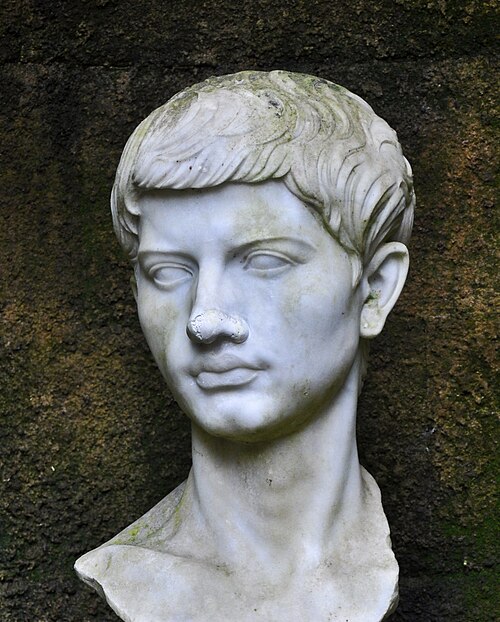
Start at the top for an easy introduction. Go further down for more detail and scholarship.
- Easy
- Intermediate
- Advanced
For young readers
Virgil was born more than two thousand years ago on a farm near the town of Mantua in northern Italy. He was a quiet, shy boy who loved books. When he grew up he became a poet, and people say he was so shy that when fans recognized him in the street he would hide in the nearest house.
He lived at a frightening time. Rome was fighting civil wars, which are wars between people of the same country. Soldiers even took farms away from families to give to veterans. Then one leader, Octavian, won the wars and became the first Roman emperor, called Augustus. Virgil hoped peace would last, but he never forgot how much the wars had hurt people.
Virgil wrote three great works. The first is a book of short poems about shepherds singing in the countryside. The second is a long poem about farming: how to plough fields, grow grapes, look after cows and keep bees. The third is his masterpiece, the Aeneid.
The Aeneid tells the story of Aeneas, a prince who escapes from the city of Troy when the Greeks burn it. He carries his old father on his back and leads his little son by the hand. After many adventures at sea, a sad love story with Queen Dido of Carthage, and a journey to the land of the dead, he reaches Italy and fights a war there. The Romans believed that his descendants founded Rome.
Virgil worked on the Aeneid for eleven years and died before he could finish polishing it. He asked for it to be burned, but the emperor said no. Aren't we lucky? For two thousand years children in Europe learned Latin by reading it, and poets from Dante to modern writers have admired it.
At a glance
- Lived
- 15 October 70 BCE – 21 September 19 BCE
- Born
- Andes, a village near Mantua in Cisalpine Gaul (northern Italy)
- Died
- Brundisium (Brindisi), on returning from Greece; buried near Naples
- Language
- Latin; all his major works are in dactylic hexameter verse
- Major works
- Eclogues (c. 42–38 BCE), Georgics (c. 37–29 BCE), Aeneid (29–19 BCE, unfinished at his death)
- Patrons
- Gaius Maecenas and the emperor Augustus
- Name
- Publius Vergilius Maro; spelled “Vergil” or “Virgil” in English
- Significance
- The central poet of Latin literature and a model for European epic from Dante and Milton onward
Easy
Who was Virgil?
Publius Vergilius Maro, known in English as Virgil or Vergil, was a Roman poet of the late Republic and the first years of the Roman Empire. He wrote three works that survive complete: the Eclogues, ten short poems about shepherds; the Georgics, a four-book poem about farming; and the Aeneid, a twelve-book epic about the Trojan hero Aeneas, whose journey leads to the founding of the Roman people.
Within his own lifetime Virgil was recognized as the greatest poet of Rome. His works were taught in schools almost immediately, quoted in graffiti on the walls of Pompeii, and copied more carefully than those of any other Latin poet. For later Europeans he was simply “the Poet”, the author every educated person knew.
Virgil’s poetry is famous for its beauty of sound, its compression of meaning into few words and, above all, its feeling for human suffering. A line from the Aeneid, sunt lacrimae rerum, “there are tears in things”, has become a proverb for the sadness that runs through history.
Easy
Life: from Mantua to Naples
Virgil was born on 15 October 70 BCE at Andes, a village near Mantua in the Po valley. This region, called Cisalpine Gaul (“Gaul on this side of the Alps”), was only fully brought into Roman citizenship in 49 BCE, during Virgil’s youth. His family seems to have owned a farm. The ancient biographies say his father was a potter or a hired worker who married his employer’s daughter, Magia Polla, and rose by keeping bees and buying woodland, but such details may be later invention.
He was educated at Cremona and Milan and then in Rome, studying rhetoric, the art of public speaking, which prepared young men for careers in law and politics. According to his biographer, he spoke in court only once and was so slow and awkward that he gave up. He turned instead to philosophy, joining the circle of the Epicurean teacher Siro near Naples, and to poetry.
The ancient Life describes him as tall and dark, with a country look, often in poor health, and so modest that people in Naples nicknamed him Parthenias, “the maiden”. He never married. He spent most of his adult life in Campania, around Naples, rather than in Rome.
In 19 BCE, with the Aeneid nearly complete, Virgil set out for Greece intending to spend three years revising it. In Athens he met Augustus, who persuaded him to return to Italy. On the way he fell ill with a fever at Megara, and he died at Brundisium on 21 September 19 BCE, aged 50. His remains were taken to Naples. A tomb near the city is still shown as his, though whether it is the real one is uncertain.
Easy
Growing up in an age of civil war
Virgil’s life spanned the last violent decades of the Roman Republic. When he was a young man, Julius Caesar crossed the Rubicon (49 BCE) and fought Pompey. In 44 BCE Caesar was assassinated. His heir Octavian then joined Mark Antony and Lepidus to defeat Caesar’s murderers at Philippi in 42 BCE, and finally fought Antony and Cleopatra, defeating them at Actium in 31 BCE. In 27 BCE the Senate gave Octavian the name Augustus, and the Roman world entered a long period of one-man rule presented as the “restoration” of the Republic.
These wars touched ordinary families directly. After Philippi, land in many parts of Italy, including around Mantua and Cremona, was confiscated and given to discharged soldiers. The ancient biographers say Virgil’s own farm was taken and then restored through the help of powerful friends, though modern scholars treat this story cautiously because it may have been reconstructed from his poems.
Around 38 BCE Virgil joined the circle of Gaius Maecenas, Octavian’s close adviser and a great patron of literature. There he knew the poet Horace, whom Virgil and his friend Varius introduced to Maecenas. Horace called Virgil “half of my soul”. Through Maecenas, Virgil came close to Octavian himself. This closeness shaped his career and has shaped debates about his poetry ever since.
Intermediate
The Eclogues: shepherds, song and politics
The Eclogues (also called Bucolics), ten poems published around 39–38 BCE, are Virgil’s first major work. Their model is the Idylls of the Greek poet Theocritus (third century BCE), who wrote of Sicilian herdsmen competing in song. Virgil’s shepherds also sing of love and loss, but their world is disturbed by history.
The first Eclogue opens with two herdsmen. Meliboeus has been driven from his land and must go into exile; Tityrus has been allowed to keep his farm thanks to a “young man” in Rome, a figure usually understood as Octavian. The poem sets peaceful country life against the violence of land confiscations, and many readers have heard Virgil’s own experience in it.
The fourth Eclogue, addressed to the consul Asinius Pollio in 40 BCE, prophesies the birth of a child under whom a golden age will return. Scholars debate who was meant: a child of Pollio, of Antony and Octavia, or no one in particular. Later Christians, including the emperor Constantine, read the poem as a prophecy of Christ, which helped make Virgil acceptable, even honoured, in the Christian Middle Ages.
In these poems Virgil created the idea of Arcadia, the imaginary pastoral land that became a lasting image of lost innocence in European art and literature. The last poem ends with the famous phrase omnia vincit Amor, “love conquers all”.
Intermediate
The Georgics: the poetry of work
The Georgics, written over about seven years and completed around 29 BCE, is dedicated to Maecenas. It is a didactic poem, a poem that teaches, in four books: Book 1 on crops and the weather, Book 2 on trees and vines, Book 3 on cattle, horses and other livestock, and Book 4 on bees. Its models include the Greek poet Hesiod’s Works and Days and the Roman poet Lucretius’ philosophical poem On the Nature of Things.
Although full of practical detail, the Georgics is not a farming manual. It is a meditation on human labour, nature and the fragility of order. Virgil writes that “relentless work conquered everything” (labor omnia vicit improbus), yet storms, plagues and war constantly threaten the farmer’s achievements. The end of Book 1 describes Italy torn by civil war, when “the curved sickles are beaten into swords”.
Book 4 contains one of Virgil’s most beautiful stories: the beekeeper Aristaeus loses his bees and learns that he caused the death of Eurydice, wife of the singer Orpheus. Orpheus goes down to the underworld to bring her back, but looks back too soon and loses her forever. The ancient Life says Virgil read the finished Georgics aloud to Octavian over four days in 29 BCE, with Maecenas taking over when the poet’s voice tired.
Intermediate
The Aeneid: story and structure
The Aeneid, written from 29 BCE until Virgil’s death in 19 BCE, is an epic of 12 books and 9,896 lines in dactylic hexameter, the metre of Homer. It begins arma virumque cano, “I sing of arms and the man”. Its first half (Books 1–6) echoes Homer’s Odyssey, a story of wandering; its second half (Books 7–12) echoes the Iliad, a story of war.
In Book 1 a storm sent by the goddess Juno, who hates the Trojans, drives Aeneas’ fleet to Carthage in North Africa, where Queen Dido welcomes them. In Books 2 and 3 Aeneas tells her of the fall of Troy and his years of wandering. In Book 4 Dido and Aeneas fall in love, but the god Mercury reminds Aeneas that his destiny lies in Italy. He leaves, and Dido, abandoned, takes her own life, cursing his descendants: a mythical origin for the wars between Rome and Carthage.
Book 6 is the poem’s centre. Guided by the Sibyl of Cumae, Aeneas visits the underworld, where the spirit of his father Anchises shows him the souls of future Romans, from the kings to Augustus. Anchises tells him that Rome’s arts will be “to spare the conquered and to war down the proud”. In Books 7–12 the Trojans land in Latium and a bitter war breaks out with the Italian peoples, led by Turnus. Aeneas’ young ally Pallas is killed by Turnus. The poem ends suddenly: Turnus, defeated, begs for mercy; Aeneas hesitates, sees the belt Turnus had stripped from Pallas, and kills him in fury.
The poem was not finished. Some 58 lines are incomplete, and Virgil planned further revision. According to the ancient Life, he asked for the manuscript to be burned, but Augustus ordered his literary executors Lucius Varius Rufus and Plotius Tucca to publish it without adding anything.
Intermediate
Big ideas: duty, fate, empire and the cost of history
Pietas. Aeneas is called pius, “dutiful”, more than any other epithet. Roman pietas meant loyalty to the gods, to family and to country. The image of Aeneas carrying his father Anchises out of burning Troy while leading his son Ascanius became a symbol of this ideal. But pietas also demands sacrifice: Aeneas must abandon Dido and his own wishes to follow his destiny.
Fate and the gods. The Aeneid is driven by fatum, what has been spoken by Jupiter: Aeneas will reach Italy, and his descendants will found Rome. Juno cannot stop this, but she can delay it and cause great suffering. The line “so great was the effort to found the Roman people” (tantae molis erat Romanam condere gentem) sums up the price of destiny.
Empire and Augustus. The poem glorifies Rome’s mission and Augustus, who is presented as descended from Aeneas’ son Iulus and as the ruler who will bring back a golden age. Augustus’ victory at Actium is shown on Aeneas’ shield in Book 8. At the same time, the poem gives deep sympathy to Rome’s victims and enemies: Dido, Turnus, the young warriors Nisus and Euryalus, the warrior maiden Camilla and the many mothers and fathers who mourn their children.
Suffering and compassion. Virgil’s most characteristic tone is melancholy. Heroes weep; victories are mixed with loss; the future glory of Rome is bought with the lives of individuals. This double vision, pride in Rome together with sorrow at its cost, is what makes the poem feel so modern and so open to different readings.
Intermediate
Influence: from Roman schoolroom to world literature
Roman readers treated Virgil as a classic at once. The poet Propertius, even before the Aeneid was published, announced that “something greater than the Iliad is being born”. Schoolchildren across the Empire copied his lines, and scholars wrote commentaries on him, above all Servius in the late fourth century, whose commentary preserves a vast amount of ancient learning. People even consulted his verses as an oracle by opening the book at random, a practice called the sortes Vergilianae.
Christian writers had a complex relationship with him. Augustine confessed that as a boy he wept for Dido while ignoring his own spiritual state. The messianic reading of the fourth Eclogue made Virgil seem almost a pagan prophet. In medieval legend, especially around Naples, he became a magician who built wonders and protected the city.
Dante chose Virgil as his guide through Hell and Purgatory in the Divine Comedy (early fourteenth century), calling him his master and author. Renaissance and early modern epic poets, including Ariosto, Tasso, Camões and Milton, measured themselves against the Aeneid. John Dryden’s English translation (1697) shaped English verse. In the twentieth century T. S. Eliot called Virgil the classic of all Europe, and Hermann Broch wrote the novel The Death of Virgil (1945).
Virgil also belongs to the history of politics. The Aeneid provided a model for later states that wished to tell stories of divine mission and imperial destiny. Modern readers, from postcolonial writers to classical scholars, often read it both as a founding text of empire and as a critique of empire’s human cost.
Advanced
How reliable are the ancient lives of Virgil?
Almost everything we know about Virgil’s life comes from the Vita Donatiana, a biography prefixed by the fourth-century grammarian Aelius Donatus to his commentary. It is generally thought to derive largely from the lost On Poets of Suetonius (early second century CE). Other short lives are attached to the commentaries of Servius and of “Probus”, and there are medieval expansions.
These sources contain valuable information, but also a great deal of anecdote. Ancient biographers often built lives out of the poet’s own works, reading the shepherds of the Eclogues, for example, as Virgil himself. The story that his farm was confiscated and restored, the details of his parents’ occupations, and some of the anecdotes about his shyness may belong to this kind of reconstruction. Modern scholars accept the broad outline, dates of birth and death, education, patronage and the circumstances of the Aeneid’s publication, while treating many details with caution.
The famous epitaph, which the Life says Virgil composed for himself, is typical of this mixture: Mantua me genuit, Calabri rapuere, tenet nunc / Parthenope; cecini pascua, rura, duces, “Mantua bore me, the Calabrians took me, now Naples holds me; I sang of pastures, farms and leaders.” It neatly summarizes both his life and his three works, which is exactly why some scholars suspect it was written by someone else.
Advanced
Scholarly debates: optimism, pessimism and the “two voices”
The central modern debate about the Aeneid concerns its attitude to Augustus and empire. For much of its history the poem was read as a celebration of Rome and of the Augustan settlement, with Aeneas as a model of the dutiful ruler. In the mid-twentieth century a group of American scholars sometimes called the “Harvard School”, including Adam Parry, Wendell Clausen and Michael Putnam, emphasized instead the poem’s darker side. Parry’s essay “The Two Voices of Virgil’s Aeneid” (1963) argued that alongside the public voice of triumph runs a private voice of sorrow and loss.
The ending is the crux. Some critics see Aeneas’ killing of Turnus as just and necessary, an act of pietas toward the dead Pallas. Others see it as a failure of the ideal Anchises had set out, “to spare the conquered”, leaving the poem on a note of rage rather than reconciliation. Related debates concern the Gates of Sleep at the end of Book 6, where Aeneas leaves the underworld through the ivory gate, the gate of false dreams, a detail that has been read as undermining the prophecy of Rome’s glory.
Many scholars today reject a simple choice between “optimistic” and “pessimistic” readings. They argue that the poem holds both views in tension, that its ambiguity reflects the real complexity of living under Augustus, or that the categories themselves are modern impositions. Richard F. Thomas has shown how much the history of Virgil criticism has been shaped by the politics of each era’s readers, including readings under twentieth-century authoritarian regimes.
Other active questions include Virgil’s relationship to his Greek models (Homer, Apollonius of Rhodes, Theocritus, Hesiod) and his Latin predecessors (Ennius, Lucretius, Catullus); the degree of the poem’s incompleteness; and the authenticity of the Appendix Vergiliana, a collection of minor poems attributed to Virgil in antiquity, most of which modern scholars consider not genuine.
Advanced
The text: manuscripts and transmission
Virgil is the best-preserved Latin poet from antiquity. Several manuscripts survive from late antiquity itself (fourth to sixth centuries CE), which is exceptional. They include the Vergilius Vaticanus and Vergilius Romanus, both with painted illustrations and now in the Vatican Library, the Mediceus in Florence, the Palatinus, and fragments of the Vergilius Augusteus. Thousands of medieval manuscripts follow.
In addition, Virgil’s words survive in quotations by ancient grammarians, in Servius’ commentary, in papyri from Egypt, in school exercises and in graffiti from Pompeii, destroyed in 79 CE. These independent witnesses allow editors to check the manuscript text against much earlier evidence.
The standard critical edition in English-speaking scholarship for many decades has been R. A. B. Mynors’ Oxford Classical Text (1969), with more recent editions refining the evidence. Because the Aeneid was published after Virgil’s death, editors also consider which features, such as the half-lines, reflect his intention and which reflect its unfinished state; the ancient Life insists that Varius and Tucca added nothing.
Key ideas
- Pietas
- Dutiful devotion to gods, family and country; the defining virtue of “pious Aeneas” and a core Roman value.
- Fatum (fate)
- The destiny decreed by Jupiter that Aeneas will reach Italy and his descendants found Rome; the gods may delay but not change it.
- Imperial mission
- Anchises’ prophecy that Rome’s task is to rule, spare the conquered and war down the proud, linked to Augustus’ new order.
- Cost of history
- Virgil’s sympathy for victims, Dido, Turnus, fallen youths, shows the suffering behind Rome’s glory.
- Pastoral (Arcadia)
- The idealized countryside of shepherds created in the Eclogues, which became a lasting image of peace and lost innocence.
- Labour and nature
- The Georgics presents farming work as heroic but always threatened by weather, disease and war.
- Imitation and rivalry
- Virgil reworked Homer, Theocritus and Hesiod to create Roman equivalents, making creative imitation a central literary method.
Records
- 70 BCE — Virgil is born on 15 October near Mantua (70 BCE).
- 49 BCE — Julius Caesar grants Roman citizenship to the people north of the Po, including Virgil’s homeland (49 BCE).
- 44 BCE — Julius Caesar is assassinated (44 BCE).
- 42 BCE — Battle of Philippi; land confiscations for veterans follow in northern Italy (42 BCE).
- c. 39 BCE — The Eclogues are published; Virgil joins the circle of Maecenas (c. 39–38 BCE).
- 31 BCE — Octavian defeats Antony and Cleopatra at Actium (31 BCE).
- 29 BCE — Virgil completes the Georgics and reads it to Octavian; he begins the Aeneid (29 BCE).
- 27 BCE — Octavian receives the name Augustus (27 BCE).
- 19 BCE — Virgil dies at Brundisium on 21 September (19 BCE); the Aeneid is published soon after by Varius and Tucca.
- c. 400 CE — Servius writes his commentary; the illustrated Vergilius Vaticanus is made around this time.
- c. 1308 — Dante begins the Divine Comedy, with Virgil as his guide through Hell and Purgatory.
- 1697 — John Dryden publishes his English translation of Virgil’s works.
Glossary
- Epic
- A long narrative poem about heroes, gods and great events, such as Homer’s Iliad or Virgil’s Aeneid.
- Dactylic hexameter
- The six-beat metre of Greek and Latin epic, built from long and short syllables.
- Eclogue
- A short poem, especially a pastoral poem in which shepherds converse or sing.
- Didactic poetry
- Poetry that teaches a subject, such as farming in the Georgics.
- Patron
- A wealthy or powerful supporter of artists and writers; Virgil’s patrons were Maecenas and Augustus.
- Cisalpine Gaul
- The Roman name for northern Italy south of the Alps, where Virgil was born.
- Aeneas
- A Trojan prince, son of the goddess Venus, regarded by Romans as the ancestor of their people.
- Sibyl
- A prophetess; the Sibyl of Cumae guides Aeneas through the underworld in Book 6.
- Commentary
- A scholarly work explaining a text line by line; Servius’ commentary on Virgil is the most important ancient one.
- Appendix Vergiliana
- A collection of minor poems attributed to Virgil in antiquity, mostly considered not genuine.
Questions and answers
Is it “Virgil” or “Vergil”?
Both are used. His Latin name was Vergilius; the spelling Virgilius became common in late antiquity and the Middle Ages, so “Virgil” is traditional in English while some scholars prefer “Vergil”.
What is the Aeneid about?
It tells how the Trojan prince Aeneas escaped the fall of Troy, wandered the Mediterranean, loved and left Queen Dido of Carthage, visited the underworld and fought a war in Italy, preparing the way for the founding of Rome.
Did Virgil really want the Aeneid burned?
The ancient biography says so, because he felt it was unfinished. Augustus overruled him. Whether the story is exactly true cannot be proven, but the poem does contain unfinished lines.
Was Virgil just writing propaganda for Augustus?
The poem praises Augustus and Rome, but it also shows deep sympathy for Rome’s victims and ends on a troubling note. Scholars debate how these elements fit together; many think the poem deliberately holds both.
Why is Virgil in Dante’s Divine Comedy?
For Dante, Virgil represented the height of human wisdom and poetry, and his Aeneid includes a journey to the underworld. As a pagan he can guide Dante through Hell and Purgatory but not into Paradise.
What sources tell us about Virgil’s life?
Mainly the Life by Aelius Donatus, which probably draws on Suetonius, plus shorter lives by Servius and others. They mix reliable facts with anecdotes, some reconstructed from the poems.
Why do the Eclogues matter if they are so short?
They invented the literary Arcadia, brought contemporary politics into pastoral poetry and, through the fourth Eclogue, made Virgil seem to later Christians a prophet of Christ.
Sources and further reading
- Virgil. Wikipedia
- 베르길리우스. 위키백과
- Aeneid. Wikipedia
- Eclogues. Wikipedia
- Georgics. Wikipedia
- Aelius Donatus. Wikipedia
- Servius the Grammarian. Wikipedia
- Vergil, Aeneid (trans. Theodore C. Williams, 1910). Perseus Digital Library, Tufts University
- R. A. B. Mynors (ed.), P. Vergili Maronis Opera. Oxford University Press (Oxford Classical Texts), 1969
- Richard F. Thomas, Virgil and the Augustan Reception. Cambridge University Press, 2001
Related
- HomerThe poet tradition credits with the Iliad and the Odyssey, the founding epics of Greek literature. Whether one person composed both is debated.
- Founding of RomeRome's traditional founding is dated to 753 BCE, but the date and the story of Romulus belong to later legend.
- Assassination of Julius CaesarThe killing of Julius Caesar by a group of Roman senators on 15 March 44 BCE.
- Divine ComedyItalian narrative poem by Dante Alighieri describing a journey through Hell, Purgatory and Paradise.
- Augustine of HippoA Christian bishop and thinker whose writings shaped Western theology and philosophy.
Written with AI assistance from the published sources listed above, and revised as new research appears.