Start at the top for an easy introduction. Go further down for more detail and scholarship.
- Easy
- Intermediate
- Advanced
For young readers
Long ago, Rome was a republic. That meant no king was allowed; instead, leaders were chosen for one year at a time and a council of important men, called the Senate, gave advice. Romans were very proud of this, and the word “king” made them angry, because they remembered how they had thrown out their last king hundreds of years earlier.
Julius Caesar was a brilliant general who conquered Gaul (today mostly France) and then won a civil war against other Roman leaders. Afterwards he became dictator, a leader with special powers. Normally a dictator served for only a few months, but Caesar was made dictator for life. Some people loved him because he helped the poor and his soldiers. Others were afraid that he was becoming a king.
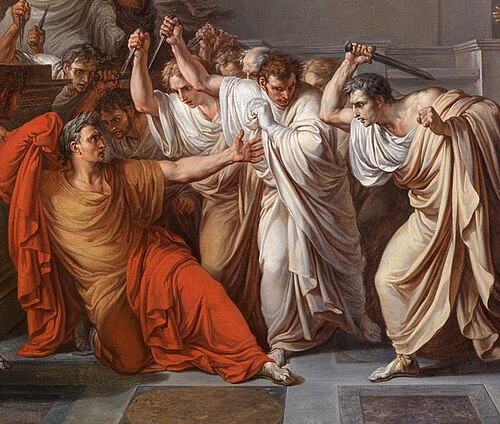
About sixty senators made a secret plan. On 15 March, a day the Romans called the Ides of March, Caesar came to a Senate meeting. The plotters crowded around him, pretending to ask for a favour, and then pulled out daggers hidden in their clothes. Caesar was stabbed 23 times and fell dead at the foot of a statue of his old rival, Pompey.
One of the plotters was Brutus, a man Caesar had forgiven and trusted. A famous play by William Shakespeare has Caesar say “Et tu, Brute?”, “You too, Brutus?”, but those words were invented much later. An ancient writer says that some people reported he spoke Greek words meaning “You too, child?”, and others said he said nothing at all.
The plotters thought everyone would thank them for freeing Rome. Instead, many ordinary Romans were furious. New wars broke out, the plotters were defeated, and Caesar’s adopted son, Octavian, became Rome’s first emperor, Augustus. The plan to save the Republic ended up finishing it.
At a glance
- Date
- 15 March 44 BCE, the Ides of March
- Place
- Curia of Pompey, a meeting hall in Pompey’s theatre complex on the Campus Martius, Rome (near today’s Largo di Torre Argentina)
- Victim
- Gaius Julius Caesar, dictator for life (dictator perpetuo), aged 55
- Conspirators
- More than sixty senators, led by Marcus Junius Brutus, Gaius Cassius Longinus and Decimus Junius Brutus Albinus; about twenty are known by name
- Wounds
- 23 stab wounds, of which, according to the physician Antistius, only one was fatal
- Aim
- To end Caesar’s near-monarchical power and restore the traditional Republic
- Result
- New civil wars; defeat of the conspirators at Philippi (42 BCE); rise of Octavian (Augustus) and the Roman Empire
- Main sources
- Nicolaus of Damascus, Plutarch, Suetonius, Appian and Cassius Dio; letters and speeches of Cicero
Easy
What happened?
On the morning of 15 March 44 BCE, the Roman Senate met in a hall called the Curia of Pompey. Rome’s regular Senate house had burned down in 52 BCE, and the new one Caesar was building was not finished, so meetings were held in this hall, attached to the great theatre complex that Caesar’s former rival Pompey had built.
Caesar arrived late. His wife Calpurnia had had a frightening dream the night before and begged him to stay home, and the priests’ sacrifices had produced bad omens. One of the conspirators, Decimus Brutus, whom Caesar trusted, came to his house and persuaded him not to disappoint the Senate. On the way, according to Plutarch, a Greek teacher named Artemidorus handed him a note warning of the plot, but Caesar did not read it.
When Caesar sat down, a group of senators crowded around him. Lucius Tillius Cimber pretended to plead for the return of his exiled brother and then pulled Caesar’s toga off his shoulders: the signal. Publius Servilius Casca struck the first blow. The others joined in, even wounding each other in the confusion. Caesar received 23 wounds and fell at the base of a statue of Pompey.
The senators who were not in the plot fled in panic. The conspirators marched out, holding up their daggers and shouting about liberty. Caesar’s body lay in the empty hall until three enslaved servants carried it home on a litter, with one arm hanging down.
Easy
Background: how Caesar became so powerful
For centuries Rome had been a republic. Power was shared among elected magistrates who served one-year terms, above all the two consuls, and the Senate, a council of former magistrates. Romans told the story that they had expelled their last king, Tarquin the Proud, around 509 BCE; after that, the very word rex, king, was hated.
In the first century BCE this system broke down. Rome’s empire had grown enormously, and powerful generals with loyal armies competed for control. Julius Caesar (born 100 BCE) rose as a popular politician and, from 58 to 50 BCE, conquered Gaul in a series of brutal campaigns. When his enemies in the Senate tried to strip him of his command, he crossed the Rubicon river into Italy with his army in 49 BCE, starting a civil war against Pompey and the senatorial government.
Caesar won. Pompey was murdered in Egypt in 48 BCE, and Caesar defeated the remaining Pompeian forces in Africa and Spain by 45 BCE. He was famous for his clementia, mercy: instead of executing his defeated opponents, he pardoned many of them, including Marcus Brutus and Gaius Cassius, and gave them offices.
Easy
Why did the conspirators kill him?
After the war Caesar held more power than any Roman before him. He was named dictator for ten years in 46 BCE and then, early in 44 BCE, dictator perpetuo, dictator for life. He decided who would hold office, and the Senate voted him extraordinary honours: a golden chair, a statue among those of the ancient kings, his portrait on coins while he was still alive, and the renaming of his birth month, Quintilis, as Iulius (July).
Several incidents fed fears that he wanted to be king. When the Senate came to honour him, he received them sitting down. Someone placed a diadem, the band of royalty, on his statue. At the festival of the Lupercalia on 15 February 44 BCE, his fellow consul Mark Antony offered him a crown in public. Caesar refused it, but many suspected the scene was staged to test public opinion.
Caesar was also about to leave Rome for a great war against the Parthian Empire in the east, planned for 18 March. He would be away for years, with his supporters controlling the magistracies. For the conspirators this was the last chance to act.
Their motives were mixed. Some, like Brutus, were driven by devotion to the Republic and to the memory of his supposed ancestor Lucius Junius Brutus, who had expelled the kings. Others resented Caesar’s control over their careers, had lost status, or had personal grievances. Many were former Pompeians whom Caesar had pardoned; others, like Decimus Brutus and Gaius Trebonius, were long-standing Caesarian officers.
Intermediate
The conspirators and the plan
Suetonius says more than sixty men took part in the conspiracy; about twenty names survive. The leaders were Marcus Junius Brutus, the urban praetor, a philosopher-statesman respected for his integrity; Gaius Cassius Longinus, also a praetor and an experienced soldier, often seen as the driving force; Decimus Junius Brutus Albinus, one of Caesar’s most trusted generals and consul-designate for 42 BCE; and Gaius Trebonius, a former consul. Others included the brothers Casca, Tillius Cimber, Minucius Basilus and Cassius of Parma.
The conspirators discussed where to strike: on the Sacred Way, at the elections, or at the Senate. They chose the Senate meeting because Caesar would be surrounded only by senators, and because killing him in the Senate could be presented as a public act of the governing body rather than a private murder. Caesar had recently dismissed his Spanish bodyguard.
They debated whether to kill Mark Antony too. Brutus insisted that only the tyrant should die, so that the act would look like justice, not a factional purge. On the day, Trebonius (or, in some accounts, Decimus) kept Antony talking outside the hall. This decision proved fatal for the conspirators, because Antony survived to lead the Caesarian side.
The orator Cicero, the most famous republican statesman, was not told of the plot, perhaps because the conspirators doubted his nerve. Afterwards he praised the deed warmly in his letters and speeches, and regretted only that Antony had been spared.
Intermediate
The Ides of March: omens, last words and the fatal wound
Ancient writers surrounded the day with omens, as they often did with the deaths of great men. The soothsayer Spurinna had warned Caesar that danger would come no later than the Ides of March. According to Suetonius and Plutarch, on the day itself Caesar joked to him that the Ides had come; Spurinna replied that they had come, but not yet gone. The famous line “Beware the Ides of March” is Shakespeare’s version.
Caesar’s last words are uncertain. Suetonius says that at the first blow he cried out, and then fell silent as he saw the daggers on every side, covering his face with his toga and arranging its folds so that he would fall decently. He adds that some writers reported that when Brutus attacked, Caesar said in Greek kai su, teknon, “you too, child?”. Plutarch says that when he saw Brutus with a drawn dagger he pulled his toga over his head and stopped resisting. The Latin “Et tu, Brute?” comes from Renaissance drama and was made famous by Shakespeare’s Julius Caesar (1599).
Suetonius reports that the physician Antistius examined the body and concluded that of the 23 wounds only one, the second, in the chest, was fatal. This is sometimes called the first recorded autopsy report, though it was an examination, not a dissection.
Intermediate
Aftermath: amnesty, funeral and the will
The conspirators had no plan for what came next beyond declaring liberty. They took refuge on the Capitoline Hill. The city was stunned. Antony, as consul, and Marcus Aemilius Lepidus, who commanded troops near the city, controlled the armed forces. On 17 March the Senate met and, with Cicero’s support, reached a compromise: the killers would receive an amnesty, but all of Caesar’s acts and appointments would remain valid, since many senators owed their positions to him.
Then the mood changed. Caesar’s will was opened: he left each Roman citizen 300 sesterces and gave his gardens across the Tiber to the people, and he adopted his 18-year-old great-nephew Gaius Octavius as his son and main heir. At the public funeral in the Forum, Antony’s speech and the display of Caesar’s bloodstained robe stirred the crowd to fury. People built a pyre on the spot and burned the body in the Forum itself, then ran with torches to attack the conspirators’ houses. Brutus and Cassius soon left Rome.
In July 44 BCE, during games held in Caesar’s honour, a bright comet appeared for seven days. Romans took it as a sign that Caesar’s soul had joined the gods; it became known as the sidus Iulium, the Julian star. Octavian, now calling himself Caesar, made skilful use of it.
Intermediate
Results: new civil wars and the end of the Republic
The assassination did not restore the Republic. Octavian, Antony and the Senate first fought one another; then, in November 43 BCE, Octavian, Antony and Lepidus formed the Second Triumvirate, a legal dictatorship of three men. They published proscription lists, outlawing hundreds of their enemies, whose property was seized and who could be killed on sight. Cicero was among the victims, murdered on 7 December 43 BCE.
A law passed in 43 BCE, the lex Pedia, condemned Caesar’s killers. Trebonius was killed in Asia in 43 BCE, and Decimus Brutus was captured and executed in Gaul the same year. Brutus and Cassius raised armies in the eastern provinces and minted coins celebrating their act; one famous silver coin shows a freedman’s cap between two daggers with the words EID MAR, the Ides of March. In October 42 BCE Antony and Octavian defeated them in two battles at Philippi in Macedonia; both took their own lives. Suetonius claims that hardly any of the assassins survived Caesar by more than three years or died a natural death.
On 1 January 42 BCE the Senate declared Caesar a god, Divus Iulius, and a temple was later built for him on the spot in the Forum where his body had been burned. The Curia of Pompey was walled up, and the Ides of March was called the Day of Parricide, on which the Senate would never again meet.
The final conflict was between Octavian and Antony. After his victory at Actium in 31 BCE, Octavian became the sole ruler of the Roman world and in 27 BCE received the name Augustus. He carefully avoided the title of king or dictator, but he held permanent power. The Roman Empire had begun, founded by the heir of the man the conspirators had killed to prevent monarchy.
Intermediate
Memory: tyrannicide or murder?
From the very beginning, Romans disagreed about what the assassination meant. For the conspirators and for Cicero, it was tyrannicide, the lawful and glorious killing of a tyrant, in the tradition of the first Brutus. For Caesar’s soldiers, the urban poor and his heirs, it was parricide, the murder of the “father of the fatherland” by men he had pardoned. Under Augustus and later emperors, the official version condemned the killers, yet writers such as Lucan in the first century CE could still express admiration for the republican cause.
Later ages kept rewriting the story. In Dante’s Inferno, Brutus and Cassius are chewed forever in the mouths of Satan beside Judas, as traitors to their lord. Renaissance republicans in Florence, by contrast, admired Brutus; Michelangelo carved a bust of him. Shakespeare’s Julius Caesar (1599) made Brutus a tragic idealist, “the noblest Roman of them all”, and gave the world phrases such as “Beware the Ides of March” and “Friends, Romans, countrymen”.
In modern times the assassination became a reference point in debates about political violence. Revolutionaries in the eighteenth and nineteenth centuries invoked Brutus as a hero of liberty; others pointed to the aftermath as proof that killing a leader rarely achieves its aims. Historians note that the conspirators’ “liberty” was mainly the liberty of a narrow senatorial elite, while Caesar’s popularity among soldiers and ordinary citizens was real.
The site itself has been identified in the Largo di Torre Argentina in central Rome, an archaeological area excavated from the late 1920s, where the foundations of part of Pompey’s Curia can be seen behind the remains of Republican temples. Today it is also famous as a sanctuary for stray cats.
Advanced
The sources and their problems
No eyewitness narrative of the killing survives. The most detailed accounts were written between about half a century and more than two centuries later. The earliest is the Life of Augustus by Nicolaus of Damascus, a Greek scholar who knew Herod the Great and Augustus, written probably in the late first century BCE or early first century CE; it survives only in excerpts but contains a detailed account of the conspiracy and the day. Next come Plutarch’s Lives of Caesar and of Brutus (around 100 CE) and Suetonius’ Life of the Deified Julius (around 120 CE). Appian’s Civil Wars (second century CE) and Cassius Dio’s Roman History (early third century CE) give continuous narratives.
These writers drew on earlier works now lost, including contemporary histories by Asinius Pollio and the relevant books of Livy. They also shared literary habits: omens, dramatic speeches and moralizing contrasts between noble Brutus and resentful Cassius. Details such as Calpurnia’s dream, Artemidorus’ note and the exact words spoken are part of a story that grew in the retelling and should be treated with caution.
The only truly contemporary evidence comes from Cicero’s letters, especially those to his friend Atticus written in the weeks after the Ides, and his Philippics, speeches attacking Antony in 44–43 BCE. They reveal the confusion, hopes and disappointment of the months after the murder, but they are partisan. Coins, such as the EID MAR denarius struck for Brutus, and the archaeological remains of the Curia of Pompey add material evidence.
Advanced
Historians’ debates
Did Caesar want to be king? Some historians think Caesar aimed at an open monarchy, perhaps on a Hellenistic model; others argue he was content with a dictatorship that gave him real power without the hated name, and that the crown episodes were attempts by supporters or enemies to compromise him. The ancient sources themselves disagree, and the question may be partly anachronistic, since permanent dictatorship already made him a monarch in practice.
Was the Republic already dead? Ronald Syme’s The Roman Revolution (1939) argued that the Republic had become a contest of aristocratic factions and that monarchy was the likely outcome; in that view the assassination changed only who would become ruler. Other scholars stress contingency: had the conspirators killed Antony too, or had Caesar gone to Parthia and died there, events might have gone differently.
Who led the plot? Popular tradition centres on Brutus. Some recent work, notably Barry Strauss’s The Death of Caesar (2015), highlights the role of Decimus Brutus and of Caesar’s own former officers, showing that the conspiracy united disappointed Caesarians as well as old Pompeians. The motives of the lesser conspirators are mostly unknown.
Did Caesar expect it? Suetonius reports a view that Caesar, in poor health, did not care to live longer and ignored warnings; others saw his dismissal of his bodyguard as confidence that the Senate needed him to prevent renewed civil war. Such interpretations are ultimately speculative, but they shape how the event is read: as a noble defence of liberty, a short-sighted aristocratic reaction, or a tragedy in which all sides misjudged the situation.
Key ideas
- Republic
- Rome’s system of elected annual magistrates and a Senate, which the conspirators wanted to defend against one-man rule.
- Tyrannicide
- The killing of a tyrant, regarded in Greek and Roman thought as justified; the conspirators saw themselves as tyrannicides.
- Clementia
- Caesar’s policy of pardoning defeated enemies, which won support but also left former opponents in the Senate, some of whom killed him.
- Dictator perpetuo
- Caesar’s unprecedented title “dictator for life”, turning an emergency office into permanent power.
- Unintended consequences
- The murder, meant to restore the Republic, triggered civil wars that ended in the permanent monarchy of Augustus.
- Memory and myth
- From Dante to Shakespeare to modern revolutionaries, the event has been retold to serve changing ideas of loyalty, liberty and violence.
Records
- 49 BCE — Caesar crosses the Rubicon, starting civil war against Pompey and the Senate (49 BCE).
- 48 BCE — Pompey is defeated at Pharsalus and murdered in Egypt (48 BCE).
- 46 BCE — Caesar is made dictator for ten years (46 BCE).
- 44 BCE — Caesar becomes dictator for life (early 44 BCE); Antony offers him a crown at the Lupercalia on 15 February.
- 44 BCE — 15 March 44 BCE: Caesar is assassinated in the Curia of Pompey; on 17 March the Senate grants the killers an amnesty.
- 44 BCE — July 44 BCE: a comet seen at games in Caesar’s honour is hailed as his soul rising to the gods.
- 43 BCE — The Second Triumvirate is formed and proscriptions begin; Cicero is killed (43 BCE).
- 42 BCE — Caesar is deified as Divus Iulius (1 January); Brutus and Cassius are defeated at Philippi and die (October 42 BCE).
- 31 BCE — Octavian defeats Antony and Cleopatra at Actium (31 BCE).
- 27 BCE — Octavian receives the name Augustus; the Principate begins (27 BCE).
- c. 121 CE — Suetonius writes his Life of the Deified Julius, a key account of the assassination.
- 1599 — Shakespeare’s Julius Caesar is first performed in London.
Glossary
- Ides
- In the Roman calendar, the middle of the month: the 15th of March, May, July and October, and the 13th of other months.
- Senate
- Rome’s council of former magistrates, which advised officials and had great authority.
- Dictator
- Originally a temporary emergency magistrate with supreme power for up to six months.
- Curia
- A building where the Senate met.
- Consul
- One of the two highest annual magistrates of the Roman Republic.
- Praetor
- A senior magistrate below the consuls, mainly responsible for justice; Brutus and Cassius were praetors in 44 BCE.
- Proscription
- The public posting of names of people declared outlaws, whose property was confiscated and who could be killed.
- Triumvirate
- A group of three men sharing power; the Second Triumvirate of Octavian, Antony and Lepidus was formally established by law in 43 BCE.
- Deification
- The official declaration that a person has become a god; Caesar was the first Roman leader deified by the state.
- Liberatores
- “Liberators”, the name the conspirators used for themselves.
Questions and answers
Why is it called the Ides of March?
The Romans called the middle of certain months the Ides. In March it fell on the 15th, the day Caesar was killed.
Did Caesar really say “Et tu, Brute?”
No ancient source says so. Suetonius reports that some said he spoke Greek words meaning “you too, child?”, while others said he said nothing. The Latin phrase was made famous by Shakespeare.
Was Brutus Caesar’s son?
Almost certainly not. Caesar had a long affair with Brutus’ mother Servilia, which led to later rumours, but Brutus was born when Caesar was only about fifteen.
How many people killed Caesar?
More than sixty senators were in the conspiracy, according to Suetonius, and many struck him. He received 23 wounds.
Did the assassination save the Roman Republic?
No. It led to more civil wars, the defeat of the conspirators and the rule of Augustus, the first Roman emperor.
Where exactly was Caesar killed?
In the Curia of Pompey, part of Pompey’s theatre complex, not in the Forum’s Senate house. Its remains lie in the Largo di Torre Argentina in Rome.
How reliable are the stories of omens and warnings?
They come from writers of the first to third centuries CE who liked dramatic signs of fate. Some may reflect real rumours, but historians treat them as literary tradition rather than fact.
Did Cicero take part?
No. He was not told of the plot, but he welcomed it enthusiastically afterwards and later led the Senate’s opposition to Antony, which cost him his life.
Sources and further reading
- Assassination of Julius Caesar. Wikipedia
- Julius Caesar. Wikipedia
- 율리우스 카이사르. 위키백과
- Liberatores. Wikipedia
- Marcus Junius Brutus. Wikipedia
- Curia of Pompey. Wikipedia
- Suetonius, The Lives of the Caesars: Julius (trans. Alexander Thomson). Perseus Digital Library, Tufts University
- Plutarch, Life of Caesar (Loeb translation by Bernadotte Perrin). LacusCurtius (Bill Thayer), University of Chicago
- Ronald Syme, The Roman Revolution. Oxford University Press, 1939
- Barry Strauss, The Death of Caesar: The Story of History’s Most Famous Assassination. Simon & Schuster, 2015
Related
- VirgilA Roman poet whose Aeneid became one of the most influential works of Latin literature.
- Founding of RomeRome's traditional founding is dated to 753 BCE, but the date and the story of Romulus belong to later legend.
- Library of AlexandriaAn ancient center for collecting and studying texts in Ptolemaic Alexandria.
- Fall of the Western Roman EmpireThe removal of the western emperor Romulus Augustulus in 476 CE, often used as a marker for the end of the Western Roman Empire.
- William ShakespeareEnglish playwright and poet whose plays span comedy, history and tragedy.
- Assassination of Archduke Franz FerdinandThe killing of Archduke Franz Ferdinand and his wife Sophie in Sarajevo on 28 June 1914 triggered a diplomatic crisis that led to the First World War.
Written with AI assistance from the published sources listed above, and revised as new research appears.