Start at the top for an easy introduction. Go further down for more detail and scholarship.
- Easy
- Intermediate
- Advanced
For young readers
Long, long ago, in the lands that are now Iran, Afghanistan and Central Asia, people sang songs to God and to the good powers of the world. Some of these songs were made by a teacher named Zarathustra, whom many people today call Zoroaster. His followers are called Zoroastrians, and their holy book is the Avesta.
For a very long time, nobody wrote the Avesta down. Priests learned every word by heart, like learning a very long song, and taught it to their children and students. They were careful to say each sound exactly right, because they believed the words themselves were holy and powerful.
The most special part of the Avesta is a group of seventeen songs called the Gathas. Zoroastrians believe Zarathustra himself made them. They talk about choosing between truth and lies, and about a wise and good God called Ahura Mazda, the “Wise Lord”.
Other parts of the Avesta are hymns to helpers of Ahura Mazda, like the spirits of water, the sun and the moon, and rules for keeping people, fire, water and earth clean. There are also short prayers that Zoroastrian families still say today, at home and in fire temples.
About 1,500 years ago, priests invented a special alphabet so they could write the sounds of the Avesta exactly. Much of the book was lost later, but the parts used in prayers survived, because people kept saying them every day. Zoroastrians in Iran and India still use it today.
At a glance
- What it is
- The collected sacred texts of Zoroastrianism, mostly liturgical (texts recited in worship)
- Language
- Avestan, an Old Iranian language with two layers: Old Avestan and Young Avestan
- Composed
- Orally; Old Avestan texts probably c. 1500–900 BCE (many scholars favour around 1000 BCE), Young Avestan texts probably c. 900–400 BCE — all dates debated
- First written
- Sasanian period: the Avestan alphabet was created perhaps in the 4th century CE, and a great written edition in 21 volumes (nasks) is usually dated to the 5th–6th century CE
- Main parts today
- Yasna (72 chapters, including the Gathas), Visperad, Vendidad (22 chapters), 21 Yashts, and the Khordeh Avesta (“Little Avesta”) of daily prayers
- Oldest manuscripts
- Early 14th century CE (the oldest dated copy is from 1323); most surviving manuscripts are from the 17th century or later
- Communities
- Zoroastrians in Iran (e.g. Yazd and Kerman), the Parsis of India, and a worldwide diaspora
- Map point
- Yazd, Iran — a historic centre of the Iranian Zoroastrian community, used here as a representative place because the text itself has no single place of origin
Easy
What is the Avesta?
The Avesta is the name for the sacred texts of Zoroastrianism, one of the oldest religions still practised in the world. It is not a single book written by one author at one time, like a modern novel. It is a collection of prayers, hymns, ritual texts and religious laws, composed over many centuries and preserved by a community of priests.
The texts are in Avestan, an ancient Iranian language that nobody has spoken as an everyday language for well over two thousand years. Avestan is the oldest known Iranian language after Proto-Iranian itself; its oldest parts are older than the Old Persian inscriptions of the Achaemenid kings, such as those carved at Persepolis. The Avesta is therefore the largest body of literature surviving from the Old Iranian period.
Most of what survives is liturgy: words meant to be recited aloud by priests during ceremonies, or by ordinary believers in their daily prayers. This is an important key to understanding the Avesta. It survived not mainly as a library book but as a living voice, repeated in worship generation after generation.
Today the Avesta is still used by Zoroastrians in Iran, by the Parsi community of India, and by Zoroastrians who have settled in many other countries. For them it is scripture: a holy text whose words are believed to carry spiritual power. For historians and linguists it is also a precious window onto the religion, society and languages of ancient Iran and Central Asia.
Easy
Zarathustra and the Zoroastrian faith
Zoroastrians revere Zarathustra (known in Greek and later in European languages as Zoroaster) as the prophet of their religion. According to their tradition, he received a revelation from Ahura Mazda, the “Wise Lord”, and taught people to follow truth, to reject deception, and to care for the good creation. Traditional stories say that he found a royal patron, King Vishtaspa, who accepted his teaching and helped it spread.
At the heart of the faith is the belief that the world is a place of struggle between good and evil. Ahura Mazda is the creator of everything good. Opposed to him is Angra Mainyu, the destructive spirit. Every person is free to choose which side to support, and good choices are expressed through good thoughts, good words and good deeds — a famous threefold formula in Zoroastrian teaching.
Zoroastrians believe that the Gathas, the oldest hymns in the Avesta, were composed by Zarathustra himself. Many modern scholars agree that the Gathas come from a single circle or a single poet, and that they are the oldest part of the collection. Others are more cautious, as later sections of this page explain. Both views agree on one thing: the Gathas are the foundation on which the rest of the tradition was built.
Because Zoroastrianism is a living religion, it is important to remember that questions about dates and authorship are scholarly questions. They do not decide what the Avesta means to believers, for whom it is the word of their faith recited in their homes and fire temples.
Easy
What is inside the Avesta?
The Avesta that exists today is usually described as having a few main parts. The most important is the Yasna, a text of 72 chapters recited during the central Zoroastrian act of worship, also called the Yasna. In the middle of the Yasna lie its oldest pieces: the five Gathas and a short prose text called the Yasna Haptanghaiti, the “Worship in Seven Chapters”.
The Visperad (“all the masters” or “all the ratus”) is a collection of 24 short sections. It is not normally recited on its own; instead its pieces are slotted into the Yasna to make a longer, more solemn ceremony. The Vendidad has 22 chapters called fargards. It contains a creation story, the legend of the first king Yima, and many rules about purity, illness, death and the care of fire, water, earth and animals.
The Yashts are 21 hymns in praise of particular divine beings, called yazatas (“ones worthy of worship”): for example the waters, the sun, the moon, Mithra (the guardian of contracts and truth), and the fravashis, the guardian spirits of the righteous. Many of them contain vivid stories about heroes and legendary kings of the Iranian past.
Finally there is the Khordeh Avesta, the “Little Avesta”, a prayer book for everyday use. It gathers short prayers such as the Niyayishs (praises of the sun, Mithra, the moon, the waters and fire), the five Gahs (prayers for the five watches of the day), invocations of the divinities of the thirty days of the month, and blessings used on special occasions. Together, these parts make up a book of worship more than a book of history.
Intermediate
The Gathas: the oldest songs
The Gathas are five poems, containing 17 hymns in all, arranged in the Yasna according to their metre. The Ahunavaiti Gatha (Yasna 28–34) has seven hymns; the Ushtavaiti Gatha (Yasna 43–46) has four; the Spentamainyu Gatha (Yasna 47–50) has four; the Vohukhshathra Gatha (Yasna 51) and the Vahishtoishti Gatha (Yasna 53) have one each. Together they contain 238 stanzas. With the Yasna Haptanghaiti, which sits between the first and second Gatha, the Old Avestan texts amount to only about 5,600 words — a small core for such an influential tradition.
The language of the Gathas is highly compressed, allusive poetry, full of rare words and complex grammar. The speaker often addresses Ahura Mazda directly, asking questions and seeking guidance. Central ideas include asha (truth, right order) and its opposite druj (the lie, deception); the free choice every person must make between them; and the “bounteous” powers associated with Ahura Mazda, such as Good Thought (Vohu Manah) and Truth, which later tradition developed into the Amesha Spentas, the “Beneficent Immortals”.
The Gathas also criticise those who worship the daevas. In older Indo-Iranian religion these were a class of gods; in the Gathas they are rejected as false gods, and in later Zoroastrianism they became demons. This shift is one of the clearest signs of a deliberate religious reform in the Gathic texts.
Just before the Gathas, at Yasna 27, stand the four most sacred short prayers (manthras) of Zoroastrianism, which are also in Old Avestan. The greatest is the Ahuna Vairya, a stanza of 21 words that believers recite many times a day. Its exact meaning is famously hard to translate: its syntax is so compact that translators, ancient and modern, have understood it in quite different ways. For believers its power lies as much in faithful recitation as in a single fixed translation.
Intermediate
The Young Avesta: hymns, myths and laws
Most of the surviving Avesta is in Young Avestan, a later form of the language. Old Avestan and Young Avestan are not simply grandparent and grandchild: they seem to reflect different dialects as well as different periods, but scholars treat them as varieties of one language. Young Avestan texts are more numerous, more varied, and less tightly fixed in wording than the Gathas.
The Young Avesta shows a religion that has grown and absorbed older traditions. Divinities barely mentioned in the Gathas, such as Mithra, the waters (personified as Aredvi Sura Anahita) and the sacred plant Haoma, receive long hymns. Some Yashts preserve heroic legends — dragon-slayers, rival kings, and a royal “glory” (khvarenah) that passes from worthy ruler to worthy ruler. Many of these figures reappear, transformed, over a thousand years later in Persian epic, above all Ferdowsi’s Shahnameh.
Young Avestan texts also mention real places in the eastern Iranian world — regions corresponding to areas around Sistan, Herat, Merv and Bactria (today parts of Iran, Afghanistan, Turkmenistan and Tajikistan). The first chapter of the Vendidad, for example, lists sixteen lands created by Ahura Mazda and the evils Angra Mainyu set against each. By contrast, the Old Avestan texts name no identifiable places at all. Neither layer mentions western Iranian peoples like the Medes and Persians.
The Vendidad deserves special mention. Its name comes from an Avestan phrase meaning “law against the daevas”. It is presented largely as a dialogue in which Zarathustra asks Ahura Mazda questions and receives answers. It sets out rules to protect the good creation from pollution, especially from contact with death, and it gives remarkable attention to the care of dogs, water and fire. It is the only one of the volumes of the great Sasanian edition that has survived complete.
Intermediate
A text that lives in ritual
To understand the Avesta, it helps to picture the Yasna ceremony. A trained priest, assisted by a second priest, recites all 72 chapters before a consecrated fire, preparing and offering haoma (a sacred drink made from a plant) and water. The full recitation takes about two hours and is usually performed in the morning. Its purpose, in Zoroastrian understanding, is to strengthen the good spiritual and material creation of Ahura Mazda against the attacks of destructive forces. It ends with the ab-zohr, an offering to the waters.
Longer ceremonies interweave the Visperad and, at night, the Vendidad with the Yasna. The nocturnal Vendidad ceremony, performed today only in India, shows that even the book of laws was used as sacred recitation. This is why modern scholars increasingly describe the surviving Avesta as the “text of the rituals” rather than as a random remnant of a lost library.
The Avesta also shapes daily life. Every Zoroastrian who has been initiated wears a sacred shirt (sudreh) and a sacred cord, the kusti, which is tied around the waist several times a day while reciting Avestan prayers. By tradition the kusti is woven of 72 threads, matching the 72 chapters of the Yasna. Short prayers such as the Ahuna Vairya and the Ashem Vohu, a praise of asha, are among the first words Zoroastrian children learn.
Recitation must be precise. In Zoroastrian thought, sacred words (manthras) are effective when spoken correctly, with the right sounds and cadence. This concern for precise sound is the reason the texts were preserved orally for so long — and, as we shall see, why a special alphabet was eventually invented to write them.
Intermediate
From memory to manuscript: how the Avesta was written down
For many centuries the Avesta existed only in the memories of priests. Scholars think the Old Avestan texts became fixed in wording very early, while Young Avestan material stayed more fluid for a time, allowing each generation to adapt it. Young Avestan texts were probably fixed as well by around the Achaemenid period, when Zoroastrian religion gained political prominence in the Persian empire.
Later Zoroastrian tradition, preserved in Middle Persian books, tells that a complete written Avesta existed long before, but was destroyed when Alexander the Great conquered Iran, and that later kings gathered the scattered remains. Modern historians treat this story with caution: it expresses the community’s memory of loss and restoration, but there is no evidence for an ancient written Avesta, and most scholars think the texts were transmitted orally until much later.
The decisive step came under the Sasanian dynasty (224–651 CE), the last great pre-Islamic Iranian empire, which supported Zoroastrianism. Priests created the Avestan alphabet, based on the Pahlavi script used for Middle Persian but greatly expanded: where Pahlavi had at most 22 ambiguous letters, Avestan has 53 characters, including separate letters for vowels. Written from right to left, it could record the sounds of recitation with a precision few ancient scripts matched. Its creation is often placed in the 4th century CE, possibly under Shapur II, though some scholars date the first written Avesta to the 5th or 6th century.
The resulting Sasanian Avesta was a vast work organised into 21 nasks (volumes), a number chosen to match the 21 words of the Ahuna Vairya prayer. It was accompanied by the Zand, a translation and commentary in Middle Persian. After the Arab conquest and the fall of the Sasanians in 651, the Zoroastrian community gradually became a minority and most of this edition was lost. We know about its contents mainly from summaries in the Denkard, a Middle Persian encyclopaedia of the 9th–10th century.
Intermediate
Manuscripts, the Parsis and the European discovery
What survived the losses were mainly the texts that priests needed for ritual and prayer, copied again and again by hand. The oldest surviving dated manuscript goes back only to 1323 CE, and most of the more than 300 manuscripts catalogued today were copied after the 17th century. In other words, there is a gap of well over two thousand years between the composition of the oldest hymns and our oldest written copy.
Manuscripts were copied in two main communities: the Zoroastrians who remained in Iran, especially around Yazd and Kerman, and the Parsis, descendants of Zoroastrians who settled in Gujarat in western India after the Islamic conquest. Scholars classify the manuscripts by use (Yasna, Visperad or Vendidad liturgies), by origin (Iranian or Indian), and by type: “Sade” (“pure”) manuscripts contain only the Avestan text for recitation, while others add the Middle Persian translation.
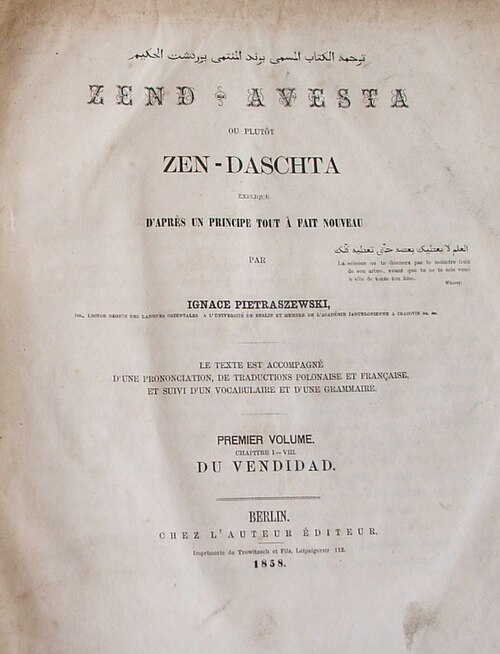
Europe learned of the Avesta through the French scholar Abraham Hyacinthe Anquetil-Duperron. He sailed for India in 1755, reached Surat in 1758, and studied there with Parsi priests, notably one named Darab, who taught him through Persian what they knew of the language and religion. In 1762 he deposited some 180 manuscripts in the Royal Library in Paris, and in 1771 he published a three-volume French translation, the Zend-Avesta.
The reception was stormy. The young William Jones, later famous as a pioneer of Indo-European comparative linguistics, published a pamphlet the same year dismissing the work as a forgery. In time, however, the authenticity of the texts was vindicated, as comparative study showed how closely Avestan is related to Sanskrit. Older books often call the language “Zend”, but this is a misunderstanding: Zand refers to the Middle Persian commentary, not to the Avestan text itself.
Intermediate
Influence and legacy
Within Zoroastrianism, the Avesta remains the heart of worship. Priests are still trained to recite it from memory; families still pray with the Khordeh Avesta; fire temples such as the Atash Behram in Yazd continue ceremonies built around Avestan texts. For a community that has endured conquest, minority status and migration, the continuous recitation of these words is a powerful thread of identity.
For linguistics, the Avesta was essential in reconstructing the Indo-Iranian branch of the Indo-European family. Old Avestan and the Vedic Sanskrit of the Rigveda are so close that whole phrases can be converted from one to the other by regular sound laws. Shared vocabulary — Avestan haoma and Vedic soma, asha and the Vedic concept rta, daeva and deva, ahura and asura — reveals a common inheritance, even as the two traditions came to value some of these terms in opposite ways.
For the history of religion, the Avesta is a key source for ideas that many scholars have compared with later traditions: a single supreme good creator, a cosmic struggle between good and evil, personal moral choice, individual judgment after death, and a final renewal of the world. How far, and through which routes, these ideas influenced Judaism, Christianity and Islam is debated; the Avesta is central evidence in that debate.
For Iranian culture more broadly, the legends of the Young Avesta — of Yima, the dragon-slayers and the Kayanian kings — flowed through Middle Persian literature into the Persian national epic. Modern Iranian nationalism and European thought (including Nietzsche’s very free literary use of the figure of Zarathustra) have also drawn on the Avesta, sometimes in ways far removed from the texts themselves.
Advanced
Dating Zarathustra and the Old Avestan texts
The Avesta contains no absolute dates and mentions no datable historical king, so every chronology is an inference. Medieval Zoroastrian sources place Zarathustra “258 years before Alexander”, i.e. in the 7th–6th century BCE. Critical scholarship generally regards this figure as a retroactive calculation: when the Seleucids introduced an era counted from Alexander, Zoroastrian priests seem to have computed an “era of Zoroaster” back through generations. Greek authors, meanwhile, placed Zoroaster absurdly early — 6,000 years before Xerxes — perhaps misreading Zoroastrian world-ages of 3,000 years.
The main modern argument is linguistic. Old Avestan is morphologically very archaic and closely resembles the language of the Rigveda, usually dated to the later second millennium BCE. The distance between Old and Young Avestan implies several centuries. The material culture reflected in the Gathas — a pastoral society, with no cities and no mention of western Iranian peoples or of the Achaemenid empire — fits better with an early date and an eastern setting. On this basis many scholars place the Gathas around 1000 BCE, within a wider range of roughly 1500–900 BCE.
A minority argue for a later date, in the 7th–6th century BCE, sometimes by identifying the Gathic patron Vishtaspa with Hystaspes, the father of Darius I. Critics reply that the name was common, that the Avesta shows no knowledge of the Achaemenids, and that the linguistic gap to Old Persian is large. The place of Zarathustra’s activity is also debated: proposals include Bactria, Sistan, Chorasmia and regions linked to the Bronze Age Bactria–Margiana cultures; medieval claims for a birthplace in Media are not accepted by most scholars.
More radically, some scholars — Jean Kellens and Prods Oktor Skjærvø among them — have questioned whether the Gathas can be read as the personal compositions of a historical prophet at all, seeing “Zarathustra” in the texts partly as a ritual or poetic persona. Others, such as Helmut Humbach, stressed the ritual character of the Gathas while still treating them as coming from Zarathustra. The debate illustrates a general point: the tradition offers a coherent biography, whereas critical scholarship can reconstruct only a probable linguistic and cultural setting.
Advanced
Editions, archetypes and the liturgical turn
Critical editing of the Avesta began in the 19th century. Niels Ludvig Westergaard published the first critical edition in 1852, drawing on manuscripts collected by Rasmus Rask; Friedrich von Spiegel produced an edition that included the Middle Persian translations. The standard edition remains that of Karl Friedrich Geldner (1886–1896), based on 133 manuscripts and covering the Yasna, Visperad, Vendidad and Khordeh Avesta. Christian Bartholomae’s dictionary made possible Fritz Wolff’s German translation of 1910, which superseded earlier renderings such as James Darmesteter’s.
Nineteenth- and early twentieth-century scholars tried to explain oddities in the text by positing an “Arsacid archetype”, a supposed written Avesta of the Parthian period in an ambiguous script that Sasanian scribes later transcribed imperfectly. In the 1950s Karl Hoffmann overturned this model. He argued that many irregularities reflect changes during oral transmission: habits of recitation, influence from other Iranian languages as the tradition moved from east to west, and phonetic developments in the Avestan of the reciters themselves. The Sasanian alphabet, on this view, faithfully records the Avesta as it was being recited in the Sasanian period, not the speech of Zarathustra.
This has important consequences. A critical edition built on Geldner’s method reconstructs something close to the Sasanian archetype — itself more than a millennium younger than the Gathas. Behind it lies an oral history we can only infer. Scholars such as Jean Kellens and Alberto Cantera have further emphasised that the surviving Avesta is essentially a set of liturgies. Cantera’s work on the Vendidad, for example, challenges the older view that its ritual use was a late, Islamic-period innovation, and argues that its structure is tied to liturgical performance.
Current projects put this “liturgical turn” into practice. The Avestan Digital Archive has digitised more than 150 manuscripts, making many available online, and the Corpus Avesticum Berolinense edits texts in the form in which they appear in manuscripts of actual ceremonies, rather than extracting an idealised original. Open questions include the precise date and place of the alphabet’s creation, the relation between the 21-nask Sasanian edition and the surviving liturgies, and how to translate Gathic poetry whose grammar is certain but whose meaning often remains contested.
Key ideas
- Asha and druj
- Asha is truth, right order and the way things ought to be; druj is the lie or deception that opposes it. The contrast runs through the whole Avesta, from the Gathas to the Vendidad.
- Free choice
- The Gathas present each person as choosing between truth and the lie. Later Zoroastrianism sums up the right choice as good thoughts, good words and good deeds.
- Ahura Mazda and Angra Mainyu
- Ahura Mazda, the Wise Lord, is creator of all that is good; Angra Mainyu is the destructive spirit. Human beings are called to help the good creation in their struggle.
- Sacred speech (manthra)
- Avestan words are believed to be effective when recited correctly. This belief explains centuries of careful oral transmission and the invention of a precise alphabet.
- Purity of creation
- Fire, water, earth, plants, animals and people are good creations to be protected from pollution, especially from death. The Vendidad turns this idea into detailed rules.
- Liturgy, not library
- The surviving Avesta is mainly what was needed for worship. Modern scholarship reads it as the text of living rituals rather than as the scattered remains of a lost book.
- Two layers of language
- Old Avestan (Gathas, Yasna Haptanghaiti, the sacred prayers) and Young Avestan (most other texts) differ in grammar and date, which helps scholars reconstruct the history of the tradition.
Records
- c. 1000 BCE — Probable period of the Old Avestan texts (Gathas, Yasna Haptanghaiti); many scholars favour around 1000 BCE within a range of about 1500–900 BCE. Zoroastrian tradition dates Zarathustra differently.
- c. 800 BCE — Young Avestan texts begin to be composed orally in the eastern Iranian world (c. 900–400 BCE).
- c. 500 BCE — Achaemenid period: Zoroastrian religion gains political importance; Young Avestan texts are thought to become fixed around this time.
- c. 350 CE — Sasanian period: the Avestan alphabet is created, perhaps under Shapur II (r. 309–379); some scholars place the first written Avesta later.
- c. 550 CE — The great Sasanian Avesta in 21 nasks, with Middle Persian commentary (Zand), is usually dated to the 5th–6th century.
- 651 CE — Fall of the Sasanian empire after the Arab conquest; over the following centuries most of the Sasanian Avesta is lost.
- c. 900 CE — The Denkard, a Middle Persian encyclopaedia, summarises the contents of the 21 nasks.
- 1323 — Date of the oldest surviving dated Avesta manuscript.
- 1762 — Anquetil-Duperron deposits about 180 manuscripts, obtained in India, in the Royal Library in Paris.
- 1771 — Anquetil-Duperron publishes the first European translation, the Zend-Avesta, in three volumes.
- 1852 — Niels Ludvig Westergaard publishes the first critical edition of the Avestan texts.
- 1886 — Karl Friedrich Geldner begins publishing his edition (1886–1896), still the standard scholarly text.
Glossary
- Avestan
- The ancient Iranian language of the Avesta, known in an older form (Old Avestan) and a later form (Young Avestan).
- Gathas
- Five poems (17 hymns) in Old Avestan within the Yasna, attributed by tradition to Zarathustra.
- Yasna
- The principal Zoroastrian act of worship, and the 72-chapter text recited during it.
- Vendidad
- A Young Avestan text of 22 chapters on creation, purity and religious law; the only complete surviving volume of the Sasanian Avesta.
- Yasht
- A hymn of praise to a particular divinity; the Avesta contains a collection of 21 Yashts.
- Yazata
- “One worthy of worship”: a divine being honoured in Zoroastrian worship, such as Mithra or the waters.
- Nask
- One of the 21 volumes into which the Sasanian written Avesta was divided.
- Zand
- The Middle Persian translation and commentary on the Avesta; the source of the mistaken name “Zend” for the Avestan language.
- Ahuna Vairya
- The most sacred Zoroastrian prayer, a 21-word Old Avestan stanza at Yasna 27.13.
- Kusti
- The sacred cord worn by initiated Zoroastrians, traditionally of 72 threads, tied while reciting Avestan prayers.
- Parsis
- Zoroastrians of India, descendants of Iranian Zoroastrians who migrated to Gujarat after the Islamic conquest of Iran.
Questions and answers
Did Zarathustra write the Avesta?
Not in the sense of writing it down. Zoroastrian tradition holds that he composed the Gathas, the oldest hymns; the rest of the Avesta was composed over later centuries. The texts were passed on orally and written only in the Sasanian period, over a thousand years later.
Why was it memorised instead of written?
In ancient Iran, sacred words were thought to work through correct recitation, and priestly schools trained memory for exactly this purpose. There was also no script suited to recording Avestan sounds until the Sasanian priests invented one.
Is all of the Avesta still there?
No. The Sasanian edition in 21 volumes was much larger than what survives. The parts used regularly in worship survived; much else is known only from later summaries such as those in the Denkard.
Is the Avesta related to the Rigveda?
The languages are close relatives: Old Avestan and Vedic Sanskrit descend from a common Indo-Iranian ancestor and share many words and poetic forms. The religions developed differently, and some shared terms, like daeva and deva, took on opposite values.
Why is the oldest manuscript so late?
Manuscripts were used in daily ritual and wore out, and Zoroastrian communities suffered losses during centuries of hardship. The oldest dated manuscript is from 1323; the text itself was preserved by constant copying and, above all, recitation.
What did Hoffmann’s theory change?
Karl Hoffmann showed that irregularities in the text are best explained by oral transmission and the pronunciation of later reciters, not by errors in copying a lost Parthian-era written archetype. The written Avesta thus records Sasanian recitation, a key point for editors.
Can non-Zoroastrians read the Avesta?
Yes, in editions and translations, which are widely studied. Within the community, ritual recitation is reserved for trained priests, and many Zoroastrians approach the texts first of all as prayer rather than as literature.
Sources and further reading
- Avesta. Wikipedia
- Gathas. Wikipedia
- Zoroaster. Wikipedia
- Avestan. Wikipedia
- Avestan alphabet. Wikipedia
- Yasna. Wikipedia
- Vendidad. Wikipedia
- Ahuna Vairya. Wikipedia
- Abraham Hyacinthe Anquetil-Duperron. Wikipedia
- 아베스타. 위키백과
Related
- RigvedaThe oldest collection of Vedic Sanskrit hymns, handed down orally for centuries before it was written down.
- PersepolisA ceremonial and administrative center of the Achaemenid Empire in southwestern Iran, begun under Darius I.
- Cyrus CylinderA clay foundation cylinder inscribed in Babylonian cuneiform after Cyrus the Great conquered Babylon in 539 BCE, presenting him as a just king chosen by the god Marduk.
- ShahnamehPersian epic by Ferdowsi recounting Iran's legendary kings and historical past.
- Early UpanishadsTexts that ask what the self (ātman) is and how it relates to ultimate reality (brahman) — a foundation of later Indian philosophy.
- Siddhartha Gautama (the Buddha)Founder of Buddhism, who taught a path to liberation from suffering on the Ganges plain. His dates are disputed.
Written with AI assistance from the published sources listed above, and revised as new research appears.