Start at the top for an easy introduction. Go further down for more detail and scholarship.
- Easy
- Intermediate
- Advanced
For young readers
Long before books, and even before people in India wrote things down, poets there made songs of praise to their gods. The best of these songs were collected into one great collection called the Rigveda. Its name means something like “knowledge of praise verses”. It is one of the oldest collections of poems in the world that people still recite.
Here is the amazing part: for more than two thousand years, nobody needed to write the Rigveda down. Teachers taught it to students by heart, and the students taught their students. They practised saying the words in many different orders, forwards and in patterns, so that not a single sound would be lost. It is like a game of “telephone” that nobody ever got wrong.
The songs speak to many gods. Agni is the god of fire, who carries offerings up to the sky in his smoke. Indra is a strong warrior god who fights a giant serpent that is holding back the rivers, and sets the water free. Ushas is the goddess of dawn, and Soma is a holy drink and a god at the same time.
Some songs ask big questions that grown-ups and philosophers still wonder about. One famous song asks how the world began, and ends by saying that perhaps even the highest god does not know.
The Rigveda is still alive. Priests in India recite its verses at weddings, funerals and daily prayers, and many Hindus say one of its verses, the Gayatri mantra, every morning.
At a glance
- Date
- Composed roughly 1500–1000 BCE (most hymns probably in the second half of the second millennium BCE); collected into its present form later
- Region
- North-western South Asia, especially the land of the Indus and its tributaries (the Punjab), with some links to present-day Afghanistan
- Language
- Vedic Sanskrit, the oldest attested form of Sanskrit, with a pitch accent
- Structure
- 10 books (maṇḍalas), 1,028 hymns (sūktas), about 10,550 verses (ṛc)
- Main deities
- Indra (about a quarter of the hymns), Agni, Soma, the Aśvins, Varuṇa, Mitra, Uṣas and others
- Transmission
- Oral recitation in schools (śākhās); the Śākala recension survives in full. Oldest known manuscripts about the 11th century CE
- Recognition
- Vedic chanting: UNESCO Intangible Cultural Heritage (proclaimed 2003, inscribed 2008); Rigveda manuscripts in Pune: UNESCO Memory of the World (2007)
- Significance
- Foundational text of the Vedic and Hindu traditions and a key source for Indo-European language and religion
Easy
What is the Rigveda?
The Rigveda is the oldest of the four Vedas, the most sacred texts of the Hindu tradition. The others are the Samaveda (melodies for singing), the Yajurveda (formulas for ritual action) and the Atharvaveda (spells, charms and hymns). The name combines ṛc, “verse of praise”, and veda, “knowledge”. It is a collection of poems, not a single story or a book of rules.
The poems are called sūktas, “well-spoken” hymns. They were composed by poet-seers called ṛṣis, who were believed to have “seen” or received them through inspired vision. In the tradition, the Veda is regarded as śruti, “what was heard”, not composed by human authors in the ordinary sense, and therefore of the highest authority.
The hymns praise gods, ask for their help and accompany rituals in which offerings were poured into a sacred fire. They ask for cattle, sons, long life, victory and rain; they celebrate the dawn and the rivers; they tell of divine deeds; and some reflect on the origin of the universe, the nature of speech and the fate of the dead.
Scholars prize the Rigveda because it is among the oldest surviving texts in any Indo-European language, close in age and language to the oldest parts of the Iranian Avesta. For Hindus it is the root of a living religious tradition.
Easy
How the collection is built
The Rigveda is divided into ten books, called maṇḍalas (“circles”). Books 2 to 7 are known as the “family books”: each was handed down by one family of poets, such as the Viśvāmitras (book 3), the Vāmadevas (book 4), the Atris (book 5), the Bharadvājas (book 6) and the Vasiṣṭhas (book 7). These are usually regarded as the oldest core of the collection.
Within the family books the hymns are arranged by a clear system: first hymns to Agni, then to Indra, then to other gods, and within each group from longer to shorter. This orderly arrangement shows that the collection was carefully edited.
Book 9 is entirely devoted to Soma, gathering hymns sung while the soma juice was pressed and purified. Books 1 and 10 are generally considered later additions. Book 10 in particular contains many of the most famous and philosophical hymns, as well as wedding and funeral hymns and a gambler’s lament.
The hymns are written in several metres, based on the number of syllables per line. The most common are the triṣṭubh (four lines of eleven syllables), the gāyatrī (three lines of eight syllables) and the jagatī (four lines of twelve syllables). The whole collection, in the Śākala version, contains 1,028 hymns, including eleven “supplementary” (vālakhilya) hymns placed in book 8.
Easy
Gods of fire, storm, dawn and order
The very first verse of the Rigveda praises Agni, the fire: “I call on Agni, the one placed in front, god of the sacrifice.” Agni is both the physical fire of the altar and a god. He is the messenger between humans and gods, carrying offerings upward in his smoke, and he is present in the hearth of every household.
Indra, the king of the gods, receives more hymns than any other deity, about a quarter of the collection. He is a warrior who drinks soma to gain strength and, armed with the thunderbolt (vajra), slays the serpent Vṛtra, who has held back the waters. By killing him, Indra releases the rivers and makes life possible. Indra also helps his worshippers in battle and in raids for cattle.
Soma is at once a plant, the drink pressed from it and a god. What plant it was is unknown; suggestions have ranged from ephedra to mushrooms. Other important gods include Varuṇa and Mitra, guardians of ṛta, the cosmic and moral order; Uṣas, the dawn, praised in some of the most beautiful hymns; Sūrya, the sun; Rudra, a dangerous god of healing and wild places; the twin horsemen called the Aśvins; and Viṣṇu, who takes three great strides across the universe. Some of these gods, such as Viṣṇu and Rudra (later Śiva), became far more important in later Hinduism.
The religion of the Rigveda has no temples or images. Worship took place around fires set up for each ritual, where priests recited hymns and poured offerings of ghee, grain and soma. The gods were invited to come and sit on sacred grass spread for them.
Intermediate
The world of the Rigveda
The Rigveda does not describe its own time and place directly, but it contains many clues. Its geography is centred on the rivers of the north-west: the Sindhu (Indus) and its tributaries in the Punjab, and the Sarasvatī, praised as the greatest river. A hymn in book 10 (10.75) lists rivers from the Gaṅgā in the east to the western tributaries of the Indus. Some rivers in earlier hymns may have been in present-day Afghanistan.
The people of the hymns called themselves Ārya. They were organised in tribes (such as the Bharatas and Pūrus) led by chiefs, and lived mainly by herding cattle, with some farming. Cattle were the chief form of wealth. Horses and light, spoke-wheeled chariots were prized for racing and warfare. There were no cities; settlements were probably semi-mobile.
Conflict is frequent in the hymns: between Ārya tribes themselves, and with peoples called Dāsa or Dasyu, described as enemies who do not perform the proper rites. Who these peoples were is debated. Book 7 describes the “Battle of the Ten Kings”, in which King Sudās of the Bharatas, aided by Indra, defeated a coalition of tribes on the Paruṣṇī river (the Ravi). The name of the Bharatas is echoed in Bhārata, one of the Sanskrit names for India, although later tradition traces that name to a legendary king Bharata.
Social divisions existed, especially between priests, warrior-chiefs and ordinary people, but the fully developed four-class (varṇa) system appears only in one late hymn, discussed below. Women appear as poets of a few hymns and as participants in ritual, and the wedding hymn (10.85) gives a picture of marriage customs.
Intermediate
Big questions: the philosophical hymns
Some of the most influential hymns, mostly in book 10, reflect on the origin and nature of the universe. The Nāsadīya Sūkta (10.129), often called the Hymn of Creation, begins: “There was neither non-existence nor existence then.” It imagines a time before light and darkness, when “that One” breathed without breath, and desire arose as the first seed of mind. It ends with doubt: the one who oversees creation in the highest heaven perhaps knows how it arose, “or perhaps he does not know”.
The Puruṣa Sūkta (10.90) describes the gods sacrificing a cosmic man, Puruṣa, and creating the world from his body. From his mouth came the Brāhmaṇa (priest), from his arms the Rājanya (warrior), from his thighs the Vaiśya (commoner) and from his feet the Śūdra (servant). This is the earliest statement of the four varṇas. Because it appears to be one of the latest hymns, many scholars regard it as reflecting a later stage of society, and its role in justifying caste hierarchy has made it much discussed in modern India.
Other hymns explore speech (Vāc) as a divine power (10.125), the unknown god who created all (10.121, which asks repeatedly “To which god shall we offer?”), and the funeral journey of the dead to the world of the ancestors ruled by Yama (10.14). The famous Gāyatrī mantra (3.62.10), a prayer to the sun god Savitṛ to inspire our thoughts, belongs to book 3.
These hymns show that questioning and speculation were part of Vedic religion from the start. Later thinkers, especially in the Upaniṣads, developed their ideas about the One, the self and the origin of the world partly in dialogue with them.
Intermediate
Memory as technology: how the text survived
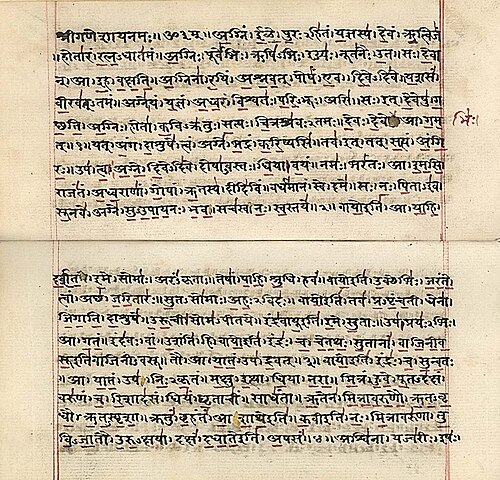
The Rigveda was composed and transmitted orally. Even after writing spread in India from the third century BCE, the tradition held that the Veda should be learned from the mouth of a teacher, not from a book. The earliest surviving manuscripts date from around the eleventh century CE, some two thousand years after the hymns were composed.
To protect the text, reciters developed a remarkable system of techniques. Besides the continuous text (saṃhitāpāṭha), in which sounds merge according to the rules of Sanskrit phonetics, students learned the word-by-word text (padapāṭha), attributed to the grammarian Śākalya, in which each word is separated. More complex patterns (vikṛtis) repeat words in fixed sequences, such as ab, ba, ab, bc, cb, bc in jaṭāpāṭha, or even more intricate combinations in ghanapāṭha. Any error in one version would be exposed by the others.
Recitation also preserves the pitch accents of Vedic Sanskrit, marked by hand movements, which disappeared from the ordinary language long ago. Linguists consider the result one of the most accurate transmissions of any ancient text, almost like a sound recording from the second millennium BCE.
Specialised ancillary sciences grew up around this effort: phonetics (śikṣā), metre, grammar and etymology. The ancient Indian science of grammar, which culminated in Pāṇini, developed in part from the need to analyse and preserve the Vedic texts. UNESCO recognised the Tradition of Vedic Chanting as a Masterpiece of the Oral and Intangible Heritage of Humanity in 2003, while noting that only a small number of the many historical recitation branches survive.
Intermediate
The Rigveda in later tradition
The hymns became embedded in a large body of later Vedic literature. The Brāhmaṇas attached to the Rigveda (the Aitareya and Kauṣītaki) explain the ritual uses and meanings of the hymns; the Āraṇyakas and Upaniṣads attached to them, such as the Aitareya Upaniṣad, turn towards philosophical reflection. The Rigveda thus stands at the start of a continuous tradition leading to classical Hindu philosophy.
In later Hinduism the gods of the Rigveda were partly transformed. Indra became a lesser king of heaven, while Viṣṇu and Śiva (identified with Rudra) became supreme deities. The authority of the Veda, however, remained central: the orthodox schools of Indian philosophy define themselves by accepting it, while Buddhism and Jainism rejected it.
Commentators worked to explain the increasingly archaic language. Yāska’s Nirukta, an early work of etymology, discusses difficult Vedic words. The most famous commentary is that of Sāyaṇa, a scholar at the court of the Vijayanagara empire in the fourteenth century, whose explanations influenced both Indian and European readers.
Today verses of the Rigveda are recited at Hindu weddings, initiations, funerals and daily worship. The Gāyatrī mantra is recited by millions. The Rigveda has also become a symbol of Indian cultural heritage and, in modern times, a subject of intense public debate about history and identity.
Intermediate
Manuscripts, editions and translations
The earliest known manuscripts of the Rigveda come from Nepal and date to about the eleventh century CE. Manuscripts survive in many scripts, including Devanāgarī, Śāradā, Grantha and Malayalam, reflecting the spread of Vedic learning across South Asia. A collection of Rigveda manuscripts held by the Bhandarkar Oriental Research Institute in Pune was inscribed on UNESCO’s Memory of the World Register in 2007.
European scholars became interested in the Vedas in the late eighteenth and nineteenth centuries, when the kinship of Sanskrit with Greek, Latin and other European languages was recognised. Friedrich Max Müller published the first printed edition of the Rigveda with Sāyaṇa’s commentary between 1849 and 1875, and Theodor Aufrecht published a text edition in the 1860s and 1870s.
Many translations followed. Karl Friedrich Geldner’s complete German translation (published in full in 1951) and Louis Renou’s French studies were major achievements. In English, the complete translation by Stephanie W. Jamison and Joel P. Brereton (2014) is now the standard scholarly version; older translations such as Ralph Griffith’s (1889–1892) are widely available but outdated.
Translating the Rigveda remains difficult. Its language is archaic and highly poetic, full of riddles, puns and allusions whose meaning was already unclear to ancient commentators. Scholars disagree about many words and passages, and every translation reflects choices between literal accuracy and poetic sense.
Advanced
Debates: dating, geography and the origins of the Indo-Aryans
No hymn is dated, so scholars rely on indirect evidence. Linguistically, Vedic Sanskrit is very close to Old Avestan, the language of the oldest Zoroastrian texts. A treaty of the fourteenth century BCE between the Hittite king and the kingdom of Mitanni in northern Syria invokes the gods Mitra, Varuṇa, Indra and the Nāsatyas, and Mitanni horse-training texts use Indo-Aryan numerals. These show that Indo-Aryan speakers and their gods existed in the Near East by that time. The Rigveda mentions bronze or copper (ayas) but not clearly iron, which appears in later Vedic texts. On such grounds most scholars place the bulk of the hymns in the second half of the second millennium BCE.
The mainstream scholarly view, based on comparative linguistics and increasingly on ancient DNA studies, is that Indo-Aryan languages were brought into South Asia by groups coming from Central Asia during the second millennium BCE, after the decline of the Harappan (Indus) cities, and that they mixed with existing populations. This was probably a gradual process of migration and cultural interaction rather than a single invasion; the older idea of a violent “Aryan invasion” that destroyed the Indus cities has been abandoned.
A minority position, often called the “Indigenous Aryans” or “Out of India” view, argues that Vedic culture originated in South Asia and may be identical with or earlier than the Indus civilisation. It has little support among specialists in linguistics, archaeology and genetics, but is prominent in public debate in India. The identification of the Sarasvatī river is part of this debate: some identify it with the now largely dry Ghaggar-Hakra system in north-western India, others with the Helmand (Haraxvaitī) in Afghanistan, and it may refer to different rivers at different times.
The relationship between the Rigveda and the Indus civilisation also remains unresolved. The hymns know no cities, writing or seals, which suggests a different society, but the Indus script is undeciphered and some elements of later Indian culture may derive from Harappan traditions.
Advanced
Interpreting the hymns: methods and questions
Interpreters have long disagreed about how to read the Rigveda. The traditional Indian approach, represented by Sāyaṇa, reads the hymns in light of ritual practice and later theology. Nineteenth-century European scholars often read them as nature poetry, seeing gods as personified natural forces, or used them to reconstruct an Indo-European mythology. Modern scholarship emphasises the hymns’ intimate connection with ritual performance, their sophisticated poetics and the social relations they encode, such as the exchange between poet, patron and god.
Comparative method is especially important. Many Rigvedic terms and ideas have cognates in the Avesta and other Indo-European traditions: Mitra corresponds to Avestan Mithra; soma to Avestan haoma; ṛta to Avestan aša; and the poetic formula “imperishable fame” (śravas akṣitam) has a close parallel in Homeric Greek. Such correspondences allow linguists to reconstruct aspects of Proto-Indo-Iranian and even Proto-Indo-European poetic language.
Internal chronology is another active field. Scholars use linguistic features, metre, the arrangement of the books and references to people and places to distinguish older from younger layers. The family books are generally older, and book 10 and parts of book 1 are younger, but individual hymns can be exceptions.
Finally, scholars reflect on the text’s oral nature. The Rigveda was an oral “canon” fixed with extraordinary precision, but its original performers were also creative poets who competed in verbal skill. How composition, collection and fixation took place, perhaps under the patronage of the early Kuru kingdom around 1200–1000 BCE as some scholars have argued, is still debated.
Key ideas
- Śruti
- “What was heard”: the Veda as revealed knowledge seen by inspired seers, with the highest authority in Hindu tradition.
- Yajña (sacrifice)
- The fire ritual in which offerings are poured into the fire and hymns are recited to invite and please the gods.
- Ṛta
- The cosmic, ritual and moral order that keeps the universe running, guarded especially by Varuṇa and Mitra.
- Oral transmission
- The hymns were preserved by memorisation and recitation techniques for more than two thousand years before being written down.
- Speculative hymns
- Late hymns such as the Nāsadīya and Puruṣa Sūktas ask how the world began and lay the ground for later philosophy.
- Poetic skill
- Vedic poets valued riddles, word-play and new formulations as gifts to the gods, and competed in eloquence.
- Indo-European heritage
- The language, gods and poetic formulas of the Rigveda are related to those of ancient Iran, Greece and other Indo-European cultures.
Records
- c. 1900 BCE — The major cities of the Indus (Harappan) civilisation begin to decline.
- c. 1500 BCE — Approximate beginning of the composition of the Rigvedic hymns in north-western South Asia.
- c. 1380 BCE — A Hittite–Mitanni treaty invokes Mitra, Varuṇa, Indra and the Nāsatyas.
- c. 1200 BCE — The hymns begin to be collected and arranged, possibly in the early Kuru kingdom (to c. 1000 BCE).
- c. 500 BCE — Auxiliary sciences flourish; Yāska’s Nirukta discusses difficult Vedic words (date approximate).
- c. 1040 — Approximate date of the oldest known Rigveda manuscripts, from Nepal.
- c. 1360 — Sāyaṇa writes his commentary on the Rigveda at the Vijayanagara court.
- 1849 — Max Müller begins publishing the first printed edition of the Rigveda with Sāyaṇa’s commentary (completed 1875).
- 2003 — UNESCO proclaims the Tradition of Vedic Chanting a Masterpiece of the Oral and Intangible Heritage of Humanity.
- 2007 — Rigveda manuscripts in Pune are inscribed on UNESCO’s Memory of the World Register.
- 2014 — Jamison and Brereton publish a complete English translation of the Rigveda.
Glossary
- Veda
- “Knowledge”; the four oldest collections of sacred texts in the Hindu tradition.
- Maṇḍala
- One of the ten books of the Rigveda.
- Sūkta
- A hymn of the Rigveda.
- Ṛṣi
- A seer-poet to whom hymns are attributed.
- Saṃhitā
- The “collected” continuous text of a Veda.
- Padapāṭha
- A version of the text with each word separated, used to preserve and analyse it.
- Śākhā
- A school or branch of Vedic recitation that preserves a particular version of the text.
- Soma
- A ritual drink pressed from an unidentified plant, and the god identified with it.
- Agni
- The god of fire and messenger between humans and gods.
- Indra
- Warrior king of the gods, slayer of the serpent Vṛtra.
- Varṇa
- One of four social classes (priests, warriors, commoners, servants) first named in the Puruṣa Sūkta.
Questions and answers
How old is the Rigveda?
Most scholars think the hymns were composed roughly 1500–1000 BCE, which makes them more than 3,000 years old.
How could people remember it without writing?
Students memorised it from teachers and practised special recitation patterns, saying the words in many orders, so that errors could be caught.
Who wrote the Rigveda?
Tradition attributes the hymns to seers (ṛṣis) from several families of poets. In Hindu belief the Veda was “heard” or seen by them rather than invented.
Is the Rigveda still used today?
Yes. Its verses are recited in Hindu rituals such as weddings and funerals, and the Gāyatrī mantra is part of daily prayer for many people.
Does the Rigveda describe the caste system?
Only one late hymn, the Puruṣa Sūkta, names the four varṇas. Most scholars think the full caste system developed later.
Did “Aryans” invade India and destroy the Indus cities?
The old invasion theory has been abandoned. The mainstream view is that Indo-Aryan speakers migrated gradually into South Asia after the Indus cities had declined and mixed with local peoples; a minority view holds that Vedic culture was indigenous.
What was soma?
Nobody knows for certain. The hymns describe pressing and filtering a plant to make an inspiring drink; proposals include ephedra and certain mushrooms, but the question is unresolved.
Sources and further reading
- Rigveda. Wikipedia
- 리그베다. 위키백과
- Tradition of Vedic chanting. UNESCO Intangible Cultural Heritage
- Nasadiya Sukta. Wikipedia
- Purusha Sukta. Wikipedia
- Vedic period. Wikipedia
- Shakha. Wikipedia
- Sayana. Wikipedia
- Stephanie W. Jamison and Joel P. Brereton, The Rigveda: The Earliest Religious Poetry of India (3 vols.). Oxford University Press, 2014
Related
- Early UpanishadsTexts that ask what the self (ātman) is and how it relates to ultimate reality (brahman) — a foundation of later Indian philosophy.
- MahabharataA vast Sanskrit epic centered on a conflict between related royal families, with the Bhagavad Gita among its parts.
- RamayanaA Sanskrit epic about Rama, Sita and their exile, preserved in many versions across South and Southeast Asia.
- Siddhartha Gautama (the Buddha)Founder of Buddhism, who taught a path to liberation from suffering on the Ganges plain. His dates are disputed.
- Adi ShankaraIndian philosopher associated with Advaita Vedanta, which teaches the ultimate unity of the self and brahman.
Written with AI assistance from the published sources listed above, and revised as new research appears.