Start at the top for an easy introduction. Go further down for more detail and scholarship.
- Easy
- Intermediate
- Advanced
For young readers
More than three thousand years ago, kings of the Shang dynasty ruled part of northern China from a great city beside the Huan River. When the dynasty fell, the city was abandoned and slowly covered by fields. Later people called the place Yinxu, which means “the ruins of Yin”.
The Shang kings wanted to know what the future held. Will it rain? Will the harvest be good? Will we win the battle? To find out, a diviner would take a piece of turtle shell or the flat shoulder bone of an ox, heat it until it cracked with a loud pop, and read the cracks like a message from the king’s ancestors. Then scribes carved the question, and sometimes the answer, into the bone.
These oracle bones are the oldest large collection of Chinese writing we have. Many of their characters are the great-great-grandparents of characters Chinese people still use today. For example, the sign for “sun” was a circle with a dot, and the sign for “person” looked like a person standing sideways.
At Yinxu archaeologists have found the foundations of palaces and temples, workshops for making bronze, bone and jade objects, and huge tombs. In one untouched tomb lay Lady Fu Hao, a queen who also led armies into battle. She was buried with hundreds of bronze vessels and jades and nearly seven thousand shells that were used like money.
Yinxu also has a sad side. The Shang killed many people, often prisoners of war, as offerings to their ancestors and gods, and buried them in pits near the royal tombs. Archaeologists study these remains carefully, so that we remember the victims as well as the kings.
At a glance
- Period
- Late Shang dynasty, c. 1300 (or c. 1250) to 1046 BCE; the traditional dates of the capital begin with King Pan Geng’s move to Yin
- Place
- North-west of Anyang, Henan Province, China, on both banks of the Huan River
- Rulers
- Traditionally 12 kings, from Pan Geng to Di Xin; oracle-bone inscriptions begin with King Wu Ding
- Size
- The ancient settlement covers about 30 km²; the World Heritage property covers 414 hectares
- Main areas
- Palace and ancestral temple area at Xiaotun (south bank); royal cemetery at Xibeigang–Houjiazhuang (north bank)
- Key finds
- About 150,000 pieces of oracle bones; the intact tomb of Fu Hao (1976); the Houmuwu ding, weighing about 833 kg
- Excavation
- Scientific excavation since 1928 (Academia Sinica, 15 seasons to 1937), resumed from 1950
- Status
- UNESCO World Heritage Site (2006)
Easy
What is Yinxu?
Yinxu (殷墟) is the name of the archaeological site of the last capital of the Shang dynasty, the first Chinese dynasty confirmed by contemporary written records. It lies just north-west of the city of Anyang in Henan Province, in the plain of northern China, about 500 km south of Beijing. The ancient city spread across both banks of the Huan River, which curves through the site.
The name means “Ruins of Yin”. Yin was the name later Chinese historians used for the Shang, especially in its last phase, after the capital was moved to this place. The Shang themselves seem to have called their capital “Shang” or the “Great Settlement Shang” (Da Yi Shang).
Yinxu is not a single building but a huge landscape of remains: foundations of rammed-earth palaces and temples, residential areas, workshops for bronze casting, bone carving and jade and pottery making, roads, drainage ditches, cemeteries of ordinary people and the tombs of the kings themselves.
The site is famous above all for oracle bones, which contain the earliest substantial body of Chinese writing, and for its bronzes, which show the high point of Bronze Age casting in East Asia. UNESCO inscribed Yinxu on the World Heritage List in 2006, recognising it as testimony to a “golden age” of early Chinese culture.
Easy
How to “read” the site
The heart of Yinxu is at Xiaotun, on the south bank of the Huan River where it bends. Here archaeologists found more than 80 foundations of large buildings, made of rammed earth: layers of soil pounded hard between wooden boards. On these platforms stood timber halls with thatched roofs. Scholars interpret them as palaces, ancestral temples and altars. There were no stone walls: Shang architecture was built of earth and wood, and only the foundations, post holes and bases survive.
Instead of a city wall, a large ditch ran along the west and south of the palace area, with the river on the other sides. Around this core lay many clusters of houses, workshops and family cemeteries spread over some 30 square kilometres, suggesting a loosely organised city of lineages rather than a tightly walled town.
On the north bank, at Xibeigang near Houjiazhuang, lies the royal cemetery. Its largest tombs are huge pits with sloping ramps leading down from two or four sides, forming a cross shape. The burial chambers lay more than ten metres deep. Around them are over a thousand smaller pits containing sacrificial victims, horses, chariots and other offerings.
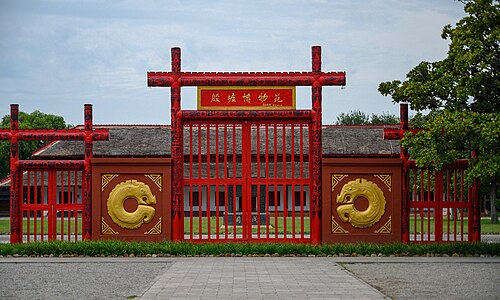
Visitors to the site today see reconstructed buildings, preserved chariot pits, the tomb of Fu Hao and a museum. Most of the site, however, lies under fields and the modern town, and much remains to be excavated.
Easy
Oracle bones: asking the ancestors
The Shang kings believed that their dead ancestors and other powers, including a high god called Di, controlled the weather, harvests, illness and victory in war. To learn their will, the king’s diviners practised pyromancy, divination by fire. They prepared the shoulder blades (scapulae) of cattle and the flat under-shells (plastrons) of turtles, carved rows of hollows into the back, and then applied heat to the hollows until the bone cracked with a sharp sound. The shape of the cracks, often like the character 卜 (bu, “to divine”), was read as an answer.
Afterwards scribes often carved a record into the bone. A complete inscription can contain the date, the name of the diviner, the question (“charge”), the king’s prediction, and sometimes what actually happened. Topics include rain and harvests, hunting, military campaigns, childbirth, illness, dreams, and which ancestors should receive which sacrifices. One well-known set asks whether Fu Hao’s childbirth will be good.
About 150,000 pieces of inscribed oracle bone and shell have been found, most of them at Yinxu. The inscriptions use around 4,000–5,000 distinct characters, of which only about a quarter to a third have been deciphered with confidence. Many are clearly ancestors of modern Chinese characters.
The oracle bones are extraordinary because they record the concerns of real kings in their own time, rather than stories written down centuries later. They are the foundation of our knowledge of Shang history, religion and language.
Intermediate
Bronze, chariots and craft workshops
Shang artisans made bronze vessels for offering food and wine to the ancestors, as well as weapons, tools and chariot fittings. Unlike early Near Eastern and European metalworkers, who often hammered metal or cast it in simple moulds, Shang founders used sectional piece-moulds made of clay, which allowed complex shapes and decoration to be cast directly. Foundry sites at Yinxu have yielded thousands of mould fragments, showing large-scale, organised production.
The largest known Shang bronze, the Houmuwu ding, was found at Yinxu in 1939. It is a rectangular cauldron 1.33 m high weighing about 833 kg, the heaviest bronze vessel known from the ancient world. Its inscription, formerly read as “Simuwu”, is now usually read as “Houmuwu”, an offering to a royal mother named Wu. The vessel is now in the National Museum of China in Beijing.
Shang bronzes are decorated with the taotie, a symmetrical mask-like design with eyes, horns and jaws, often formed of two animals in profile. Its meaning is debated; it may represent spirits or simply be a powerful decorative motif.
Yinxu also provides the earliest evidence of chariots in China. Pits containing two-wheeled chariots buried with their horses, and sometimes their drivers, appear around the time of King Wu Ding. Because the chariot appears suddenly and fully developed, most scholars think it was introduced from the steppes of Central Asia. Workshops for bone objects (such as hairpins and arrowheads), jade carving and pottery complete the picture of a large, specialised urban economy.
Intermediate
The tomb of Fu Hao
Almost all the large royal tombs at Yinxu were robbed in ancient or modern times. In 1976 the archaeologist Zheng Zhenxiang and her team found a smaller tomb near the palace area at Xiaotun, designated M5, which had never been disturbed. It turned out to belong to Fu Hao, a consort of King Wu Ding.
The tomb was a pit about 5.6 by 4 metres with a wooden chamber, yet it held extraordinary riches: more than 460 bronze objects (including about 200 ritual vessels and 130 weapons), about 755 jades, over 560 bone objects, ivory cups, and around 6,900 cowrie shells, which were used as a form of wealth. Many bronzes bear her name. Sixteen human victims and six dogs were also buried with her.
Fu Hao is mentioned in many oracle-bone inscriptions. They show her leading military campaigns with thousands of troops, conducting sacrifices, and holding her own estate. The king divined about her childbirths and illnesses. She is the most vividly documented woman of Shang China and shows that elite women could hold military and religious power.
Because the tomb is intact and well documented, it is a key reference point for dating Shang objects and for understanding the reign of Wu Ding, the period from which most oracle bones come.
Intermediate
Kings, ancestors and the fall of Shang
Traditional Chinese histories, above all the Records of the Grand Historian (Shiji) by Sima Qian (c. 100 BCE), say that the Shang moved their capital several times until King Pan Geng settled at Yin. From then until the fall of the dynasty, twelve kings ruled there. The last, Di Xin, was remembered in later Zhou-dynasty writings as a cruel tyrant, a portrait that served to justify the Zhou conquest.
The oracle bones allowed scholars to test these traditions. In 1917 the scholar Wang Guowei showed that the names of Shang kings and ancestors in the inscriptions largely matched Sima Qian’s king list, written a thousand years later. This proved that the Shang dynasty was historical and that the Shiji preserved genuine information, although with some errors in order and relationships.
The inscriptions reveal a state centred on the king and his ancestral cult. The king was the chief diviner and offered sacrifices to a large pantheon of ancestors according to a regular schedule. Royal power depended on alliances with lineages and on warfare against neighbouring peoples, such as the Qiang to the west.
Around 1046 BCE, according to the dating proposed by the Xia–Shang–Zhou Chronology Project, King Wu of Zhou defeated Di Xin at the Battle of Muye, and the Shang capital was abandoned. The Zhou allowed Shang descendants to continue ancestral rites in the state of Song. The exact date of the conquest remains debated, with proposals ranging over several decades.
Intermediate
Human sacrifice and the victims’ story
Human sacrifice was a regular part of Shang royal religion. Oracle-bone inscriptions record offerings of people to ancestors, sometimes by the dozen or hundred at a time, and many of the victims were prisoners taken in war, especially Qiang people. Estimates of the number of victims recorded in inscriptions run into the thousands.
Archaeology confirms these records. Around the royal tombs at Xibeigang are well over a thousand sacrificial pits, many containing decapitated skeletons laid in rows. Large tombs also contained attendants buried with the dead, possibly relatives, guards or servants. Animal sacrifices, including horses, dogs and cattle, were also common.
Scientific studies of skeletons, including analysis of strontium and oxygen isotopes in teeth and of ancient DNA, have begun to show where victims came from, how old they were and how they lived. Such work helps restore a human identity to people who appear in the inscriptions only as numbers.
Human sacrifice declined after the Shang and was increasingly criticised in later Chinese thought, though retainer burial continued in some states for centuries. At Yinxu, remembering the victims is an essential part of understanding a society that also produced great art and the beginnings of Chinese writing.
Intermediate
“Dragon bones” and the birth of Chinese archaeology
For centuries farmers near Anyang dug up old bones and sold them to pharmacies as “dragon bones”, a traditional medicine ground into powder. A popular story says that in 1899 the scholar Wang Yirong, while being treated for illness, noticed ancient characters on bones bought for his medicine. The details of this story are probably legendary, but Wang was indeed among the first to collect inscribed bones and recognise them as ancient writing.
In 1903 Liu E published the first book of rubbings of oracle bones. The scholar Luo Zhenyu traced them to the village of Xiaotun at Anyang and identified the place as the ruins of the Shang capital. Wang Guowei’s work followed, confirming the historical value of the inscriptions.
In 1928 the newly founded Institute of History and Philology of Academia Sinica began scientific excavations at Yinxu, led at different times by Dong Zuobin, Li Ji and Liang Siyong. In fifteen seasons up to 1937 they uncovered palace foundations and the royal tombs, and in 1936 found pit YH127, which contained over 17,000 pieces of inscribed shell. These were among the first large-scale scientific excavations conducted by Chinese archaeologists, and Yinxu is often called the birthplace of modern Chinese archaeology.
The Japanese invasion halted the work in 1937. After the civil war, the finds and records of the Academia Sinica excavations went to Taiwan, while excavations at Yinxu resumed in 1950 under the Institute of Archaeology in Beijing. Both collections remain essential for research, a legacy of China’s twentieth-century divisions.
Advanced
Debates: dating Yinxu, Huanbei and the nature of the Shang state
When did Yinxu become the capital? Traditional histories place Pan Geng’s move to Yin around 1300 BCE. Yet the oracle-bone inscriptions begin only with Wu Ding, and the earliest archaeological phase at Yinxu is modest. In 1999 a large walled city was discovered just north-east of Yinxu across the Huan River, now called Huanbei (“North of the Huan”). It covered about 470 hectares, was occupied for a few decades around 1350–1300 BCE and was then burned and abandoned. Many scholars think Huanbei was the predecessor of Yinxu, perhaps the city of Pan Geng or an earlier king, and that the capital moved to the Xiaotun area around the time of Wu Ding (c. 1250 BCE).
Absolute chronology. The Xia–Shang–Zhou Chronology Project (1996–2000) combined texts, astronomical records in inscriptions (such as lunar eclipses), radiocarbon dating and archaeology to propose dates such as 1046 BCE for the Zhou conquest and c. 1250–1192 BCE for Wu Ding. Its methods and conclusions have been criticised by some scholars outside China, and alternative dates for the conquest, such as the traditional 1122 BCE or 1027 BCE (derived from the Bamboo Annals), continue to be cited; earlier scholarship had proposed dozens of dates between about 1130 and 1018 BCE. The dates remain approximate.
Periodisation of the bones. Dong Zuobin divided the oracle bones into five periods based on the diviners named in them, their calligraphy and content. Later scholars refined this scheme by grouping inscriptions by diviner groups and by the archaeological context of their discovery. The “Li group” inscriptions, for example, have been dated by different scholars to very different reigns, a long-running debate that affects reconstructions of Shang history.
What kind of state was the Shang? Some historians describe a territorial kingdom with provinces; others, using the inscriptions, see a smaller core ruled directly by the king, surrounded by allied and hostile polities whose loyalty shifted. The inscriptions show only the concerns of the royal court at Yinxu and may overstate its reach. Other Bronze Age cultures of the time, such as Sanxingdui in Sichuan, show that the Shang was one of several complex societies in what is now China.
Advanced
Evidence and methods
Written evidence. The oracle bones are primary sources of a special kind: they record divinations, not narratives, and were made for and by the royal court. They are collected in large corpora, notably the Jiaguwen heji, and studied through palaeography, grammar and the reconstruction of sets of related inscriptions. David Keightley’s Sources of Shang History (1978) remains a classic methodological introduction in English. Bronze inscriptions, still short at Yinxu, become much longer in the Zhou period.
Archaeological evidence. The stratigraphy of pottery and bronze styles allows Yinxu to be divided into four main phases. Settlement surveys map neighbourhoods, workshops and cemeteries across the site, and show a city organised around lineage groups. Excavations of foundries and workshops reveal production methods and the organisation of labour.
Scientific methods. Radiocarbon dating, including the dating of oracle bones themselves, has been used to anchor the chronology. Isotope analysis tracks diet and mobility; ancient DNA studies explore the origins of the population and of sacrificial victims; metallurgical analysis traces the sources of copper, tin and lead used in bronzes, some of which may have come from distant regions.
Critical reading of later texts. Accounts of the Shang in Zhou-period and Han-period texts, including the Shiji, were written long after the dynasty’s fall and partly shaped by Zhou ideology, such as the idea of the Mandate of Heaven used to justify the conquest. Comparing them with contemporary inscriptions shows both how much later tradition preserved and how it reshaped the past.
Key ideas
- Late Shang capital
- Yinxu was the political and religious centre of the last Shang kings, from the thirteenth century BCE to about 1046 BCE.
- Oracle-bone divination
- Kings consulted ancestors by cracking bones and shells with heat and recorded questions and results in writing.
- Earliest Chinese writing
- The oracle-bone script is the earliest large body of Chinese writing and the direct ancestor of modern characters.
- Ancestor worship
- Royal religion centred on regular sacrifices to deceased kings and queens, who could help or harm the living.
- Bronze Age craft
- Piece-mould casting produced massive, intricately decorated ritual vessels in organised workshops.
- Human sacrifice
- Thousands of people, many of them war captives, were killed in royal rituals; archaeology now studies their lives and origins.
- Texts meet archaeology
- Yinxu proved that the Shang dynasty of the traditional histories was real, and showed where those histories were wrong.
Records
- c. 1350 BCE — The walled city at Huanbei, across the Huan River from Yinxu, is occupied (to c. 1300 BCE).
- c. 1300 BCE — Traditional date for King Pan Geng’s move of the Shang capital to Yin.
- c. 1250 BCE — Reign of King Wu Ding begins; the earliest oracle-bone inscriptions and the tomb of Fu Hao date from his reign.
- c. 1046 BCE — King Wu of Zhou defeats Di Xin at Muye; the Shang capital is abandoned (date per the Xia–Shang–Zhou Chronology Project).
- c. 100 BCE — Sima Qian’s Shiji records the Shang king list, later confirmed by oracle bones.
- 1899 — Wang Yirong recognises inscribed “dragon bones” as ancient writing.
- 1917 — Wang Guowei shows that the oracle bones confirm the Shiji king list.
- 1928 — Academia Sinica begins scientific excavations at Yinxu (15 seasons to 1937).
- 1936 — Pit YH127 yields over 17,000 inscribed pieces.
- 1976 — The intact tomb of Fu Hao is excavated.
- 1999 — The Middle Shang city of Huanbei is discovered.
- 2006 — Yinxu is inscribed on the UNESCO World Heritage List.
Glossary
- Shang dynasty
- The Bronze Age dynasty that ruled part of northern China in the second millennium BCE, the earliest confirmed by contemporary writing.
- Oracle bone
- An ox scapula or turtle plastron used for divination by heat and often inscribed with the result.
- Pyromancy
- Divination by fire, here by reading cracks produced by heating bone or shell.
- Rammed earth
- Soil pounded hard in layers between boards, used for foundations and walls in ancient China.
- Ding
- A ritual cauldron with legs, used to cook or present food offerings to ancestors.
- Taotie
- A symmetrical animal-mask motif common on Shang bronzes.
- Piece-mould casting
- A technique in which molten bronze is poured into a clay mould made of several fitted sections.
- Cowrie shell
- A small sea shell used as a valuable and a form of wealth in Shang China.
- Rubbing
- A copy of an inscription made by pressing paper onto it and dabbing ink over the surface.
- Di
- A high god in Shang religion who controlled weather and other powers.
Questions and answers
What does “Yinxu” mean?
It means “Ruins of Yin”. Yin is another name for the Shang dynasty, especially in its last period.
Why did people write on bones?
Not to send messages to each other, but to record questions asked of the ancestors and the answers read from cracks in the bone.
Can we read oracle-bone writing today?
Partly. Out of about 4,000–5,000 different signs, only about a quarter to a third have been deciphered with confidence, but these include most common words.
Who was Fu Hao?
A consort of King Wu Ding who led armies and performed rituals. Her tomb, found intact in 1976, is one of the richest ever found in China.
Did the Shang really sacrifice people?
Yes. Both inscriptions and archaeology show that thousands of people, many of them war captives, were killed in royal rituals.
Is Yinxu the oldest Chinese capital?
No. Earlier Shang centres such as Zhengzhou and Huanbei, and earlier sites such as Erlitou, are older. Yinxu is the oldest capital with a large body of contemporary writing.
How certain is the date 1046 BCE?
It is the date proposed by China’s Xia–Shang–Zhou Chronology Project, but other scholars argue for different dates; the fall of Shang is best treated as approximate.
Sources and further reading
- Yin Xu. UNESCO World Heritage Centre
- Yinxu. Wikipedia
- 은허. 위키백과
- Oracle bone. Wikipedia
- Tomb of Fu Hao. Wikipedia
- Houmuwu ding. Wikipedia
- Huanbei. Wikipedia
- Shang dynasty. Wikipedia
- Xia–Shang–Zhou Chronology Project. Wikipedia
- David N. Keightley, Sources of Shang History: The Oracle-Bone Inscriptions of Bronze Age China. University of California Press, 1978
Related
- Sima QianA Han dynasty historian who compiled the Records of the Grand Historian, a broad history of the ancient Chinese world.
- Classic of Poetry (Shijing)China's oldest poetry anthology — folk songs, court odes and temple hymns later counted among the Confucian classics.
- ConfuciusTeacher from the state of Lu whose sayings, gathered in the Analects, shaped ethics and government across East Asia.
- Terracotta ArmyThousands of life-size clay figures buried near the tomb of Qin Shi Huang, China's first emperor.
- Qin's Wars of UnificationA series of Qin campaigns that conquered six rival states between 230 and 221 BCE.
Written with AI assistance from the published sources listed above, and revised as new research appears.