Start at the top for an easy introduction. Go further down for more detail and scholarship.
- Easy
- Intermediate
- Advanced
For young readers
Long ago, the land we now call China was divided into several kingdoms that fought each other for more than two hundred years. Historians call this time the Warring States period. By the end, seven big states were left.
The strongest was Qin, in the west. Its rulers had changed their laws so that every farmer could also be a soldier, and soldiers who fought bravely were rewarded with land and rank. Qin became rich in grain and strong in war.
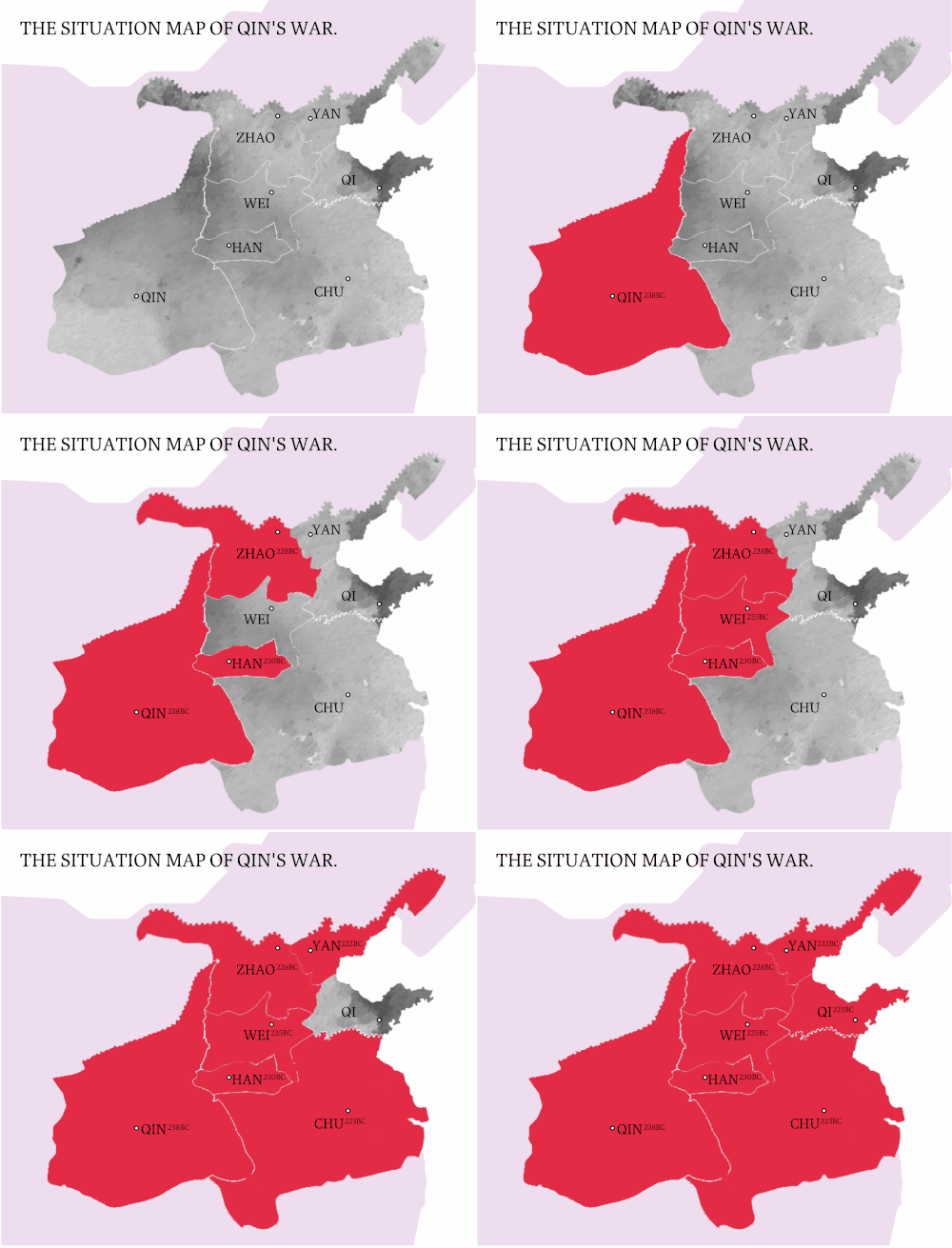
In 230 BCE, the young king of Qin, Ying Zheng, began to conquer the other six kingdoms: Han, Zhao, Wei, Chu, Yan and Qi. In just ten years he defeated them all. Some fought fiercely; the last one gave up without a battle.
When the wars ended in 221 BCE, the king gave himself a brand-new title: Shi Huangdi, “First Emperor”. He made everyone use the same kind of writing, money and measures, so that the whole land could be ruled as one.
The wars were terrible for ordinary people. Many soldiers and villagers died, cities were flooded or burned, and families were forced to move. The empire the First Emperor built lasted only fifteen years, but the idea of one united country lasted for more than two thousand.
At a glance
- When
- 230–221 BCE, the final phase of the Warring States period
- Where
- Northern and central China, from the Wei River valley to the Yangzi and the Shandong peninsula
- Victor
- The state of Qin under King Ying Zheng (later Qin Shi Huang), capital Xianyang
- Conquered states
- Han (230), Zhao (228; its successor Dai 222), Wei (225), Chu (223), Yan (222), Qi (221 BCE)
- Key generals
- Wang Jian, Wang Ben, Li Xin, Meng Wu, Neishi Teng; on the other side Li Mu of Zhao and Xiang Yan of Chu
- Outcome
- Creation of the Qin empire (221–206 BCE) and the title huangdi, “emperor”
- Main source
- Sima Qian’s Records of the Grand Historian (Shiji), c. 90 BCE, plus excavated Qin documents
- Legacy
- A centralised empire of commanderies and counties that later dynasties inherited
Easy
What were Qin’s wars of unification?
Qin’s wars of unification were a series of campaigns in which the state of Qin conquered the six other major states of the Warring States period between 230 and 221 BCE. They ended a long age of interstate war and created the first empire to govern most of the lands where Chinese was written, from the Wei River valley in the west to the sea in the east.
The victor, King Ying Zheng of Qin, took a new title in 221 BCE: huangdi, usually translated “emperor”, and called himself Shi Huangdi, “First Emperor”. The Qin dynasty that he founded collapsed in 206 BCE, only four years after his death, but its system of centralised government was taken over by the Han dynasty and shaped Chinese states for two millennia.
Calling these wars “unification” reflects a later point of view. For the people of Chu, Qi or Zhao, they were wars of conquest by a foreign and often feared state. Historians today use both words and try to show both sides.
Easy
The seven states
In the eleventh century BCE the Zhou dynasty had divided its lands among relatives and allies. Over the centuries these vassal states became independent, and the Zhou king kept only ritual prestige. By the fifth century BCE a handful of large territorial states were fighting for supremacy. Chinese historians call the period from about 475 to 221 BCE the Warring States (Zhanguo).
Seven states dominated. Qin held the Wei River valley in the west, behind mountain passes. Han, the smallest, and Wei lay in the central plains along the Yellow River. Zhao lay to the north, bordering the steppe. Yan held the far northeast, around modern Beijing. Qi was a wealthy state on the Shandong peninsula by the sea. Chu, the largest, covered much of the middle Yangzi region and had its own distinctive culture.
These states shared a written language and many traditions, but they differed in dialect, script forms, laws, coins and measures. Their rulers had all taken the title of king (wang), a sign that none accepted the others as superior.
Easy
Ten years, six kingdoms: the campaigns step by step
Han fell first. In 230 BCE a Qin army under Neishi Teng captured the Han capital and the king, and Han became a Qin commandery. Zhao, Qin’s toughest rival, was next. Its general Li Mu defeated Qin armies several times, but Qin agents bribed a Zhao minister to accuse him of treason, and the king had him removed and killed. In 228 BCE the Zhao capital Handan fell. A Zhao prince fled north and held out as king of Dai until 222 BCE.
Yan tried a desperate gamble. In 227 BCE its Crown Prince Dan sent the swordsman Jing Ke to the Qin court, disguised as an envoy carrying a map, with a poisoned dagger rolled inside. The assassination failed, and Qin armies took the Yan capital the next year. The king of Yan fled to the Liaodong peninsula and was captured in 222 BCE.
Wei fell in 225 BCE, when the Qin general Wang Ben diverted river water to flood its capital, Daliang, forcing the king to surrender. Chu was the hardest. A first invasion under the young general Li Xin was defeated by the Chu general Xiang Yan. The king then gave the veteran Wang Jian an enormous army, which the Shiji puts at 600,000 men. Wang Jian waited behind fortifications until the Chu army withdrew, then attacked. By 223 BCE Chu was conquered and Xiang Yan was dead.
Qi, which had stayed out of the wars for decades, was last. In 221 BCE a Qin army marched in from the north, and the king of Qi surrendered without a fight. For the first time, one ruler controlled all the Warring States.
Intermediate
Why Qin won: reforms, resources and strategy
Qin’s rise began with the reforms of Shang Yang, a minister from Wei who served Duke Xiao of Qin from the 350s BCE. He reorganised the population into units of five and ten households responsible for one another’s behaviour, rewarded farming and military service, created a system of ranks earned through merit in war, especially by the number of enemy heads taken, and replaced hereditary lords with counties run by appointed officials. Harsh but consistent laws applied to everyone. Later thinkers associated with this approach are called Legalists (fajia).
Qin also gained economic strength. It conquered the rich Sichuan basin (the states of Ba and Shu) in 316 BCE, where the Dujiangyan irrigation system was built in the third century BCE, and the Zheng Guo canal, begun in 246 BCE, watered large areas of the Wei River plain. These projects gave Qin the grain to feed large armies.
Military victories wore down its rivals. At the Battle of Changping in 260 BCE the Qin general Bai Qi surrounded a huge Zhao army; according to the Shiji, some 400,000 surrendered soldiers were then killed. The number is probably exaggerated, but Zhao never recovered. In 256 BCE Qin also ended the last Zhou royal domain.
Diplomacy mattered as much as battle. Qin statesmen followed a policy of “befriending the distant and attacking the near”, while the other states repeatedly failed to maintain alliances against Qin. Qin agents used bribery to divide enemy courts. When Ying Zheng took full power in 238 BCE, after crushing a rebellion by Lao Ai and removing the powerful chancellor Lü Buwei, he inherited a state already far stronger than its neighbours. Advisers such as Li Si, a former student of the philosopher Xunzi, helped plan the final conquests.
Intermediate
The human cost
The Warring States period was among the most violent eras of early history, and the final wars were no exception. Qin’s reward system encouraged soldiers to count enemy dead, and the Shiji records many campaigns with casualty figures in the tens or hundreds of thousands. Such numbers are often rounded or inflated, but there is no doubt that the killing was massive.
Archaeology gives the victims a presence. Near Gaoping in Shanxi, the traditional site of Changping, excavations in the 1990s uncovered pits with the remains of many people, some showing wounds, widely associated with the massacre after the battle. The flooding of Daliang in 225 BCE killed soldiers and civilians alike. Conquered populations were moved: after unification the Shiji says 120,000 wealthy households were resettled at Xianyang, where they could be watched.
Ordinary Qin soldiers also left traces. In another tomb at Shuihudi, archaeologists found two wooden letters written home by two brothers, Hei Fu and Jing, who were serving in the campaign against Chu around 223 BCE. They ask their family to send money and summer clothing, send greetings to relatives and worry about news from home. These are among the oldest private letters known from China, and they are a reminder that the armies of unification were made up of farmers far from their families, whose own lives depended on the outcome of battle.
Resistance continued after defeat. The saying attributed to the people of Chu, “even if Chu has only three households left, it will be Chu that destroys Qin”, expressed a bitterness that returned in the rebellions after the First Emperor’s death, which were led by men of Chu such as Xiang Yu, grandson of the general Xiang Yan. For many in the conquered states, unification meant the loss of their kings, their laws and sometimes their homes.
Intermediate
Results: building an empire
In 221 BCE Ying Zheng rejected proposals to give his sons kingdoms to rule, as the Zhou had done. On Li Si’s advice the whole realm was divided into commanderies (jun), at first thirty-six, each subdivided into counties (xian), run by salaried officials appointed and removed by the centre. This commandery–county system became the basic framework of Chinese administration.
The empire standardised many things. The Shiji summarises: “carts with the same axle width, writing with the same characters”. The Qin small seal script became the standard form, weights and measures were unified, and Qin’s round coin with a square hole (banliang) replaced the many local currencies. Weapons of the conquered states were collected and melted down, some into twelve giant bronze statues, and fortifications between the former states were demolished.
The emperor also launched huge projects and new wars: roads radiating from Xianyang, canals, the linking of northern walls against the Xiongnu under the general Meng Tian, campaigns in the far south, a vast palace and his own mausoleum with the Terracotta Army. In 213 BCE, on Li Si’s proposal, private possession of many books, especially histories of other states and the Classic of Poetry and Book of Documents, was banned except in official hands, and in 212 BCE, according to the Shiji, more than 460 scholars were killed in the capital.
Intermediate
Collapse and long-term legacy
The First Emperor died in 210 BCE while touring the east. His chief minister Li Si and the eunuch Zhao Gao concealed the death, forged orders forcing the heir Fusu to commit suicide, and put a younger son, Huhai, on the throne. In 209 BCE conscripted labourers led by Chen Sheng and Wu Guang, who faced execution for arriving late, rose in revolt. Rebellions spread, many claiming to restore the old states. In 206 BCE the last Qin ruler surrendered to Liu Bang, and after a civil war with Xiang Yu, Liu Bang founded the Han dynasty in 202 BCE.
The Han condemned Qin’s cruelty but kept most of its institutions: commanderies and counties, a salaried bureaucracy, written law and a single emperor. For most of the next two thousand years, political unity under one ruler was treated as the normal and proper condition of China, and periods of division as temporary breakdowns. Qin also gave China its name in many foreign languages, probably through forms such as Sanskrit Cīna, though this derivation has been debated.
The unification also shaped neighbouring regions. Qin and Han expansion brought commanderies into the far south and, under the Han, into the northeast, and it created a powerful state that neighbouring peoples, from the Xiongnu of the steppe to the kingdoms of the Korean peninsula, had to deal with for centuries.
Intermediate
Memory and changing judgments
For about two thousand years the dominant image of Qin came from Han and later Confucian writers. The Han statesman Jia Yi’s essay The Faults of Qin (Guo Qin lun) argued that Qin fell because it failed to rule with humaneness after conquering by force. The book burning and the killing of scholars made the First Emperor a symbol of tyranny in the Confucian tradition, and this view spread across East Asia.
Some thinkers, however, praised Qin’s achievement. Legalist-leaning writers and later reformers admired its efficiency, and in the twentieth century nationalists saw unification as the founding act of the Chinese nation. In the People’s Republic, Mao Zedong openly compared himself with the First Emperor, and in the early 1970s official campaigns praised Qin and Legalism against Confucianism. Since then Chinese scholarship has become more varied, generally honouring unification while acknowledging its brutality.
Popular culture keeps reinterpreting the story. The attempted assassination by Jing Ke has been told as heroic resistance and, in films such as Zhang Yimou’s Hero (2002), as a debate about whether peace through unification justifies tyranny. Outside China, historians often compare Qin with other ancient empires, such as Rome or the Maurya empire of Ashoka, asking how states built and justified large-scale rule.
Advanced
Sources: the Shiji and excavated documents
The main narrative comes from Sima Qian’s Shiji, completed around 90 BCE, especially the Basic Annals of Qin and of the First Emperor and the biographies of generals and ministers such as Wang Jian, Bai Qi, Li Si and Jing Ke. Sima Qian used Qin court records, which he says survived when other states’ histories were burned, but he wrote under the Han, a dynasty whose legitimacy rested on Qin’s failure. His dates for the campaigns are generally accepted; his speeches, anecdotes and large numbers need critical reading.
Other received texts include the Stratagems of the Warring States (Zhanguo ce), a collection of persuasions and stories whose historical reliability varies, and the Book of Lord Shang and Han Feizi, which preserve Legalist thought. Stone inscriptions set up by the First Emperor on his tours, quoted in the Shiji, give the regime’s own view of its achievement.
Excavated documents have transformed the field. The bamboo slips from Shuihudi (found in 1975 in the tomb of a local Qin official) contain Qin statutes, legal cases and a year-by-year chronicle that mentions campaigns of the unification wars. The Liye slips (found in 2002 in Hunan), numbering more than 37,000, preserve the daily records of a Qin county in the conquered south. These texts show a bureaucracy obsessed with records, quotas and legal procedure, and they allow historians to test the Shiji against contemporary evidence.
Advanced
Scholarly debates
Was unification inevitable? Traditional narratives present Qin’s victory as the natural outcome of its superior institutions, or of Heaven’s will. Many historians now stress contingency: Qin suffered major defeats, such as at Handan in 257 BCE and against Li Mu, and the other states might have survived with better alliances or leadership. Comparative historians also ask why the Chinese world, unlike Europe after Rome, was reunited repeatedly after periods of division.
How harsh was Qin? The image of Qin as uniquely cruel comes largely from Han sources. The Shuihudi and Liye documents show laws that were severe but also detailed and procedural, with rules on evidence and appeals, leading some scholars to argue that Qin rule was more bureaucratic than arbitrary. Others stress that forced labour, collective punishment and mutilating penalties were real and widespread.
Did the book burning and the “burying of scholars” happen as described? Scholars such as Michael Nylan and Martin Kern have questioned the traditional account, pointing out that the Qin court employed classical scholars and that the Classics were still cited in Qin and early Han writings. Some argue that the word usually translated “buried alive” may simply mean “killed”, and that the victims were not specifically Confucians. Others accept that a book ban and a purge occurred but were magnified by later writers.
Unification or conquest? The very framing of the wars as “unification” assumes that a single China already existed in principle. Scholars such as Mark Edward Lewis emphasise that Warring States elites shared a written culture and ideals of a single world order (“all under Heaven”, tianxia), which made unification thinkable; others emphasise the regional diversity that the wars suppressed. Both perspectives are needed to understand why the Qin empire fell so quickly and yet its model endured.
Key ideas
- Warring States
- The era of competing territorial states (c. 475–221 BCE) that ended with Qin’s conquests.
- Legalism
- A tradition of statecraft stressing clear laws, rewards and punishments and a strong central ruler, associated with Shang Yang, Han Fei and Li Si.
- Total mobilisation
- Qin’s system linking farming, military service, rank and registration so that the state could raise huge armies.
- Commandery–county system
- Administration through centrally appointed officials rather than hereditary lords, extended to the whole empire in 221 BCE.
- Standardisation
- Unifying script, weights, measures, coins and axle widths to govern a diverse realm as one.
- Emperor (huangdi)
- A new title created in 221 BCE to raise the ruler above kings; used by Chinese rulers until 1912.
- Unity as ideal
- The lasting belief, reinforced by Qin and Han, that the Chinese world should be ruled by one state.
Records
- 356 BCE — Shang Yang begins his reforms in Qin (356 BCE).
- 260 BCE — Battle of Changping: Qin crushes the army of Zhao (260 BCE).
- 256 BCE — Qin ends the last Zhou royal domain (256 BCE).
- 246 BCE — Ying Zheng becomes king of Qin at the age of 13 (246 BCE).
- 230 BCE — Qin conquers Han, the first of the six states (230 BCE).
- 228 BCE — Qin captures Handan, capital of Zhao (228 BCE).
- 227 BCE — Jing Ke’s attempt to assassinate the king of Qin fails (227 BCE).
- 225 BCE — Wang Ben floods Daliang; Wei surrenders (225 BCE).
- 223 BCE — Wang Jian completes the conquest of Chu (223 BCE).
- 222 BCE — Qin captures the king of Yan and the Zhao successor state of Dai (222 BCE).
- 221 BCE — Qi surrenders; Ying Zheng proclaims himself First Emperor (221 BCE).
- 206 BCE — The last Qin ruler surrenders to Liu Bang; the Qin dynasty ends (206 BCE).
Glossary
- Qin
- A state in western China that conquered its rivals and gave its name to the first imperial dynasty (221–206 BCE).
- Warring States period
- The period of about 475–221 BCE, named after a collection of stories, the Zhanguo ce.
- Zhou dynasty
- The royal dynasty (c. 1046–256 BCE) whose kings lost real power as their vassal states grew.
- Commandery (jun)
- A large administrative region of the Qin and later empires, divided into counties.
- County (xian)
- A local administrative unit governed by an appointed official.
- Legalism (fajia)
- A later label for thinkers who emphasised law, administration and state power.
- Small seal script
- The standardised form of Chinese writing promoted by the Qin.
- Shiji
- The Records of the Grand Historian by Sima Qian, the main narrative source for the period.
- Bamboo slips
- Thin strips of bamboo used as writing material, tied together into documents and books.
- Tianxia
- “All under Heaven”: the idea of a single world order under one legitimate ruler.
Questions and answers
How long did the wars of unification take?
The final conquests took about ten years, from 230 to 221 BCE, but Qin had been fighting and weakening its neighbours for more than a century before that.
Why was Qin so strong?
Its reforms turned farmers into soldiers and rewarded success in war, it controlled rich farmland and strong natural defences, and its rivals failed to stay united against it.
Who was Jing Ke?
An assassin sent by the crown prince of Yan in 227 BCE to kill the king of Qin with a dagger hidden in a map. He failed and was killed, and Yan was conquered soon after.
Did the First Emperor really burn all the books?
No. In 213 BCE many private books were banned and burned, but official copies and practical works were kept, and some scholars doubt parts of the traditional story.
Why did the Qin empire collapse so quickly?
Heavy labour and military demands, harsh punishments, resentment in the conquered states and a succession crisis after the First Emperor’s death led to rebellions in 209 BCE.
Is it right to call these wars “unification”?
The word reflects the later ideal of one China. For the conquered states they were wars of conquest, so historians use both terms and look at both perspectives.
How do historians check Sima Qian’s account?
They compare it with excavated Qin documents such as the Shuihudi and Liye bamboo slips, inscriptions on weapons and archaeological remains.
Sources and further reading
- Qin’s wars of unification. Wikipedia
- Qin dynasty. Wikipedia
- Qin Shi Huang. Wikipedia
- Battle of Changping. Wikipedia
- Burning of books and burying of scholars. Wikipedia
- Shuihudi Qin bamboo texts. Wikipedia
- Liye Qin Slips. Wikipedia
- Derk Bodde, The State and Empire of Ch’in, in The Cambridge History of China, vol. 1: The Ch’in and Han Empires, 221 B.C.–A.D. 220. Cambridge University Press, 1986
- Mark Edward Lewis, The Early Chinese Empires: Qin and Han. Belknap Press of Harvard University Press, 2007
- Sima Qian, Records of the Grand Historian: Qin Dynasty (translated by Burton Watson). Columbia University Press, 1993
Related
- Terracotta ArmyThousands of life-size clay figures buried near the tomb of Qin Shi Huang, China's first emperor.
- Sima QianA Han dynasty historian who compiled the Records of the Grand Historian, a broad history of the ancient Chinese world.
- The Art of WarAn early Chinese treatise on warfare traditionally attributed to Sunzi; its authorship and date are debated.
- ConfuciusTeacher from the state of Lu whose sayings, gathered in the Analects, shaped ethics and government across East Asia.
- MenciusA Confucian thinker who argued that people have the beginnings of moral goodness and that rulers must care for their subjects.
- AshokaA Mauryan emperor whose inscriptions describe his commitment to dhamma after a devastating conquest of Kalinga.
Written with AI assistance from the published sources listed above, and revised as new research appears.