Start at the top for an easy introduction. Go further down for more detail and scholarship.
- Easy
- Intermediate
- Advanced
For young readers
In 1974, some farmers in China were digging a well near the city of Xi’an when their spades hit pieces of clay. They had found the head and body of a clay soldier. Soon archaeologists came and discovered that under the fields stood not one soldier but thousands.
The soldiers were made for Qin Shi Huang, the first emperor of China. He wanted an army to protect him after he died, just as real soldiers had protected him while he was alive. So workers made soldiers, horses and chariots out of clay and buried them in huge underground pits near his tomb.
Every soldier is as big as a real man. They wear armour, hats or hair tied in knots, and their faces look different from one another: some are young, some older, some serious, some calm. Once they were painted in bright colours and held real bronze weapons.
Making so many figures was like working in a giant factory. Workers used moulds for parts such as legs, bodies and heads, then added details by hand, like moustaches and ears. Many soldiers even carry the stamped names of the workers’ bosses, so that bad work could be traced.
The emperor’s own tomb, under a big hill nearby, has never been opened. An old history book says it holds a model of the whole world with rivers of mercury. Scientists have measured mercury in the soil there, but archaeologists are waiting until they can protect whatever is inside.
At a glance
- Made
- c. 246–209 BCE, as part of the funerary complex of Qin Shi Huang (died 210 BCE)
- Place
- About 1.5 km east of the tomb mound at Mount Li, Lintong District, Xi’an, Shaanxi Province, China
- Discovered
- March 1974, by farmers digging a well; excavation began the same year
- Size
- Estimated more than 8,000 soldiers, about 130 chariots, 520 chariot horses and 150 cavalry horses in three pits
- Figures
- Life-size fired clay, roughly 1.75–2 m tall, originally painted; assembled from moulded parts and finished by hand
- Weapons
- Tens of thousands of bronze weapons and fittings recovered, mostly arrowheads
- Status
- Part of the Mausoleum of the First Qin Emperor, UNESCO World Heritage Site (1987)
- Tomb
- The emperor’s burial chamber under the mound remains unexcavated
Easy
What is the Terracotta Army?
The Terracotta Army is a collection of life-size clay sculptures of soldiers, horses and chariots buried in pits near the tomb of Qin Shi Huang (259–210 BCE), the ruler who united China in 221 BCE and took the new title of First Emperor. It lies on the northern foot of Mount Li (Lishan), roughly 30–40 km east-northeast of the centre of modern Xi’an, not far from the old Qin capital Xianyang.
The name in Chinese, bingmayong, means “figures of soldiers and horses”. Terracotta means “baked earth”: the figures were made of local clay and fired in kilns. They were arranged in battle formation in underground chambers with timber roofs, facing east, the direction from which the emperor’s conquered rivals had come.
The army is only one part of a vast burial complex covering many square kilometres, with walls, halls, stables, pits of bronze chariots, figures of officials and entertainers, and a mound over the emperor’s own tomb. It is one of the most important archaeological discoveries of the twentieth century and one of the best-known works of ancient art in the world.
Who was the emperor it served? Ying Zheng became king of the western state of Qin as a boy in 246 BCE. Over ten years, from 230 to 221 BCE, his armies conquered the six other major states of the Warring States period, and he declared himself Shi Huangdi, “First Emperor”. With his chancellor Li Si he imposed a single system of commanderies and counties, standard weights, measures, coins and writing, and huge building projects. He also became notorious in later tradition for harsh laws, forced labour and the burning of books. The Terracotta Army belongs to the same story: it could only have been made by a state able to command so many people and so much material.
Easy
Discovery in 1974
In late March 1974, during a drought, villagers of Xiyang village in Lintong were digging a well when they struck fragments of clay figures and bronze arrowheads. Among the diggers was Yang Zhifa, who later became famous as “the farmer who found the Terracotta Army”; several villagers took part, and who deserves the credit has sometimes been disputed.
A local official and the archaeologist Zhao Kangmin of the Lintong county museum recognised the importance of the fragments and began to piece figures together. After news reached Beijing, a team of archaeologists from Shaanxi began systematic excavation in the summer of 1974. What they found was the largest known group of pottery figures in the world.
Test drilling located Pit 2 and Pit 3 in 1976. A museum built over Pit 1 opened to the public in 1979, and the site quickly became a symbol of China’s ancient civilisation, visited by millions of people from around the world. Excavation continues today, slowly, because each figure must be carefully recorded, conserved and reassembled.
Easy
How to “read” the pits
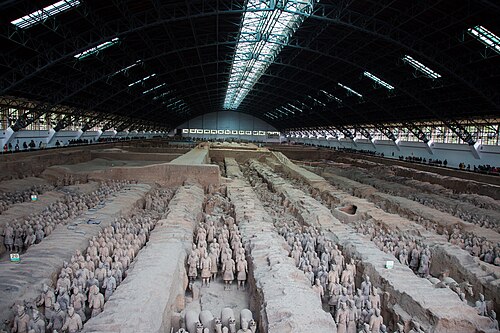
Pit 1, the largest, is about 230 m long and 62 m wide. It holds the main army, estimated at several thousand figures (a figure of about 6,000 is often given), only part of which has been excavated. At the front stand three rows of unarmoured archers and crossbowmen, the vanguard. Behind them, eleven long corridors separated by earth walls hold columns of armoured infantry and chariots, with soldiers on the sides facing outward to guard the flanks.
Pit 2, L-shaped, shows a different arrangement of mixed units: kneeling and standing archers, chariots, cavalrymen standing beside their saddled horses, and infantry. It shows how Qin forces combined different types of troops. Pit 3, the smallest, contains a single chariot and about 68 figures facing each other in a U-shape. It is usually interpreted as the command post. Pit 4 was dug but left empty, perhaps because work stopped when the empire collapsed.
Rank can be read from dress and posture. Ordinary soldiers wear short tunics or armour of small plates; higher officers wear finer armour with ribbons or knots, and elaborate caps; the so-called generals are the tallest figures. Hairstyles, belts, shoes and even the treads on the soles are carefully shown. The figures are therefore an extraordinary source for the organisation and equipment of a third-century BCE army.
Intermediate
How the figures were made
The figures were made in a system that combined standard parts with individual finishing. Legs were solid; torsos were hollow and built up from coils or slabs of clay; arms and hands were made separately; heads were pressed in moulds and then modelled by hand to add ears, hair, moustaches and expressions. The parts were joined before firing. The art historian Lothar Ledderose has used the army as a key example of “module” systems in Chinese art, in which a limited set of parts produces great variety.
Many figures bear stamped or incised inscriptions giving the names of foremen or master potters. Some names are linked to government workshops, others to local workshops from nearby towns. Similar marks appear on bricks and tiles from Qin palaces. They reflect the Qin legal practice of “inscribing the maker’s name” so that poor work could be traced and punished.
After firing, the figures were coated with lacquer and painted in many colours, including red, green, blue, purple, pink, white and black. The purple pigment is a synthetic barium copper silicate often called “Han purple”. Much of the paint flakes off within minutes when figures dry out after excavation, which is one reason conservators move slowly.
The soldiers carried real bronze weapons: swords, spears, halberds, crossbows and huge numbers of arrowheads. Inscriptions on some weapons date them to the 240s–220s BCE, showing that they were made in state arsenals before being buried. Studies of arrowhead bundles suggest that production was organised in small, self-contained workshop units working to common standards.
Intermediate
The mausoleum: a world for the afterlife
Work on the tomb began in 246 BCE, when the future emperor became king of Qin at the age of thirteen, and expanded greatly after unification in 221 BCE. The historian Sima Qian, writing about a century later in the Records of the Grand Historian (Shiji), says that 700,000 people were sent from all over the empire to work on it. The emperor died in 210 BCE and was buried there that year; work continued under his son until rebellions stopped it.
Sima Qian describes an underground palace filled with treasures, crossbows set to shoot intruders, a ceiling showing the heavens and a floor showing the earth with rivers and seas of flowing mercury. He does not mention the terracotta army at all. Surveys of the mound have found unusually high concentrations of mercury in the soil, which many scholars take as partial support for his account, although the interpretation is debated.
The necropolis was designed as a model of the emperor’s world. Inner and outer walls surround the mound. Excavations have found half-size bronze chariots with horses and drivers (discovered in 1980), pits with figures of civil officials, acrobats or entertainers, musicians, stone suits of armour, stables with real horse burials, and an underground garden with bronze cranes, swans and ducks. The army was only the eastern guard of this imagined empire.
The idea behind it was that the dead ruler would need his court, his servants, his entertainment and his protection in the afterlife. Earlier Chinese rulers had sometimes been buried with sacrificed people; the Qin complex used clay and bronze substitutes on an unprecedented scale. Sima Qian nevertheless reports that childless concubines were made to follow the emperor in death and that craftsmen who knew the tomb’s secrets were sealed inside.
Intermediate
Who built it? Labour, law and the Qin state
The army is a product of the Qin state, whose laws and administration organised people and resources with great thoroughness. The same system that conscripted soldiers for the wars of unification also mobilised labourers, convicts and craftsmen for monumental projects such as roads, palaces, frontier walls and the mausoleum.
Archaeology has revealed the human cost. Near the mausoleum, cemeteries of workers have been found, some with small tile fragments inscribed with a person’s name, home town and legal status, often showing that they were convicts working off debts or punishments. Studies of skeletons from a burial pit of workers show mostly young men. These discoveries remind us that behind the admired sculptures were people who worked under compulsion, many of whom died far from home.
At the same time, the quality of the sculptures shows the skill of craftsmen trained in pottery, bronze casting and architecture. The army is thus both a monument to imperial power and a record of the knowledge and labour of ordinary people whose names survive, if at all, only as stamps on clay.
Intermediate
Looting, fire and burial
The Qin dynasty collapsed only four years after the First Emperor’s death. In 206 BCE rebel armies entered the capital region; later historical accounts say that the rebel leader Xiang Yu plundered the mausoleum and burned buildings.
Archaeological evidence from the pits fits part of this story. The wooden roofs of Pits 1 and 2 burned and collapsed, crushing the figures beneath, and many weapons are missing, possibly taken by rebels. Some scholars, however, argue that the fire could have had other causes and that the evidence does not prove Xiang Yu was responsible. Whether the emperor’s own tomb chamber was ever robbed is unknown; the mercury readings and the lack of obvious robber tunnels have led some to think it may be intact.
Over the following two thousand years, earth and silt from Mount Li covered the pits. Local people occasionally found fragments of clay figures, and some later graves cut into the area, but the army remained essentially unknown until 1974.
Intermediate
Excavation, conservation and display
Almost every figure was found broken into pieces. Restorers sort fragments, glue them together and fill gaps, a process that can take months for a single warrior. Excavation has proceeded in phases since 1974, with new campaigns in Pit 1 in the 1980s and from 2009, and ongoing work in Pit 2.
Preserving the paint is the hardest problem. The lacquer layer under the paint shrinks and curls as soon as it loses moisture. Chinese conservators, working with international partners, have developed methods to keep newly excavated surfaces moist and consolidate them, but only a small number of figures retain much of their colour.
In 1987 the Mausoleum of the First Qin Emperor, including the Terracotta Army, was inscribed on the UNESCO World Heritage List. Selected figures have travelled in exhibitions around the world since the 1970s and 1980s, drawing record crowds, for example at the British Museum’s exhibition The First Emperor in 2007–2008. China has decided for now not to open the emperor’s tomb chamber, on the grounds that current technology cannot guarantee the preservation of its contents.
Intermediate
Place in art history and legacy
Before the Qin, figures placed in Chinese tombs were usually small. The Qin army is unique in its life-size scale and in its naturalism: varied faces, realistic bodies and detailed costume. Later Han dynasty tombs continued to include armies of pottery figures, such as those at Yangjiawan and at the tomb of Emperor Jing (Yangling), but they are much smaller, often about a third of life size. Monumental human sculpture on the Qin scale did not return in China until Buddhist sculpture centuries later.
Today the army is a global symbol of China and of the First Emperor. It appears in films, games, cartoons and advertising, and in debates about how to judge a ruler who united a vast territory through war and forced labour. For China it is a source of national pride; for scholars everywhere it is a unique window into the organisation of the first imperial state.
Advanced
Scholarly debates
Portraits or types? Because the faces differ, it is often said that every soldier is a portrait of a real person. Most specialists think the heads were built from a limited number of mould types and then individualised by hand, so they are best seen as varied types rather than portraits in the modern sense. Recent studies using photogrammetry to compare ears and faces have tried to test how individual the figures are, and the question remains open.
Outside influence? The sudden appearance of life-size naturalistic sculpture has led some writers to suggest influence from Hellenistic Greek art transmitted across Central Asia. Supporters point to the new realism and to contacts across Eurasia; critics note the lack of direct evidence, the purely Chinese techniques of the figures, and the Eurocentric assumption that naturalism must come from Greece. Most Chinese archaeologists stress local development, and the debate is unresolved.
What was the army for? It is usually read as a guard for the emperor in the afterlife, facing the eastern states he had conquered. Others see it as a representation of the imperial guard or garrison of the capital, or as part of a wider plan to reproduce the whole imperial order, including officials and entertainers, in the tomb. These views are not exclusive.
How reliable is Sima Qian? His account was written about a century after the events by a Han historian, at a time when the Qin was presented as a cruel and short-lived regime. Archaeology confirms some details, such as the scale of the complex and the mercury, and adds much that he does not mention, such as the army itself. The relationship between the text and the site is therefore a central methodological issue.
Advanced
Evidence and methods
Excavation and survey. Most knowledge comes from archaeological excavation of the pits and associated burials, and from non-invasive survey of the mound using drilling, geophysics and soil chemistry. The official excavation reports on Pit 1 and later pits provide detailed plans and inventories, while the mound is studied without digging.
Scientific analysis. Pigment analysis identifies the colours and the synthetic purple; metallurgical analysis of bronze weapons and chariots reveals casting and finishing techniques; analysis of clay and firing shows local sources and kiln temperatures; studies of human remains shed light on the workforce. These methods have turned the army from a spectacle into a detailed record of production.
Inscriptions and texts. Potters’ stamps, weapon inscriptions and workers’ tile inscriptions provide contemporary written evidence that can be compared with Qin legal texts, such as the bamboo slips found at Shuihudi, which describe rules for workshops and labour. The Shiji supplies the historical narrative but must be read critically.
Ethics and conservation. Every decision to excavate exposes fragile materials, so archaeologists weigh the knowledge gained against the risk of loss. The choice to leave the emperor’s tomb closed is itself a methodological statement: some evidence is best preserved by waiting.
Key ideas
- Army for the afterlife
- The belief that the dead ruler needed protection, a court and servants in the next world, provided here by sculpted substitutes.
- Modular production
- Figures were built from standard moulded parts and finished by hand, producing variety on a massive scale.
- Quality control by name
- Makers’ names stamped on figures allowed the Qin state to trace and punish poor work.
- Microcosm of empire
- The mausoleum complex reproduced the emperor’s world, from soldiers to officials, stables and gardens.
- State power and forced labour
- The project mobilised huge numbers of conscripts and convicts, revealing both the capacity and the cruelty of the Qin state.
- Naturalism
- Life-size, varied and detailed figures, unprecedented in earlier Chinese tomb art.
- Preservation before excavation
- Fragile paint and the unopened tomb show why archaeologists sometimes choose to wait.
Records
- 246 BCE — Ying Zheng becomes king of Qin at 13; work on his tomb begins (246 BCE).
- 221 BCE — Qin completes the conquest of the other states; Ying Zheng becomes the First Emperor (221 BCE).
- 210 BCE — The First Emperor dies on a tour and is buried at Mount Li (210 BCE).
- c. 208 BCE — Rebellions halt work on the mausoleum (around 208 BCE).
- 206 BCE — The Qin dynasty falls; later accounts say Xiang Yu plundered the tomb complex (206 BCE).
- 1974 — Farmers digging a well discover fragments; excavation of Pit 1 begins.
- 1976 — Pits 2 and 3 are located by test drilling.
- 1979 — The museum over Pit 1 opens to the public.
- 1980 — Two half-size bronze chariots are discovered west of the tomb mound.
- 1987 — The Mausoleum of the First Qin Emperor is inscribed on the UNESCO World Heritage List.
- 1999 — A pit containing figures of acrobats or entertainers is excavated.
- 2009 — A new phase of excavation begins in Pit 1.
Glossary
- Terracotta
- Fired clay, used for pottery, tiles and sculpture.
- Mausoleum
- A large, grand tomb or burial complex.
- Necropolis
- A “city of the dead”: a large burial area with many tombs and structures.
- Qin
- The state, and then the dynasty (221–206 BCE), that first united China.
- Mould
- A hollow form into which clay is pressed to make repeated shapes.
- Lacquer
- A varnish made from tree sap, applied under the paint on the figures.
- Crossbow
- A mechanical bow with a trigger, a major weapon of Warring States and Qin armies.
- Shiji
- The Records of the Grand Historian by Sima Qian, completed around 90 BCE, the main written source on the First Emperor.
- Conscript
- A person compelled by the state to serve as a soldier or labourer.
- Han purple
- A synthetic purple pigment (barium copper silicate) used in ancient China.
Questions and answers
How many soldiers are there?
Archaeologists estimate more than 8,000 soldiers in the three main pits, plus chariots and horses. Only part of them has been excavated so far.
Are all the faces different?
They look different, but they were made from a limited number of mould types and then shaped by hand. So they are varied rather than true portraits of individual people.
Were the soldiers always grey?
No. They were painted in bright colours over lacquer, but most of the paint has flaked away, much of it within minutes of excavation.
Why hasn’t the emperor’s tomb been opened?
Because archaeologists cannot yet guarantee that its contents, especially fragile materials, would survive exposure. The Chinese authorities have chosen to wait.
Is there really mercury in the tomb?
Soil over the mound shows unusually high mercury levels, which matches Sima Qian’s description of mercury rivers, but no one has seen inside the tomb.
Who made the army?
State and local workshops, with craftsmen and huge numbers of conscripted labourers and convicts. The names of many foremen survive as stamps on the figures.
Was it influenced by Greek sculpture?
Some scholars have suggested it, but there is no direct evidence, and many archaeologists argue the figures reflect local Chinese techniques and developments.
Sources and further reading
- Terracotta Army. Wikipedia
- Mausoleum of the First Qin Emperor. Wikipedia
- 병마용. 위키백과 (Korean Wikipedia)
- 진시황릉. 위키백과 (Korean Wikipedia)
- Mausoleum of the First Qin Emperor. UNESCO World Heritage Centre
- Shuihudi Qin bamboo texts. Wikipedia
- Jane Portal (ed.), The First Emperor: China’s Terracotta Army. British Museum Press, 2007
- Lothar Ledderose, Ten Thousand Things: Module and Mass Production in Chinese Art. Princeton University Press, 2000
Related
- Qin's Wars of UnificationA series of Qin campaigns that conquered six rival states between 230 and 221 BCE.
- Sima QianA Han dynasty historian who compiled the Records of the Grand Historian, a broad history of the ancient Chinese world.
- Great Pyramid of GizaA royal tomb built for the Egyptian pharaoh Khufu. It is the largest of the Giza pyramids and the only surviving Wonder of the ancient world.
- Mask of TutankhamunA gold funerary mask found in the tomb of the Egyptian pharaoh Tutankhamun.
- YinxuThe remains of a late Shang capital near modern Anyang, with royal tombs, workshops and inscribed oracle bones.
Written with AI assistance from the published sources listed above, and revised as new research appears.