Start at the top for an easy introduction. Go further down for more detail and scholarship.
- Easy
- Intermediate
- Advanced
For young readers
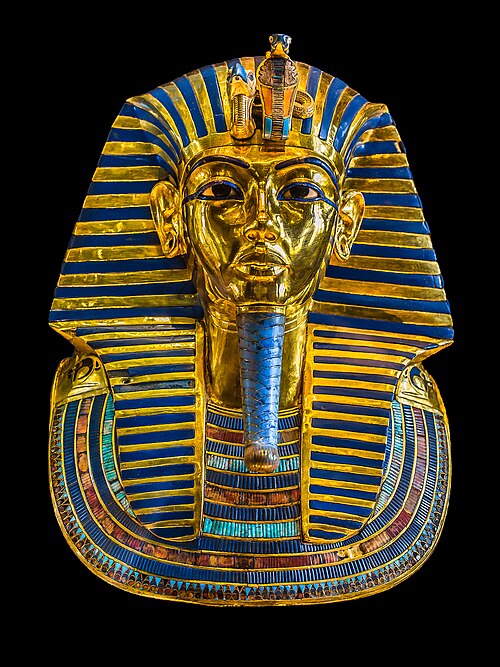
About 3,300 years ago, a teenage king named Tutankhamun ruled Egypt. He died when he was only about eighteen or nineteen years old. The Egyptians believed that a person could live again after death, but only if the body was kept safe. So they turned his body into a mummy and put a heavy mask of gold over his head and shoulders.
The mask is about as tall as a school ruler and a half, and it weighs about 10 kilograms, as much as a big bag of rice. It is made of two sheets of gold hammered together. The king’s eyes are made of white stone with black glass-like stone for the pupils, and his eyebrows and eye-lines are dark blue stone called lapis lazuli.
On his head he wears a striped royal headcloth. On his forehead are two little animals: a cobra and a vulture. They stood for the two halves of Egypt, the south and the north, and showed that he was king of the whole land. From his chin hangs a long, thin braided beard, like the beard of the god Osiris, the king of the dead.
On the back of the mask there is a magic spell written in picture-writing called hieroglyphs. It says that each part of the face belongs to a god, so that the king’s face would be strong and protected forever.
For more than 3,000 years the mask lay hidden in a small tomb in a desert valley. In 1922 an English archaeologist, Howard Carter, and his Egyptian workers found the tomb. In 1925 they opened the last of three nested coffins and saw the gold face shining up at them. Today it is one of the most famous treasures in the world, and you can see it in a museum near the pyramids in Egypt.
At a glance
- Date
- Late Eighteenth Dynasty, New Kingdom; buried with Tutankhamun around 1323 BC
- Found
- Tomb KV62, Valley of the Kings, Thebes (modern Luxor), Egypt; tomb discovered 1922, mask revealed 28 October 1925
- Size and weight
- About 54 cm tall, 39.3 cm wide, 49 cm deep; about 10.2 kg
- Materials
- Two layers of gold (mainly about 23 carat), inlaid with lapis lazuli, quartz, obsidian, carnelian, amazonite, turquoise, faience and coloured glass
- Inscription
- Protective spell, later known as Book of the Dead chapter 151, in ten vertical and two horizontal lines on the back and shoulders
- Excavator
- Howard Carter, funded by George Herbert, 5th Earl of Carnarvon, with a large Egyptian workforce
- Location today
- Grand Egyptian Museum, Giza (formerly the Egyptian Museum, Cairo)
Easy
What is the Mask of Tutankhamun?
The Mask of Tutankhamun is a funerary mask: an object made to cover the head and shoulders of a mummy. It was made for, or at least used for, Tutankhamun, a king (pharaoh) of Egypt who reigned from about 1332 to 1323 BC, near the end of the Eighteenth Dynasty. When the king died young, his body was embalmed and wrapped in linen, and the gold mask was placed directly over the wrapped head, inside the innermost of three coffins.
Masks like this had a practical and a religious job. Practically, they gave the mummy an idealized, permanent face. Religiously, they were meant to identify the dead king with the gods and to give his spirit a recognizable, indestructible image to return to. Gold was chosen because Egyptians thought of it as the incorruptible “flesh of the gods”: it does not rust or tarnish.
Many royal burials once contained masks of this kind, but almost all were stolen and melted down in ancient times. Tutankhamun’s tomb, though robbed twice shortly after his burial, survived with its burial chamber largely intact. That is why this mask survived, and why it has become, in the words of the Egyptologist Nicholas Reeves, perhaps the best-known object from ancient Egypt.
Easy
How to “read” the mask
Start with the headcloth. The king wears the nemes, a striped cloth that only kings wore. On the mask, the stripes are made of gold alternating with bands of blue glass imitating lapis lazuli. At the back, the cloth gathers into a kind of tail.
Look at the forehead. Two creatures rise from the brow: a cobra with its hood spread, the goddess Wadjet of Lower (northern) Egypt, and a vulture head, the goddess Nekhbet of Upper (southern) Egypt. Together they announce that the wearer ruled the “Two Lands”.
Now the face. The eyes are made of white quartz with pupils of obsidian, a black volcanic glass. The eyebrows and the long lines extending from the eyes are inlaid with lapis lazuli, a deep blue stone that had to be imported from far away, probably from what is now Afghanistan. The face itself is smooth, calm and youthful. It is not a photographic portrait but an ideal image of the king, and the same features appear on his coffins and statues.
Below the chin hangs a narrow, curved beard of gold inlaid with blue glass in a braided pattern. This kind of curled beard was associated with gods, especially Osiris, the ruler of the dead. Wearing it, the dead king appears as Osiris himself. Around the shoulders lies a broad collar made of rows of coloured inlays, and the ears are pierced for earrings.
Easy
Who was Tutankhamun?
Tutankhamun was born around 1342 BC with the name Tutankhaten, “living image of the Aten”. His father, according to DNA studies published in 2010, was the man buried in tomb KV55, most likely the pharaoh Akhenaten; his mother was an unnamed woman known from her mummy as the “Younger Lady”. Akhenaten had tried to change Egyptian religion, raising the sun-disc god Aten above all others and building a new capital at Amarna.
Tutankhaten became king as a boy of about eight or nine. Within a few years his government reversed Akhenaten’s changes. The king changed his name to Tutankhamun, “living image of Amun”, honouring the traditional god Amun of Thebes, and a decree now called the Restoration Stela described how temples were repaired and priests restored. The court left Amarna. Because he was so young, powerful officials such as Ay and the general Horemheb probably guided policy.
Tutankhamun married Ankhesenamun, a daughter of Akhenaten. Two tiny mummified daughters, stillborn or dying soon after birth, were found in his tomb. He died at about eighteen or nineteen. Studies of his mummy have found evidence of malaria and a broken left leg shortly before death, but the exact cause of death is still debated. His successor Ay, an elderly official, is shown on the wall of the burial chamber performing the “Opening of the Mouth” ritual for him, a way of claiming the right to rule.
Later kings removed Tutankhamun from official king lists because he was associated with the Amarna period. Ironically, this near-forgetting may have helped his tomb survive: by the time of later tomb robberies, his small tomb had been buried under debris from the digging of another tomb nearby.
Intermediate
How the mask was made
The mask is about 54 cm high, 39.3 cm wide and 49 cm deep, and weighs about 10.23 kg. It was made from two sheets of gold, 1.5 to 3 mm thick, hammered into shape and joined. Analysis in 2007 found that the body of the mask is mostly about 23-carat gold alloyed with a little copper, which made the metal easier to shape by cold hammering. The surface is covered by an extremely thin layer, about 30 nanometres, of two slightly different gold alloys: a paler one (about 18.4 carat) on the face and neck and a richer one (about 22.5 carat) elsewhere. The difference in colour may have been deliberate, to give the face a lighter, glowing skin tone.
Goldsmiths then created cells (cloisons) on the surface and filled them with cut stones and glass. The materials came from across Egypt’s world: lapis lazuli from Central Asia, turquoise from Sinai, carnelian, amazonite, quartz and obsidian, together with faience and glass made in Egyptian workshops. Coloured glass was a luxury material in this period, and was used alongside real gemstones rather than simply as a cheap substitute.
The beard, weighing about 2.5 kg, was made separately and attached with a tube. When Carter found the mask the beard had become detached; it was fixed back on in 1944 with a wooden dowel. A three-strand necklace of gold and faience beads with lotus-flower ends was placed around the neck, but it is usually displayed separately.
Who made it is unknown. Egyptian royal art was produced in palace and temple workshops by teams of specialists, and individual artists’ names are rarely recorded. Craftsmen from the royal workshops of the late Eighteenth Dynasty produced the similarly styled gold coffins and jewellery in the same tomb.
Intermediate
Religious meaning: a face for eternity
Egyptians believed that a person consisted of several parts, including the body, the ka (life force) and the ba (personality, often shown as a bird with a human head). After death, these parts needed to be reunited for the person to live on as a blessed spirit (akh). The preserved body and its image were essential anchors, and the mask ensured that the dead would always have a perfect face.
The mask also transformed the king. With his divine beard and golden skin, Tutankhamun was shown as an Osiris, identified with the god who had been murdered, restored to life and made ruler of the underworld. Gold skin and lapis lazuli hair were features of divine images, and Egyptian texts describe the gods as having flesh of gold and hair of lapis lazuli.
The spell inscribed on the back and shoulders makes this explicit. It first appears on masks in the Middle Kingdom, around 500 years earlier, and was later included as chapter 151 of the Book of the Dead, a collection of spells for the afterlife. It addresses the mask itself and identifies each part of the face with a divine being: the right eye is the night-boat of the sun god, the left eye the day-boat, the eyebrows the Ennead (the nine great gods), the forehead Anubis, the back of the neck Horus. The mask is told to guide the deceased on good paths and strike down the followers of Seth, the god of chaos. The text names the king by his throne name, Nebkheperure.
The mask was the innermost layer of a whole system of protection: three coffins nested one inside another (the innermost of solid gold, weighing about 110 kg), a stone sarcophagus, and four gilded wooden shrines filling the burial chamber. Each layer repeated the king’s image and the gods’ protection, like the layers of a nesting doll.
Intermediate
Discovery, 1922–1925
By the early twentieth century many archaeologists believed the Valley of the Kings had been exhausted. The British archaeologist Howard Carter, funded by George Herbert, 5th Earl of Carnarvon, kept searching. On 4 November 1922, his workers uncovered a step cut into the rock under the remains of workmen’s huts. On 26 November Carter made a small hole in the sealed doorway and, holding a candle, saw the antechamber crowded with gilded furniture, chariots and statues.
Clearing the tomb took ten seasons of work. The burial chamber was officially opened on 16 February 1923. Lord Carnarvon died of an infection in Cairo in April 1923, which fed the popular story of a “curse of the pharaohs”, an idea for which there is no evidence. Work was then interrupted in 1924 by a bitter dispute between Carter and the Egyptian Antiquities Service over access and control.
Only in the autumn of 1925 did the team reach the mummy. On 28 October 1925 they lifted the lid of the innermost gold coffin and saw the mask resting on the wrapped body. Carter wrote in his diary of the mask’s “sad but tranquil expression”. The mummy and mask were stuck to the coffin by hardened resins and ointments poured over them at the funeral, and the team used heat and tools to free them, damaging the mummy. In December 1925 the mask was taken to the Egyptian Museum in Cairo.
Carter’s team included the photographer Harry Burton, the chemist Alfred Lucas and the conservator Arthur Mace, as well as many Egyptian workers and foremen whose names were often left out of published accounts. Recent scholarship and exhibitions have tried to restore the role of these Egyptian workers in the discovery.
Intermediate
Whose treasure? The mask and modern Egypt
The discovery happened at a turning point in Egyptian history. Britain had declared Egypt nominally independent in February 1922, only months before the tomb was found, but kept considerable control. Until then, foreign excavators in Egypt had commonly received a share of their finds. The Egyptian government, and Egyptian nationalists, argued that an intact royal tomb belonged wholly to Egypt.
After the 1924 dispute, a settlement was reached: the finds from the tomb would not be divided between the Egyptian government and the excavation’s sponsors, and almost the whole assemblage went to the Egyptian Museum in Cairo. This was a landmark in the history of archaeology in Egypt and in wider debates about who owns the past.
Tutankhamun quickly became a symbol for modern Egyptian identity, appearing in Egyptian art, architecture and public imagery of the 1920s, a movement sometimes called Pharaonism. At the same time, in Europe and America, “Tutmania” shaped fashion, design, cinema and advertising. The mask sits at the centre of both stories: as a national emblem for Egyptians and as a global icon of “ancient Egypt”.
Intermediate
Travels, damage and a new home
For most of the twentieth century the mask was displayed at the Egyptian Museum on Tahrir Square in Cairo. It travelled abroad in the 1970s in the exhibition “Treasures of Tutankhamun”, which drew enormous crowds in London and in several cities in the United States. Since then, Egypt has not allowed the mask to leave the country, and later international Tutankhamun exhibitions have travelled without it.
In August 2014 the beard came off while the mask was being handled for maintenance. Museum staff hastily reattached it with epoxy glue, leaving it slightly crooked and with visible adhesive. When this was noticed in January 2015, a German–Egyptian conservation team removed the epoxy and reattached the beard using beeswax, a material ancient Egyptians themselves used. In 2016 several museum employees were disciplined. The episode prompted wider discussion about conservation standards and training.
The Grand Egyptian Museum, built about 2 km from the pyramids of Giza, was officially inaugurated on 1 November 2025. For the first time the entire Tutankhamun collection of more than 5,000 objects is displayed together there, with the gold mask as its centrepiece.
Advanced
Debate: was the mask made for someone else?
Since about 2001, Nicholas Reeves and some other Egyptologists have argued that the mask, or at least part of it, was originally made for another ruler: Neferneferuaten, a mysterious pharaoh who reigned briefly near the end of the Amarna period and who is often identified with Nefertiti or with one of Akhenaten’s daughters. Several objects in Tutankhamun’s tomb, including coffinettes for his internal organs, are known to have been made for Neferneferuaten and re-inscribed, so reuse of earlier royal equipment is not in itself unlikely.
Reeves’s arguments for the mask include: the face appears to be made of a separate piece joined to the headdress; there are slight differences in the gold composition between face and headdress; the pierced ears are more typical of queens and children in Egyptian art; and traces in the cartouches on the inscription have been interpreted as showing that an earlier name was altered to Tutankhamun’s.
Other specialists disagree. The conservator Christian Eckmann, who worked on the 2015 beard repair and examined the mask closely, stated that he saw no sign that the face was of different gold from the rest or that the cartouches had been altered. Zahi Hawass argued that earrings were worn by Eighteenth Dynasty kings, so pierced ears prove nothing. The question remains open and is tied to larger debates about the succession after Akhenaten and the identity of Neferneferuaten and Smenkhkare.
A related hypothesis by Reeves, that hidden chambers lie behind the painted walls of the burial chamber and might contain the burial of Nefertiti, attracted worldwide attention in 2015. Radar surveys produced conflicting results, and a later study in 2018 concluded that there were no such chambers, though some researchers continue to argue for further investigation.
Advanced
Evidence and methods
Excavation records. Carter’s notes, object cards, drawings and diaries, together with Harry Burton’s photographs, are held at the Griffith Institute, University of Oxford, and much of this archive has been published online. These documents make KV62 one of the best recorded excavations of its era, allowing researchers to reconstruct where each object lay. Carter’s popular account, The Tomb of Tut.ankh.Amen (volume 1 written with Arthur Mace, 1923), must be read alongside these records, since it was written for a general audience and omits much.
Scientific analysis. X-ray and compositional studies (such as the 2007 analysis of the gold alloys) and the close examination during the 2015 conservation have provided data on how the mask was built. Such analyses are limited: they sample only surfaces or small areas, and the museum has understandably restricted invasive testing.
Context and comparison. Because few royal burials of the New Kingdom survived, the mask must be interpreted by comparison with non-royal masks, with other objects in the same tomb (such as the gold coffins and canopic coffinettes), and with texts like the Book of the Dead. Evidence of ancient robberies in the tomb, including the repacking of objects by officials after the break-ins, reminds us that even KV62 is not a perfectly “untouched” deposit.
Mummy studies. CT scanning in 2005 and DNA analysis published in 2010 transformed understanding of Tutankhamun’s health and family, but their conclusions, especially on family relationships and cause of death, are still debated because of the difficulty of working with ancient DNA and the damage done to the mummy in 1925. The history of the mask is therefore also a history of changing scientific methods and of their limits.
Key ideas
- Funerary mask
- An image placed over the face of a mummy to give the dead a perfect, lasting face and to identify them with the gods.
- Gold as divine flesh
- Egyptians associated gold, which never tarnishes, with the bodies of gods; the king’s gold face made him divine and eternal.
- King as Osiris
- The curled beard and the funerary setting show the dead king as Osiris, god of the dead and of rebirth.
- Protective spell
- The inscription, later Book of the Dead chapter 151, assigns each part of the face to a god to keep the king safe.
- Layers of protection
- Mask, three coffins, sarcophagus and four shrines formed nested layers around the royal body.
- Reuse of royal objects
- Some items in the tomb were made for an earlier ruler; whether the mask was among them is debated.
- Heritage and nationhood
- The decision to keep the tomb’s contents together in Egypt made the mask a symbol of Egyptian ownership of its past.
Records
- c. 1342 BCE — Tutankhaten is born, probably at Amarna, during the reign of Akhenaten.
- c. 1332 BCE — Tutankhaten becomes king as a child; he soon changes his name to Tutankhamun and restores the cult of Amun.
- c. 1323 BCE — Tutankhamun dies at about 18 or 19 and is buried in KV62 with the gold mask; Ay succeeds him.
- 1922 — 4 November: Howard Carter’s team finds the first step of KV62; on 26 November Carter looks into the antechamber.
- 1923 — 16 February: the burial chamber is officially opened; Lord Carnarvon dies in April.
- 1925 — 28 October: the innermost coffin is opened and the mask revealed; in December it is taken to the Egyptian Museum, Cairo.
- 1944 — The detached beard is reattached to the mask with a wooden dowel.
- 1972 — The “Treasures of Tutankhamun” exhibition opens in London; a US tour follows later in the decade.
- 2014 — August: the beard comes off during handling and is hastily glued back with epoxy.
- 2015 — A German–Egyptian team removes the epoxy and reattaches the beard with beeswax.
- 2025 — 1 November: the Grand Egyptian Museum is inaugurated, with the mask at the heart of the full Tutankhamun collection.
Glossary
- Pharaoh
- A modern name for the kings of ancient Egypt, from an Egyptian phrase meaning “great house” (the palace).
- New Kingdom
- The period of about 1550–1070 BC, including the Eighteenth to Twentieth Dynasties, when Egypt was a major imperial power.
- Amarna period
- The reign of Akhenaten and its aftermath, when the Aten was promoted above other gods and the capital moved to Amarna.
- Nemes
- The striped royal headcloth worn by Egyptian kings.
- Uraeus
- The rearing cobra worn on a king’s forehead as a symbol of royal power and protection.
- Lapis lazuli
- A deep blue stone, imported to Egypt from Central Asia, used for the mask’s eyebrows and eye-lines.
- Cartouche
- An oval ring enclosing a king’s name in hieroglyphs.
- Book of the Dead
- A modern name for a collection of Egyptian spells written for the dead to help them in the afterlife.
- KV62
- The official number of Tutankhamun’s tomb: the 62nd tomb recorded in the Valley of the Kings (King’s Valley).
- Sarcophagus
- A large stone container for coffins; Tutankhamun’s is made of quartzite.
Questions and answers
Is the mask solid gold?
It is made of two hammered sheets of gold, each a few millimetres thick, so it is not a solid block, but it still contains about 10 kg of gold. It is inlaid with stones and glass.
Does the mask really look like Tutankhamun?
It shows an idealized royal face that matches his other images. Egyptian royal portraits were not photographs; they showed the king as he should look for eternity.
Why did the beard fall off?
The beard was made separately. It was already detached when found in 1925 and was reattached in 1944. In 2014 it came off again during handling and was badly glued; experts repaired it properly in 2015.
Is there a curse on the tomb?
No. The “curse” story spread in newspapers after Lord Carnarvon died of an infection in 1923. Most people involved in the excavation lived long lives, including Howard Carter.
Why was the mask found inside three coffins?
Egyptian royal burials used several nested layers to protect the body and repeat the king’s divine image: the mask, three coffins, a stone sarcophagus and four gilded shrines.
Was the mask originally made for another pharaoh?
Some scholars, notably Nicholas Reeves, think it was first made for the Amarna ruler Neferneferuaten and later adapted. Others who have examined it closely see no evidence of alteration. The question is unresolved.
Why did the mask stay in Egypt?
After a dispute in 1924, it was agreed that the tomb’s contents would not be divided with the excavators’ sponsors. This decision reflected Egypt’s new political independence and its claim to its own heritage.
Sources and further reading
- Mask of Tutankhamun. Wikipedia
- Tutankhamun. Wikipedia
- KV62 (Tomb of Tutankhamun). Wikipedia
- Howard Carter. Wikipedia
- Neferneferuaten. Wikipedia
- Book of the Dead. Wikipedia
- Nemes. Wikipedia
- Grand Egyptian Museum. Wikipedia
- Howard Carter and A. C. Mace, The Tomb of Tut.ankh.Amen, Volume 1. Cassell, 1923
- Nicholas Reeves, The Complete Tutankhamun. Thames & Hudson, 1990
Related
- Great Pyramid of GizaA royal tomb built for the Egyptian pharaoh Khufu. It is the largest of the Giza pyramids and the only surviving Wonder of the ancient world.
- Battle of KadeshA battle between Egyptian forces under Ramesses II and Hittite forces under Muwatalli II near Kadesh in Syria.
- Pyramids of MeroëRoyal funerary pyramids of the Kushite kingdom at Meroë in present-day Sudan.
- Terracotta ArmyThousands of life-size clay figures buried near the tomb of Qin Shi Huang, China's first emperor.
- KnossosA major Bronze Age center on Crete, known for its extensive Minoan palace complex.
Written with AI assistance from the published sources listed above, and revised as new research appears.