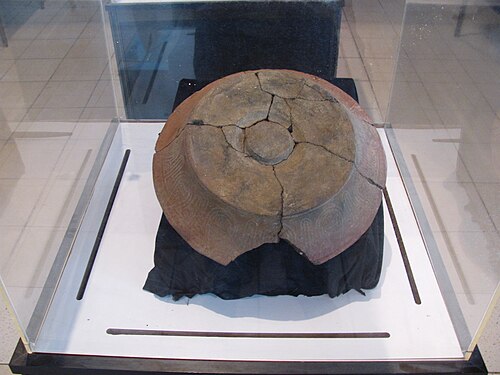
Start at the top for an easy introduction. Go further down for more detail and scholarship.
- Easy
- Intermediate
- Advanced
For young readers
Imagine a huge ocean dotted with islands so far apart that you cannot see the next one from the beach. About 3,000 years ago, before anyone lived on many of these islands, a group of people set out in canoes to find them. Archaeologists call them the Lapita people.
They sailed in outrigger canoes—boats with an extra float on the side to keep them steady—and carried everything they needed for a new home: pigs, dogs, chickens, and plants such as taro, yams, bananas and breadfruit.
The Lapita people are famous for their pottery. Before baking their clay pots, they pressed tiny toothed stamps into the clay, like a comb, to make beautiful patterns of lines, circles and even faces. Scientists can follow the Lapita across the ocean by finding pieces of these pots.
They lived in villages on beaches and on small islands, sometimes in houses on stilts over lagoons. They fished, collected shellfish, grew gardens and traded shiny black volcanic glass called obsidian over long distances.
In only a few hundred years they spread across more than 4,000 kilometres of ocean, from islands near New Guinea all the way to Fiji, Tonga and Samoa. No one had ever lived on those far islands before.
The name “Lapita” comes from a beach in New Caledonia where archaeologists dug in 1952. Their children’s children’s children became the Polynesians, who later found Hawaiʻi, Rapa Nui (Easter Island) and Aotearoa (New Zealand). Many people in the Pacific today see the Lapita as their ancestors.
At a glance
- Period
- About 1350–500 BCE; the earliest dates in the Bismarck Archipelago are debated (older estimates c. 1600–1500 BCE, recent re-dating c. 1350–1300 BCE)
- Region
- From the Bismarck Archipelago (Papua New Guinea) through the Solomon Islands, Vanuatu and New Caledonia to Fiji, Tonga and Samoa
- Type site
- Site 13 on the Foué Peninsula near Koné, Grande Terre, New Caledonia, excavated in 1952 by Edward W. Gifford and Richard Shutler Jr.
- Known sites
- More than 200, spread over more than 4,000 km
- Hallmark
- Low-fired earthenware decorated with dentate (toothed) stamps in complex geometric and face-like designs
- Economy
- Pigs, dogs, chickens; taro, yam, banana, coconut, breadfruit; fishing and shellfish; long-distance exchange of obsidian and stone adzes
- Language
- Probably Proto-Oceanic, a branch of the Austronesian family
- Key sites
- Talepakemalai (Mussau), Watom (New Britain), Nenumbo (Reef Islands), Teouma (Efate, Vanuatu), Lapita (New Caledonia), Bourewa and Moturiki (Fiji), Tongatapu (Tonga), Mulifanua (Samoa)
Easy
What is the Lapita culture?
“Lapita” is an archaeological name. We do not know what these people called themselves, because they left no writing. Archaeologists use the word for a set of objects and ways of life—above all a distinctive decorated pottery—that appear suddenly in the islands east of New Guinea around 3,300 years ago and then spread rapidly across the south-west Pacific.
The Lapita people are important because they were the first humans to reach and settle the islands of what scholars call Remote Oceania: Vanuatu, New Caledonia, Fiji, Tonga and Samoa. People had lived in New Guinea, the Bismarck Archipelago and the main Solomon Islands for tens of thousands of years, but the islands further out, separated by wider stretches of sea, had never been inhabited. Crossing them required new boats, new sailing skills and a new way of life carried by canoe.
Today the Lapita are regarded as the ancestors of many peoples of Island Melanesia and of all Polynesians. Their descendants later settled the vast Polynesian Triangle from Hawaiʻi to Rapa Nui and Aotearoa New Zealand. For many Pacific Islanders, the Lapita story is not distant prehistory but the beginning of their own family history.
Easy
The famous pottery
Lapita pottery is usually low-fired earthenware, tempered with shell or sand. The most striking pots were decorated before firing by pressing a small toothed tool—a “dentate stamp,” something like a comb—into the soft clay, over and over, to build up bands of intricate patterns. Potters also used incised lines, circle stamps and small punched marks, and sometimes filled the patterns with white lime so that they stood out against a red slip.
The designs are geometric: zigzags, interlocking curves, rows of circles, and a cross-in-circle motif. On some pots the patterns form stylized faces with eyes and noses, perhaps representing ancestors or spirits. Researchers have suggested that similar designs may also have been used on tattoos and on bark cloth (tapa) or mats, which have not survived.
Alongside decorated pots, the Lapita made plain vessels for cooking and storage, such as bowls, jars and flat-bottomed dishes. Over time, especially in Fiji, Tonga and Samoa, the decoration became simpler and eventually disappeared, leaving only plain ware. In Western Polynesia pottery-making stopped altogether—in Samoa by around the beginning of the Common Era—and the later Polynesians who settled the eastern Pacific did not make pottery at all.
Easy
Daily life: villages, gardens and the sea
Most Lapita villages in the newly settled islands were built on beaches, coastal terraces or small offshore islets, not deep inland. Some houses stood on stilts over shallow lagoons, as at Talepakemalai on Mussau Island. Living by the sea gave easy access to fish, turtles and shellfish, and to canoes for travel. Some scholars also suggest that coastal living helped the settlers avoid malaria-carrying mosquitoes or areas already occupied by other peoples.
The Lapita were farmers as well as fishers. They brought pigs, dogs and chickens, and grew root and tree crops such as taro, yams, bananas, coconuts and breadfruit. When they arrived on islands with no people, they also hunted birds, fruit bats and turtles that had never met humans, and many island species declined or became extinct soon after their arrival.
Their tool kit included adzes of ground stone and shell for cutting wood and building canoes, fish-hooks, shell ornaments such as rings and beads, and sharp flakes of obsidian (volcanic glass) and chert. Obsidian from particular sources, such as Talasea on New Britain, has been found far from where it was mined, showing that Lapita communities stayed connected across hundreds or even thousands of kilometres.
Intermediate
Voyaging into the unknown
The speed of the Lapita expansion is remarkable. After appearing in the Bismarck Archipelago, Lapita settlers reached the Solomon Islands, Vanuatu and New Caledonia by around 1200–1000 BCE and Fiji, Tonga and Samoa by roughly 900–800 BCE. Some crossings, such as the open-sea gap of several hundred kilometres between Vanuatu and Fiji, were far longer than any earlier human sea voyage in this part of the world.
The canoes themselves have not survived, but linguistic reconstruction and later Pacific traditions suggest sailing canoes with outriggers or double hulls, sails made of woven pandanus, and the capacity to carry people, animals, plants and water. Navigation probably relied on the kind of knowledge later Polynesian wayfinders were famous for: reading stars, sun, winds, ocean swells, clouds and the flight of birds.
Why did they keep moving? Scholars have proposed several reasons: the attraction of empty islands with abundant wild food; a social system in which younger siblings founded new settlements to gain status; the search for trade goods; and a culture that valued exploration. Most specialists think voyages were deliberate and planned, and that settlers kept in contact with their home islands for some time, rather than drifting by accident.
Intermediate
Where did the Lapita come from?
The Lapita were part of the great Austronesian expansion, a series of migrations by speakers of Austronesian languages that began from Taiwan several thousand years ago and eventually reached Madagascar in the west and Rapa Nui in the east. Austronesian speakers reached the northern Philippines by around 2200 BCE, and some later moved into the Mariana Islands and toward the islands north of New Guinea.
Several kinds of evidence point to this origin. Lapita pottery, with its dentate stamps, circles and cross-in-circle motif, resembles pottery from the northern Philippines—especially the Nagsabaran site on Luzon—and from the Marianas, where similar pottery appears around 1500–1300 BCE. Lapita domestic animals, crops, stilt houses, tattooing chisels and outrigger technology also have roots in Island Southeast Asia. The strongest support comes from language: Proto-Oceanic, the reconstructed ancestor of the Oceanic languages, shares a great deal of vocabulary with Proto-Malayo-Polynesian, spoken further west.
At the same time, the Lapita arrived in a region where Papuan-speaking peoples had lived for at least 30,000–40,000 years. The newcomers exchanged crops, tools and ideas with them and intermarried, to different degrees in different places. Most specialists accept Roger Green’s “Triple-I” model—intrusion of Austronesian settlers, innovation after arrival, and integration with existing populations—as a way to describe how Lapita culture formed in the Bismarck Archipelago.
Intermediate
Discovery and key sites
The first recorded Lapita pottery was found in 1909 by Otto Meyer, a Catholic missionary on Watom Island off New Britain, after a storm exposed sherds on the beach. In 1920 the American anthropologist William McKern excavated more than 1,500 stamped sherds on Tongatapu, without knowing of Meyer’s finds. The link between these discoveries was recognized only gradually.
In 1952 Edward W. Gifford and Richard Shutler Jr. excavated Site 13 on the Foué Peninsula in New Caledonia. The name “Lapita” came from a local word, apparently misheard by the archaeologists, from the Haveke language—xapeta’a, meaning “to dig a hole” or “the place where one digs.” Gifford used the then-new method of radiocarbon dating and showed that the pottery was almost 3,000 years old, and he connected it with the sherds from Watom and Tonga. In the 1960s and after, excavations by Jack Golson, Roger Green, Patrick Kirch and many others established the Lapita as the earliest settlers across much of the south-west Pacific.
Important sites include Talepakemalai on Mussau (one of the earliest, with stilt houses), Nenumbo in the Reef Islands of the Solomons, Teouma on Efate in Vanuatu, sites on Fiji and Tongatapu, and Mulifanua in Samoa, where Lapita pottery was dredged from a now-submerged site. More than 200 Lapita sites are now known.
Intermediate
Teouma: the oldest cemetery in the Pacific Islands
In 2003 earthworks near Teouma Bay on Efate Island in Vanuatu uncovered decorated pottery, leading to the discovery of the oldest known cemetery in the Pacific Islands, dating to about 3,000 years ago. Excavations found burials of dozens of individuals, some with complete Lapita vessels.
The burial practices were complex. Many skeletons had no skulls: after the bodies had decomposed, mourners removed the heads, sometimes replacing them with cone-shell rings, and treated them separately. One grave held an elderly man with three skulls placed on his chest. One burial jar is decorated with four bird figures looking down into the vessel. Such practices suggest strong beliefs about ancestors and the importance of the head, themes also found in later Pacific cultures.
Teouma has also been crucial for science. Isotope analysis of teeth and bones suggested that some people buried there had grown up elsewhere, while others were locally born. In 2016 researchers succeeded in extracting ancient DNA from the inner-ear bone of individuals from Teouma—among the first successful ancient DNA extractions from the tropics—which transformed debates about Lapita origins.
Intermediate
From Lapita to Polynesia
In Fiji, Tonga and Samoa—the eastern edge of the Lapita world—settlers remained for a long time after about 800 BCE. Over the following centuries their descendants developed a distinct culture in this region, often called the Polynesian homeland or “Hawaiki” in later traditions, and the ancestral Polynesian language. Pottery decoration faded into plain ware and then disappeared.
After a long pause of well over a thousand years, Polynesian voyagers moved east again, settling the Cook, Society and Marquesas Islands and eventually, by roughly 1000–1250 CE, Hawaiʻi, Rapa Nui and Aotearoa New Zealand. Their canoes, crops, animals and many words and customs can be traced back through Western Polynesia to Lapita ancestors.
Scholars such as Matthew Spriggs have argued that Lapita was the source not only of the Oceanic languages but also of many cultural and religious concepts found across the Pacific, while also stressing that there was considerable cultural continuity between Lapita communities and later Melanesian societies. Lapita is therefore seen as a founding layer, not a vanished culture.
Advanced
Debates over dating and the speed of expansion
The chronology of Lapita has been revised repeatedly. Older syntheses placed the beginning of “classic” Lapita in the Bismarck Archipelago around 1600–1500 BCE. Later work, using more careful selection of short-lived samples and Bayesian statistical modelling of radiocarbon dates, has argued for a younger start, around 1350–1300 BCE. This matters because it compresses the expansion: if Lapita began later but still reached Tonga and Samoa by around 850–800 BCE, the spread across Remote Oceania took only a few centuries, one of the fastest dispersals in human prehistory.
Dating is complicated by the materials. Shell dates must be corrected for the marine reservoir effect, which varies from place to place; charcoal may come from long-lived trees older than the settlement; and many coastal sites have been disturbed by sea-level change, tectonic uplift or later occupation. The earliest dates in Tonga, from sites at Nukuleka on Tongatapu, and in Fiji, from Bourewa, have been the subject of detailed debate about which island was settled first.
The end of Lapita is equally hard to fix. It is defined by the disappearance of dentate-stamped decoration, which happened at different times in different places. In Vanuatu and New Caledonia, local pottery traditions developed out of Lapita; in Western Polynesia, plain ware continued for several centuries before pottery vanished. Dates like “500 BCE” for the end of Lapita are therefore conventions rather than a single event.
Advanced
Ancient DNA and the question of who the Lapita were
For decades scholars debated two models. The “express train” model, associated with Jared Diamond and with Peter Bellwood’s work on Austronesian dispersal, saw Lapita as the product of a fast migration from Island Southeast Asia with little local mixing. Others, including Jim Allen and J. Peter White in the 1980s and 1990s, argued that Lapita culture developed largely within the Bismarck Archipelago from local roots. The “Triple-I” model of Roger Green offered a middle ground.
Ancient DNA has reshaped this debate. In 2016 Pontus Skoglund and colleagues published genome-wide data from three individuals from Teouma (about 3,100–2,700 years before present) and one from Talasiu in Tonga (about 2,700–2,300 years before present). These early individuals had little to no Papuan ancestry; they were most similar to present-day Indigenous peoples of Taiwan, such as the Ami and Atayal, and to the Kankanaey of the northern Philippines. This suggested that the first settlers of Remote Oceania came with little prior mixing with New Guinea populations. A 2020 study linked them closely to early settlers of the Mariana Islands.
Yet present-day Pacific Islanders all carry substantial Papuan ancestry—at least about a quarter in Polynesians and much more in Vanuatu. A 2018 study led by Cosimo Posth showed that people with Papuan-related ancestry began arriving in Vanuatu around 2,500 years ago and that, over time, their ancestry almost completely replaced the original Lapita ancestry there. Remarkably, the Austronesian languages were not replaced. This case of population replacement with language continuity, which the authors called extremely rare, shows why pottery, genes and languages must be studied separately and cannot be assumed to travel together.
Advanced
Language, identity and heritage today
Historical linguists reconstruct Proto-Oceanic, the common ancestor of about 450 Oceanic languages, as spoken in the Bismarck Archipelago in the late second millennium BCE. Because its homeland and date overlap with early Lapita, most archaeologists and linguists agree that Lapita communities spoke Proto-Oceanic or closely related dialects—though, as scholars caution, pots do not speak, and some Lapita groups may have used other languages too. Reconstructed Proto-Oceanic words for outrigger canoes, sails, fishing techniques, crops and kinship give a rare glimpse into Lapita life beyond the archaeological record.
The interpretation of Lapita also carries contemporary meaning. Early twentieth-century European writers often ranked Pacific peoples by race and imagined waves of “Melanesians” and “Polynesians” as separate groups. Modern research emphasizes instead long histories of interaction and mixing. Pacific Islander scholars and communities have drawn on Lapita research to celebrate a shared ancestral heritage of voyaging, as have revival movements in traditional navigation.
Lapita sites are increasingly threatened by coastal erosion, development and rising seas, and many important collections were taken abroad in the colonial era. Archaeologists now work more closely with local communities and national cultural centres in Vanuatu, New Caledonia, Fiji, Tonga and Samoa, and Lapita designs have become symbols of national and regional identity, appearing in contemporary art, tattoos and design.
Key ideas
- First settlers of Remote Oceania
- The Lapita were the first humans to live on Vanuatu, New Caledonia, Fiji, Tonga and Samoa.
- Dentate-stamped pottery
- Their pottery, decorated with comb-like stamps, is the main way archaeologists recognize and trace them.
- Austronesian expansion
- Lapita was one branch of a long migration of Austronesian-speaking seafarers that began in Taiwan.
- Transported landscapes
- Settlers carried plants and animals—taro, yams, pigs, dogs, chickens—to create new homes on uninhabited islands.
- Interaction and mixing
- Lapita culture formed through contact between newcomers and long-established Papuan-speaking peoples, and later migrations reshaped Pacific ancestry.
- Genes, languages and pots
- Ancient DNA shows that ancestry can change while languages persist, so archaeological cultures must not be equated with peoples.
- Ancestors of the Polynesians
- Polynesian cultures developed in Fiji, Tonga and Samoa from Lapita foundations before spreading across the eastern Pacific.
Records
- c. 2200 BCE — Austronesian speakers reach the Batanes and northern Philippines.
- c. 1500 BCE — Stamped pottery appears in the Mariana Islands (c. 1500–1300 BCE).
- c. 1350 BCE — Lapita culture appears in the Bismarck Archipelago (older estimates place this c. 1600–1500 BCE).
- c. 1200 BCE — Lapita settlers reach the Solomon Islands, Vanuatu and New Caledonia.
- c. 1000 BCE — The Teouma cemetery on Efate, Vanuatu, is in use.
- c. 850 BCE — Lapita settlers reach Fiji, Tonga and Samoa, the eastern limit of the Lapita world.
- c. 500 BCE — Dentate-stamped decoration has largely disappeared; plain ware continues in Western Polynesia.
- c. 1 CE — Pottery-making ends in Samoa.
- 1909 — Missionary Otto Meyer finds Lapita sherds on Watom Island.
- 1952 — Gifford and Shutler excavate Site 13 in New Caledonia, giving Lapita its name.
- 2003 — The Teouma cemetery is discovered in Vanuatu.
- 2016 — First ancient genomes from Lapita individuals (Vanuatu and Tonga) are published.
Glossary
- Archaeological culture
- A group of objects, sites and practices that appear together in a region and period, used by archaeologists to describe past peoples.
- Dentate stamp
- A small toothed tool pressed into wet clay to make dotted decorative lines.
- Sherd
- A broken piece of pottery.
- Near and Remote Oceania
- Near Oceania (New Guinea, Bismarcks, main Solomons) was settled tens of thousands of years ago; Remote Oceania was first reached by the Lapita and their descendants.
- Austronesian
- A large language family spoken from Madagascar to Rapa Nui, with origins in Taiwan.
- Proto-Oceanic
- The reconstructed ancestor language of the Oceanic branch of Austronesian, probably spoken by Lapita communities.
- Outrigger canoe
- A canoe with a float attached to the side to make it stable at sea.
- Obsidian
- Natural volcanic glass that breaks into very sharp edges; its source can be traced chemically.
- Radiocarbon dating
- A method of estimating the age of once-living material by measuring its remaining carbon-14.
- Ancient DNA
- Genetic material recovered from old bones or teeth, used to study the ancestry of past populations.
Questions and answers
Why are they called Lapita?
The name comes from a beach site in New Caledonia excavated in 1952. It seems the archaeologists misheard a local word meaning “to dig a hole” or “the place where one digs.”
How did they find islands they could not see?
Probably by skilled navigation using stars, winds, ocean swells, clouds and birds, the same kinds of knowledge later Polynesian wayfinders used. The canoes themselves have not survived.
Did the Lapita people have writing?
No. Everything we know comes from archaeology, language reconstruction and, recently, ancient DNA.
Are Polynesians descended from the Lapita?
Yes. Polynesian cultures developed from Lapita communities in Fiji, Tonga and Samoa. Polynesians also have Papuan-related ancestry from later contacts.
Why did they stop making decorated pottery?
No one knows for sure. Decoration grew simpler over centuries, possibly as the social meaning of the pots changed; in Western Polynesia pottery-making eventually stopped altogether.
What did ancient DNA reveal?
The earliest Lapita individuals from Vanuatu and Tonga had almost no Papuan ancestry and were closest to peoples of Taiwan and the northern Philippines. Later migrations added Papuan ancestry, especially in Vanuatu, without replacing the languages.
When did Lapita begin?
Around 1350–1300 BCE according to recent re-dating, though older studies placed it a few centuries earlier. The debate affects how fast the expansion must have been.
Sources and further reading
- Lapita culture. Wikipedia
- Teouma. Wikipedia
- Austronesian peoples. Wikipedia
- Proto-Oceanic language. Wikipedia
- Oceanic languages. Wikipedia
- Pontus Skoglund et al., Genomic insights into the peopling of the Southwest Pacific. Nature 538, 2016
- Cosimo Posth et al., Language continuity despite population replacement in Remote Oceania. Nature Ecology & Evolution 2, 2018
- Patrick V. Kirch, On the Road of the Winds: An Archaeological History of the Pacific Islands before European Contact. University of California Press, 2000
- Matthew Spriggs, The Island Melanesians. Blackwell, 1997
Related
- MoaiLarge stone figures carved by the Rapa Nui people on Easter Island over several centuries.
- Nan MadolNearly one hundred artificial islets of basalt and coral built on a reef off Pohnpei, the ceremonial, mortuary and political centre of the Saudeleur rulers who first united the island.
- Treaty of WaitangiAgreement in English and Māori first signed on 6 February 1840 by the British Crown’s representative William Hobson and Māori rangatira, now regarded as a founding document of New Zealand.
- BennelongWangal man of the Sydney Harbour region who, after being kidnapped by the first British colonists, became the leading Aboriginal go-between and diplomat of early colonial New South Wales.
Written with AI assistance from the published sources listed above, and revised as new research appears.