Start at the top for an easy introduction. Go further down for more detail and scholarship.
- Easy
- Intermediate
- Advanced
For young readers
Aotearoa New Zealand is a country of islands in the South Pacific. Māori, the first people to live there, arrived by canoe many hundreds of years ago. Each tribe had its own lands and its own leaders, called rangatira.
In the early 1800s more and more people from Britain came to New Zealand—traders, whalers, missionaries and then settlers wanting land. Some brought trouble, and some Māori leaders worried that France might try to take over. The British government decided it wanted to set up a government in New Zealand, but it wanted Māori leaders to agree.
So in February 1840 a British naval officer named William Hobson met many rangatira at a place called Waitangi, in the Bay of Islands. He brought a written agreement, a treaty. A missionary translated it into the Māori language overnight. The chiefs talked about it for many hours—some were for it and some were against it.
On 6 February 1840 more than forty rangatira signed. Then copies were carried all around the country, and by the end of the year more than 500 Māori leaders had signed, including at least thirteen women. Most of them signed the Māori-language version.
Here is the tricky part: the English version and the Māori version do not say quite the same thing. In English, the chiefs gave the Queen “sovereignty,” the highest power over the land. In Māori, they gave “kāwanatanga,” which means governorship, while being promised that they would keep “tino rangatiratanga,” their full chiefly authority over their lands, homes and treasures.
Over the next years many promises were broken, and Māori lost most of their land, sometimes through war. Since the 1970s, New Zealanders have worked to understand the treaty better and to put right some of the wrongs. Every year on 6 February, Waitangi Day, the country remembers the treaty and talks about what it means today.
At a glance
- First signed
- 6 February 1840, at James Busby’s house (now the Treaty House) at Waitangi, Bay of Islands
- Parties
- Captain William Hobson, as consul and lieutenant-governor for the British Crown, and Māori rangatira (chiefs)
- Texts
- Two: an English text and a Māori text (te reo Māori), each with a preamble and three articles; the Māori text is not a literal translation of the English
- Signatures
- Between 43 and 46 rangatira at Waitangi on 6 February; over 500 by the end of 1840 (at least 13 women), almost all on the Māori text; only 39 signed the English text, at Waikato Heads and Manukau
- Documents
- Nine signed sheets, now displayed in the He Tohu exhibition at the National Library of New Zealand, Wellington
- Legal status
- Not directly part of domestic law; referred to in many Acts; the Treaty of Waitangi Act 1975 created the Waitangi Tribunal to interpret it and hear claims
- Commemoration
- Waitangi Day (6 February) is New Zealand’s national day; the treaty is on UNESCO’s Memory of the World Register (1997)
Easy
What is the Treaty of Waitangi?
The Treaty of Waitangi—Te Tiriti o Waitangi in Māori—is an agreement made in 1840 between the British Crown and Māori rangatira. It was first signed on 6 February 1840 on the lawn of the British Resident James Busby’s house at Waitangi, in the Bay of Islands in the far north of the North Island. Over the following months copies were carried around the country and signed by hundreds more chiefs.
The treaty is short. It has a preamble and three articles. But it exists in two versions, one in English and one in Māori, and they are not the same. The most important difference concerns who would hold authority in New Zealand. This difference has shaped the country’s history ever since.
For much of the nineteenth and twentieth centuries, governments largely ignored the treaty; in 1877 a judge even called it a “simple nullity.” Since the 1970s it has returned to the centre of New Zealand life. Today it is widely regarded as a founding document of the country and is referred to in many laws, while its meaning remains the subject of vigorous debate.
Easy
Before the treaty: Māori, missionaries and settlers
Māori society was organised around iwi (tribes) and hapū (sub-tribes), each led by rangatira who exercised authority, or mana, over land and resources on behalf of their people. From the early nineteenth century, contact with Europeans grew quickly. Traders, whalers and sealers arrived, and from 1814 Christian missionaries of the Church Missionary Society set up stations in the north.
Before then Māori had no written form of their language. Missionaries, working with Māori, developed one between about 1817 and 1830. Printed scripture in Māori spread widely, and many Māori learned to read. This mattered in 1840: some key words in the treaty’s Māori text, such as kāwanatanga (governorship), were familiar from the Māori Bible.
In 1831, worried by rumours that a French warship intended to annex the country, thirteen northern chiefs wrote to King William IV asking Britain to be a “friend and guardian.” In 1832 Britain sent James Busby as British Resident. In 1835, 34 northern rangatira signed He Whakaputanga o te Rangatiratanga o Nu Tireni, the Declaration of the Independence of New Zealand, which asserted that all sovereign power and authority in the land rested with them. More chiefs added their names by 1839. Britain acknowledged the declaration.
By the late 1830s British policy was changing. Numbers of settlers were rising, and the private New Zealand Company was preparing to buy land and send colonists on its own. In 1839 the Colonial Office instructed Captain William Hobson to obtain Māori consent to British sovereignty over all or part of New Zealand, to take control of land dealings, and to set up a civil government.
Easy
February 1840: debate and signing at Waitangi
Hobson arrived in the Bay of Islands on 29 January 1840. With no draft from London, he wrote the treaty with his secretary James Freeman and James Busby, neither of them a lawyer, in about three days. On the night of 4 February the missionary Henry Williams and his son Edward translated it into Māori.
On 5 February several hundred people gathered in a large marquee on the lawn in front of Busby’s house. Hobson read the English text and Williams read and explained the Māori text. The rangatira debated for about five hours. Some spoke strongly against a governor. Rewa, a Catholic chief, declared that Māori did not want a governor: the land was still theirs, and the chiefs governed the land of their ancestors. Others demanded the return of land unjustly bought by Europeans. Others, including Hōne Heke and Tāmati Wāka Nene, urged acceptance, arguing that a governor could control lawless Europeans and protect Māori from other foreign powers. The Catholic bishop Pompallier advised his followers to be cautious. Debate went on into the night on the river flat below.
On 6 February more than forty chiefs signed; Hōne Heke was the first. As each signed, Hobson said “He iwi tahi tātou”—“We are now one people.” During that day, at Pompallier’s request, Williams wrote down a statement that the governor would protect the faiths of England, the Wesleyans and Rome, and also Māori custom. This is sometimes called the “fourth article,” though historians disagree about its status.
Over the next seven months about fifty meetings were held around the country. Some chiefs signed eagerly, some signed after argument, and some refused, among them the Waikato leader Pōtatau Te Wherowhero and iwi such as Ngāti Tūwharetoa, Te Arawa and Tūhoe. Bad weather meant copies never reached some southern areas. On 21 May 1840 Hobson proclaimed British sovereignty over the North Island by cession and over the South Island by discovery.
Intermediate
Two texts: what each version says
In Article 1 of the English text, the chiefs “cede to Her Majesty the Queen of England absolutely and without reservation all the rights and powers of Sovereignty.” In the Māori text, the chiefs give the Queen “te Kawanatanga katoa o o ratou wenua”—which the scholar Sir Hugh Kāwharu translated as “the complete government over their land.” Kāwanatanga was a word formed from “governor,” not a traditional Māori concept. As the Waitangi Tribunal explains, “sovereignty” had no direct equivalent in Māori society, where rangatira exercised full authority (mana) over land and resources on behalf of their communities.
In Article 2 of the English text, the Queen guarantees to the chiefs and tribes “the full exclusive and undisturbed possession of their Lands and Estates Forests Fisheries and other properties,” and the chiefs give the Crown an exclusive right of pre-emption—the right to be the only buyer of land. In the Māori text, the Queen promises to uphold the chiefs’ “tino rangatiratanga”—which Kāwharu translated as the “unqualified exercise of their chieftainship”—over their lands, villages and “taonga katoa,” all their treasures. The land-sale clause in Māori uses hokonga, a general word for buying and selling, which many Māori may have understood as giving the Crown first offer rather than an exclusive right.
Article 3 is closest between the two texts: the Crown extends royal protection and the rights and privileges of British subjects, or in the Māori text “the same rights and duties of citizenship as the people of England.” The Tribunal notes that the English text emphasises property and ownership, while the Māori text emphasises status and authority.
Put simply, in the English text the chiefs gave up sovereignty in return for guarantees of property and citizenship. In the Māori text they granted a right of governance while being promised continued chiefly authority over their own lands and treasures. Almost all the signatories signed the Māori text.
Intermediate
What did each side think it was agreeing to?
The Crown has always regarded the treaty as the means by which Māori consented to British sovereignty. Hobson’s instructions were to obtain that recognition, and his proclamations of May 1840 rested on it. For many rangatira, however, the treaty may have looked like an agreement to share power and authority, in which a governor would control British settlers and keep order while chiefs continued to govern their own people and lands.
Context matters. Most Māori in 1840 lived in an oral culture, even though literacy was spreading. The chiefs would have weighed what Hobson and the missionaries said aloud at least as much as the written words. Williams presented the treaty as an act of love from Queen Victoria, a protection “like a fortress” that would let Māori keep what was theirs. Many Christian chiefs understood it as a covenant, a sacred bond with the Queen as head of both state and church. Of the more than 500 signatories, only about a dozen wrote their names in the Latin alphabet; many drew their moko (personal tattoo designs) or made other marks.
Soon after signing, the northern chief Nōpera Panakareao summed up his understanding: “The shadow of the land will go to the Queen, but the substance of the land will remain with us.” Later, the historical record says, he reversed the saying—feeling that the substance had gone to the Queen and only the shadow remained for Māori. His words capture the gap between expectation and outcome.
Intermediate
After 1840: land, war and a “simple nullity”
At first the Crown’s right of pre-emption was meant to protect Māori from dubious land deals. Governors Hobson and FitzRoy appointed Protectors of Aborigines to check owners and boundaries. But Māori grew frustrated when the government bought cheaply and resold at a profit. FitzRoy waived pre-emption in 1844; his successor George Grey restored it and set out to buy large areas in advance of settlement. The whole South Island had been purchased by 1860, often on terms Māori later showed had not been honoured.
Disagreement over sovereignty and land led to armed conflict, beginning with the Northern War of 1845–46, sparked by Hōne Heke’s felling of the flagstaff at Kororāreka. In the 1850s several Waikato and central North Island tribes formed the Kīngitanga (Māori King movement), partly to unite Māori authority, justified by the treaty’s promise of rangatiratanga. In 1863 Grey’s government invaded the Waikato. Wars followed in Taranaki and on the East Coast until 1872. The government confiscated large areas of land from tribes it labelled rebels, including about 12,000 square kilometres in 1865.
The Native Land Court (later the Māori Land Court), created in 1865, also abolished Crown pre-emption; its operation became one of the main channels through which Māori land passed out of Māori hands, a central issue in later Tribunal inquiries. In the 1877 case Wi Parata v Bishop of Wellington, Chief Justice Prendergast declared the treaty a “simple nullity” as a transfer of sovereignty from Māori to the Crown. Māori have since argued that this judgment, and laws based on it, conveniently legitimised the taking of land and resources. This remained the legal orthodoxy for decades. Māori, however, continued to appeal to the treaty in demands for greater independence and for the return of confiscated and unfairly purchased land.
Intermediate
Revival: protest, the Waitangi Tribunal and settlements
Interest in the treaty revived in the twentieth century. In the early 1930s the Governor-General, Lord Bledisloe, bought the Treaty House and grounds and gave them to the nation. For much of the century, textbooks and official publicity presented the treaty as proof of British benevolence and good race relations—a view Māori continued to challenge.
From the late 1960s a strong Māori protest movement called on the government to “honour the treaty.” In 1975 Parliament passed the Treaty of Waitangi Act, which created the Waitangi Tribunal, a permanent commission of inquiry. It can determine the meaning of the two texts, decide issues raised by their differences, investigate claims that the Crown has breached the “principles of the Treaty,” and recommend remedies. In 1985 its jurisdiction was extended back to 1840.
In 1987 the Court of Appeal, in New Zealand Maori Council v Attorney-General, described the treaty as establishing a partnership that requires the partners to act reasonably and in good faith, and identified a Crown duty of active protection. From the early 1990s the Crown negotiated settlements of historical claims. They include the 1992 Sealord fisheries deal, the 1995 Waikato-Tainui settlement, accompanied by a Crown apology for the invasion of the Waikato and confiscation of land, and the 1997–98 Ngāi Tahu settlement, under which Aoraki / Mount Cook was returned and gifted back to the nation. Settlements typically include an agreed historical account, a Crown apology, financial and commercial redress, and cultural redress.
Settlements remain controversial on several sides. Many Māori argue that redress has been a small fraction of what was lost; some politicians have criticised what they called a “grievance industry.” Waitangi Day, the national day, has often been an occasion both for celebration and for protest.
Intermediate
The documents themselves
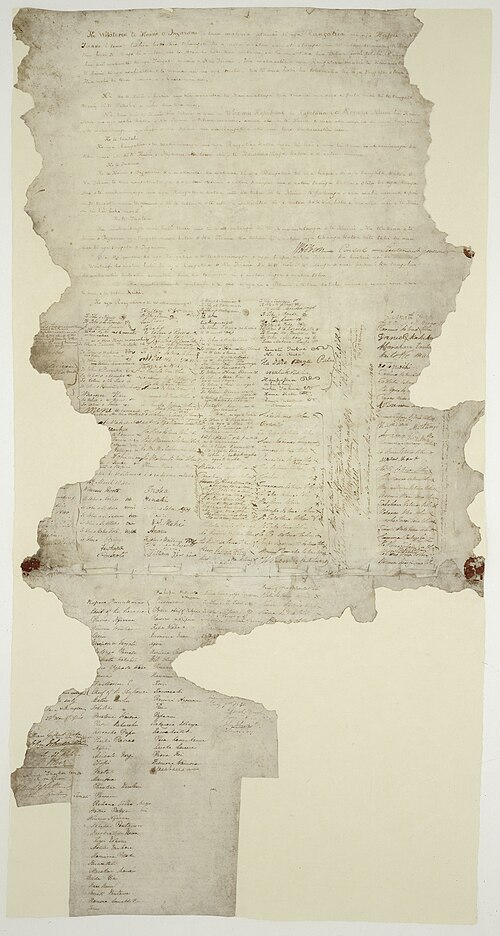
There are nine signed sheets: the Waitangi sheet (about 240 signatures) and eight copies taken around the country, including the Waikato-Manukau sheet, the only one bearing the English text, with 39 signatures. About fifty meetings were held between February and September 1840 to gather signatures.
The documents have had a precarious life. In 1841 they were rescued from a fire that destroyed government offices in Auckland. In 1908 the historian Thomas Hocken found them in a basement in poor condition, damaged by water and partly eaten by rodents; they were restored in 1913. They were shown at Waitangi for the 1940 centenary, later cared for by the Alexander Turnbull Library, restored again in 1977–80, and displayed at the National Archives from 1990.
Since 2017 the treaty sheets have been displayed in the He Tohu exhibition at the National Library of New Zealand in Wellington, together with He Whakaputanga (1835) and the 1893 Women’s Suffrage Petition. In 1997 the treaty was inscribed on UNESCO’s Memory of the World Register.
Advanced
The translation debate: kāwanatanga, mana and Henry Williams
Why did the Māori text use kāwanatanga rather than a word such as mana? The term had already been used by Henry Williams in translating He Whakaputanga, where “sovereign power and authority” appeared as kīngitanga and mana. The historian Ruth Ross argued that mana would have conveyed the transfer of sovereignty more accurately. Others, including Judith Binney, have replied that mana is not the same as sovereignty and that no one can give away their mana, so it would not have been appropriate either.
Scholars also disagree about Williams’s intentions. One view sees an honest but limited translation produced overnight. Paul Moon and Sabine Fenton argued instead that Williams was fluent in Māori and deliberately crafted both versions so that each would be acceptable to its audience without either noticing the contradictions. Williams himself certified the Māori text as “as literal a translation … as the idiom of the language will allow.” The bibliographer D. F. McKenzie interpreted the episode as a meeting between a literate and a wholly oral culture, in which the written document carried very different weight for each side.
Because of these differences, many scholars treat the two versions as distinct documents—“Te Tiriti o Waitangi” and “The Treaty of Waitangi”—and argue that the Māori text should take precedence, since it was the one debated and signed at Waitangi and by the great majority. The Waitangi Tribunal also gives additional weight to the Māori text. Others stress that the Crown’s intention to acquire sovereignty was clear and was explained at the time. Historians such as Claudia Orange have traced how British policy shifted in 1839 from a “Māori New Zealand” with limited settlement towards a “settler New Zealand in which a place had to be kept for Māori.”
Advanced
Did Māori cede sovereignty? The 2014 Tribunal finding
The Waitangi Tribunal’s Te Paparahi o Te Raki (Northland) inquiry, Wai 1040, was unusual in focusing directly on Māori and Crown understandings of He Whakaputanga and Te Tiriti. After hearings in 2010–11 with Ngāpuhi and other northern claimants, its Stage 1 report, He Whakaputanga me te Tiriti / The Declaration and the Treaty, was handed over at Waitangi on 14 November 2014.
The Tribunal found that the rangatira who signed Te Tiriti at Waitangi, Waimate and Mangungu in February 1840 did not cede their sovereignty. In its reading, they agreed to share power and authority with the governor, with each having different roles and spheres of influence: the governor to control British subjects and keep the peace, and rangatira to retain authority over their own people and lands. At the handover, Tribunal manager Julie Tangaere told the claimants that their ancestors “did not cede their sovereignty.”
The finding concerns the meaning of the agreement as understood by those northern signatories in 1840. The Tribunal’s findings are recommendations, not binding judgments, and the Crown continues to exercise sovereignty in New Zealand. The report nevertheless sharpened a long-running constitutional conversation about how kāwanatanga and tino rangatiratanga might be reconciled in practice, through co-governance arrangements, Māori-led institutions, or constitutional reform. Stage 2 reports, on the period after 1840, followed from 2022.
Advanced
The treaty in law and politics today
The treaty is not itself part of New Zealand domestic law, and its status in international law is debated. Instead, the “principles of the Treaty”—a phrase introduced by the 1975 Act and developed by the Tribunal and courts—are referred to in more than thirty-five principal Acts. Commonly cited principles include partnership, good faith, active protection of Māori interests, and redress. In 1938 the Privy Council, in Te Heuheu Tukino v Aotea District Maori Land Board, had held that the treaty was valid in terms of the transfer of sovereignty but was not part of New Zealand law and therefore did not bind the Crown.
The meaning of taonga has broadened: courts and the Tribunal have held that it can include intangible treasures such as the Māori language and culture. Disputes over resources such as the foreshore and seabed (2003–04) showed how different cultural understandings of ownership continue to matter. Proposals to entrench the treaty in the 1990 Bill of Rights were dropped, partly because many Māori feared it would be downgraded.
Debate intensified in the 2020s. The ACT party argued that existing principles had created unequal rights and introduced the Principles of the Treaty of Waitangi Bill to define the principles by statute and put them to a referendum. Opponents—including many legal scholars, Māori leaders and the Tribunal’s claimants—argued that it rewrote the treaty and undermined Māori rights. In November 2024 a nationwide hīkoi (march), Hīkoi mō te Tiriti, travelled to Parliament in protest. On 10 April 2025 the bill was defeated at its second reading by 112 votes to 11.
Public opinion remains divided. Surveys have found New Zealanders split over whether the treaty should remain in law and whether it has too much or too little influence on government. What almost everyone agrees on is that the treaty is central to the country’s identity; what they disagree about is what it means and how it should be honoured. Studying the treaty therefore means studying both texts, the circumstances of 1840, and the many ways later generations—Māori and Pākehā alike—have interpreted it.
Key ideas
- Kāwanatanga
- Governance or governorship—what the Māori text of Article 1 gives the Crown, in place of the English text’s “sovereignty.”
- Tino rangatiratanga
- Full chiefly authority or self-determination over lands, villages and treasures, guaranteed to Māori in Article 2 of the Māori text.
- Taonga
- Treasures; now understood to include intangible things such as language and culture, not only physical property.
- Two texts, one treaty?
- The English and Māori versions differ; most signatories signed the Māori text, and the Tribunal gives it additional weight.
- Pre-emption
- The Crown’s exclusive right to buy Māori land, understood very differently by the two sides and central to later land loss.
- Principles of the Treaty
- Partnership, good faith, active protection and redress—principles developed by the Tribunal and courts to apply the treaty today.
- Redress and settlement
- Since the 1990s the Crown has negotiated settlements with iwi that include apologies, historical accounts and financial and cultural redress.
Records
- 1831 — Thirteen northern chiefs write to King William IV asking Britain to be a “friend and guardian.”
- 1835 — 34 northern rangatira sign He Whakaputanga, the Declaration of the Independence of New Zealand (28 October).
- 1840 — The treaty is debated on 5 February and first signed at Waitangi on 6 February; Hobson proclaims British sovereignty on 21 May.
- 1845 — The Northern War begins, the first of the New Zealand Wars (to 1872).
- 1863 — The government invades the Waikato; large-scale land confiscations follow from 1865.
- 1877 — In Wi Parata v Bishop of Wellington the treaty is declared a “simple nullity.”
- 1934 — The Treaty House and grounds, given to the nation, are dedicated as a national reserve; Waitangi Day is first commemorated.
- 1975 — The Treaty of Waitangi Act creates the Waitangi Tribunal.
- 1987 — The Court of Appeal describes the treaty as a partnership requiring good faith (NZ Maori Council v Attorney-General).
- 1995 — Waikato-Tainui settlement, with a Crown apology for the invasion of the Waikato and land confiscation.
- 2014 — The Tribunal finds that northern rangatira did not cede sovereignty in 1840 (Te Paparahi o Te Raki Stage 1 report).
- 2025 — The Treaty Principles Bill is defeated at its second reading (10 April).
Glossary
- Rangatira
- A Māori chief or leader who exercises authority on behalf of a hapū or iwi.
- Iwi and hapū
- Iwi are tribes; hapū are sub-tribes or kin groups, the main political units in 1840.
- Mana
- Prestige, authority and spiritual power, held by people and groups.
- Kāwanatanga
- Governance or governorship; a word created from the English “governor.”
- Tino rangatiratanga
- Full chieftainship, self-determination or absolute authority.
- Taonga
- Treasures or precious things, tangible or intangible.
- Pre-emption
- The exclusive right of the Crown to purchase land from Māori.
- Pākehā
- A Māori term for New Zealanders of European descent.
- Waitangi Tribunal
- A permanent commission of inquiry, created in 1975, that hears claims of Crown breaches of the treaty’s principles.
- Hīkoi
- A march or journey on foot, often used for political protest.
Questions and answers
Why was the treaty signed at Waitangi?
Waitangi, in the Bay of Islands, was where the British Resident James Busby lived and where northern chiefs had signed He Whakaputanga in 1835. The Bay of Islands was then the main area of contact between Māori and Europeans.
Why are there two versions?
Hobson’s English draft was translated into Māori overnight by missionaries so the chiefs could read and debate it. The translation does not match the English exactly.
Did all Māori chiefs sign?
No. More than 500 did, but some important leaders and whole tribes refused, and copies never reached some areas.
Which version counts?
The Crown historically relied on the English text. Most signatories signed the Māori text, and the Waitangi Tribunal gives it additional weight when interpreting the treaty.
Is the treaty part of New Zealand law?
Not directly. But many Acts refer to the “principles of the Treaty,” and courts and the Tribunal apply those principles.
What did the Waitangi Tribunal decide in 2014?
That the northern rangatira who signed in 1840 did not cede sovereignty but agreed to share power with the governor. The finding is not a binding judgment.
Why is Waitangi Day sometimes a day of protest?
Because for many Māori it is a reminder of promises the Crown did not keep, as well as a day of national commemoration.
Sources and further reading
- About the treaty. Waitangi Tribunal
- Māori and English texts. Waitangi Tribunal
- Te Paparahi o Te Raki (Northland) inquiry, Wai 1040. Waitangi Tribunal
- Treaty of Waitangi. Wikipedia
- He Whakaputanga. Wikipedia
- Waitangi Tribunal. Wikipedia
- Principles of the Treaty of Waitangi. Wikipedia
- Treaty of Waitangi claims and settlements. Wikipedia
- New Zealand Wars. Wikipedia
- Treaty Principles Bill. Wikipedia
Related
- BennelongWangal man of the Sydney Harbour region who, after being kidnapped by the first British colonists, became the leading Aboriginal go-between and diplomat of early colonial New South Wales.
- Magna CartaCharter of liberties agreed by King John with rebel barons at Runnymede on 15 June 1215, later a symbol of the rule of law.
- United States Declaration of IndependenceDocument adopted by the Continental Congress on 4 July 1776 declaring the thirteen colonies independent of Britain.
- Lapita cultureAncient Austronesian seafaring culture, known for dentate-stamped pottery, whose people were the first to settle Vanuatu, New Caledonia, Fiji, Tonga and Samoa.
- MoaiLarge stone figures carved by the Rapa Nui people on Easter Island over several centuries.
Written with AI assistance from the published sources listed above, and revised as new research appears.