Start at the top for an easy introduction. Go further down for more detail and scholarship.
- Easy
- Intermediate
- Advanced
For young readers
More than 800 years ago, England had a king named John. He lost wars in France, asked his nobles for more and more money, and punished people he did not like without fair trials. Many powerful landowners, called barons, became very angry.
In 1215 the barons rebelled and captured London. King John had to meet them in a meadow called Runnymede beside the River Thames, not far from his castle at Windsor.
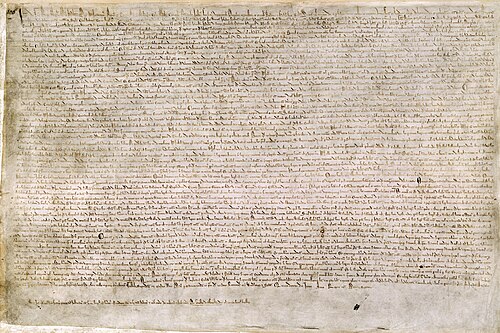
There they agreed on a long list of promises written in Latin on a sheet of parchment. The king did not sign his name. Instead, his great seal, a stamp pressed into wax, was attached to copies to show that he agreed.
The most famous promise said that no free man could be arrested, put in prison or have his land taken away except by a fair judgement or by the law of the land. Another said the king would not sell justice, refuse it or delay it.
The peace did not last. Within a few months the king asked the Pope to cancel the charter, and war broke out again. But after John died, the government of his young son issued the charter again several times, and from 1217 it was called Magna Carta, which means “Great Charter.”
Much later, people in England, America and many other countries remembered Magna Carta as a sign that even rulers must obey the law. Four copies from 1215 still survive: two in the British Library in London, one at Salisbury Cathedral and one at Lincoln Castle.
At a glance
- What
- Royal charter of liberties, written in Latin on parchment and authenticated with the king’s great seal
- Agreed
- 15 June 1215 at Runnymede, a meadow on the Thames between Windsor and Staines; copies issued from 19 June
- Parties
- King John of England and rebel barons, with Archbishop Stephen Langton as mediator
- Content
- About 63 clauses (numbered only since 1759) on church liberty, feudal payments, justice, forests, debts, towns and a council of 25 barons
- Fate in 1215
- Annulled by Pope Innocent III on 24 August 1215; the First Barons’ War followed
- Reissues
- 1216, 1217 (when it was first called Magna Carta), 1225 and 1297 (entered as statute law)
- Surviving 1215 copies
- Four: two in the British Library, one at Salisbury Cathedral, one (Lincoln Cathedral’s) at Lincoln Castle; UNESCO Memory of the World, 2009
- Still in force
- Three clauses of the 1297 version remain law in England and Wales, including the due-process clause
Easy
What is Magna Carta?
Magna Carta, Latin for “Great Charter,” is a royal charter of rights agreed by King John of England at Runnymede, near Windsor, on 15 June 1215. It was drafted as a peace agreement between the unpopular king and a group of rebel barons. It promised to protect the rights of the Church, to protect the barons from illegal imprisonment, to give swift and fair justice and to limit the payments that the Crown could demand from its feudal tenants.
As a peace treaty, it failed within weeks. Neither side trusted the other, the Pope declared the charter void, and civil war broke out. Yet the charter did not disappear. After John’s death it was reissued in revised forms in 1216, 1217 and 1225, and in 1297 it was entered into English statute law. Over centuries it became one of the most famous documents in the history of law and government.
Today historians stress two different stories. One is the charter of 1215 itself: a practical, often technical settlement about the rights of barons and free men in a feudal kingdom. The other is the “myth” or legend of Magna Carta, built mainly from the 17th century onward, which saw it as an ancient guarantee of liberty for everyone. Both stories matter for understanding why it is still remembered.
Easy
Why did the barons rebel?
King John was the third king of the Angevin dynasty, which also held large lands in France. In 1204 he lost Normandy and most of these French lands to King Philip II of France. For ten years he raised heavy taxes and fees from his barons to pay for a war to win them back. In 1214 his allies were defeated at the Battle of Bouvines, and the campaign ended in expensive failure.
Angevin kings often ruled by what historians call vis et voluntas, “force and will,” making arbitrary decisions and sometimes claiming to be above the law. John used his powers to demand large sums from barons when they inherited land, married or wanted justice in the royal courts, and many barons were deep in debt to the Crown. He was also personally distrusted.
Rebel barons, especially in the north and east of England, swore to “stand fast for the liberty of the church and the realm.” They demanded that John confirm the Charter of Liberties issued by King Henry I around a century earlier. In May 1215 they renounced their loyalty to the king and marched on London, which they captured. John agreed to negotiate.
Easy
The meeting at Runnymede
On 10 June 1215 John met the rebel leaders at Runnymede, a water-meadow on the south bank of the Thames. It was a traditional place for assemblies, and it lay on neutral ground between the royal fortress of Windsor Castle and the rebel base at Staines. The charter itself names the place as “Ronimed, between Windsor and Staines.”
The rebels presented their demands in a document known as the Articles of the Barons. Over about ten days, Stephen Langton, Archbishop of Canterbury, helped turn these demands into a full charter. By 15 June a text had been agreed, and on 19 June the rebels renewed their oaths of loyalty to John and copies of the charter were formally issued.
Contrary to the popular picture, John did not sign Magna Carta, and the barons did not add their seals. Royal clerks wrote out copies in abbreviated Latin on sheets of parchment, and each was authenticated with the king’s great seal in wax. At least thirteen copies were sent out to sheriffs and bishops across the kingdom.
Intermediate
What the charter said
The original text runs continuously, without paragraphs or numbers; the clause numbers used today were introduced by the jurist William Blackstone in 1759. Most of the charter deals with the feudal rights of the Crown over the barons. Clauses 2 and 3 fixed the “relief” an heir had to pay to inherit an estate. Clauses 12 and 14 said that scutage (money paid instead of military service) and certain other aids could only be raised with the common counsel of the kingdom, gathered in a council of bishops, abbots, earls and greater barons.
Clause 1 promised that the English Church would be free. Other clauses protected widows from being forced to remarry, confirmed the liberties of the City of London and other towns, ordered the removal of fish weirs from rivers, set standard measures for wine, ale and cloth, and promised to reverse recent extensions of the royal forests, whose special laws were widely hated. Clauses 10 and 11 dealt with debts owed to Jewish moneylenders, who were under the king’s special protection; clauses 56 and 57 addressed Welsh lands and hostages.
The most famous clauses are 39 and 40. Clause 39 says, in paraphrase, that no free man shall be arrested, imprisoned, stripped of his property, outlawed, exiled or ruined in any way, nor will the king proceed against him, except by the lawful judgement of his peers or by the law of the land. Clause 40 reads: “To no one will we sell, to no one will we deny or delay right or justice.” In 1215 these were demands aimed at John’s abuse of royal justice; later generations read them as general principles of due process.
Clause 61, the “security clause,” set up a council of twenty-five barons. If the king broke the charter and did not correct it within forty days, the council could seize his castles and lands until amends were made. This formal means of collectively coercing a king was new, and it helped make the 1215 settlement impossible for John to accept.
Intermediate
Failure and the First Barons’ War
Neither side put the peace into practice. The twenty-five barons chosen for the council were all rebels, and many rebels kept their forces armed. John, who had made himself a vassal of the Pope in 1213, appealed to Pope Innocent III in July, arguing that the charter harmed the Pope’s rights as his feudal lord. In a letter dated 24 August 1215 the Pope declared the charter “shameful and demeaning, illegal and unjust,” and “null and void of all validity for ever.”
By then fighting had begun. The rebel barons offered the English crown to Louis, son of King Philip II of France, who landed in England in 1216, was proclaimed king by the barons in London (though never crowned) and soon controlled more than half the kingdom. The war settled into stalemate. John fell ill and died in October 1216, leaving his nine-year-old son, Henry III, as heir.
The regency government of the boy king, led by the famous knight William Marshal and the papal legate Guala Bicchieri, cleverly adopted the charter as its own. It reissued a shortened version in November 1216, removing clause 61 and other provisions, to win back rebels. After royalist victories at Lincoln and in a sea battle off Sandwich in 1217, Louis agreed to the Treaty of Lambeth and left England.
Intermediate
How it became “the Great Charter”
In 1217 the government issued the charter again, together with a separate Charter of the Forest dealing with the royal forests. To tell them apart, scribes called the larger document magna carta libertatum, “the great charter of liberties,” and in time it became simply Magna Carta. The name originally meant “big charter” in contrast to the smaller forest charter.
In 1225, needing money to defend his lands in Gascony, Henry III reissued both charters in exchange for a large tax. This time the king declared that he granted them of his own “spontaneous and free will,” which gave the 1225 version much more authority. It became the definitive text, and it is the version that later lawyers usually knew. The National Archives holds an original of this issue.
Kings confirmed the charters many times, often in return for taxation. In 1297 Edward I reissued the 1225 text, and it was entered on the statute rolls as part of English law. The Confirmatio Cartarum of the same year ordered copies to be sent to cathedrals and read to the people twice a year. According to Sir Edward Coke, the charter was reconfirmed 32 times between the 13th and 15th centuries.
Intermediate
The surviving copies
Of the thirteen or more copies of the 1215 charter, four survive, all in England. The British Library holds two. One was given to the antiquary Sir Robert Cotton in 1629 by a lawyer who may have found it in a tailor’s shop; the other was found in Dover Castle in 1630 and was badly damaged in the Cotton library fire of 1731 and by a failed attempt at conservation in the 1830s. It is the only 1215 copy with its great seal still attached, though melted.
Lincoln Cathedral’s copy has been in Lincoln since 1215. During the Second World War it was kept at Fort Knox in the United States for safety. It is now displayed at Lincoln Castle beside an original 1217 Charter of the Forest. Salisbury Cathedral’s copy, first delivered to the old cathedral at Old Sarum, is often described as the best preserved; its handwriting differs from the others, suggesting it was written by cathedral staff and then authenticated by the royal court.
Later issues also survive in several places, including a single 1216 copy at Durham, copies of 1217 at the Bodleian Library and Hereford, and copies of 1297 in the National Archives in London, the Guildhall, Parliament House in Canberra and the National Archives in Washington, D.C., where a 1297 exemplification is on loan from its owner. In 2009 UNESCO added the four 1215 copies to its Memory of the World Register.
Advanced
Coke, the “ancient constitution” and the making of a myth
By the mid-15th century Magna Carta had lost much of its central political role, although lawyers still used it, especially to protect property rights, and printed editions from 1508 spread its text. Early printers worked from the 1225 version and often attributed the charter to Henry III rather than John.
From the late 16th century antiquarians developed the idea of an “ancient constitution”: a set of Anglo-Saxon liberties overthrown by the Norman Conquest and restored in 1215. In the early 17th century the judge and parliamentarian Sir Edward Coke used Magna Carta repeatedly against the Stuart kings’ claims to rule by divine right. He and his allies argued that it guaranteed trial by jury, habeas corpus and the powers of Parliament. The Petition of Right of 1628 cited it in its preamble. Modern historians such as Ralph Turner and Claire Breay have criticised Coke’s reading as anachronistic, while J. C. Holt noted that the charter’s history had already become distorted by Coke’s time.
The Whig view of history after the Glorious Revolution of 1688 made Magna Carta a founding document of English liberty. William Stubbs’s Constitutional History of England in the 1870s marked the high point of this interpretation. From the 1890s onward, historians including F. W. Maitland and Edward Jenks, whose 1904 article was titled “The Myth of Magna Carta,” returned the charter to its 13th-century context as a document about baronial rights rather than the liberties of the people at large.
Advanced
Magna Carta in America and the wider world
English colonists took the idea of Magna Carta across the Atlantic. The Virginia Charter of 1606, largely drafted by Coke, promised settlers the same liberties as people born in England, and the Massachusetts Body of Liberties echoed the charter’s due-process clause. In 1687 William Penn published the first copy of Magna Carta printed in America. During the American Revolution, colonists argued that they were defending rights they believed Magna Carta guaranteed.
The United States Constitution’s Fifth Amendment, which says that no person shall be “deprived of life, liberty, or property, without due process of law,” uses a phrase that descends from the charter through a statute of 1354 that rephrased “lawful judgement of his peers or the law of the land” as “due process of law.” The U.S. National Archives presents this link to visitors alongside its 1297 copy. In 1957 the American Bar Association erected a memorial at Runnymede.
The charter’s influence also travelled through the British Empire. Chapter 29 of the 1297 statute remains in force in New Zealand and in several Australian states and territories. Campaigners and courts around the world have invoked Magna Carta, though often as a symbol rather than as working law. Its legacy is thus bound up with the spread of English common law, including in colonised societies whose own legal traditions were displaced.
Advanced
Historians’ debates today
Modern scholarship treats Magna Carta as one of many charters of its age, in England and elsewhere in Europe, that set out rights and limited royal power. Its language drew on Henry I’s Charter of Liberties, on charters granted to towns and on church and baronial practice. Historians debate how far it was a narrowly baronial document and how far it reached beyond the barons: it spoke of “free men,” a limited category, but some clauses also concerned widows, merchants, towns and even the villeins (serfs) in clauses 16, 20 and 28.
J. C. Holt’s Magna Carta (first published 1965) placed the charter within the political thought and administrative practice of its time. David Carpenter, who observed that the charter “wasted no time on political theory,” has worked on its drafting and copies; in 2015 he argued that the British Library’s damaged copy found at Dover was probably the one sent to Canterbury Cathedral. The discovery in 2013 of a draft text in a Peterborough Abbey register, and the identification in 2025 of a Harvard copy of the 1300 confirmation as an original, show that research on the documents continues.
Historians also study the charter’s treatment of marginal groups: its clauses on Jewish creditors reflect the precarious position of England’s Jewish community, which would be expelled in 1290, and its promises were made to “free men” in a society where many people were unfree. At the same time, as W. L. Warren observed, many who knew little of its content invoked its name, because it came to mean more than it said.
Key ideas
- Rule of law
- The king himself should act within the law and custom of the realm rather than by “force and will.” This idea gave the charter its lasting power.
- Lawful judgement and the law of the land
- Clause 39’s promise that free men would not be punished except through proper legal process, later linked to “due process of law.”
- Justice not for sale
- Clause 40’s pledge that the king would not sell, deny or delay justice, aimed at John’s practice of charging for access to royal courts.
- Consent to taxation
- Certain feudal levies required the “common counsel of the kingdom,” an idea later used to argue that taxes need parliamentary consent.
- Enforcement by council
- Clause 61’s council of 25 barons was a radical attempt to create a lawful way to compel a king to keep his promises.
- Charter and myth
- The charter of 1215 was a feudal settlement; its later reputation as a guarantee of universal liberty was largely built in the 17th century.
- Living symbol
- Though almost all of it has been repealed, Magna Carta remains a powerful symbol invoked in debates about liberty and state power.
Records
- 1100 — Henry I issues his Charter of Liberties, which the rebels of 1215 later demand be confirmed.
- 1204 — King John loses Normandy and most Angevin lands in France to Philip II.
- 1214 — John’s allies are defeated at Bouvines; his French campaign fails.
- 1215 — Rebels take London (May); the charter is agreed at Runnymede on 15 June; Pope Innocent III annuls it on 24 August; the First Barons’ War begins.
- 1216 — Louis of France invades; John dies in October; Henry III’s regency reissues a revised charter in November.
- 1217 — Royalist victories at Lincoln and Sandwich; Treaty of Lambeth; the charter is reissued with the Charter of the Forest and called Magna Carta.
- 1225 — Henry III reissues Magna Carta of his “free will” in return for a tax; this becomes the definitive text.
- 1297 — Edward I reissues the charter, which is entered on the statute rolls.
- 1628 — The Petition of Right, supported by Sir Edward Coke, cites Magna Carta against Charles I.
- 1759 — William Blackstone publishes an edition of the 1215 charter and introduces the clause numbering used today.
- 1791 — The U.S. Bill of Rights, including the Fifth Amendment’s due-process clause, is ratified.
- 2015 — The 800th anniversary; the four 1215 copies are displayed together at the British Library.
Glossary
- Charter
- A formal written grant of rights or privileges, issued by a ruler and authenticated with a seal.
- Baron
- A powerful landholder who held land directly from the king in return for military service and other obligations.
- Great seal
- The king’s official seal, pressed into wax and attached to documents to show royal approval.
- Exemplification
- An official copy of a charter issued under the royal seal; each surviving 1215 copy is one.
- Relief
- A payment owed to the lord when an heir inherited a feudal estate.
- Scutage
- “Shield money”: a payment made to the king instead of performing military service.
- Royal forest
- Land, not necessarily wooded, placed under special royal law to protect hunting and royal revenue.
- Due process
- The principle that the state must follow fair and established legal procedures before punishing anyone.
- Habeas corpus
- A legal order requiring that a detained person be brought before a court to test whether their imprisonment is lawful.
- Regency
- Government on behalf of a monarch who is too young or unable to rule.
Questions and answers
Did King John sign Magna Carta?
No. Medieval kings did not sign charters. Copies were authenticated with the king’s great seal, pressed into wax. Paintings of John signing with a pen are later imaginations.
Did Magna Carta give rights to everyone?
Not in 1215. Most clauses concerned barons, the Church and “free men,” and many people in England were unfree. Later generations interpreted its principles much more broadly.
Is Magna Carta still law?
Only three clauses of the 1297 version remain in force in England and Wales: those on the freedom of the Church, the liberties of the City of London, and lawful judgement and justice. Everything else has been repealed.
Why is it called the “Great” Charter?
In 1217 it was issued together with the smaller Charter of the Forest, so scribes called the larger one the great charter. The name reflects its size before it reflected its fame.
Where was it agreed?
At Runnymede, a meadow beside the Thames in Surrey. It was neutral ground between the king at Windsor and the rebels at Staines. The exact spot in the meadows is not known.
How did it influence the United States?
Colonists saw it as a guarantee of English liberties, and the Fifth Amendment’s phrase “due process of law” descends from its language. A 1297 copy is displayed at the U.S. National Archives.
Why do historians call part of its story a myth?
Seventeenth-century lawyers claimed it restored ancient Anglo-Saxon liberties and guaranteed jury trial and habeas corpus. Research since the 19th century shows those claims misread a 13th-century feudal document, even though the myth itself shaped real political history.
Sources and further reading
- Magna Carta. Wikipedia
- 마그나 카르타. Wikipedia (Korean)
- Magna Carta 1214–1225. The National Archives (UK)
- Magna Carta. U.S. National Archives
- Magna Carta. Salisbury Cathedral
- First Barons’ War. Wikipedia
- Runnymede. Wikipedia
- Charter of the Forest. Wikipedia
- J. C. Holt, Magna Carta (3rd edition). Cambridge University Press, 2015
- David Carpenter, Magna Carta. Penguin Classics, 2015
Related
- Code of HammurabiA collection of legal judgments issued under Hammurabi, king of Babylon, in the eighteenth century BCE.
- Cyrus CylinderA clay foundation cylinder inscribed in Babylonian cuneiform after Cyrus the Great conquered Babylon in 539 BCE, presenting him as a just king chosen by the god Marduk.
- United States Declaration of IndependenceDocument adopted by the Continental Congress on 4 July 1776 declaring the thirteen colonies independent of Britain.
- Storming of the BastilleThe seizure of a Paris fortress and prison on 14 July 1789 became an early emblem of the French Revolution.
- Constitution of 3 May 1791Written constitution adopted by the Great Sejm of the Polish–Lithuanian Commonwealth, often called Europe’s first modern codified national constitution, which tried to rescue the state before it was partitioned.
Written with AI assistance from the published sources listed above, and revised as new research appears.