Start at the top for an easy introduction. Go further down for more detail and scholarship.
- Easy
- Intermediate
- Advanced
For young readers
More than 230 years ago, Poland and Lithuania were joined together in one very large country called the Commonwealth. It had a king, but the real power belonged to the nobles, and the country had become very weak.
One big problem was a strange rule in their parliament. If even one member shouted “I forbid it!”, everything the parliament had decided in that meeting was cancelled. Imagine a class where one child could cancel every decision the whole class made, just by saying no. Nothing would ever get done—and powerful neighbours could pay someone to say no.
Russia, Prussia and Austria, the country’s neighbours, had already taken big pieces of its land in 1772. Many Poles and Lithuanians realised that if they did not fix their government, their country might disappear.
So on 3 May 1791, in the Royal Castle in Warsaw, the parliament voted for a new set of rules for the whole country: a constitution. It ended the “I forbid it!” rule, split power between lawmakers, the king’s government and judges, gave townspeople new rights and promised to protect farmers, called peasants, by law.
People in the streets cheered. It was the first written constitution of its modern kind in Europe, coming soon after the one in the United States.
But the neighbours did not want a strong country next door. Russia sent its army, and by 1795 the Commonwealth had been completely divided up. Still, people never forgot the constitution. Today 3 May is a national holiday in Poland, and it is remembered in Lithuania too.
At a glance
- Official title
- Ustawa Rządowa (Government Act)
- Adopted
- 3 May 1791, by the Great (Four-Year) Sejm, 1788–1792
- Where
- Royal Castle, Warsaw, capital of the Polish–Lithuanian Commonwealth
- Main authors
- King Stanisław August Poniatowski, Ignacy Potocki and Hugo Kołłątaj, with others including Scipione Piattoli and Stanisław Małachowski
- Structure
- Preamble and 11 articles, with associated laws on towns, regional assemblies and the union of Poland and Lithuania
- Key changes
- Abolished the liberum veto and confederations; separation of powers; hereditary monarchy; rights for burghers; peasants placed under the protection of law
- In force
- About 19 months; annulled by the Grodno Sejm on 23 November 1793 under Russian pressure
- Originals
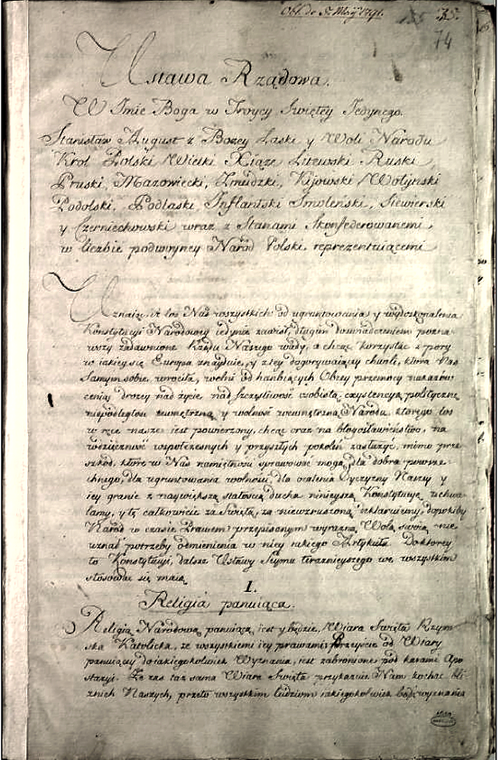
- Manuscript copies held in the Central Archives of Historical Records (AGAD), Warsaw
Easy
What was the Constitution of 3 May?
The Constitution of 3 May 1791 was a written set of basic laws for the Polish–Lithuanian Commonwealth, a large state in east-central Europe formed by the Kingdom of Poland and the Grand Duchy of Lithuania. Its official title was Ustawa Rządowa, the “Government Act,” meaning the act that set up the system of government. It was adopted by the parliament, called the Sejm, meeting in the Royal Castle in Warsaw.
It is often described as the first modern codified national constitution in Europe and the second in the world, after the Constitution of the United States. By “modern” historians mean a single written document that sets out how the state is organised, divides power among separate branches, and places the ruler under the law. An earlier constitution had been written for the short-lived Corsican Republic in 1755, which is one reason careful writers add qualifications to the claim.
The Constitution tried to rescue a state that had become almost impossible to govern. It removed rules that allowed a single deputy to block all legislation, strengthened the government and the army, gave political rights to townspeople and promised the protection of law to peasants. It lasted only about nineteen months before foreign armies and Polish opponents destroyed it. Yet it became one of the most cherished symbols of Polish, and also Lithuanian, history.
Easy
The problem: a great state that could not govern itself
In the seventeenth century the Commonwealth had been one of Europe’s great powers, and in the eighteenth it was still the largest state on the continent after Russia. Its political system, sometimes called the “nobles’ democracy,” gave enormous freedom to the nobility, the szlachta. Nobles elected their kings, sat in the Sejm and in regional assemblies (sejmiks), and could even form legal armed leagues against the king, known as confederations.
The worst weakness was the liberum veto, the “free veto.” From 1652 any single deputy could stop a session of the Sejm and cancel all the laws it had passed. Foreign powers and rich magnates bribed deputies to use it, and for long periods the Sejm could pass almost nothing. During thirty years of the reign of Augustus III only one session managed to pass legislation. The state had a tiny army—about 16,000 soldiers—while Russia had about 300,000 and Prussia and Austria about 200,000 each.
Russia treated the Commonwealth as its protectorate. In 1768 the Empress Catherine the Great made the nobles’ privileges, including the liberum veto and the election of kings, into “Cardinal Laws” that she personally guaranteed. In 1772 Russia, Prussia and Austria seized about a third of the Commonwealth’s territory and four million of its people in the First Partition. For thoughtful Poles and Lithuanians the lesson was clear: reform or perish.
Easy
How it was adopted: a bold day in Warsaw
An opportunity came when the so-called Great Sejm, or Four-Year Sejm, opened in Warsaw on 6 October 1788. Russia was busy fighting wars against the Ottoman Empire and Sweden, and an alliance with Prussia seemed to protect the Commonwealth. To avoid the liberum veto, the Sejm formed itself into a confederation, which allowed majority voting. In 1790 newly elected deputies joined, doubling its size.
King Stanisław August Poniatowski began secretly drafting a new constitution in late 1790, working with the reform leader Ignacy Potocki, the priest and thinker Hugo Kołłątaj, the Italian secretary Scipione Piattoli, the Sejm marshal Stanisław Małachowski and others. In April 1791 the Sejm first passed a law on royal towns that gave townspeople important new rights; it was later written into the constitution.
Fearing their opponents, the reformers moved the debate forward to 3 May, while many conservative deputies were still away for the Easter break. The king’s nephew, Prince Józef Poniatowski, placed the royal guard around the castle. Only about 182 members were present, roughly half of the full Sejm. After a heated debate the Government Act was adopted by a large majority, and crowds outside cheered. The king swore to uphold it, and the deputies went to St John’s church nearby for a thanksgiving service. Historians often call the day a peaceful, quasi-legal coup.
Easy
What the Constitution said
The Constitution has a preamble and eleven articles. Article I recognised Roman Catholicism as the “dominant religion” but promised tolerance and freedom to all faiths. Article II confirmed the rights of the nobility. Article III incorporated the new law on royal towns, which gave townspeople (burghers) personal security from arrest without trial, the right to buy land and the right to hold offices and army commissions. Article IV placed the peasants, the largest and most oppressed group, under the protection of national law, though it did not end serfdom.
Article V declared that “all power in civil society” comes from the will of the nation and divided government into three branches. Legislative power went to a two-chamber Sejm: an elected Chamber of Deputies and a Senate. Executive power went to the king and his council of ministers, called the Guardians of the Laws, whose members had to countersign the king’s acts and could be removed by the Sejm. Judges were to be elected and independent.
Most important of all, Article VI abolished the liberum veto and forbade confederations, calling them destructive of society. Decisions would now be made by majority vote. The monarchy became hereditary rather than elective, to stop foreign powers from interfering in every royal election; after Stanisław August the crown was to pass to the Elector of Saxony. Article XI called for a standing army of 100,000 men for the nation’s defence. The Constitution also promised to be revised by a special Sejm every twenty-five years.
Intermediate
War, betrayal and the end of the Commonwealth
Catherine the Great was furious: one of her advisers is recorded as complaining that the Polish king had become almost sovereign. Prussia, too, feared a revived Commonwealth that might demand back lands taken in 1772. Once Russia’s wars with the Ottomans and Sweden ended, Catherine was free to act. A group of powerful magnates who had lost their privileges—among them Franciszek Ksawery Branicki, Stanisław Szczęsny Potocki and Seweryn Rzewuski—formed the Targowica Confederation, founded on 27 April 1792 with a proclamation drafted in St Petersburg. They denounced the Constitution as a “contagion of democratic ideas” following the example of Paris and invited Russian troops to restore the old liberties.
In May 1792 Russian armies invaded. The Commonwealth could field only about 37,000 soldiers, many of them untrained. Under Józef Poniatowski and Tadeusz Kościuszko they fought well in several battles, but Prussia refused to honour its alliance. With Warsaw threatened, the king and a majority of his ministers decided that further resistance was hopeless, and on 24 July 1792 Stanisław August joined the Targowica Confederation, as the Empress demanded.
The Targowica leaders had expected to rule a restored old Commonwealth. Instead Russia and Prussia carried out the Second Partition in 1793. A Sejm meeting at Grodno under the pressure of Russian troops approved the partition and, on 23 November 1793, declared the Constitution void—although its legal right to do so has been questioned. In 1794 Kościuszko led a national uprising and, in the Proclamation of Połaniec, promised personal freedom to peasants. The rising was crushed by Russia and Prussia, and in 1795 the Third Partition divided what remained of the Commonwealth among Russia, Prussia and Austria. Poland and Lithuania would not regain independence until 1918.
Intermediate
Enlightenment ideas and Polish traditions
The Constitution drew on the European Enlightenment. It echoed Montesquieu’s idea of separating legislative, executive and judicial power, and Rousseau’s language of the social contract and the will of the nation. Rousseau and the French writer Mably had in fact both written advice on how Poland should be governed around 1770–1772. The king was reported to have said that the Constitution was founded mainly on those of England and the United States, while avoiding the faults of both. Some modern scholars describe the monarchy it created as close to the English model of the time.
But it was also rooted in a long Polish tradition of representative government, limits on royal power and written agreements between kings and nobles, such as the Henrician Articles and the pacta conventa signed by each elected king. Polish reformers had been proposing changes for decades. Stanisław Konarski criticised the liberum veto in the 1760s; the Commission of National Education, created in 1773 and often called the first ministry of education in the world, trained a new generation; and Kołłątaj, Stanisław Staszic and Józef Wybicki wrote influential reform programmes.
Pressure also came from below. In late 1789 representatives of the towns organised a “Black Procession” in Warsaw, dressed in black, to demand political rights for burghers. Aware of events in France, the Sejm chose compromise rather than confrontation, and the resulting law on royal towns became part of the Constitution. The reformers’ aim, as Kołłątaj put it, was a gentle revolution without violence.
Intermediate
The document itself: drafts, manuscripts and translations
The text went through several drafts. The king is credited with the general provisions, and Kołłątaj with giving the document its final shape; a draft close to the final version existed by late March 1791. The adopted act was entered into the official record books of the state. Surviving manuscript copies are kept today in the Central Archives of Historical Records (Archiwum Główne Akt Dawnych, AGAD) in Warsaw, within collections that include the Lithuanian Metrica and the archive of the Four-Year Sejm.
The Constitution was printed and circulated quickly. It was translated into Lithuanian in manuscript and published in English, French and German editions, so that readers across Europe could follow the Polish experiment. Two days after its adoption, on 5 May 1791, the Sejm confirmed it in the Declaration of the Assembled Estates and declared 3 May a national holiday.
The Government Act was not a finished system. In May and June 1791 the Sejm passed further laws on Sejm courts, the Guardians of the Laws, the police commission and town government. On 22 October 1791 it adopted the Mutual Pledge of the Two Nations, which confirmed the union of Poland and Lithuania while guaranteeing Lithuania equal representation in the main institutions. Kołłątaj spoke of further planned “economic” and “moral” constitutions, and a new legal code was called for, but war came before these could be written.
Intermediate
Memory: a national holiday and a symbol of hope
During the 123 years when there was no independent Polish or Lithuanian state, the memory of the Constitution helped keep alive hopes of freedom and a just society. Potocki and Kołłątaj called it “the last will and testament of the expiring Homeland.” A century later the constitutional scholar Bronisław Dembiński wrote that the miracle of the Constitution did not save the state but did save the nation.
The holiday of 3 May was banned by the partitioning powers but restored in April 1919 as one of the first holidays of the newly independent Polish Republic. During the Second World War both the Nazi and Soviet occupiers forbade it. Poland’s communist government, which preferred the workers’ holiday of 1 May, removed it from the official calendar by 1951, and until 1989 the date was often an occasion for anti-communist protest. It was restored as a national holiday in 1990. Polish communities abroad, for example in Chicago, celebrate it with parades.
Outside Poland the Constitution was admired in its own time. Edmund Burke, the British critic of the French Revolution, praised it warmly, contrasting what he saw as a moderate reform with the upheaval in France. Its enemies, by contrast, portrayed it as Jacobinism in the east. Both images—moderate reform and dangerous revolution—have influenced later interpretations.
Advanced
“First in Europe, second in the world”? Comparisons and qualifications
The claim that the Constitution was Europe’s first and the world’s second modern constitution is widely repeated by constitutional scholars such as Albert Blaustein and by historians such as Norman Davies, who called it the first constitution of its type in Europe. Yet the claim depends on definitions. The Corsican constitution of 1755 was earlier, but the Corsican Republic ended in 1769, so it is usually left out of genealogies of lasting national constitutions. Some American state constitutions also preceded the federal one. The French Constitution of September 1791 followed only months later. The Polish document was therefore part of a cluster of Atlantic and European experiments rather than a lonely first.
Comparisons of content also vary. The Polish-American writer Jacek Jędruch placed its liberality below that of the French Constitution of 1791 but above Britain’s Constitutional Act of 1791 for Canada and far above the Prussian General State Laws of 1794, while not equalling the American Constitution. Such rankings are rough, because the Polish text mixed modern principles—popular sovereignty, separation of powers, ministerial responsibility—with older features such as a privileged nobility, a dominant church and a monarchy.
Scholars also debate the social limits of the reform. The Constitution extended citizenship to burghers and spoke of peasants as part of the nation, but it did not abolish serfdom; Jews gained only limited protections, and a planned reform of their status was never carried out. At the same time, the related law on sejmiks removed the vote from about 300,000 of some 700,000 nobles—the poor, landless nobles who had often voted as magnates told them. Whether this was democratisation or the replacement of one elite by another depends on the historian’s viewpoint.
Advanced
Revolution or restoration? Legitimacy and the Polish–Lithuanian relationship
The manner of adoption has always been contested. The reformers exploited the Easter recess, did not send recall notices to known opponents and surrounded the castle with troops. Opponents at the time argued that the Sejm had violated the terms of its own confederation and ignored the instructions deputies had received from their regional assemblies. The Targowica confederates called the day “a revolution and a conspiracy.” Defenders reply that the old procedures had long been manipulated by foreign powers, that most regional assemblies meeting in 1791 and early 1792 endorsed the Constitution, and that it was the first constitutional act of the century passed without foreign involvement. By the same logic, the Grodno Sejm’s annulment in 1793, carried out under Russian guns, is widely regarded as of doubtful legality.
A second debate concerns Lithuania. The Constitution spoke of a single nation and state and did not mention the Grand Duchy separately, which alarmed many Lithuanian deputies who wished to preserve the dual character of the union. The Mutual Pledge of the Two Nations in October 1791 was a compromise that kept many federal elements, including equal representation. Polish historiography long emphasised the Constitution as a national Polish achievement; Lithuanian scholarship and public memory, especially since 1990, have increasingly claimed it as part of Lithuania’s own constitutional heritage, and Lithuania also commemorates the date.
Historians have also debated how far the Constitution caused the final partitions. One view holds that the reform provoked Russia and Prussia and hastened the destruction of the state. Another replies that partition was already the neighbours’ aim and that the Constitution merely denied them a pretext of “anarchy.” The long tradition of Polish scholarship on the Great Sejm—from nineteenth-century historians such as Walerian Kalinka and Władysław Smoleński to Bogusław Leśnodorski in the twentieth century—has moved between these poles, as have English-language historians of the partitions such as Jerzy Lukowski and Richard Butterwick.
Advanced
Sources and how historians study the Constitution
The main primary sources are the text of the Government Act and the related laws of the Great Sejm, preserved in the AGAD archive and reproduced in facsimile editions; the printed diaries and records of Sejm debates; the correspondence of the king, Potocki, Kołłątaj and Piattoli; the political pamphlets of the reform era; and the reports of foreign diplomats in Warsaw, which show how neighbouring courts perceived the reform. The printed translations of 1791 also reveal how the reformers wanted Europe to see them.
Because the Constitution was quickly mythologised—first as a symbol of lost statehood and later as a national holiday—historians must separate the document’s actual provisions and short practical life from the meanings attached to it afterwards. Studies of its single year in operation, of provincial reactions in the sejmiks and of the burghers’ movement have helped to show what the Constitution meant to people at the time, beyond the celebrated debates in Warsaw.
Terminology is another trap for modern readers. In the Commonwealth the word konstytucja traditionally meant any law passed by a Sejm, not a fundamental charter; that is why the document itself was called the Government Act. Likewise “nation” in 1791 still meant chiefly the political community of nobles, now widened to include burghers, rather than everyone who lived in the country.
Key ideas
- Abolition of the liberum veto
- Ending the right of any single deputy to cancel all legislation, and replacing it with majority rule, so that the state could finally act.
- Separation of powers
- Legislative power in a two-chamber Sejm, executive power in the king and the Guardians of the Laws, and judicial power in elected courts.
- Popular sovereignty
- Article V declared that all power in civil society derives from the will of the nation, though the ‘nation’ was still defined narrowly.
- Ministerial responsibility
- The king acted through ministers who countersigned his acts and answered to the Sejm, echoing the British principle that the king can do no wrong.
- Hereditary monarchy
- Replacing royal elections, which foreign powers had repeatedly manipulated, with a hereditary throne.
- Rights for townspeople
- The law on royal towns gave burghers security from arbitrary arrest, the right to own land and access to offices.
- Peasants under the law
- A first step toward protecting the peasantry, without abolishing serfdom.
- Reform or perish
- The conviction, sharpened by the First Partition, that the Commonwealth would disappear unless its institutions were rebuilt.
Records
- 1652 — The liberum veto is first used to break up a session of the Sejm.
- 1772 — First Partition: Russia, Prussia and Austria seize about a third of the Commonwealth.
- 1788 — The Great (Four-Year) Sejm opens in Warsaw on 6 October.
- 1791 — 18 April: law on royal towns; 3 May: the Government Act is adopted; 22 October: Mutual Pledge of the Two Nations.
- 1792 — 27 April: the Targowica Confederation is formed; May: Russia invades; 24 July: the king joins Targowica.
- 1793 — Second Partition; on 23 November the Grodno Sejm annuls the Constitution.
- 1794 — Kościuszko Uprising and the Proclamation of Połaniec; the rising is crushed.
- 1795 — Third Partition ends the Polish–Lithuanian Commonwealth.
- 1918 — Poland and Lithuania regain independence.
- 1919 — 3 May restored as a holiday in the Second Polish Republic.
- 1951 — Communist Poland removes 3 May from the list of national holidays.
- 1990 — 3 May is restored as a national holiday in Poland.
Glossary
- Sejm
- The parliament of the Polish–Lithuanian Commonwealth (and the lower house of Poland’s parliament today).
- Szlachta
- The Polish–Lithuanian nobility, a large class with extensive political privileges.
- Liberum veto
- The ‘free veto’ that let any single deputy dissolve a Sejm session and cancel its laws.
- Confederation
- A sworn league of nobles, sometimes armed; a ‘confederated Sejm’ could decide by majority and escape the veto.
- Magnate
- A member of the richest and most powerful noble families.
- Burghers
- Townspeople, especially the citizens of royal towns.
- Serfdom
- A system in which peasants were bound to the land and owed labour and obedience to landlords.
- Partition
- The division and annexation of the Commonwealth’s territory by neighbouring powers in 1772, 1793 and 1795.
- Guardians of the Laws
- The royal council of ministers created by the Constitution to exercise executive power with the king.
- Targowica Confederation
- The 1792 league of magnates, backed by Russia, that overthrew the Constitution; its name became a byword for treason in Poland.
Questions and answers
Why is it called the Constitution of 3 May?
Because it was voted on 3 May 1791. Its official name was the Government Act.
Was it really the first constitution in Europe?
It is usually called Europe’s first modern codified national constitution. Corsica had a constitution in 1755, but that republic did not last, and the French constitution followed a few months later in 1791.
Did it free the peasants?
No. It placed peasants under the protection of the law, but serfdom remained. Kościuszko’s Proclamation of Połaniec in 1794 went further.
Why did Russia and Prussia oppose it?
A stronger, reformed Commonwealth would be harder to control and might try to recover lands lost in 1772. Its enemies also portrayed it as a revolutionary threat like that in France.
Was the adoption legal?
This is debated. Reformers used the Easter recess and guarded the castle, but most regional assemblies later endorsed the Constitution, and its annulment in 1793 took place under Russian military pressure.
Is it important for Lithuania as well as Poland?
Yes. It was adopted for the joint Polish–Lithuanian state, a Lithuanian translation was made, and the later Mutual Pledge of the Two Nations defined Lithuania’s place in the union.
How is 3 May celebrated today?
It is a national holiday in Poland, marked with official ceremonies, flags and, among Polish communities abroad, parades.
Sources and further reading
- Constitution of 3 May 1791. Wikipedia
- Konstytucja 3 maja. Wikipedia (Polish)
- Great Sejm. Wikipedia
- Targowica Confederation. Wikipedia
- Second Partition of Poland. Wikipedia
- Jerzy Lukowski, The Partitions of Poland: 1772, 1793, 1795. Longman, 1999
- Norman Davies, God’s Playground: A History of Poland. Oxford University Press, 1981
- Richard Butterwick, The Polish-Lithuanian Commonwealth, 1733–1795: Light and Flame. Yale University Press, 2020
Related
- United States Declaration of IndependenceDocument adopted by the Continental Congress on 4 July 1776 declaring the thirteen colonies independent of Britain.
- Storming of the BastilleThe seizure of a Paris fortress and prison on 14 July 1789 became an early emblem of the French Revolution.
- Jean-Jacques RousseauGeneva-born writer whose arguments about inequality, political authority and education influenced European thought.
- Magna CartaCharter of liberties agreed by King John with rebel barons at Runnymede on 15 June 1215, later a symbol of the rule of law.
- Emancipation reform of 1861Alexander II’s reform that legally freed some 23 million privately owned serfs in the Russian Empire, while making them buy their land through decades of redemption payments.
Written with AI assistance from the published sources listed above, and revised as new research appears.