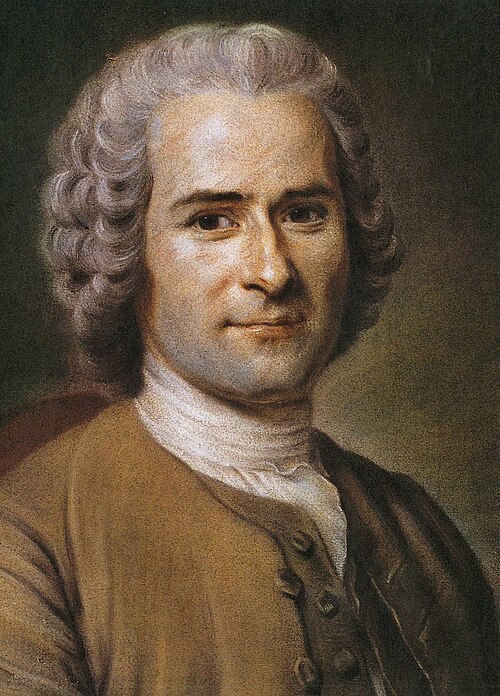
Start at the top for an easy introduction. Go further down for more detail and scholarship.
- Easy
- Intermediate
- Advanced
For young readers
About three hundred years ago, a boy named Jean-Jacques was born in Geneva, a city by a big lake in the mountains of Europe. His mother died just after he was born, and his father, a watchmaker, raised him and read books with him late into the night.
When he grew up, Rousseau moved around a lot and ended up in Paris, the busy capital of France. There he met clever writers who believed that science and learning would make the world better. Rousseau surprised them all. He said: we have more knowledge and fancier things than ever, but are we really kinder or happier?
Rousseau imagined the very first humans living simply in the forest. He thought they were not wicked. Things went wrong, he said, when people began comparing themselves with each other, fencing off land and saying “this is mine,” and making some people rich and others poor.
He also asked a big question: why should anyone obey a government? His answer was that rules are fair only when all the people make them together, for the good of everyone—a bit like a class that agrees on its own rules instead of having one bossy child decide.
Rousseau wrote about how children should learn, too. He said children are not small adults: they should run, play, touch real things and learn by discovering. Many schools today still use ideas that come partly from him. He was not always a good person himself, though—he gave away his own children to an orphanage—and people still argue about him.
At a glance
- Lived
- 28 June 1712 – 2 July 1778
- Born
- Geneva, then an independent Protestant city-republic
- Died
- Ermenonville, near Paris, France
- Active in
- Paris and its surroundings, Switzerland, England (1766–67) and elsewhere
- Roles
- Philosopher, novelist, composer, music copyist, autobiographer
- Major works
- Discourse on the Sciences and Arts (1750), Discourse on Inequality (1755), Julie (1761), The Social Contract (1762), Émile (1762), Confessions (published 1782–89)
- Key ideas
- Natural goodness, amour-propre, the general will, popular sovereignty, education according to nature
- Language
- French
Easy
Who was Rousseau?
Jean-Jacques Rousseau was one of the most widely read and most argued-about writers of the European eighteenth century. He wrote philosophy, novels, operas, letters and a famous autobiography. He is remembered especially for three big questions: Why are people so unequal? What makes a government legitimate, that is, rightfully in charge? And how should children be raised so that they grow up free and good?
Rousseau lived during the Enlightenment, a period when many writers believed that reason, science and the spread of knowledge would steadily improve human life. He belonged to this world—he wrote for the great Encyclopédie and was friends with its editor, Denis Diderot—but he also became one of its sharpest critics. He warned that progress in arts, sciences and wealth could go together with vanity, dependence and injustice.
Because he was both inside and outside the Enlightenment, people have claimed him for very different causes: democracy and revolution, romantic feeling and love of nature, modern education, and even, according to some critics, authoritarian politics. Reading Rousseau carefully means seeing why each of these readings has something to hold on to.
Easy
A restless life
Rousseau was born in Geneva on 28 June 1712. His mother, Suzanne Bernard, died a few days after his birth. His father, Isaac, was a watchmaker who read novels and histories with the boy, including Plutarch’s lives of ancient heroes. When Rousseau was about ten, his father left Geneva after a quarrel, and the boy was placed with relatives and later apprenticed to an engraver.
At fifteen, in 1728, Rousseau found the city gates shut after a walk in the country and decided not to go back. He wandered into Savoy, where he met Françoise-Louise de Warens, a Catholic noblewoman who became his protector and, later, his lover. He converted to Catholicism in Turin and spent years in a patchwork of jobs: servant, secretary, music teacher, tutor. He largely taught himself philosophy, science and music.
In the early 1740s he came to Paris with a new system of musical notation that he hoped would make his name. It did not, but he found work, met Diderot and other writers, and began living with Thérèse Levasseur, a laundress who remained his companion for the rest of his life. According to his own Confessions, they had five children, all of whom he left at the Paris foundling hospital—a decision he later tried to justify and that his enemies used against him.
Fame came suddenly in 1750, when his essay on the arts and sciences won a prize from the Academy of Dijon. Over the next twelve years he wrote his most important works. After The Social Contract and Émile were condemned in 1762, he fled arrest and spent years moving between Switzerland, England and France. He died at Ermenonville, north of Paris, on 2 July 1778.
Easy
The surprising answer of 1750
In 1749 the Academy of Dijon asked essay writers whether the restoration of the sciences and arts had helped to purify morals. Rousseau later described reading this question on the road to Vincennes, where Diderot was imprisoned, and feeling a sudden flood of ideas. Whether or not it happened as dramatically as he told it, this “illumination” became part of the legend of his life.
His Discourse on the Sciences and Arts answered “no.” Refined culture, he argued, teaches people to seem rather than to be: to hide their real feelings behind politeness, to seek praise, and to depend on luxury. He praised ancient Sparta and republican Rome for their simple virtue and criticized the sophistication of modern Paris.
The essay won the prize and made him famous overnight. Many readers found it paradoxical that a man of letters should attack letters, and Rousseau spent the next years defending and deepening the argument. Out of those debates grew his much more ambitious theory of how human beings and societies had changed over time.
Intermediate
The Discourse on Inequality: a history of humankind
In 1755 Rousseau published his Discourse on the Origin and Foundations of Inequality among Men, written for another Dijon prize competition. It did not win, but it became one of the founding texts of modern social thought. Rousseau imagined a “state of nature” before society. He did not present it as a record of real events; he called it a set of hypothetical and conditional reasonings meant to separate what is natural in human beings from what society has added.
Natural human beings, in his picture, are solitary, healthy and simple. They are moved by two feelings: amour de soi, a basic love of oneself that seeks survival and well-being, and pitié, a natural reluctance to see another creature suffer. What distinguishes humans from other animals is freedom and “perfectibility,” the capacity to change and develop—a capacity that makes progress possible but also exposes humans to corruption.
As people settle down, form families and live near each other, a new passion appears: amour-propre, the desire to be esteemed by others and to count for something in their eyes. Comparison breeds pride, envy and shame. Agriculture and metallurgy create property and dependence. Rousseau’s most quoted image comes at the start of the second part: the first person who fenced off a plot of land and said “this is mine,” and found people simple enough to believe him, was the real founder of civil society.
Finally, he argued, the rich persuaded the poor to accept laws and governments that claimed to protect everyone but in fact made existing inequality permanent. This was a bold claim: much of the inequality people take for granted is not natural but social, and what history has made, people might in principle judge and change.
Intermediate
Émile: education according to nature
Émile, or On Education (1762) follows an imaginary boy, Émile, and his tutor from birth to marriage. Its first sentence sets the theme: everything is good as it leaves the hands of the Author of things; everything degenerates in the hands of man. The goal of education is therefore to protect the child from the corrupting pressures of opinion and to let natural abilities develop in the right order.
Rousseau insisted that childhood has its own ways of seeing, thinking and feeling. Young children should learn from things rather than from words: by moving, touching, measuring and experimenting, and by feeling the natural consequences of their actions rather than arbitrary punishments. Book-learning, moral lectures and abstract reasoning should come later. Émile’s only book in early youth is Robinson Crusoe, a story of a man learning to survive by his own skill.
Book IV contains the “Profession of Faith of the Savoyard Vicar,” a statement of a natural religion grounded in conscience and feeling rather than in church authority or revelation. This section, more than anything else, led the Paris Parlement to order the book burned and Rousseau arrested. Book V describes Sophie, the young woman meant to be Émile’s wife, and her very different education, designed to make her pleasing and useful to a husband. Critics from Mary Wollstonecraft onward have attacked this double standard.
Intermediate
Novel, music and the self
Rousseau was also a successful artist. His short opera Le Devin du village (The Village Soothsayer, 1752) was performed before the French king. He wrote many articles on music for the Encyclopédie and later a Dictionary of Music, and he took the Italian side in the Paris “Quarrel of the Buffoons,” praising melody over French harmonic complexity.
His novel Julie, or the New Heloise (1761), told in letters, was one of the best-selling books of the century. Readers wept over the love of Julie and her tutor Saint-Preux and wrote to Rousseau as if the characters were real. The novel made intense feeling, virtue and the beauty of the Alpine landscape central themes of literature, and it is often seen as a forerunner of Romanticism.
In his last years Rousseau turned to himself. The Confessions, published after his death, begins by declaring that he will show a man in all the truth of nature, and that this man will be himself. It narrates shameful episodes as well as happy ones. With Rousseau, Judge of Jean-Jacques and the unfinished Reveries of the Solitary Walker, it helped create the modern autobiography, in which the inner life of an ordinary individual becomes a serious subject.
Intermediate
Condemnation, exile and quarrels
In 1762 both Émile and The Social Contract were condemned in Paris and in Geneva. Rousseau fled to Swiss territory, first to Yverdon and then to Môtiers in the principality of Neuchâtel, then ruled by the king of Prussia. In 1763 he renounced his Genevan citizenship, and in the Letters Written from the Mountain (1764) he attacked Geneva’s ruling council. Local hostility grew, and in 1765 stones were thrown at his house.
In 1766 David Hume brought him to England. The friendship collapsed within months: Rousseau came to believe that Hume was part of a plot to humiliate him, and Hume published an account of the quarrel. Rousseau’s break with Diderot, Voltaire and other former allies was equally bitter. Many historians believe that in these years he suffered from intense suspicion bordering on paranoia, though his persecution was also partly real.
Rousseau returned to France in 1767, living under an assumed name for a time, and settled again in Paris in 1770, supporting himself by copying music. In 1778 he accepted an invitation to Ermenonville, where he died that July. He was buried on an island in the estate’s park, which became a place of pilgrimage.
Intermediate
Influence and legacy
During the French Revolution Rousseau became a political saint. Revolutionaries, including Robespierre, invoked the general will and popular sovereignty, and in 1794 his remains were moved to the Panthéon in Paris. Historians debate how far the revolutionaries actually understood or applied his theory, but his language became part of modern democratic vocabulary.
His influence on philosophy was deep. Immanuel Kant said that Rousseau taught him to honour human beings, and Kant’s ideas of autonomy—giving the law to oneself—owe much to the general will. Hegel, Marx and later critics of social inequality drew on the Discourse on Inequality. In education, reformers such as Johann Heinrich Pestalozzi and Friedrich Fröbel built on Émile, and “child-centred” education still bears its mark.
Rousseau’s ideas also travelled far beyond Europe. In Meiji Japan, Nakae Chōmin translated and commented on The Social Contract in classical Chinese (1882), a text read by reformers in East Asia, and he came to be called the “Rousseau of the East.” In literature, his cult of feeling, nature and sincerity fed Romanticism, and his Confessions shaped how later writers told their own lives.
Advanced
Interpretive debates: unity, amour-propre and the general will
Rousseau claimed that his works expressed a single system organized around the principle that humans are naturally good and made bad by society. Readers have long doubted this. The individualist Rousseau of the Reveries, withdrawing from society, seems far from the civic Rousseau of The Social Contract, where citizens are to be thoroughly shaped by their community. Many scholars now reconstruct the unity by treating his works as different responses to one diagnosis: the damage done by dependence on the opinion and will of others.
A central debate concerns amour-propre. Older interpretations read it as wholly negative, the source of vice. A more recent line, associated with N. J. H. Dent and Frederick Neuhouser, argues that amour-propre—the need for recognition—is a permanent feature of social life that can take healthy forms, such as the desire for equal respect, and that Rousseau’s institutions are designed to channel rather than abolish it. Others have questioned how far this rehabilitation fits the texts.
The general will provokes the sharpest disagreement. Some read it procedurally, as whatever the assembled citizens decide under fair conditions; others read it as an objective common interest that the people can mistake. In the twentieth century, J. L. Talmon’s The Origins of Totalitarian Democracy (1952) and Isaiah Berlin’s lectures presented Rousseau as a precursor of modern tyranny, pointing to “forced to be free.” Defenders reply that Rousseau was a theorist of the rule of equal law against personal domination, and that the phrase means that law protects each citizen from dependence on any other person.
Feminist scholarship, from Wollstonecraft’s A Vindication of the Rights of Woman (1792) onward, has examined the exclusion of women from Rousseau’s citizenship and the account of Sophie in Émile. Some argue that this exclusion is an inconsistency; others that it is structurally necessary to his vision of the family and the republic. The question remains live in discussions of the gendered foundations of modern political theory.
Advanced
Sources, self-portraits and the problem of biography
Much of what is known about Rousseau’s life comes from Rousseau himself. The Confessions, Dialogues and Reveries are masterpieces of self-presentation, written partly to defend himself against enemies he believed were conspiring against him. They are indispensable but not neutral: dates, motives and conversations are shaped by memory and by purpose. The story of the Vincennes illumination, for example, rests almost entirely on his own later accounts.
Biographers therefore check his narrative against a vast correspondence, preserved in a modern critical edition, and against the testimony of contemporaries—some friendly, many hostile, like the memoirs connected with Louise d’Épinay’s circle. The quarrel with Hume has its own dossier of competing published accounts. Major modern biographies, such as those by Maurice Cranston and Leo Damrosch, weigh these sources differently, especially on the question of his mental state in later life.
Textual scholarship also matters. Rousseau revised and sometimes left works unfinished; the Confessions and Reveries appeared only after his death, edited by others. The standard scholarly edition is the multi-volume Œuvres complètes in the Bibliothèque de la Pléiade. Translators face real choices: key terms such as amour-propre, volonté générale and pitié have no exact English equivalents, and how they are rendered can tilt interpretation.
Key ideas
- Natural goodness
- Rousseau’s central claim that human beings are not wicked by nature; vice and misery arise mainly from social relations of comparison, dependence and inequality.
- Amour de soi and amour-propre
- Amour de soi is a natural, healthy love of oneself aimed at survival and well-being. Amour-propre is the socially formed desire to be valued by others, which can become pride, envy and domination.
- Perfectibility
- The human capacity to change and develop. It makes culture and progress possible, but also opens the way to corruption and new forms of unhappiness.
- The social contract
- An agreement in which each person gives himself to the whole community on equal terms, creating a people that governs itself through general laws.
- The general will
- The will of the citizens as aimed at the common good, as opposed to the sum of private interests (the “will of all”). It is the source of legitimate law.
- Popular sovereignty
- Supreme authority belongs to the whole people and, for Rousseau, cannot be handed over to representatives.
- Negative education
- In Émile, the idea that early education should protect the child from bad influences and premature instruction, letting experience and nature do the teaching.
Records
- 1712 — Born in Geneva on 28 June; his mother dies days later.
- 1728 — Leaves Geneva, meets Madame de Warens and converts to Catholicism in Turin.
- 1742 — Arrives in Paris and presents a new system of musical notation to the Academy of Sciences.
- 1750 — His Discourse on the Sciences and Arts wins the prize of the Academy of Dijon.
- 1752 — His opera Le Devin du village is performed at Fontainebleau before Louis XV.
- 1755 — Publishes the Discourse on the Origin and Foundations of Inequality.
- 1761 — Julie, or the New Heloise becomes a best-seller.
- 1762 — The Social Contract and Émile appear; both are condemned in Paris and Geneva and he flees.
- 1766 — Travels to England with David Hume; their friendship ends in a public quarrel.
- 1778 — Dies at Ermenonville on 2 July.
- 1782 — The first part of the Confessions and the Reveries are published posthumously.
- 1794 — His remains are transferred to the Panthéon in Paris during the Revolution.
Glossary
- Enlightenment
- An eighteenth-century European intellectual movement that emphasized reason, criticism of tradition, science and reform.
- Encyclopédie
- A huge French reference work edited by Diderot and d’Alembert (from 1751), a flagship of the Enlightenment; Rousseau wrote articles on music and political economy for it.
- State of nature
- A thought experiment about how human beings would live without government or society, used by Hobbes, Locke and Rousseau.
- Sovereign
- In Rousseau, the whole body of citizens acting together as lawmaker, not a king.
- Republic of Geneva
- An independent Calvinist city-state, Rousseau’s birthplace, whose citizens he idealized and later criticized.
- Civil religion
- A minimal public faith, described in The Social Contract, meant to support loyalty to the laws.
- Epistolary novel
- A novel told through letters, like Julie.
- Panthéon
- A building in Paris used since the Revolution as a burial place for honoured French figures.
Questions and answers
Did Rousseau say people should go back to living in the forest?
No. This was a common misunderstanding even in his lifetime; Voltaire joked that reading him made one want to walk on all fours. Rousseau said plainly that return to the state of nature was impossible. He used it to show what society had added to human nature, so that people could build better institutions.
Was Rousseau French?
He was born a citizen of Geneva, an independent republic, and signed some works “Citizen of Geneva.” He wrote in French and spent much of his adult life in France, so he is usually treated as part of French literature and thought.
Is it true he gave away his children?
Yes. According to his own Confessions, he and Thérèse Levasseur had five children and he placed each of them in the Paris foundling hospital, where survival rates were low. He offered several justifications and later expressed regret. The contrast with Émile, his book on raising children, has been noted by critics ever since.
What is the difference between the general will and a majority vote?
For Rousseau, a vote is a way of discovering the general will, not the same thing. The general will aims at the common good; a majority can be mistaken or captured by factions. He thought votes reveal the general will reliably only when citizens are well informed, think about the common good, and are not divided into organized groups.
Why did Kant keep a portrait of Rousseau?
Contemporaries reported that the only picture in Kant’s study was a portrait of Rousseau. Kant wrote that Rousseau had corrected his pride in learning and taught him to respect ordinary people, an influence visible in Kant’s moral philosophy.
Was Rousseau a democrat or a precursor of totalitarianism?
Scholars disagree. His insistence on popular sovereignty and equal law is foundational for democratic theory, but phrases like “forced to be free” and his civil religion led critics such as Talmon and Berlin to see authoritarian dangers. Many recent interpreters argue he was mainly concerned to prevent personal domination.
What should a beginner read first?
The Discourse on Inequality is short and gives the core of his diagnosis. The first two books of The Social Contract and the first books of Émile follow naturally, and the opening of the Confessions shows his literary voice.
Sources and further reading
- Jean Jacques Rousseau. Stanford Encyclopedia of Philosophy
- Rousseau, Jean-Jacques. Internet Encyclopedia of Philosophy
- Jean-Jacques Rousseau. Wikipedia
- Discourse on Inequality. Wikipedia
- Emile, or On Education. Wikipedia
- Julie, or the New Heloise. Wikipedia
- Confessions (Rousseau). Wikipedia
- Leo Damrosch, Jean-Jacques Rousseau: Restless Genius. Houghton Mifflin, 2005
- Frederick Neuhouser, Rousseau’s Theodicy of Self-Love: Evil, Rationality, and the Drive for Recognition. Oxford University Press, 2008
Related
- VoltaireFrench writer and Enlightenment thinker known for satire, religious criticism and public campaigns against judicial injustice.
- Immanuel KantPrussian philosopher whose accounts of knowledge, moral duty and judgment reshaped modern philosophy.
- Storming of the BastilleThe seizure of a Paris fortress and prison on 14 July 1789 became an early emblem of the French Revolution.
- United States Declaration of IndependenceDocument adopted by the Continental Congress on 4 July 1776 declaring the thirteen colonies independent of Britain.
- Johann Wolfgang von GoetheGerman writer whose poetry, drama and fiction, from the Sturm und Drang to Weimar Classicism, became central to German literature and European culture.
- Georg Wilhelm Friedrich HegelGerman philosopher whose account of history, thought and social institutions profoundly influenced later philosophy.
Written with AI assistance from the published sources listed above, and revised as new research appears.
Intermediate
The Social Contract and the general will
The Social Contract (1762) opens with a famous line: “Man is born free, and everywhere he is in chains.” Rousseau did not claim he could return people to the state of nature. He asked instead what could make the chains of political life legitimate—how people could live under laws and still remain free.
His answer is the social contract. Each person gives himself, with all his rights, to the whole community, on the same terms as everyone else. Because the conditions are equal for all, no one has an interest in making them burdensome to others. The result is a “sovereign” made up of all citizens together. When citizens obey laws they have made as members of this body, they obey themselves.
The key idea is the general will (volonté générale). It is not simply the sum of everyone’s private wishes, which Rousseau calls the “will of all,” but the will of the citizens insofar as they aim at the common good. Laws must be general—applying to everyone alike—and must come from the whole people. For this reason Rousseau held that sovereignty cannot be represented: elected deputies may carry out tasks, but the people themselves must approve the laws. He famously mocked the English for thinking themselves free when they were free only during elections.
The book also contains ideas that trouble many readers: that someone who refuses to obey the general will may be “forced to be free,” that a nearly superhuman “Legislator” may be needed to found a people, and that a “civil religion” with a few simple dogmas should support civic loyalty. Rousseau designed his ideal for small, fairly equal republics like the Geneva he idealized, not for large modern states.
[1][5][2]