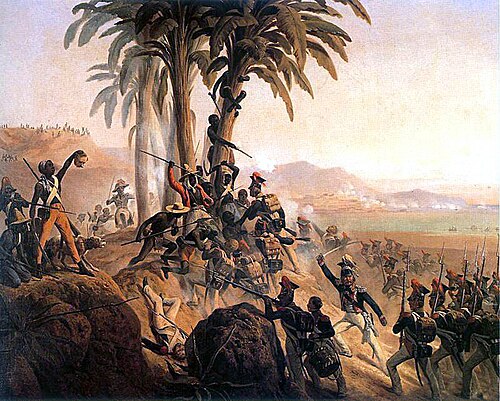
Start at the top for an easy introduction. Go further down for more detail and scholarship.
- Easy
- Intermediate
- Advanced
For young readers
About 230 years ago, on an island in the Caribbean Sea, there was a French colony called Saint-Domingue. It was one of the richest places in the world, because it grew huge amounts of sugar and coffee. But that wealth was made by around half a million people who had been kidnapped from Africa, or born to kidnapped parents, and forced to work as slaves.
Enslaved people were not paid. They were beaten, worked from dawn to dark, and many died young. In August 1791, after secret meetings, thousands of them in the north of the colony rose up at the same time. They burned the sugar plantations where they had been forced to work and fought for their freedom.
The war lasted more than twelve years. A formerly enslaved man named Toussaint Louverture became a brilliant general and leader. The people of Saint-Domingue fought against Spanish, British and French soldiers. In 1793 and 1794 France agreed to end slavery, but later the French ruler Napoleon Bonaparte sent a huge army to take back control.
The people of Saint-Domingue won. On 1 January 1804, their leader Jean-Jacques Dessalines declared independence and gave the country a new name, Haiti, from the name used by the island’s first inhabitants, the Taíno.
Haiti became the first country in the world founded by people who had freed themselves from slavery. The war was terrible, and many thousands of people died. But the Haitian Revolution showed the whole world that the idea of freedom belongs to everyone.
At a glance
- Dates
- August 1791 – 1 January 1804
- Place
- French colony of Saint-Domingue, the western part of the island of Hispaniola (today Haiti); fighting also spread to Spanish Santo Domingo
- Population in 1789
- About 450,000–500,000 enslaved people, about 40,000 whites and about 28,000 free people of colour (estimates)
- Main leaders
- Dutty Boukman, Georges Biassou, Jean-François, Toussaint Louverture, Jean-Jacques Dessalines, Henri Christophe, Alexandre Pétion, André Rigaud
- Opponents
- French colonial authorities and planters; Spanish and British forces (1793–98); Napoleon’s expedition under Leclerc and Rochambeau (1802–03)
- Result
- Abolition of slavery (1793–94) and independence of Haiti (1804), the first state in the Americas to abolish slavery permanently
- Human cost
- Estimates suggest well over 100,000 deaths among the people of the colony, and tens of thousands of European soldiers, many from yellow fever
Easy
What was the Haitian Revolution?
The Haitian Revolution was a long war and a social revolution that took place in Saint-Domingue, a French colony on the western third of the Caribbean island of Hispaniola. It began in August 1791 as a massive uprising of enslaved people and ended on 1 January 1804 with the declaration of the independent state of Haiti.
It was unique in world history. There had been many revolts of enslaved people before, in Africa, the Americas and elsewhere, but almost all of them had been crushed. In Saint-Domingue, enslaved people not only destroyed the slave system in their own land but also defeated the armies of Europe’s great powers and built a new state. Haiti was the second independent country in the Americas, after the United States, and the first in the world to be founded by formerly enslaved people.
The revolution was closely connected with the French Revolution, which had begun in 1789 with the promise that “men are born and remain free and equal in rights.” People in Saint-Domingue asked a simple and powerful question: did those rights apply to them as well?
Easy
Saint-Domingue: a rich colony built on slavery
By the 1780s, Saint-Domingue was the most profitable colony in the world. It produced a large share of the sugar and coffee consumed in Europe, as well as indigo and cotton. French ports such as Bordeaux and Nantes grew rich on this trade.
This wealth depended on slavery. Estimates suggest that in 1789 the colony had about 450,000 to 500,000 enslaved people, about 40,000 whites and about 28,000 free people of colour. Every year, tens of thousands of new captives were brought from West and West-Central Africa, because the conditions on the sugar plantations were so brutal that deaths outnumbered births. Many of the enslaved had been born in Africa and brought with them languages, military experience and religious practices.
Colonial society was divided by law and custom into rigid groups. Wealthy white planters, poorer whites, free people of colour (many of mixed African and European descent, some of whom owned plantations and slaves themselves) and the enslaved majority all had different interests. French law, the Code Noir of 1685, set rules for slavery but was often ignored, and punishments were cruel. Some enslaved people escaped to the mountains and formed communities of maroons, and resistance of many kinds had always been part of life in the colony.
Easy
The great uprising of 1791
When the French Revolution began, each group in Saint-Domingue tried to use it. White planters wanted more self-government. Free people of colour demanded equal rights; in 1790 a free man of colour, Vincent Ogé, led a small armed revolt to demand them and was captured and executed on the wheel in 1791. The enslaved heard news of the Revolution and of debates in Paris about rights and slavery.
On the night of 22 August 1791, enslaved people on plantations across the Northern Plain near the port of Cap-Français rose up together. Within weeks they had burned hundreds of sugar and coffee plantations and killed many planters, and tens of thousands of people had joined the rebellion. The planters and colonial troops responded with mass executions.
According to Haitian tradition, the uprising was planned at a ceremony in a place called Bois Caïman shortly before, led by a man named Dutty Boukman and a Vodou priestess, Cécile Fatiman. Boukman was killed in November 1791, but the revolt continued under leaders such as Jean-François and Georges Biassou. Among Biassou’s officers was a formerly enslaved coachman in his late forties who would become the revolution’s most famous leader: Toussaint Louverture.
Intermediate
War, empires and the abolition of slavery (1792–1794)
In April 1792 the French Legislative Assembly granted full citizenship to free people of colour and sent civil commissioners, including Léger-Félicité Sonthonax, to restore order. In 1793 France went to war with Britain and Spain. Spain, which ruled the eastern part of the island, recruited the insurgent armies as allies, and many of the rebel leaders, including Toussaint, fought for the Spanish king. British forces invaded the colony in September 1793, invited by planters who hoped Britain would preserve slavery.
Facing enemies on all sides and needing soldiers, Sonthonax proclaimed the freedom of all enslaved people in the north on 29 August 1793, and his fellow commissioner extended it to the rest of the colony. On 4 February 1794 (16 Pluviôse Year II), the National Convention in Paris abolished slavery throughout the French colonies, after a deputation from Saint-Domingue that included a formerly enslaved man, Jean-Baptiste Belley, took its seats. The decree was the result of pressure from the insurgents themselves, not simply a gift from Paris.
In May 1794, Toussaint switched sides and brought his troops over to the French Republic. His reasons are debated: historians point to the French abolition, the Spanish refusal to end slavery, and his own political ambitions. Over the next years he drove out the Spanish and wore down the British, whose army lost huge numbers of men, mostly to yellow fever and malaria, before withdrawing in 1798.
Intermediate
Toussaint Louverture’s rise and rule (1794–1802)
Toussaint was born around 1743 on the Bréda plantation in the north of the colony. He learned to read, worked as a coachman and livestock keeper, and had been freed by about 1776; as a free man he even leased land and, for a time, enslaved workers himself, a fact that shows how complicated colonial society was. He took the name Louverture (“the opening”) around 1793.
By 1797 he was the commander-in-chief of the colony’s army. In the War of the South (1799–1800) he defeated André Rigaud, a leader of the free people of colour in the southern peninsula; the war was fought with great brutality on both sides. In 1801 he took over Spanish Santo Domingo and issued a constitution that abolished slavery for ever, made him governor for life, and gave Saint-Domingue near-independence while still calling it a French colony.
To rebuild the economy, Toussaint kept the plantations running. Former slaves were now legally free and paid a share of the crop, but they were required to stay on the plantations and work under military discipline. Many of them resented this system, which to them felt too close to slavery, and there were revolts against it, including one led by his adopted nephew Moïse, whom Toussaint had executed in 1801. This tension between freedom and forced labour runs through the whole history of the revolution.
Intermediate
Napoleon’s expedition and the war of independence (1802–1803)
Napoleon Bonaparte, who had seized power in France in 1799, was determined to restore full French control over the colony. At the end of 1801 he sent a large expedition under his brother-in-law, General Charles Leclerc; eventually tens of thousands of soldiers were sent. Toussaint’s generals resisted fiercely, most famously at the fortress of Crête-à-Pierrot in March 1802, but several of them, including Henri Christophe and Jean-Jacques Dessalines, eventually came to terms with the French.
In June 1802 Toussaint was invited to a meeting, arrested and deported to France. As he boarded the ship he is reported to have said that in overthrowing him the French had cut down only the trunk of the tree of liberty, which would spring up again from its roots. He died in a cold cell in the Fort de Joux in the Jura mountains on 7 April 1803.
News that Napoleon had restored slavery in Guadeloupe and Martinique, and fear that the same would happen in Saint-Domingue, led the colony’s Black and mixed-race officers to rise again in late 1802 under Dessalines, now allied with Pétion. Yellow fever killed thousands of French soldiers, including Leclerc himself. His successor, Rochambeau, waged a war of terror, and both sides committed atrocities. On 18 November 1803 the revolutionary army defeated the French at the Battle of Vertières near Cap-Français, and the remaining French forces left the colony.
Intermediate
Independence and the first years of Haiti
On 1 January 1804, at Gonaïves, Dessalines proclaimed the independence of the country and renamed it Haiti (Ayiti), a Taíno name for the island, honouring its original inhabitants, who had been almost destroyed by Spanish colonisation. In the following months, on Dessalines’s orders, most of the remaining French white population was killed; estimates are usually in the range of several thousand. This massacre has been condemned, explained as revenge and fear of a French return, and used by Haiti’s enemies to justify isolating the country, and it remains a painful subject.
Dessalines made himself emperor in 1804. The constitution of 1805 banned slavery forever, forbade white men from owning property as masters, and declared that all Haitians would be known as “black” regardless of skin colour, a radical political statement of equality. Dessalines was assassinated in 1806, and the country split into a northern state (later kingdom) under Henri Christophe and a southern republic under Alexandre Pétion. It was reunited under Jean-Pierre Boyer in 1820.
Haiti gave shelter and help to other freedom fighters. Pétion supported Simón Bolívar’s campaigns for the independence of Spanish South America in 1815–16, reportedly on condition that Bolívar free enslaved people in the lands he liberated.
Intermediate
Isolation, the indemnity and the revolution’s global effects
The world’s slave-holding powers treated Haiti as a threat. France refused to recognise it, and the United States, where slavery was still legal, did not establish diplomatic relations until 1862. In 1825 King Charles X of France, with warships off Port-au-Prince, demanded 150 million francs as compensation to former colonists, including for the loss of enslaved people, in exchange for recognition. The sum was reduced to 90 million francs in 1838, but Haiti had to borrow from French banks to pay it, creating a “double debt”. The indemnity was paid off around 1883, and related loans were serviced until the mid-twentieth century. Many historians and economists see this burden as one of the long-term causes of Haiti’s poverty, and calls for restitution have continued into the twenty-first century.
The revolution also changed the Atlantic world. The loss of Saint-Domingue helped persuade Napoleon to sell the vast Louisiana territory to the United States in 1803. Many planters fled with enslaved people to Cuba, Jamaica and the United States, and Cuba expanded its own sugar industry. For enslaved people throughout the Americas, Haiti became a beacon of hope, and news of it inspired later revolts and conspiracies; for slaveholders it became a nightmare that justified harsher repression.
In Europe, the revolution influenced debates about slavery and universal rights. Some scholars, notably Susan Buck-Morss, have argued that news from Saint-Domingue helped shape Hegel’s famous dialectic of master and slave, although this connection remains debated.
Advanced
Sources and the problem of voices
Most surviving written sources were produced by colonial officials, planters, French officers and foreign observers, who often wrote in fear or hostility. The voices of the enslaved majority survive mostly indirectly: in interrogation records, proclamations and letters by revolutionary leaders (many dictated to secretaries), songs and oral tradition. Toussaint’s own correspondence and his memoir written at the Fort de Joux are important but were also carefully crafted political documents.
The Bois Caïman ceremony shows the problem clearly. The earliest detailed written description comes from a hostile white colonist, Antoine Dalmas, published in 1814; the Haitian writer Hérard Dumesle later recorded a version of Boukman’s words based on oral tradition. Historians such as David Geggus have examined the date and location of the meeting, and some scholars have questioned whether it happened in the form later remembered. For many Haitians it is a foundational event of national and religious history, and scholars generally agree that meetings to plan the revolt took place in August 1791, even if the details are uncertain.
Numbers are also uncertain. Population figures for 1789 come from colonial censuses that probably undercounted the enslaved. Estimates of deaths during the war vary widely, and the figures for European soldiers (French, British and Spanish) depend on incomplete military records. Such figures should be read as orders of magnitude rather than exact counts.
Advanced
Interpretations: from silence to a central event of the Age of Revolutions
For a long time the Haitian Revolution was marginal in European and North American histories of the “Age of Revolutions”, which focused on the United States and France. Haitian historians of the nineteenth century, such as Thomas Madiou and Beaubrun Ardouin, wrote detailed national histories, but their work was little read outside Haiti. The anthropologist Michel-Rolph Trouillot argued in Silencing the Past (1995) that the revolution was “unthinkable” to many contemporaries, because it contradicted their assumptions about race and slavery, and that this helped silence it in later historical writing.
C. L. R. James’s The Black Jacobins (1938) was a turning point. Written by a Trinidadian Marxist on the eve of decolonisation, it presented Toussaint as a tragic revolutionary hero and the revolution as a struggle of the masses shaped by the French Revolution. Later historians broadened the picture. Carolyn Fick’s The Making of Haiti (1990) emphasised the revolution “from below”, the role of ordinary enslaved people and maroons, and their resistance to forced plantation labour. David Geggus’s detailed studies clarified chronology, numbers and the role of Africans.
Laurent Dubois’s Avengers of the New World (2004) and related work stressed that the insurgents did not merely receive ideas of rights from France but themselves pushed the meaning of universal rights further than the French had intended; the abolition of 1794 is thus seen as a joint product of events in the colony and in Paris. Other scholars have highlighted the African backgrounds of many insurgents, including military experience from wars in the Kingdom of Kongo, and the role of Vodou. Debates continue over how to judge leaders such as Toussaint and Dessalines, over labour policy, and over the violence of 1804, and Haitian, French, American and Caribbean perspectives often differ.
Key ideas
- Self-emancipation
- Enslaved people freeing themselves through their own action rather than waiting for others to free them. The Haitian Revolution is the most important example in history.
- Universal rights
- The idea that rights such as liberty and equality belong to all human beings. Haitians insisted that the French Revolution’s promises must include them.
- Abolition of slavery
- Saint-Domingue’s insurgents forced France to abolish slavery in 1793–94; after Napoleon tried to reverse this, Haiti made abolition permanent.
- Anti-colonial independence
- Haiti broke away from a European empire and created a state governed by formerly enslaved and colonised people.
- Freedom and forced labour
- Leaders tried to keep plantation agriculture alive by forcing free workers to stay on estates, which many saw as a betrayal of freedom.
- Silencing of the past
- Trouillot’s idea that events which challenge dominant assumptions can be left out of the historical record and public memory.
- Independence debt
- The 1825 indemnity France demanded for recognition, often seen as a long-term cause of Haiti’s economic difficulties.
Records
- 1685 — France issues the Code Noir, regulating slavery in its colonies.
- 1697 — By the Treaty of Ryswick, Spain recognises French control of the western part of Hispaniola, which becomes Saint-Domingue.
- 1791 — February: Vincent Ogé is executed. August: meeting at Bois Caïman (traditionally 14 August) and uprising on the Northern Plain (night of 22 August).
- 1792 — 4 April: France grants citizenship to free people of colour; Sonthonax is sent to the colony.
- 1793 — 29 August: Sonthonax proclaims the freedom of the enslaved in the north. September: British invasion.
- 1794 — 4 February: the National Convention abolishes slavery in all French colonies. May: Toussaint joins the French Republic.
- 1798 — British forces withdraw from Saint-Domingue.
- 1801 — Toussaint takes over Spanish Santo Domingo and issues a constitution naming him governor for life.
- 1802 — Leclerc’s expedition arrives; battle of Crête-à-Pierrot; Toussaint is arrested and deported; slavery is restored in Guadeloupe.
- 1803 — 7 April: Toussaint dies at the Fort de Joux. 18 November: Battle of Vertières.
- 1804 — 1 January: Dessalines proclaims the independence of Haiti at Gonaïves.
- 1825 — France demands an indemnity of 150 million francs for recognising Haiti.
Glossary
- Saint-Domingue
- The French colony in the western part of Hispaniola, which became Haiti in 1804.
- Hispaniola
- The Caribbean island shared today by Haiti and the Dominican Republic.
- Free people of colour (gens de couleur libres)
- Free people of African or mixed descent in the colony, who faced legal discrimination before 1792.
- Maroons
- People who escaped slavery and lived in independent communities, often in mountains or forests.
- Code Noir
- The French royal decree of 1685 that regulated slavery in French colonies.
- Vodou
- A Haitian religion combining West and Central African traditions with elements of Catholicism.
- Civil commissioner
- An official sent from revolutionary France with wide powers to govern the colony, such as Sonthonax.
- Yellow fever
- A disease spread by mosquitoes that killed very large numbers of European soldiers in the Caribbean.
- Indemnity
- A payment demanded as compensation; here, the sum France forced Haiti to pay in 1825.
- Ayiti
- A Taíno name for the island, adopted as the name of the new country in 1804.
Questions and answers
Why is the Haitian Revolution so important?
It was the only uprising of enslaved people in history that ended slavery in its territory and created an independent country. It proved that freedom and equality belonged to everyone, not only to Europeans.
Who was Toussaint Louverture?
A formerly enslaved man who became the revolution’s greatest general and the leader of Saint-Domingue. He was captured by the French in 1802 and died in prison in France in 1803, shortly before Haiti became independent.
Why did so many European soldiers die?
The revolutionary armies fought hard, and they used the land and the seasons well. But diseases such as yellow fever, to which newly arrived Europeans had no resistance, killed even more soldiers than the fighting.
Did the French Revolution free the slaves of Saint-Domingue?
Only partly. French officials in the colony declared freedom in 1793 and the Convention abolished slavery in 1794, but they did so because the enslaved had already risen up and were needed as soldiers. Napoleon later tried to reverse abolition.
Did the Bois Caïman ceremony really happen?
Meetings to plan the revolt certainly took place in August 1791. The famous ceremony is known from later written accounts and oral tradition, and historians debate its details and exact date.
How did the 1825 indemnity affect Haiti?
Haiti had to pay France huge sums, and the loans used to pay them, for decades. Many historians and economists argue that this drained money that could have built schools, roads and institutions.
Why was the revolution ignored for so long in Western histories?
Scholars such as Michel-Rolph Trouillot argue that it challenged racist assumptions so deeply that it was hard for many writers to take seriously, so it was left out or treated as a side story of the French Revolution.
Sources and further reading
- Haitian Revolution. Wikipedia
- Toussaint Louverture. Wikipedia
- Bois Caïman. Wikipedia
- Haiti indemnity controversy. Wikipedia
- C. L. R. James, The Black Jacobins: Toussaint L’Ouverture and the San Domingo Revolution. Secker & Warburg, 1938
- Carolyn E. Fick, The Making of Haiti: The Saint Domingue Revolution from Below. University of Tennessee Press, 1990
- Michel-Rolph Trouillot, Silencing the Past: Power and the Production of History. Beacon Press, 1995
- David Patrick Geggus, Haitian Revolutionary Studies. Indiana University Press, 2002
- Laurent Dubois, Avengers of the New World: The Story of the Haitian Revolution. Belknap Press of Harvard University Press, 2004
- Susan Buck-Morss, Hegel, Haiti, and Universal History. University of Pittsburgh Press, 2009
Related
- Storming of the BastilleThe seizure of a Paris fortress and prison on 14 July 1789 became an early emblem of the French Revolution.
- United States Declaration of IndependenceDocument adopted by the Continental Congress on 4 July 1776 declaring the thirteen colonies independent of Britain.
- Columbus's First VoyageChristopher Columbus's 1492 Atlantic voyage for the Spanish Crown reached islands inhabited by Indigenous peoples.
- Georg Wilhelm Friedrich HegelGerman philosopher whose account of history, thought and social institutions profoundly influenced later philosophy.
- Jean-Jacques RousseauGeneva-born writer whose arguments about inequality, political authority and education influenced European thought.
Written with AI assistance from the published sources listed above, and revised as new research appears.