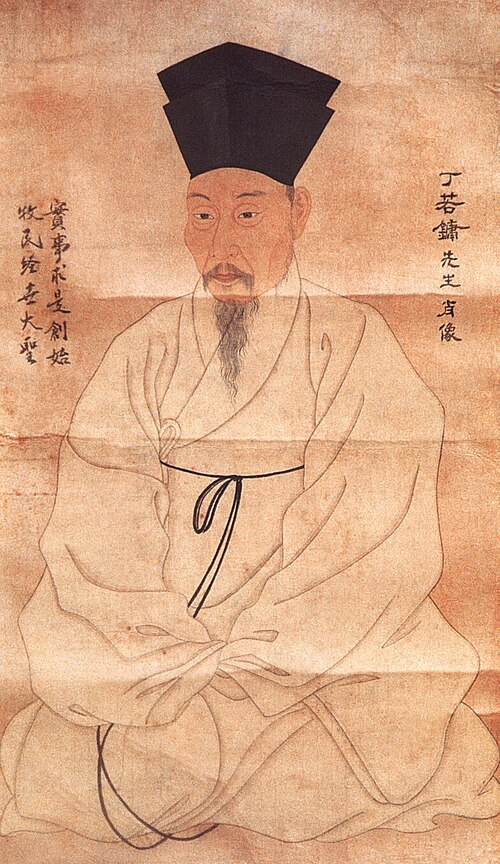
Start at the top for an easy introduction. Go further down for more detail and scholarship.
- Easy
- Intermediate
- Advanced
For young readers
Jeong Yak-yong was born in 1762 in a village by the Han River, near today’s Seoul in Korea. From a young age he loved books and was very clever. Many people know him by his pen name, Dasan, which means “tea mountain”.
When he grew up he passed the hardest government exam and worked for King Jeongjo, a king who liked new ideas. The king asked him to help plan a new fortress wall for the city of Suwon. Dasan designed a lifting machine, a kind of crane with pulleys, so that workers could lift heavy stones more easily.
Then his luck changed. After the king died in 1800, the new government punished people linked to Catholicism, a religion that had recently come to Korea and was forbidden. Some of Dasan’s family and friends were Catholics. One of his brothers was executed, and Dasan was sent far away to live as an exile.
He lived in exile for eighteen years, mostly in Gangjin, a place in the far south-west of Korea. Instead of giving up, he read, taught students and wrote, and wrote, and wrote. He wrote books about how a good official should look after people, how courts should judge fairly, and how the whole country could be better organised.
His most famous book, Mongmin simseo, tells local officials to be honest, to care for the poor and to never take bribes. Today Koreans remember Dasan as one of the wisest thinkers in their history, and many public servants still read his book.
At a glance
- Born
- 1762 (16th day of the 6th lunar month), Majae village, Gwangju county, Gyeonggi province (now Joan-myeon, Namyangju)
- Died
- 1836 (22nd day of the 2nd lunar month), at his home in Majae
- Names
- Pen names Dasan (茶山), Sam (俟菴) and others; his house and collected works are called Yeoyudang (與猶堂)
- Dynasty
- Joseon, reigns of Jeongjo (1776–1800) and Sunjo (1800–1834)
- Career
- Passed the civil service examination in 1789; served King Jeongjo in the royal library (Gyujanggak) and various offices; helped plan Hwaseong Fortress in Suwon
- Exile
- 1801–1818: briefly at Janggi, then at Gangjin in South Jeolla province, including about eleven years at the thatched house known as Dasan Chodang
- Major works
- Gyeongse yupyo (1817), Mongmin simseo (1818), Heumheum sinseo (1819/1822), and extensive commentaries on the Confucian classics; about 500 volumes in total
- Recognition
- Chosen by UNESCO as one of the anniversaries it commemorated in 2012, the 250th year since his birth
Easy
Who was Jeong Yak-yong?
Jeong Yak-yong, often called by his pen name Dasan, lived during the late Joseon dynasty, which ruled Korea from 1392 to 1897. He is widely regarded as the greatest figure of Silhak, the name later given to a group of Korean scholars who argued that Confucian learning should deal with practical problems: land, taxes, law, technology and the welfare of the people.
He was a brilliant official and engineer in his youth, a victim of political and religious persecution in his middle years, and an astonishingly productive writer in exile. His works range from commentaries on the Confucian classics to studies of geography, medicine, language, music and poetry. Modern scholars estimate their total at about 500 volumes (gwon).
Dasan wrote in Classical Chinese, the language of scholarship throughout East Asia at the time. His best-known book in Korea today is Mongmin simseo, a guide for local magistrates that is still read as a model of public ethics.
Easy
Family and youth
Jeong was born in 1762 in Majae, a village on the Han River east of Seoul. His family, the Jeong clan of Naju, belonged to the Namin (Southerners), a political faction that had been largely excluded from power for much of the eighteenth century. His father, Jeong Jae-won, served as a local official. His mother came from the Haenam Yun family, descendants of the poet Yun Seon-do and the painter Yun Du-seo.
He had three older brothers, Jeong Yak-hyeon, Jeong Yak-jeon and Jeong Yak-jong. Through his family and friends he met the ideas of Yi Ik (1681–1763), whose writings on practical reform inspired many Namin scholars, and, in 1784, Catholic books from China introduced to him by Yi Byeok, his eldest brother’s brother-in-law. Western learning (Seohak), which included both Christian teachings and European science, fascinated many young scholars in these years.
He married in 1776, passed the lower civil service examination (jinsa) in 1783, and passed the higher examination (mungwa) in 1789. King Jeongjo, who was trying to strengthen royal power and to bring talented men from outside the dominant faction into government, took a strong interest in him.
Easy
Serving King Jeongjo: Hwaseong and the crane
King Jeongjo (reigned 1776–1800) is remembered as one of the most learned and reform-minded kings of Joseon. He created the Gyujanggak, a royal library and research institute, and gathered young scholars around him. Jeong was one of his favourites.
When Jeongjo decided to build a new fortified city at Suwon, near the tomb of his father, Crown Prince Sado, he asked Jeong to help draw up plans. Jeong studied Chinese and Western works on fortification and machines, including an illustrated Chinese book on Western mechanical devices from the royal library. He designed a crane (geojunggi) using pulleys and other lifting devices, which helped the workers move heavy stones. Hwaseong Fortress was built between 1794 and 1796 and was inscribed as a UNESCO World Heritage Site in 1997.
He also served as a secret royal inspector (amhaeng eosa) in 1794, travelling in disguise to check on local officials, and as magistrate of Goksan in Hwanghae province from 1797. These experiences showed him how ordinary farmers suffered from corrupt clerks and unfair taxes, and they later shaped his writings on local government.
Intermediate
Catholicism, faction and the persecution of 1801
Jeong’s connection with Catholicism was both a source of ideas and the cause of his downfall. In the 1780s he read Catholic writings and took part in the early Catholic community. When Catholicism was banned and its followers attacked by opponents of the Namin, he was repeatedly accused. In 1797 he submitted a memorial to the king explaining that he had once been attracted to the new teaching but had abandoned it. Whether he ever returned to the faith later in life is disputed: some Catholic accounts written in the nineteenth century say that he did, while many historians regard this as unproven.
When Jeongjo died suddenly in 1800, the young King Sunjo came to the throne under the regency of Queen Dowager Jeongsun, who was allied with factions hostile to the Namin. In 1801 the government launched a major persecution of Catholics, the Sinyu Persecution. Hundreds were killed, including Jeong’s brother Jeong Yak-jong and the first baptised Korean Catholic, Yi Seung-hun, who was Jeong’s brother-in-law. The persecution also served to remove political rivals.
Jeong and his brother Yak-jeon were exiled, Jeong first to Janggi on the east coast. Later that year, a Catholic named Hwang Sa-yeong, the husband of Jeong’s niece, was arrested with a letter written on silk asking the bishop in Beijing to seek Western military help for the Church. The scandal led to new interrogations. Jeong was sent to Gangjin, in the far south-west, and Yak-jeon to the island of Heuksando.
Intermediate
Eighteen years in Gangjin
At first Jeong lived in a small room behind a tavern in the town of Gangjin, which he named Sauijae, “the room of four proprieties”: clear thought, a solemn appearance, few words and careful action. He later stayed at a Buddhist hermitage and at a student’s house, and in 1808 he moved to a thatched cottage on a hill overlooking Gangjin Bay, in a place called Dasan, “tea mountain”, from which his best-known pen name comes. He lived there until his release in 1818.
At Dasan Chodang (the thatched cottage of Dasan) he built a library, laid out a small garden with a pond, carved the character jeong (丁) on a rock, and drew water from a spring. He taught local young men and organised them in research and copying, which helps explain how he produced so much. He formed friendships with Buddhist monks, including Hyejang and the tea master Choui, and exchanged letters with his brother Yak-jeon, who wrote a pioneering study of fish and sea life, Jasan eobo, on Heuksando before dying there in 1816.
His letters to his sons from exile, urging them to study, keep the family’s dignity and never give up despite the family’s ruin, are among the most moving writings of the period. The present building at Dasan Chodang is a reconstruction with a tiled roof, built in 1958; the site was designated a Historic Site of Korea in 1963.
Intermediate
The “one pyo and two seo”: plans for a better state
Jeong’s three most famous works on statecraft are known together as “il-pyo i-seo”, one memorial (pyo) and two books (seo). Gyeongse yupyo (roughly “A Bequeathed Memorial on Ordering the World”, 1817) is a plan for reorganising the whole central government, the land system, taxation and the military, inspired by the ancient Chinese classic the Rites of Zhou. It was left unfinished, and he called it a “bequeathed memorial” because he could not present it to the king.
Mongmin simseo (Admonitions on Governing the People, 1818), in 48 volumes, is a practical handbook for county magistrates. Its twelve parts, each divided into six articles, follow the magistrate from taking up his post, through disciplining himself, serving the state, caring for the people, and managing personnel, revenue, rites, military affairs, justice and public works, to relief of famine and leaving office. It is full of concrete cases, showing how clerks cheated farmers and how an honest official could stop them.
Heumheum sinseo (roughly “A New Book on Careful Judgment”, completed around 1819 and prefaced in 1822) deals with homicide cases. Its title comes from a phrase meaning to be careful and reverent when judging. It collects Chinese and Korean cases, discusses forensic examination and warns magistrates against careless or cruel judgments. Together these works show Jeong’s belief that reform had to reach from the court to the village.
Intermediate
Poet, physician and geographer
Jeong also left some 2,500 poems, many of them written in exile. Several describe the lives of farmers and fishermen with bitter realism. The best known, Aejeoryang (“Lament for a Severed Manhood”, 1803), tells of a poor man in Gangjin who mutilated himself in despair after officials demanded military tax for his newborn son and his dead father, a practice that was illegal but common. Jeong declared that a poem which does not grieve for the times and resent corruption is not a true poem.
His curiosity extended to medicine, geography and language. Magwa hoetong (1798) gathered Chinese and Korean knowledge on measles and related diseases, a subject that touched him personally because several of his children died young. Abang gangyeokgo (1811) examined the historical geography of ancient Korean states, and Aeon gakbi (1819) corrected common errors in the use of words and characters. He also studied music, rites and the organisation of the military.
This range was not scattered curiosity. For Jeong, all these fields served one goal: understanding the world accurately so that government could relieve real suffering. His scholarship moved constantly between ancient texts and the concrete details of everyday life.
Intermediate
Key ideas: land, the ruler and human nature
Jeong was deeply concerned with land. In an essay on land (Jeollon, written in 1799) he proposed the yeojeon system, in which villages of about thirty households would farm land together and divide the harvest according to the labour each family contributed, so that only those who worked the land would receive its fruits. Later, in Gyeongse yupyo, he developed a more gradual reform based on the ancient well-field (jeongjeon) system.
In short essays such as Wonmok (On the Origin of Rulers) and Tangnon (On King Tang), he argued that rulers originally arose from the people, who chose leaders to settle disputes, and that a ruler who failed the people could legitimately be replaced. The essays have often been compared with European ideas of popular sovereignty, although Jeong wrote within a Confucian framework and did not call for abolishing the monarchy.
On human nature, he rejected the Neo-Confucian view, associated with Zhu Xi, that human nature is identical with a cosmic principle (li). He argued instead that human nature is a set of inclinations or preferences (the theory known as seonggiho-seol): people naturally take pleasure in goodness and are ashamed of evil, but they have the freedom to choose, and virtue is achieved only by practice. He also emphasised a personal, watchful Sangje (Lord on High) before whom a person should be careful in thought and action.
Easy
Return home and last years
In 1818 Jeong was released and returned to Majae. He never held office again. He continued revising his works, wrote a self-composed epitaph summarising his life and writings in 1822, and met with scholars who came to visit him. He called his home Yeoyudang, from a passage in the Daodejing describing caution, as if crossing a frozen stream in winter and as if fearing one’s neighbours.
He died in 1836, on the sixtieth anniversary of his wedding, and was buried on the hill behind his house in Majae. His works circulated in manuscript during his lifetime and after, but most were not printed until the twentieth century.
Today his house, tomb and a museum stand at the Dasan historic site in Namyangju, and Dasan Chodang in Gangjin is visited by many people each year. In Korea his name is used for schools, streets and awards, and Mongmin simseo is often recommended to public officials.
Advanced
Classical scholarship and the critique of Neo-Confucianism
Although he is best known today for his statecraft, the largest part of Jeong’s writings consists of commentaries on the Confucian classics: the Analects, Mencius, the Doctrine of the Mean, the Great Learning, the Book of Documents, the Book of Changes, the Book of Poetry and the ritual texts. He compared the interpretations of Han, Song, Ming and Qing scholars as well as Japanese Confucians such as Itō Jinsai and Ogyū Sorai, whose writings had reached Korea from Japan, and tried to recover what he saw as the original meaning of the ancient sages.
In doing so he broke with the Zhu Xi orthodoxy that dominated Joseon learning. He criticised the metaphysical reading of li and qi and insisted that virtues such as benevolence (ren) are not innate substances but names for relationships achieved through action. He also joined the Qing-era debate on the authenticity of the “old text” chapters of the Book of Documents, arguing, like Chinese evidential scholars, that they were later forgeries.
Scholars disagree about the sources of these ideas. Some stress the influence of Catholic works such as Matteo Ricci’s The True Meaning of the Lord of Heaven, especially on Jeong’s concept of Sangje and of free moral choice. Others emphasise continuity with earlier Confucian thought, the Namin tradition of Yi Ik and the wider East Asian movement of evidential learning. Mark Setton’s study Chong Yagyong: Korea’s Challenge to Orthodox Neo-Confucianism (1997) is a standard English-language treatment of this debate.
Advanced
Sources, editions and the modern image of Dasan
Our knowledge of Jeong’s life comes mainly from his own writings: his self-composed epitaphs, letters, poems and prefaces, together with official records such as the Veritable Records of the Joseon Dynasty and the records of the persecution of 1801. His self-portrait is a valuable but interested source, written by a man concerned with his reputation and with clearing his family’s name.
Because most of his works remained in manuscript, their publication was a modern event. Mongmin simseo was printed in 1901. The collected works, Yeoyudang jeonseo, were edited by his descendant Kim Seong-jin with the participation of Jeong In-bo and An Jae-hong, and published in 154 volumes in 76 books by Sinjoseonsa between 1934 and 1938. This coincided with the centenary of his death in 1936 and with the “Korean studies movement” (Joseonhak undong) under Japanese colonial rule, when scholars searched Korea’s past for sources of self-reliant modern thought. Modern critical editions continue to correct the texts and identify works written by his students.
The category of Silhak itself was largely constructed in the twentieth century. Historians in both South and North Korea long presented Jeong as a proto-modern thinker whose ideas showed that Korea was developing toward modernity on its own, a view connected with the theory of “internal development” that countered colonial claims of Korean stagnation. More recent scholars have questioned this framework, stressing that Jeong was a Confucian reformer working within the monarchy and that Silhak was not a unified school. Debates also continue over his relationship to Catholicism and to Western science. These discussions do not diminish his achievement but place it more firmly in its own time.
Key ideas
- Silhak (practical learning)
- A modern label for late Joseon scholars who turned Confucian learning toward practical reform of land, taxes, law and technology. Jeong is considered its greatest representative.
- Mongmin (shepherding the people)
- The ideal that officials exist to care for the people, as a shepherd cares for a flock; the title of his handbook for magistrates.
- Yeojeon system
- His proposal that villages farm land collectively and share the harvest according to work done, so that those who till the land receive its fruits.
- Rulers from the people
- The argument in Wonmok and Tangnon that rulers originally arose from the people’s choice and can be replaced if they fail.
- Human nature as inclination
- His theory that human nature is a preference for good and shame at evil, with virtue realised only through freely chosen action.
- Sangje
- The personal Lord on High of the ancient classics, whom Jeong saw as watching over human conduct and motivating moral care.
- Evidential scholarship
- The careful philological study of ancient texts to recover their original meaning, which Jeong used against later Neo-Confucian interpretations.
Records
- 1762 — Born in Majae, Gwangju county, Gyeonggi province.
- 1784 — Learns about Catholicism from Yi Byeok.
- 1789 — Passes the higher civil service examination and enters the service of King Jeongjo.
- 1792 — Helps plan Hwaseong Fortress and designs the geojunggi crane; construction runs from 1794 to 1796.
- 1797 — Submits a memorial renouncing Catholicism; appointed magistrate of Goksan.
- 1800 — King Jeongjo dies.
- 1801 — Sinyu Persecution: his brother Yak-jong is executed; Jeong is exiled to Janggi and then Gangjin.
- 1808 — Moves to Dasan Chodang, where he lives until 1818.
- 1817 — Writes Gyeongse yupyo.
- 1818 — Completes Mongmin simseo; released from exile and returns home.
- 1836 — Dies at Majae on his sixtieth wedding anniversary.
- 1934 — Publication of his collected works, Yeoyudang jeonseo, begins (completed 1938).
Glossary
- Joseon
- The Korean dynasty that ruled from 1392 to 1897, with Neo-Confucianism as its official ideology.
- Namin (Southerners)
- A political faction of Joseon officials, to which Jeong’s family belonged; many early Korean Catholics came from its circles.
- Gyujanggak
- The royal library and research institute founded by King Jeongjo in 1776.
- Hwaseong
- The fortress wall of Suwon, built 1794–96 under Jeongjo; a UNESCO World Heritage Site since 1997.
- Geojunggi
- A crane with pulleys designed by Jeong for lifting stones during the construction of Hwaseong.
- Sinyu Persecution
- The persecution of Catholics in 1801 (the sinyu year), which also removed political opponents of the ruling factions.
- Silk letter of Hwang Sa-yeong
- A secret letter written on silk in 1801 asking Western help for Korean Catholics; its discovery worsened the persecution.
- Dasan Chodang
- The thatched cottage in Gangjin where Jeong lived and wrote from 1808 to 1818.
- Magistrate (suryeong)
- The official appointed by the king to govern a county, the main subject of Mongmin simseo.
- Yeoyudang jeonseo
- The complete works of Jeong, published in 1934–38.
Questions and answers
Why is he called Dasan?
Dasan means “tea mountain”. It was the name of the hill in Gangjin where he lived in exile, and he took it as his pen name.
Did he really invent a crane?
He designed a lifting machine with pulleys, the geojunggi, based on Chinese and Western books about machines. It helped workers lift heavy stones when building Hwaseong Fortress.
Why was he sent into exile?
Because he and his family were connected with Catholicism, which was banned, and because his political opponents took power after King Jeongjo died. His exile lasted eighteen years.
What does Mongmin simseo teach?
It teaches local officials to govern honestly and carefully: to control themselves, to stop corrupt clerks, to tax fairly, to judge cases justly, and to take care of the poor, the sick and the hungry.
Was Jeong Yak-yong a Catholic?
He was involved with the early Catholic community in his youth but formally renounced it in 1797. Whether he returned to it later is debated and cannot be confirmed from reliable sources.
Was he a “modern” thinker?
His ideas about rulers, land and human nature have often been compared to modern thought, but many scholars now stress that he was a Confucian reformer of his own time, and that calling him proto-modern reflects twentieth-century concerns.
How did Western learning influence him?
He studied Chinese translations of Western works on mechanics, astronomy and religion. Scholars debate how deeply they shaped his philosophy compared with the Confucian classics and East Asian evidential scholarship.
Sources and further reading
- 조광 (Cho Kwang), 정약용 (丁若鏞). Encyclopedia of Korean Culture, Academy of Korean Studies
- 목민심서 (牧民心書). Encyclopedia of Korean Culture, Academy of Korean Studies
- 강진 정약용 유적 (Historic Sites of Jeong Yak-yong in Gangjin). Encyclopedia of Korean Culture, Academy of Korean Studies
- Jeong Yak-yong. Wikipedia
- 정약용. 위키백과
- Catholic Persecution of 1801. Wikipedia
- Hwaseong Fortress. Wikipedia
- Silhak. Wikipedia
- Mark Setton, Chong Yagyong: Korea’s Challenge to Orthodox Neo-Confucianism. State University of New York Press, 1997
- Chŏng Yag-yong, translated by Choi Byonghyon, Admonitions on Governing the People: Manual for All Administrators. University of California Press, 2010
Related
- Zhu XiSong philosopher who gave enduring form to Neo-Confucian learning.
- MenciusA Confucian thinker who argued that people have the beginnings of moral goodness and that rulers must care for their subjects.
- ConfuciusTeacher from the state of Lu whose sayings, gathered in the Analects, shaped ethics and government across East Asia.
- Wang YangmingMing philosopher and official who taught that moral knowledge must be realized in action.
Written with AI assistance from the published sources listed above, and revised as new research appears.