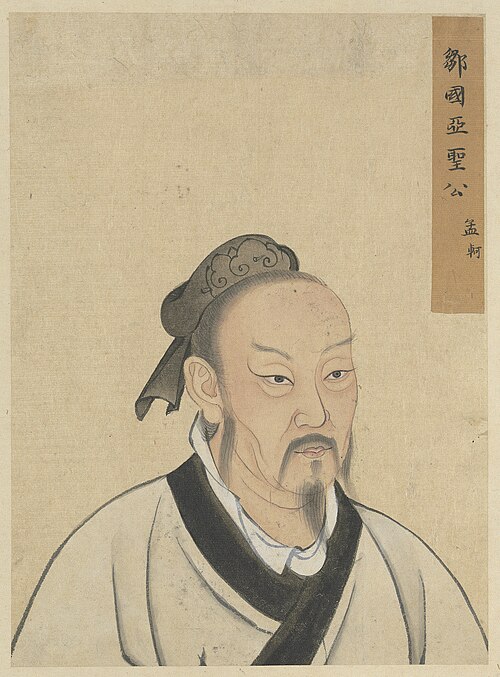
Start at the top for an easy introduction. Go further down for more detail and scholarship.
- Easy
- Intermediate
- Advanced
For young readers
Long ago in China, when many kingdoms were fighting one another, a boy named Meng Ke grew up in a small state called Zou. We know him today as Mencius, which means “Master Meng”. His father died when he was very young, and his mother raised him alone.
There is a famous old story about his mother. First they lived near a graveyard, and little Mencius played at holding funerals. So she moved next to a market, and he played at buying and selling. Then she moved next to a school, and he began to copy the students, bowing politely and reading. “This is the right place,” she said. People still tell this story to show how much our surroundings shape us.
When Mencius grew up, he became a teacher who followed the ideas of Confucius. He travelled from kingdom to kingdom with his students, telling kings: “Stop thinking only about profit and war! Be kind and fair, feed your people, and they will love you.” Most kings did not listen, but he never gave up.
Mencius believed that everyone is born good inside. He said: imagine you suddenly see a small child about to fall into a well. You would feel a jolt of alarm and want to help, not to get a reward, just because you care. That feeling is like a tiny sprout. If you water it and look after it, it grows into real kindness.
He also said something very brave for his time: the people are more important than the king. If a king is cruel and hurts his people, he is no longer a true king. His words were collected in a book called the Mencius, which children in China, Korea, Japan and Vietnam memorized for hundreds of years.
At a glance
- Lived
- Traditionally c. 372–289 BCE (dates uncertain; 4th century BCE)
- Born
- State of Zou, near Lu (modern Zoucheng, Shandong, China)
- Period
- Warring States period of the Eastern Zhou dynasty
- School
- Confucian (Ru); associated with the lineage of Confucius’s grandson Zisi
- Book
- The Mencius (Mengzi): 7 books, each in two parts, about 35,000 characters, recording conversations and sayings
- Key teachings
- Human nature is good; the “four sprouts” of virtue; humane government (renzheng); the people matter most
- Title
- “Second Sage” (亞聖, yasheng), after Confucius
- Canon
- One of the Four Books of Neo-Confucianism, basis of civil-service examinations in China from 1313 and central in Joseon Korea
Easy
Who was Mencius?
Mencius is the Latinized name, coined by European missionaries, of Meng Ke, a Chinese philosopher of the fourth century BCE. He is the most important Confucian thinker after Confucius himself, and in East Asian tradition he is called the “Second Sage”. The book that bears his name, the Mencius (Mengzi), records his conversations with kings, students and rivals.
Mencius is best known for two ideas. First, human nature is good: all people are born with the beginnings, or “sprouts”, of compassion, a sense of shame, respect for others and a sense of right and wrong. Second, government exists for the people: a ruler who cares for his people will win the whole world, while a tyrant forfeits his right to rule.
These ideas made him both admired and uncomfortable for rulers. For more than two thousand years his book was read, memorized and argued over across China, Korea, Japan and Vietnam, and it remains one of the classic texts of world philosophy.
Easy
His life
Mencius was born in Zou, a small state next to Lu, the home state of Confucius, in what is now Shandong province. The traditional dates 372–289 BCE are late reconstructions; all we can say with confidence is that he was active in the second half of the fourth century BCE. According to the historian Sima Qian, writing about two centuries later, he studied with disciples of Zisi, the grandson of Confucius.
Stories about his childhood focus on his mother, who became a model of wise parenting in East Asia. Besides the tale of her three moves, it is said that when young Mencius came home early from his studies, she cut through the cloth on her loom to show him that abandoning learning halfway ruins everything. These stories appear in Han-dynasty collections such as the Biographies of Exemplary Women by Liu Xiang, written long after Mencius’s time, and are best read as moral legends.
As an adult Mencius travelled with a group of disciples among the courts of the Warring States. The Mencius records his meetings with King Hui of Liang (the state of Wei), King Xuan of Qi, Duke Wen of the small state of Teng and others. He held an honoured position at the court of Qi for some years, but left when the king would not follow his advice. The exact order and dates of his travels are disputed.
Disappointed with the rulers of his time, he spent his last years teaching. Sima Qian says that he withdrew and, together with disciples such as Wan Zhang, composed the book in seven parts. His grave and a large temple dedicated to him still stand in Zoucheng.
Intermediate
Historical context: the Warring States and the Hundred Schools
Mencius lived in the Warring States period (c. 475–221 BCE), when the Zhou king had lost real power and seven large states fought for supremacy. Rulers built huge infantry armies, reformed their governments to raise taxes and soldiers, and competed to attract clever advisers. Warfare and famine caused immense suffering to ordinary people, a reality that Mencius describes vividly when he rebukes kings whose dogs eat the people’s food while the starving die in the roads.
This competition created a lively market of ideas later called the “Hundred Schools of Thought”. The state of Qi supported scholars at the Jixia gate of its capital. Whether Mencius was formally one of the Jixia scholars is uncertain, but he debated with the same range of rivals: followers of Mozi, who preached impartial care for all and criticized Confucian ritual; followers of Yang Zhu, who taught that one should protect one’s own life and not sacrifice even a hair for the world; the “Agriculturalists”, who wanted rulers to plough alongside the people; and strategists who taught alliances and war.
Mencius presented himself as defending the way of Confucius against these rivals. He famously accused the Yangists of having “no ruler” and the Mohists of having “no father”, meaning that the first neglected duty to society and the second ignored the special love owed to one’s own family.
Intermediate
The book: seven books of conversations
The Mencius consists of seven books, each divided into two parts, giving fourteen sections in all. The books are named after a person or phrase that appears at the start: King Hui of Liang, Gongsun Chou, Duke Wen of Teng, Li Lou, Wan Zhang, Gaozi and “Exhausting the Heart” (Jinxin). Modern scholars cite passages by book, part and number, so that “2A6” means Book 2, Part A, passage 6.
Unlike the Analects of Confucius, which consists mostly of short sayings, the Mencius contains extended dialogues and arguments. Mencius argues by analogy, story and question, and he is often witty. A farmer from Song, worried that his crops were growing too slowly, pulled on each shoot to help it along, and the next day all the plants had withered; so too, Mencius warns, moral growth cannot be forced.
The book opens with a scene that sets its tone. King Hui asks Mencius how he can profit his state. Mencius replies: “Why must Your Majesty speak of profit? There is only benevolence and righteousness.” If everyone from the king down asks only what profits themselves, he argues, the state will tear itself apart.
Intermediate
Human nature and the four sprouts
Mencius’s central claim is that human nature (xing) is good. His most famous argument is the thought experiment of the child at the well (2A6). Anyone who suddenly sees a small child about to fall into a well will feel alarm and compassion, not because they want to win favour with the parents, gain a reputation or dislike the child’s cries, but spontaneously. This shows, he says, that “all people have hearts that cannot bear the suffering of others”.
From this he develops the doctrine of the four sprouts (siduan). The heart of compassion is the sprout of benevolence (ren); the heart of shame and disdain is the sprout of righteousness (yi); the heart of deference is the sprout of propriety (li); and the heart that approves and disapproves is the sprout of wisdom (zhi). Everyone has these four, as they have four limbs. Moral cultivation means recognizing, protecting and “extending” them until they fill one’s whole life.
Mencius explains evil not as proof that nature is bad but as the result of neglect and damage. In the parable of Ox Mountain (6A8), a hillside that was once covered with fine trees has been stripped bare by axes and grazing cattle; people who see it assume it never had trees. In the same way, a person whose good heart is cut down day after day may look as if they never had one. In debate with the thinker Gaozi, who held that human nature is neither good nor bad, Mencius argues that human nature tends toward goodness as water tends to flow downhill.
He also speaks of cultivating a “flood-like qi” (haoran zhi qi), a vital energy that grows when one consistently does what is right, and of the unity between knowing one’s own heart, knowing one’s nature and knowing Heaven. These passages later became central to Neo-Confucian and Korean debates about the mind.
Intermediate
Humane government and the people
Mencius applies his view of human nature to politics. A king has the same compassionate heart as anyone else; he need only extend it to his people. When King Xuan of Qi spared an ox being led to sacrifice because he could not bear its frightened look, Mencius told him that this proved he could be a true king, if only he would show the same compassion to his subjects.
Humane government (renzheng) means light taxes, mild punishments, not taking farmers away from their fields in the busy seasons, and making sure people have enough to eat before trying to teach them morality. Mencius describes an ideal land system, the well-field (jingtian) system, in which eight families farm their own plots around a central public field. Historians debate whether such a system ever existed.
His most radical statement is: “The people are most important, the altars of the land and grain come next, and the ruler counts for least” (7B14). Asked whether it was right for King Wu of Zhou to kill the last Shang king, Zhou, Mencius answered that a ruler who destroys benevolence and righteousness is a mere “outcast”: “I have heard of the punishment of the outcast Zhou, but not of the murder of a ruler” (1B8). Heaven’s mandate, he argues, is revealed through whether the people accept a ruler.
Mencius was not a democrat in the modern sense: he believed in hereditary monarchy, in a clear division between those who work with their minds and those who work with their hands, and in hierarchical family relationships. But his insistence that legitimacy depends on the welfare and acceptance of the people gave later critics of tyranny a powerful classical authority.
Intermediate
From one voice among many to the “Second Sage”
For more than a thousand years after his death, Mencius was one Confucian authority among several. The great Confucian thinker Xunzi, a generation later, attacked his view of human nature, arguing instead that human nature is bad and that goodness comes from deliberate effort, ritual and teachers. In the second century CE the scholar Zhao Qi wrote the earliest surviving commentary on the Mencius and removed four “outer” chapters that he considered spurious; the text we have today is Zhao Qi’s seven books.
Mencius’s status rose sharply from the late Tang dynasty. The writer Han Yu (768–824) argued that the true Way of the sages had passed from Confucius to Mencius and then been lost. In the Song dynasty the book was added to the examination curriculum, and the Neo-Confucian philosopher Zhu Xi (1130–1200) grouped it with the Analects, the Great Learning and the Doctrine of the Mean as the Four Books, with his own commentary. From 1313, under the Yuan dynasty, the Four Books with Zhu Xi’s commentaries became the basis of the imperial civil-service examinations, and in 1330 Mencius was officially honoured with the title “Second Sage”.
His political ideas were not always welcome. The founding emperor of the Ming dynasty, angered by passages that limited a ruler’s authority, ordered an abridged edition, the Mengzi jiewen (1394), which removed dozens of passages; the full text was later restored.
In Korea, the Mencius was a core text of Joseon (1392–1897) education and examinations. The famous Four–Seven Debate (sachil nonjaeng), begun in 1559 between Yi Hwang (Toegye) and Gi Dae-seung (Gobong), asked how Mencius’s “four sprouts” relate to the “seven emotions” of the Book of Rites, and shaped Korean Neo-Confucianism for centuries. The scholar Jeong Yak-yong (Dasan) wrote an important commentary on the Mencius, the Maengja yoeui, offering a new reading of human nature as a tendency or preference rather than a fixed principle. In Japan, the idea that an unjust ruler could be removed sat uneasily with the ideology of an unbroken imperial line; an Edo-period tale in Ueda Akinari’s Tales of Moonlight and Rain repeats a legend that ships carrying the Mencius to Japan would sink.
Advanced
Scholarly debates and open questions
What does “nature” mean? A central debate concerns the meaning of xing. A. C. Graham argued in an influential essay (1967) that for Mencius xing refers to the proper course of development of a living thing, not a fixed essence present at birth; Roger Ames later pressed a more strongly processual reading. Others, including Irene Bloom, argued that Mencius does hold a notion of a shared, innate human nature. The question matters for comparative philosophy, because it affects whether Mencius’s ethics resembles Aristotelian virtue ethics.
Mencius as a virtue ethicist. Scholars such as Bryan W. Van Norden, Philip J. Ivanhoe and Lee H. Yearley have compared Mencius with Aristotle and Thomas Aquinas, treating him as a virtue ethicist who explains how good character develops. Kwong-loi Shun’s Mencius and Early Chinese Thought (1997) offered a detailed philological study of key terms such as xin (heart-mind), xing and yi. David S. Nivison drew attention to the problem of moral “extension”: how does compassion felt for one ox become compassion for a whole population?
Did Mencius really defend a “right of revolution”? Some readers see in 1B8 and 7B14 an early theory of popular sovereignty; others emphasize that Mencius located legitimacy in Heaven’s mandate, which works through the people but does not make them sovereign, and that only a ruler’s kin or a virtuous minister could legitimately act. How far these ideas can support modern democratic or human-rights thought in East Asia is still debated.
The Zisi–Mencius lineage. Xunzi criticized Zisi and Mencius together for inventing a doctrine of “five conducts” (wuxing). For a long time this lineage was known only from such hostile references. The discovery of a text called Wuxing in the Mawangdui tombs (excavated 1973) and in the Guodian tomb (excavated 1993, dated to around 300 BCE) revived discussion of the “Si–Meng” school and of what early Confucian texts on the heart and nature Mencius may have known.
Advanced
Evidence: how reliable is what we know?
Biography. Almost everything we know about Mencius’s life comes from the Mencius itself and from the short biography in Sima Qian’s Records of the Grand Historian (Shiji, chapter 74), written around 100 BCE. The famous stories about his mother come from later Han collections. The traditional lifespan of 372–289 BCE was calculated much later, and other reconstructions differ by decades; the Mencius itself gives no birth date.
Chronology of his travels. Sima Qian places the visit to Qi before the visit to Liang, while the order of the book, which begins with King Hui of Liang, suggests the reverse. Because the reigns of Warring States kings are themselves recalculated from conflicting sources, including the Bamboo Annals, scholars reconstruct Mencius’s movements in different ways. The one relatively firm anchor is Qi’s invasion of the state of Yan around 314 BCE, which the book discusses in detail.
The text. The Han imperial catalogue lists a Mencius in eleven sections; Zhao Qi’s edition of the second century CE kept seven and rejected four as later forgeries. Those four “outer” books are lost, and texts circulating later under that name are generally regarded as spurious. No manuscript of the Mencius has yet been found in excavated Warring States tombs, so the received text cannot be checked against pre-Han copies as has been possible for parts of the Laozi.
Authorship. Sima Qian presents Mencius as the author with his disciples. Many modern scholars think the book was compiled by disciples, perhaps over a generation, since it refers to Mencius by the honorific “Master Meng” and records rulers by posthumous names. The consistency of voice and argument nevertheless suggests that it preserves a coherent body of teaching.
Key ideas
- Human nature is good (性善)
- People are born with real tendencies toward goodness, which can be cultivated or damaged.
- Four sprouts (四端)
- Compassion, shame, deference and the sense of right and wrong: the beginnings of benevolence, righteousness, propriety and wisdom.
- Extension (推)
- Moral growth by carrying feelings we already have, such as compassion for one creature, over to similar cases.
- Humane government (仁政)
- Rule that secures the people’s livelihood first, with light taxes and mild punishments, and wins their hearts.
- The people come first (民為貴)
- The people are more important than the state’s altars or the ruler himself.
- Mandate of Heaven
- Heaven grants the right to rule, and its will is seen in whether the people accept a ruler; a tyrant loses it.
- Flood-like qi (浩然之氣)
- A vast moral energy that grows through consistently doing what is right.
Records
- c. 372 BCE — Traditional date of Mencius’s birth in the state of Zou.
- c. 320 BCE — Mencius meets King Hui of Liang (Wei), shortly before the king’s death.
- c. 314 BCE — Qi invades the state of Yan; Mencius discusses the war with King Xuan of Qi.
- c. 289 BCE — Traditional date of Mencius’s death.
- c. 100 BCE — Sima Qian includes a short biography of Mencius in the Records of the Grand Historian.
- c. 200 CE — Zhao Qi’s commentary fixes the text in seven books.
- 1190 — Zhu Xi publishes the Four Books, including the Mencius, with his commentaries.
- 1313 — The Yuan dynasty makes the Four Books the basis of the civil-service examinations.
- 1330 — Mencius is officially honoured as the “Second Sage”.
- 1394 — An abridged Mencius, removing passages critical of rulers, is issued under the Ming founder.
- 1559 — The Four–Seven Debate between Yi Hwang and Gi Dae-seung begins in Joseon Korea.
- 1993 — The Guodian tomb is excavated, revealing Confucian texts related to the Zisi–Mencius lineage.
Glossary
- Warring States period
- The era (c. 475–221 BCE) when rival Chinese states fought for supremacy before the Qin unification.
- Ru (Confucians)
- The tradition of scholars devoted to the rituals, texts and teachings associated with Confucius.
- Ren (仁)
- Benevolence or humaneness: loving care for others.
- Yi (義)
- Righteousness: a sense of what is right and fitting, and of shame at wrongdoing.
- Li (禮)
- Ritual propriety: respectful forms of conduct in family, society and worship.
- Xing (性)
- Nature: the characteristic tendencies of a living thing.
- Xin (心)
- The heart-mind: the organ of both feeling and thinking in Chinese thought.
- Four Books
- The Analects, Mencius, Great Learning and Doctrine of the Mean, grouped by Zhu Xi as the core of Confucian education.
- Well-field system
- An ideal land system in which eight families farm plots around a shared public field, shaped like the character 井.
- Four–Seven Debate
- A Korean Neo-Confucian debate (from 1559) on how the four sprouts relate to the seven emotions.
Questions and answers
Why is he called Mencius?
His Chinese name is Mengzi, “Master Meng”. European Jesuit missionaries turned it into the Latin-style name Mencius, just as Kongzi became Confucius.
Did his mother really move house three times?
The story comes from Han-dynasty writings composed centuries after his life. It may not be literally true, but it became a beloved example of how environment and parenting shape a child.
Did Mencius think everyone is already good?
Not exactly. He thought everyone is born with sprouts of goodness, but these must be protected and cultivated, like plants. People can become bad when those sprouts are neglected or destroyed.
How was Mencius different from Xunzi?
Mencius said human nature is good and needs cultivation; Xunzi said human nature is bad and goodness must be created through ritual, teachers and effort. Both were Confucians and both valued learning.
Did Mencius say that people may overthrow a bad king?
He said that a ruler who destroys benevolence and righteousness is no longer a true ruler, and that killing the tyrant Zhou was not regicide. Scholars debate whether this amounts to a right of revolution for ordinary people.
Why was Mencius important in Korea?
The Mencius was one of the Four Books studied for the Joseon civil examinations, and its idea of the four sprouts sparked the Four–Seven Debate, one of the most famous controversies in Korean philosophy.
Has an ancient manuscript of the Mencius been found?
Not yet. Tombs such as Guodian have yielded related Confucian texts, but no Warring States copy of the Mencius itself; the text we read comes from Zhao Qi’s edition of the second century CE.
Sources and further reading
- Bryan Van Norden, Mencius. Stanford Encyclopedia of Philosophy
- Mencius (c. 372—289 B.C.E.). Internet Encyclopedia of Philosophy
- Mencius. Wikipedia
- Mencius (book). Wikipedia
- Mengzi (Chinese text with James Legge’s translation). Chinese Text Project
- Guodian Chu Slips. Wikipedia
- D. C. Lau (trans.), Mencius (translation). Penguin Books, 1970
- Kwong-loi Shun, Mencius and Early Chinese Thought. Stanford University Press, 1997
Related
- ConfuciusTeacher from the state of Lu whose sayings, gathered in the Analects, shaped ethics and government across East Asia.
- MoziAn early Chinese thinker associated with Mohism, which advocated impartial concern and opposed aggressive war.
- ZhuangziA Chinese thinker associated with Daoism and with writings that question fixed judgments and conventional ambitions.
- LaoziTraditionally named author of the Daodejing. Whether he was a single historical person is still debated.
- Zhu XiSong philosopher who gave enduring form to Neo-Confucian learning.
- Jeong Yak-yongJoseon scholar and reform thinker who wrote extensively about government, law and the practical responsibilities of officials.
Written with AI assistance from the published sources listed above, and revised as new research appears.