Start at the top for an easy introduction. Go further down for more detail and scholarship.
- Easy
- Intermediate
- Advanced
For young readers
Imagine a book that is mostly people talking: a teacher visits kings, argues with clever opponents and answers his students’ questions. That is the Mencius. It is named after its main speaker, Master Meng, whom Europeans later called “Mencius”. He lived in China more than 2,300 years ago, when many kingdoms were at war.
The book has seven parts, and each part is cut into two halves, so there are fourteen sections in all. Each section holds many short pieces: some are long debates, others are just one or two sentences, like a proverb.
Master Meng loved comparisons. To show that everyone has a kind heart, he asked: what would you feel if you suddenly saw a small child crawling toward a well? You would gasp and want to help, without stopping to think about rewards. That quick feeling, he said, is like a seed of goodness that grows if you look after it.
He also told the story of a hill that was once covered with trees. People chopped the trees and let cows and sheep eat every new shoot, so the hill became bare. Visitors thought it had never had trees at all. Master Meng said people are like that hill: when someone seems bad, the goodness may have been cut down, not missing from the start.
Some of his ideas made kings nervous. He said the people matter more than the ruler, and that a cruel king is not a real king at all. Many centuries later, one emperor of China was so angry that he ordered dozens of passages cut out of the book. But the full book came back, and for hundreds of years students in China, Korea and Japan read it carefully, line by line.
At a glance
- What
- A collection of dialogues, debates, anecdotes and short sayings centred on the Confucian thinker Meng Ke (Mencius)
- Language
- Classical Chinese
- Structure
- 7 books, each divided into two parts (A and B); Zhao Qi counted 261 chapters and 34,685 characters
- Compiled
- Late 4th to early 3rd century BCE, by Mencius with his disciples according to Sima Qian; many scholars think disciples finished it after his death
- Setting
- The dialogues take place at courts such as Liang (Wei), Qi and Teng; where the book was compiled is unknown, and its traditional association is with Mencius’s home region of Zou (around modern Zoucheng, Shandong)
- Earliest commentary
- Zhao Qi (d. 201 CE), whose edition is the ancestor of every surviving text
- Lost material
- A Han catalogue lists 11 sections; Zhao Qi rejected four “outer books” as later imitations, and they are lost
- Canonical status
- One of Zhu Xi’s Four Books (printed together in 1190); examination curriculum in China from the Yuan decree of 1313 (first exams 1315) until 1905
Easy
What is the Mencius?
The Mencius (Mengzi, “Master Meng”) is a book of conversations, arguments and short sayings centred on the Chinese thinker Meng Ke, who taught in the second half of the 4th century BCE, during the Warring States period. It shows him advising kings and dukes, arguing with rival thinkers and answering questions from his students. Together with the Analects of Confucius, it became one of the two most important books of the Confucian tradition.
The book is made up of seven books (pian), each divided into a first and a second part, fourteen parts in all. Zhao Qi, the 2nd-century scholar whose edition lies behind every copy we have, counted 261 chapters and 34,685 characters. Modern readers cite a passage by book, part and chapter: “2A6” means Book 2, first part, chapter 6.
Most of the seven books take their title from a person introduced at the very beginning: King Hui of Liang, Gongsun Chou, Duke Wen of Teng, Wan Zhang and Gaozi. Two are named after their first words instead: “Li Lou”, the name of a legendary keen-sighted man, and “Jin xin”, “Exhausting the heart”. As in the Analects, the titles are labels for finding one’s place, not summaries of the contents.
Easy
A tour of the seven books
Book 1, “King Hui of Liang”, follows Mencius from court to court. It is the most unified book and is usually read as a roughly chronological series of scenes from his career as a travelling adviser. It opens with the king asking how Mencius will profit his state, and it includes the meeting with King Xuan of Qi about a sacrificial ox (1A7) and the question of killing tyrants (1B8).
Book 2, “Gongsun Chou”, is built around conversations with a disciple about self-cultivation, including the “flood-like qi”, the farmer who pulled up his sprouts and the child at the well (2A6); its second part tells of Mencius’s difficult years in Qi. Book 3, “Duke Wen of Teng”, gives practical advice to a small state on land and taxes (3A3), records a debate with followers of the agriculturalist Xu Xing (3A4) and contains Mencius’s defence against the charge that he loves to argue (3B9).
Book 4, “Li Lou”, consists mostly of short sayings with no setting. Where a setting does appear it is Qi, so the translator Robert Eno suggests that it may collect teachings recorded while Mencius advised King Xuan, around 315–313 BCE. Book 5, “Wan Zhang”, answers questions about the ancient sage-kings Yao and Shun: how the throne passed from one ruler to another, how Heaven “sees” through the people (5A5) and how to read old poems (5A4).
Book 6, “Gaozi”, is famous for its first part, which is almost entirely about human nature; the second part is a mixture of dialogues and sayings. Book 7, “Exhausting the heart”, is mainly short aphorisms on the heart, nature, Heaven and government, among them the saying that the people matter most (7B14).
Intermediate
Famous passages (1): the child at the well, Gaozi and Ox Mountain
The best-known passage today is a thought experiment (2A6): “Suppose someone suddenly sees a small child about to fall into a well—anyone would feel alarm and distress.” Mencius then removes three possible motives one by one: the feeling does not come from wanting the parents’ favour, from wanting praise from neighbours, or from disliking the child’s cries. From this single case he makes a bold step: anyone who lacks such a heart is not human, and everyone has four such “sprouts” (duan), of benevolence, righteousness, ritual propriety and wisdom, just as they have four limbs. The passage ends with an image of growth: the sprouts are like a fire just catching or a spring just breaking through, and if they are “filled out” they are enough to protect everyone within the four seas.
Book 6A preserves a debate with Gaozi. Gaozi says: “Human nature is like willow wood; righteousness is like cups and bowls.” Mencius asks whether one can carve cups without doing violence to the willow, implying that Gaozi’s view makes morality an injury to human beings. Gaozi tries another image—nature is like swirling water that flows east or west wherever a channel is opened—and Mencius turns it around: water may not care about east and west, but it does care about up and down. “Human nature’s tending toward goodness is like water’s tending downward.” Eno points out that these first exchanges test the opponent’s metaphors more than the thesis itself, and may have been kept as models for disciples learning to debate.
In 6A6 a student, Gongduzi, lists three rival views that were circulating: that nature is neither good nor bad; that it can be made good or bad; and that some people are good by nature and others are not. Mencius answers carefully: as far as its genuine dispositions go, human nature can become good, and that is what he means by calling it good; when people do wrong, it is not the fault of their natural endowment. In the received text, the slogan “human nature is good” (xing shan) itself appears only in a narrator’s summary (3A1) and in Gongduzi’s question.
The Ox Mountain passage (6A8) explains why people so often seem bad. The mountain near a large city once had fine trees; axes cut them down, and the shoots that rain, dew and rest at night brought forth were eaten by cattle and sheep. Seeing it bare, people think it never had timber—“is that the nature of the mountain?” In the same way, the calm “breath of the dawn”, when a person’s likes and dislikes are close to everyone else’s, is destroyed by what he does during the day. Mencius concludes: “Given nourishment, nothing fails to grow; deprived of it, nothing fails to wither.” Bad behaviour is evidence of damage, not of a bad nature.
Intermediate
Famous passages (2): tyrants, the people and the well-field
In 1B8 King Xuan of Qi asks whether it is true that the founders of the Shang and Zhou dynasties overthrew the last kings of the previous dynasties, and whether a subject may kill his ruler. Mencius answers by redefining names: one who violates benevolence is a “thief”, one who violates righteousness is a “ruffian”, and such a person is “a mere fellow”. “I have heard of the execution of a mere fellow called Zhòu; I have not heard of the murder of a ruler.” The argument does not say that rebellion is simply allowed; it says that a ruler stops being a ruler through his own conduct. Remarkably, no surviving Han-dynasty text cites this passage, which later became one of the most famous in the book.
In 7B14 Mencius says: “The people are what matter most, the altars of soil and grain come next, and the ruler matters least.” The rest of the chapter is less often quoted. Winning the hearts of the common people makes a man Son of Heaven; a feudal lord who endangers the altars is replaced; and even the altars are replaced if drought or flood comes despite correct sacrifices. Read this way, the passage ranks what can be replaced: rulers and even altars can be changed, while nothing is said about replacing the people. Elsewhere (5A5) Mencius quotes an old document saying that Heaven sees as the people see and hears as the people hear.
In 3A3 Duke Wen of Teng asks how to govern. Mencius begins with livelihood: people with a constant livelihood keep a constant heart, and to punish those driven to crime by poverty is to set a trap for the people. He then sketches the well-field (jingtian) system: “A square li forms one ‘well’ of nine hundred mu; the middle plot is the public field.” Eight families each farm a hundred mu privately and work the public field together, finishing the public work first. Whether such a system ever existed is disputed: some accounts treat it as an early Zhou institution, while Eno writes that few historians believe it was ever put into practice and that it served mainly as an ideal model.
Intermediate
Rhetoric and the dialogue form
Zhao Qi already observed that Mencius “excelled at analogies”, and that his words were not forceful yet his meaning came through. The book is full of them: the soldier who ran fifty paces laughing at one who ran a hundred (1A3); climbing a tree to look for fish (1A7); the farmer of Song who pulled up his sprouts to help them grow (2A2); the man who stole a chicken every day and promised to cut down to one a month (3B8); the man of Qi who boasted to his wife and concubine of rich dinners while in fact begging leftovers at graves (4B33). Many of these became everyday Chinese sayings.
The dialogues are also traps. In 1B6 Mencius asks King Xuan what should be done with a friend who neglected the family entrusted to him, then with an official who could not control his subordinates; the king answers “drop him” and “dismiss him”. Then comes the third question: what if the whole state is badly governed? “The king looked left and right and spoke of other things.” The reader is left to draw the conclusion that the king avoided.
Eno argues that Mencius took over the Mohists’ favourite tool, reasoned argument, in order to fight them, and he suggests that many dialogues also served to train followers in defending Confucian teaching against objections. His contemporaries already regarded him as unusually fond of argument. When a student reports that people say he loves disputation, he replies (3B9): “Do I love to dispute? I simply have no choice”, because the teachings of Yang Zhu and Mozi had to be resisted.
The book is shaped by its compilers as well as its hero. A narrator introduces scenes, and some passages end with a narrator’s comment rather than words of Mencius (4B33 is an example). Its literary qualities made it a model of early Chinese prose. One of its principles of reading became famous in its own right: in interpreting a poem, do not let the words distort the phrase or the phrase distort the intention, but “meet the intention with your own mind” (5A4).
Intermediate
From a “master’s book” to an examination classic
For a thousand years the Mencius was one respected book among many. Han writers cited it when it was useful: in the Discourses on Salt and Iron (a record of a court debate of 81 BCE), critics of state monopolies invoked his opening conversation about profit and righteousness. The philosopher Wang Chong (born 27 CE) even wrote an essay criticising Mencius, in a tone later scholars would not have dared to use. Commentaries were written by Zhao Qi and Liu Xi; only Zhao’s survives.
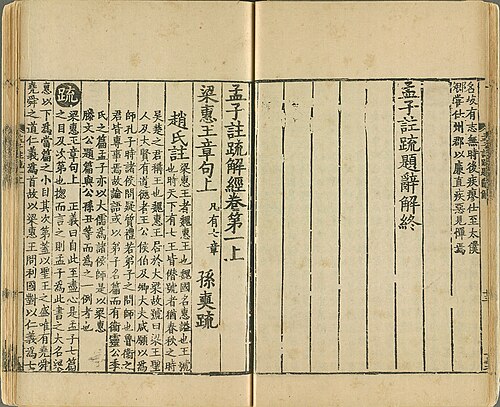
The book’s status rose from the late Tang. Han Yu argued that the true Way had passed from Confucius to Mencius and then been lost. In the Northern Song the Mencius was admitted to the canon of classics, and a sub-commentary attributed to Sun Shi (962–1033) was later included in the Thirteen Classics with Commentaries. Zhu Xi (1130–1200) wrote his Collected Commentaries on the Mencius and in 1190 printed it together with the Analects, the Great Learning and the Doctrine of the Mean: the Four Books.
In 1313 the Yuan emperor Renzong decreed that the restored civil-service examinations would use Zhu Xi’s Four Books, and the first examinations under the new rules were held in 1315. With interruptions and changes, this remained the basic curriculum in China until the examinations were abolished in 1905. For six centuries, most educated men met Mencius through Zhu Xi’s commentary.
Canonical status did not make the book safe. The Ming founder Zhu Yuanzhang (the Hongwu emperor) was angered in 1372 by a passage saying that a ruler who treats his ministers like dirt will be treated by them as an enemy. In 1394 the scholar Liu Sanwu and fellow Hanlin academicians produced the Mengzi jiewen (Abridged Mencius), which removed as many as 85 passages, and the removed passages could not be used in the examinations. The complete text was officially restored in 1415, in the Great Compendium on the Four Books, though the sensitive passages remained rare in examination questions.
Intermediate
Meanwhile in the world: arguing about nature and rule, in China and Greece
The Mencius records a live argument, and the argument continued. Within a generation or two came the reply of the Confucian Xunzi (born around 310 BCE). The chapter “Human Nature Is Bad” in the received Xunzi, traditionally attributed to him (some scholars think the chapter was later altered), opens: “Human nature is bad; its goodness comes from deliberate effort.” It names Mencius several times. Crooked wood, he says, must be steamed and pressed in a frame before it is straight; in the same way people need teachers, ritual and law. If nature were good, what need would there be for sage-kings and ritual? Yet Xunzi also says that “anyone on the street can become Yu”, a sage-king, which is close to Mencius’s claim that anyone can become Yao or Shun (6B2). This is a real connection: the chapter answers Mencius’s teaching directly, quoting him by name.
At almost exactly the same time, Aristotle (384–322 BCE) was teaching in Athens. There is no evidence that either tradition knew of the other, so what follows is a comparison, not a story of contact. Both men lived in worlds of rival states—the Warring States in China, and Greek city-states facing the rise of Macedon—and both asked how good character develops and what makes rule legitimate.
Strikingly, both used the image of natural downward motion, but drew opposite conclusions. In the Nicomachean Ethics (II.1) Aristotle argues that a stone, which by nature falls, cannot be trained to rise even if thrown upward ten thousand times; so the virtues “arise in us neither by nature nor against nature: we are fitted by nature to receive them, and perfected by habit”. Mencius uses water flowing downhill to say that goodness is the direction of human nature itself. Yet the two positions are closer than the slogans suggest. Aristotle grants a natural capacity that needs habituation; Mencius grants sprouts that need nourishment and can be destroyed. The Stanford Encyclopedia notes shared features—practical wisdom as flexible responsiveness, cultivation of character rather than rules—and a difference: Aristotle prizes theoretical contemplation, which Confucians did not value for its own sake.
On politics, Aristotle’s Politics (III.7) distinguishes kingship, rule by one for the common advantage, from tyranny, rule by one for the ruler’s own advantage. Mencius’s answer in 1B8 applies a similar test: whose good does the ruler serve? But the frameworks differ. Mencius ties legitimacy to Heaven, whose will is seen in the people’s acceptance, and has no idea of citizens taking turns in office; Aristotle counts rule by the many, under the right conditions, among the correct constitutions. Both accepted deep hierarchies: Aristotle defended natural slavery, and Mencius defended the division between those who labour with their minds and govern and those who labour with their strength and are governed (3A4).
Intermediate
Reception in Korea, Japan and beyond
In Korea the Mencius arrived with Confucianism, but according to the Encyclopedia of Korean Culture it received relatively little attention until the Joseon period, when Zhu Xi’s learning became state orthodoxy and the book became essential knowledge for scholars. In 1590 the royal Office of Collation (Gyojeongcheong) issued the Maengja eonhae, which prints each passage in Chinese followed by a Korean translation in hangul; its spelling makes it an important source for the history of the Korean language.
Korean scholars also argued with the book philosophically. The Four–Seven Debate, begun in letters between Yi Hwang and Gi Dae-seung, asked how the four sprouts of 2A6 relate to the seven emotions of the Book of Rites; it opened a line of controversies about the mind and human nature that Korean scholars pursued for some two hundred years. In his Maengja yoeui (Essential Meanings of the Mencius, 1814), Jeong Yak-yong argued that “nature” means a preference or inclination rather than a fixed principle, criticising the Neo-Confucian claim that nature is principle.
In Japan, Itō Jinsai (1627–1705) built his philosophy on a close reading of key terms in the Analects and the Mencius, in his Gomō jigi (The Meanings of Words in the Analects and Mencius), and tried to read Mencius without Zhu Xi’s framework. The Mencian idea that a tyrant may be removed was a more delicate matter; according to the Stanford Encyclopedia, such political teachings circulated chiefly among the ruling elite, although their implications later became known more widely.
In Europe, the Jesuit François Noël included Mencius in his Latin Six Classic Books of the Chinese Empire (Prague, 1711), and James Legge published an English translation with the Chinese text in 1861. In China itself, anti-Confucian critics during the May Fourth movement of 1919 attacked Mencius as the “second boss of the Confucian shop”, yet the book remains a living text for modern Confucian thinkers and for philosophers worldwide.
Advanced
Different perspectives
Good or bad by nature? Read as slogans, Mencius and Xunzi contradict each other. Many scholars now argue that the disagreement is narrower: both held that anyone can become good through sustained effort, and they differed over where the resources come from—inner sprouts that must be protected (Mencius), or ritual and teachers that reshape unruly desires (Xunzi). Even so, the difference is not trivial: for Mencius, moral standards grow out of feelings all people share, while for Xunzi they are created by the sages and must be learned. The debate was never closed: the Han thinker Wang Chong, for example, thought Mencius’s theory applied only to people above the average.
A democratic Mencius? Some modern philosophers build on passages such as 7B14 and 5A5: Bai Tongdong’s “A Mencian Version of Limited Democracy” (2008) uses them for a qualified, Confucian case for democratic institutions. Justin Tiwald’s “A Right of Rebellion in the Mengzi?” (2008) asks more cautiously how much the text really grants the people. Eno points out that no idea of active democracy existed in early China: Mencius accepted hereditary kingship, and his “populism” amounts to a theoretical right of revolution, which in practice would have meant aristocrats leading discontented commoners. Still, rulers took the book’s test of legitimacy seriously: arguments about Heaven’s mandate and the overthrow of tyrants were already politically sensitive in the Han, when Emperor Jing cut off a court debate on the subject, and the Ming founder went so far as to censor the Mencius itself in 1394.
How reliable is the text? Goldin stresses that Zhao Qi’s edition replaced everything before it, so that “we know next to nothing” about earlier versions. The Han writer Wang Chong describes Mencius’s position in words not found in the received text—human nature is entirely good and becomes bad when disordered by external things—and Goldin notes that these may preserve a quotation from the lost “outer” chapter on the goodness of nature, though without quotation marks in early Chinese texts this cannot be certain. Xunzi likewise attributes to Mencius a sentence about learners and their good nature that does not appear in our text. Goldin also notes the suggestion by the sinologist Van Ess that the claim in 3B9 that Confucius wrote the Spring and Autumn Annals may be a later interpolation. Against strong scepticism, Eno argues that the consistent, often unflattering personality in the book is hard to explain unless it was drawn from life by people who knew him.
Whose Mencius are we reading? Goldin’s survey of Han citations finds that passages now considered quintessentially Mencian—the child at the well (2A6), the tyrant as “mere fellow” (1B8), the drowning sister-in-law (4A17) and “innate knowledge” (7A15)—are never cited in surviving Han texts, while the opening interview with King Hui is quoted again and again. He cautions that silence is weak evidence, but concludes that modern readings remain heavily shaped by Neo-Confucianism.
Advanced
Evidence and method: reading through commentaries
Zhao Qi’s commentary is both indispensable and unverifiable. It is the earliest guide to who many of the book’s minor figures were, and later commentators largely depend on it; but it was written some four centuries after Mencius, and for many of its identifications there is no independent evidence. Eno therefore reminds readers that in any particular case we cannot be sure how reliable Zhao’s information was. Zhao also explained the order of the seven books as a deliberate progression: from benevolence and righteousness presented to a king, through their application, ritual and filial piety, to human nature and finally “exhausting the heart” to accord with Heaven. Whether the compilers really planned such a sequence cannot be proved.
Later commentaries read the same words in different ways. Zhu Xi read the Mencius philosophically, in terms of principle (li) and the nature received from Heaven. Qing scholars of evidential learning reacted against this: Dai Zhen (1724–1777) argued that Neo-Confucians had misunderstood Mencius’s key terms, and Jiao Xun (1763–1820) compiled the most complete collection of philological comments in his Correct Meaning of the Mencius. Modern translators usually consult all of these layers.
Dating the conversations is a separate problem. The book names rulers such as King Hui of Liang and King Xuan of Qi, but the reign dates of Warring States kings differ between Sima Qian’s chronology and later reconstructions: King Xuan of Qi is dated 342–324 BCE in some reference works and 319–301 BCE in others. Any timeline of the book’s scenes therefore rests on a choice between chronologies, which is why dates for its composition are given only as approximate ranges.
Key ideas
- Four sprouts (四端)
- Compassion, shame, deference and the sense of right and wrong: natural beginnings of benevolence, righteousness, ritual propriety and wisdom, shown by the child at the well (2A6).
- Nature like water flowing down
- Mencius’s reply to Gaozi (6A2): human nature has a direction, toward goodness, as water tends downward.
- Nourishment and damage
- The Ox Mountain passage (6A8): goodness grows when nourished and withers when cut down, so bad conduct does not prove a bad nature.
- The people matter most (民為貴)
- In 7B14 the people rank above the altars of the state and the ruler; rulers and even altars can be replaced.
- The tyrant as a “mere fellow”
- In 1B8 a ruler who destroys benevolence and righteousness has ceased to be a ruler, so his execution is not regicide.
- Constant livelihood, constant heart
- Government must secure people’s means of living before expecting moral conduct (3A3), illustrated by the well-field ideal.
- Meeting the author’s intention (以意逆志)
- A reading principle from 5A4: understand a text by meeting its intention with one’s own mind, not by fixing on single words.
Records
- c. 320 BCE — Around this time, shortly before King Hui’s death in 319 BCE, Mencius meets King Hui of Liang, the scene that opens the book.
- c. 314 BCE — Qi invades the state of Yan (c. 314 BCE); Mencius’s conversations about the war are recorded in Books 1 and 2.
- c. 289 BCE — Traditional date of Mencius’s death; disciples continue to compile and transmit his teachings.
- c. 100 BCE — Sima Qian records that Mencius and his disciples “made the Mencius in seven sections”.
- c. 170 CE — Zhao Qi (d. 201) writes his commentary, divides the seven books into fourteen parts and excludes four “outer books”; the exact date is unknown.
- 1190 — Zhu Xi prints the Mencius with the Analects, Great Learning and Doctrine of the Mean as the Four Books, with his commentaries.
- 1313 — The Yuan court decrees that the examinations will use Zhu Xi’s Four Books; the first such examinations follow in 1315.
- 1394 — The Mengzi jiewen, an abridged Mencius removing as many as 85 passages, is issued under the Hongwu emperor; the full text is restored in 1415.
- 1590 — The Maengja eonhae, a Korean vernacular translation of the Mencius, is issued by the Joseon Office of Collation.
- 1711 — François Noël’s Latin translation, including the Mencius, is published in Prague.
- 1814 — Jeong Yak-yong completes the Maengja yoeui, reinterpreting human nature as a preference.
- 1905 — The imperial examinations, based on the Four Books, are abolished in China.
Glossary
- Pian (篇)
- A section or “book” of an early Chinese text; the Mencius has seven, each later divided into two parts.
- Zhang (章)
- A chapter or passage within a section; Zhao Qi counted 261 in the Mencius.
- Outer books (外書)
- Four sections that Zhao Qi rejected as later imitations; they are lost.
- Commentary
- Explanatory notes written alongside a classic; the main ones for the Mencius are by Zhao Qi, Zhu Xi and Jiao Xun.
- Four Books
- The Great Learning, Analects, Mencius and Doctrine of the Mean, grouped by Zhu Xi as the core of Confucian study.
- Imperial examinations
- State examinations for recruiting officials; from the Yuan dynasty they were based on the Four Books with Zhu Xi’s commentaries.
- Mengzi jiewen (孟子節文)
- The abridged Mencius of 1394, from which passages that offended the Ming founder were removed.
- Well-field system (井田)
- An ideal land system in which eight families farm private plots around a shared public field, in the shape of the character 井.
- Eonhae (諺解)
- A Korean vernacular translation of a Chinese text, written in hangul alongside the original.
- Xing (性)
- “Nature”: the characteristic tendencies of a living thing, the central term in the debates of Book 6A.
Questions and answers
Did Mencius write the book himself?
Sima Qian and Zhao Qi said he did, with the help of disciples. Other scholars, from Han Yu onward, thought his disciples compiled it. Today many scholars think it goes back to Mencius and his circle but was completed by followers after his death.
Why are there two parts in every book?
The division comes from Zhao Qi in the 2nd century CE, who split each of the seven books into an upper and a lower part. That is why passages are cited with A and B, as in 2A6.
Is anything missing from the book?
Probably. A Han catalogue lists eleven sections, but Zhao Qi kept only seven and rejected four “outer books”, which are lost. Some quotations attributed to Mencius by early writers do not appear in the text we have.
Why did an emperor try to cut the book?
The Ming founder disliked passages saying that a ruler must earn his ministers’ loyalty and that the people matter more than the ruler. In 1394 an abridged edition removed as many as 85 passages, but the full text was restored in 1415.
Was the well-field system real?
Mencius describes it as an ancient institution and recommends it for the state of Teng. Some accounts treat it as an early Zhou practice, but many historians doubt that it ever existed in the neat form he describes.
Did Mencius and Aristotle know about each other?
There is no known evidence that they did. They lived at about the same time, but nothing suggests any contact between their worlds. Comparing them is useful because they asked similar questions about character and rule and gave different answers.
How is the Mencius different from the Analects?
The Analects consists mostly of short sayings. The Mencius contains long dialogues and arguments, full of analogies, and gives a much fuller picture of its main speaker’s personality.
Sources and further reading
- Bryan Van Norden, Mencius. Stanford Encyclopedia of Philosophy, 2024
- Robert Eno, Mencius: An Online Teaching Translation. Indiana University ScholarWorks, 2016
- Paul R. Goldin, Mencius in the Han Dynasty (in Dao Companion to the Philosophy of Mencius). Springer, 2023
- Ulrich Theobald, Mengzi 孟子. ChinaKnowledge.de
- Zhao Qi, Mengzi tici 孟子題辭 (Zhao Qi’s preface, Sibu congkan edition). Wikisource (Chinese)
- Mengzi 孟子 (Chinese text). Wikisource (Chinese)
- Sima Qian, Shiji, chapter 74: Biographies of Mencius and Xun Qing. Wikisource (Chinese)
- Ban Gu, Hanshu, chapter 30: Treatise on Arts and Letters. Wikisource (Chinese)
- Xunzi, “Human Nature Is Bad” (Xing e). Wikisource (Chinese)
- Xunzi. Stanford Encyclopedia of Philosophy
- Liangyan Ge, The Scholar and the State: Fiction as Political Discourse in Late Imperial China, ch. 2. University of Washington Press, 2015
- Ulrich Theobald, Sishu zhangju jizhu 四書章句集注. ChinaKnowledge.de
- Feiran Du, Zhu Xi’s Four Books 朱熹四書. Database of Religious History (Zenodo), 2024
- Hoyt Cleveland Tillman, Zhu Xi. EBSCO Research Starters
- Mencius (book). Wikipedia
- Well-field system. Wikipedia
- Aristotle, Nicomachean Ethics, Book II (trans. W. D. Ross). The Internet Classics Archive (MIT)
- Aristotle’s Ethics. Stanford Encyclopedia of Philosophy
- Fred Miller, Aristotle’s Political Theory. Stanford Encyclopedia of Philosophy
- 맹자 (孟子). Encyclopedia of Korean Culture (Academy of Korean Studies)
- 맹자언해 (孟子諺解). Encyclopedia of Korean Culture (Academy of Korean Studies)
- 맹자언해 (collection object). National Museum of Korea
- 사서: 정약용 선생의 저술 (Jeong Yak-yong’s works on the Four Books). Namyangju City, Dasan Jeong Yak-yong Cultural Festival
- Japanese Confucian Philosophy. Stanford Encyclopedia of Philosophy
- François Noël (missionary). Wikipedia
- 《孟子外书》考述 (A study of the “Outer Books” of the Mencius). Institute of Ancient Books, Sichuan University, 2005
Related
- MenciusA Confucian thinker who argued that people have the beginnings of moral goodness and that rulers must care for their subjects.
- AnalectsA collection of sayings and short dialogues of Confucius and his disciples, compiled after his death and read across East Asia for two thousand years.
- ConfuciusTeacher from the state of Lu whose sayings, gathered in the Analects, shaped ethics and government across East Asia.
- Zhu XiSong philosopher who gave enduring form to Neo-Confucian learning.
- Imperial examinationChina's system of written civil service examinations, begun under the Sui around 605 and abolished in 1905, which chose officials by tested learning rather than birth.
- AristotlePlato's student and Alexander's tutor. He founded the Lyceum and wrote on logic, ethics, politics and the natural world.
Written with AI assistance from the published sources listed above, and revised as new research appears.