Start at the top for an easy introduction. Go further down for more detail and scholarship.
- Easy
- Intermediate
- Advanced
For young readers
Imagine a teacher who never wrote a book himself. His students loved him so much that after he died they wrote down the things he had said: a sentence here, a short talk there, a story about how he behaved at a meal. Put all those notes together and you get the Analects. The teacher was Kong Qiu, whom we call Confucius. He lived in China about 2,500 years ago.
The book is not a story with a beginning and an end. It is more like a scrapbook of about five hundred short pieces arranged in twenty chapters. Many of them start with the words "The Master said…". Some are just one line long.
Confucius cared about how people should treat each other. He said that you should not do to others what you would not want done to yourself. He thought children should love and respect their parents, friends should keep their promises, and rulers should lead by being good examples, not by frightening people with punishments.
He also loved learning. The very first line of the book asks: isn't it a joy to learn something and then practise it again and again? Confucius said he would teach anyone who really wanted to learn, even a poor student who could only bring a small gift of dried meat.
For about two thousand years, children in China, Korea, Japan and Vietnam memorised parts of the Analects at school. Some of its sayings are still used every day, like proverbs, by people who may not even know where they come from.
At a glance
- Type
- Collection of sayings, dialogues and anecdotes about Confucius and his disciples
- Language
- Classical Chinese
- Length
- 20 chapters (pian), about 500 short passages; roughly 16,000 characters
- Compiled
- Traditionally by first- and second-generation disciples after 479 BCE; most scholars see gradual growth during the Warring States period and a fixed text by the Han dynasty
- Place of origin
- The state of Lu (around modern Qufu, Shandong) and the wider circle of Confucius's followers
- Standard text
- Based on Zhang Yu's composite "Marquis Zhang Analects" (1st century BCE), itself based mainly on the Lu version
- Canonical status
- One of the Four Books of Confucianism, fixed by Zhu Xi (1130–1200); core of the civil service examinations from 1313 to 1905
- Oldest manuscripts
- Han-dynasty copies from Dingzhou, Pyongyang and Haihun (1st century BCE); Warring States sayings collections from c. 300 BCE
Easy
What is the Analects?
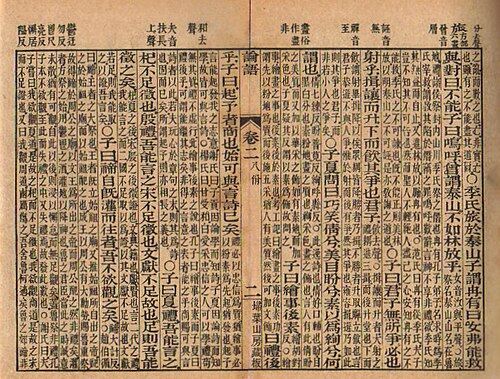
The Analects (Lunyu, 論語) is a collection of short passages that record the words and deeds of Confucius (traditionally 551–479 BCE) and some of his disciples. The Chinese title is often explained as "discussed words" or "selected sayings": lun can mean to discuss or to arrange, and yu means speech. The English title comes from a Greek word for "gleanings" or "selections", which suits a book made of fragments.
It is a small book. The received text has twenty chapters, each named after its first few words rather than its topic, and about five hundred passages. Some passages are a single sentence; others are little scenes in which a student asks a question and Confucius answers, sometimes with a joke, sometimes with a rebuke.
Confucius himself did not write it. According to the historian Ban Gu (32–92 CE), his disciples each kept notes of what the Master said, and after his death they gathered and edited them. Modern scholars think the process was longer and messier than that, but everyone agrees that the Analects is the earliest and most important source for what Confucius was believed to have taught.
For more than two thousand years it was one of the most widely read books in the world. It shaped education, government and family life across East Asia, and in modern times it has been translated into dozens of languages.
Easy
How to read a book made of fragments
Readers who open the Analects expecting an argument that builds from chapter to chapter are often puzzled. Neighbouring passages can be about completely different things, and the same idea may reappear in several chapters in slightly different words. It is better to think of it as a collection of remembered moments than as a treatise.
Many passages begin with ziyue (子曰), "the Master said". Classical Chinese had no quotation marks, so we cannot always be sure whether what follows is meant as Confucius's exact words or a summary. Other passages record sayings of disciples such as Zengzi, Zixia or Zigong, who themselves became teachers.
Some chapters have a special character. Chapter 10 is almost entirely a description of how Confucius behaved: how he dressed, ate, sat and greeted people at court. The writer Elias Canetti called the book the oldest complete intellectual and spiritual portrait of a man, and the translator Simon Leys suggested it may be the first work to describe the life of a historical individual in this way. Chapter 20, by contrast, opens with archaic-sounding speeches of the ancient sage kings and seems only loosely connected to the rest.
Because each passage is so short, readers have always relied on commentaries to explain the context. A beginner will get much more from a modern translation with notes than from the bare text. Passage numbers such as 12.2 (chapter 12, passage 2) differ by one or two between some editions.
Easy
Confucius and the world he lived in
Confucius, whose personal name was Kong Qiu and courtesy name Zhongni, was born in or near the small state of Lu in what is now Shandong Province. He lived at the end of the Spring and Autumn period, when the old Zhou royal house had lost real power and regional lords and noble families competed with one another, often violently.
According to later biographies, he came from a family of low-ranking nobility, lost his father early, grew up poor, and became known for his knowledge of the rituals and music of the early Zhou. He served in various offices in Lu, travelled for years among other states looking for a ruler who would put his ideas into practice, and in old age returned home to teach.
He described himself as a transmitter rather than an inventor (7.1): he believed that the early Zhou kings had created a harmonious social order, and that the way to fix the troubles of his own day was to recover and live by their example. In his lifetime his ideas were not very successful politically. His influence came through his students, who spread his teaching after his death.
Most details of his life come from sources written centuries later, above all Sima Qian's Records of the Grand Historian (about 100 BCE). Scholars often regard the Analects as more reliable than these biographies, but even the Analects was put together after his death.
Intermediate
The main ideas: ren, li, filial piety and the junzi
The word that appears most often at the heart of the Analects is ren (仁), variously translated as humaneness, benevolence, goodness or authoritative conduct. Later Confucians used it to mean kindness, but in the Analects it is broader: an all-round moral excellence that Confucius says he has hardly ever seen fully achieved. When students ask him to define it, he usually answers with examples suited to the person asking: be careful in speech (12.3), "love others" (12.22), restrain yourself and return to ritual (12.1).
The practical rule he gives most clearly is a negative form of the Golden Rule: "What you do not wish for yourself, do not do to others" (12.2, 15.23). A related idea, shu (恕), sometimes translated as reciprocity or empathy, asks people to use themselves as a measure for understanding others.
Li (禮) means ritual or propriety: the whole range of ceremonies, manners and customs, from ancestral sacrifices to the way one greets a guest. For Confucius, li is not empty formality. Practising it well trains the emotions and expresses respect, and a society in which people know and honour their roles is orderly without needing harsh laws. He insists that ritual without inner feeling is worthless, but also that feeling needs ritual to take proper shape.
Filial piety (xiao, 孝), devotion to one's parents, is described as the root of ren (1.2): someone who learns to love and respect family members first can extend that care outward. Finally, the ideal person of the Analects is the junzi (君子). Originally the word meant a nobleman, a "son of a lord", but Confucius used it for a person who is noble in character rather than birth. The junzi is contrasted again and again with the xiaoren, the "small person" who thinks only of profit.
Intermediate
Government by example, and the love of learning
The Analects has strong views about government. Its most famous political passage (2.3) contrasts two ways of ruling: if people are guided by laws and kept in line by punishments, they will try to avoid punishment but feel no shame; if they are guided by virtue (de, 德) and kept in line by ritual, they will have a sense of shame and correct themselves. The ruler's moral force works like the wind over grass (12.19): where it blows, the grass bends.
Another key idea is the "rectification of names" (zhengming). Asked what he would do first if given power, Confucius says he would make names correct (13.3). When the duke of Qi asks about government, he replies that the ruler should be a ruler, the minister a minister, the father a father and the son a son (12.11). Titles and roles should match reality; social chaos begins when they do not.
Education runs through the whole book. Its first line asks whether it is not a pleasure to learn and to practise what one has learned at the proper time (1.1). Confucius summarises his own life as a path of learning, from setting his heart on study at fifteen to being able to follow his heart's desires without overstepping the right at seventy (2.4). He says that learning without thinking leads to confusion, and thinking without learning is dangerous (2.15).
He claims to have taught anyone who came with even the smallest gift (7.7), which later readers took as a principle of education open to all. He rarely lectured; instead he asked questions, quoted the Classic of Poetry and expected students to work out the rest. Tradition says he had three thousand students, of whom about seventy mastered his teaching.
Intermediate
Heaven, spirits and the limits of what Confucius said
The Analects is not a religious scripture in the way that many sacred texts are, but it is not simply secular either. Confucius speaks of Tian (天), Heaven, as a moral power that has entrusted him with a mission, and he performs sacrifices with great seriousness. Yet when a disciple asks about serving spirits, he answers that if you cannot yet serve living people, how can you serve the spirits? And when asked about death, he says that if you do not yet understand life, how can you understand death (11.12)?
He advises respecting ghosts and spirits while keeping them at a distance (6.22), and the disciples note that the Master did not talk about prodigies, force, disorder or spirits (7.21). Some modern readers see this as an early form of humanism; others stress that ritual and Heaven were deeply important to him and that the book should not be read through a modern secular lens.
In later East Asian history Confucius was honoured in state temples, and people in many countries still take part in ceremonies in his honour. The Analects can therefore be read both as a work of philosophy and as a text that is part of a living tradition of ritual and respect.
Intermediate
How the text came down to us
According to Han-dynasty scholars, at least three versions of the Analects existed in the early Han. The Lu version had twenty chapters; the Qi version had twenty-two, including two chapters not found in the Lu text; and an "Old Text" version of twenty-one chapters, written in pre-Qin script, was said to have been discovered in a wall of Confucius's old house when a prince of Lu was enlarging his palace in the mid-2nd century BCE.
In the late 1st century BCE Zhang Yu, tutor of the future Emperor Cheng, produced a combined text based mainly on the Lu version with selected material from the Qi. This "Marquis Zhang Analects" was accepted as the best text and is the ancestor of the version read today. Around 175 CE the classics, including the Analects, were carved on stone tablets at the imperial academy in Luoyang to fix a standard text.
Two commentaries shaped how the text was understood. He Yan's Collected Explanations (Lunyu jijie), completed around 248 CE, gathered earlier Han and Wei interpretations and is the oldest complete commentary that survives. Zhu Xi's Collected Commentaries (Lunyu jizhu) of the 12th century reinterpreted the text through Neo-Confucian philosophy and became the standard for the next seven centuries.
Status changed too. Under Emperor Wu of Han (r. 141–87 BCE) the Analects ranked below the Five Classics, as a record of the Master's sayings rather than a canonical scripture. By the Eastern Han it was a basic school text, and in the Song dynasty Zhu Xi grouped it with the Mencius, the Great Learning and the Doctrine of the Mean as the Four Books. From 1313 until 1905 these were the core of the imperial civil service examinations.
Intermediate
Influence across East Asia and the world
The Analects travelled wherever literary Chinese was read. In Korea, one of the oldest surviving Analects manuscripts anywhere was found in a Han-period tomb in Pyongyang, and in the Joseon dynasty (1392–1897) Zhu Xi's reading of the Four Books became the foundation of state ideology and education. Japanese tradition says that a scholar named Wani, sent from the Korean kingdom of Baekje, brought the Analects to Japan; he is regarded as a semi-legendary figure, but the story shows how early the text was associated with learning. In Vietnam, too, the Four Books were central to education and examinations for centuries.
Europeans first read the Analects through Jesuit missionaries in China. A Latin translation of three of the Four Books was published in Paris in 1687, and Enlightenment thinkers such as Leibniz and Voltaire admired Confucius as a moral philosopher who reasoned without relying on revelation. In the 19th century James Legge's English translation (1861) became a standard reference.
In the 20th century the book's reputation swung dramatically. Reformers of the May Fourth Movement and later the Communist Party attacked Confucian hierarchy as a cause of China's weakness, while others saw the Analects as a foundation for moral renewal. Today it is again widely read in China and throughout the world, both as philosophy and as a key to understanding East Asian culture.
Many phrases from the book have entered everyday speech in Chinese, Korean, Japanese and Vietnamese, sometimes as four-character idioms. The age markers in 2.4, for example, gave East Asian languages traditional names for the ages of fifteen, thirty, forty, fifty, sixty and seventy.
Advanced
Debate: when and how was the Analects composed?
The traditional account, going back to Ban Gu's bibliographic treatise in the Book of Han, holds that the Analects was compiled by Confucius's direct disciples and their students soon after his death. Zhu Xi accepted this, and it made the book the most authoritative source on the historical Confucius. Doubts, however, are old. The Qing philologist Cui Shu (1740–1816) argued on linguistic grounds that the last five chapters were much later. The Japanese scholar Itō Jinsai distinguished an "upper" (chapters 1–10) and "lower" (11–20) Analects. Arthur Waley suggested that chapters 3–9 were the oldest core.
The most radical stratification is E. Bruce Brooks and A. Taeko Brooks's "accretion theory", presented in their translation The Original Analects. They argued that the text grew chapter by chapter over roughly 230 years, from Confucius's death until the conquest of Lu by Chu in 249 BCE, with each layer reflecting the concerns of the school at that time. Their chronology has been influential but also widely criticised as too precise for the evidence.
Another line of argument, associated with the Chinese historian Zhu Weizheng (1986) and developed by Michael Hunter, emphasises that the title Lunyu is not cited in any source before the Han, and that interest in the book appears suddenly in the late 2nd and 1st centuries BCE. On this view the Analects may have been assembled, or at least fixed and named, in the Western Han as one selection from a much larger body of Confucius sayings. Supporters note that most of the sayings attributed to Confucius in the Mencius are not in the received Analects; the Han thinker Wang Chong already claimed that Han copies were incomplete.
These positions are not entirely incompatible. Many scholars now think that individual sayings circulated early, that collections of them existed in the Warring States period, and that the book we know took final shape in the Han. The disagreement is over how much of the received text reflects early material, and therefore how directly it can be used to reconstruct the thought of the historical Confucius.
Advanced
Evidence from excavated manuscripts
Archaeology has transformed the debate since the 1970s. The Dingzhou Analects, bamboo strips excavated in 1973 from the tomb of a Han prince in Hebei and dated to about 55 BCE, preserves a little under half of the received text. It was damaged by fire in antiquity and by an earthquake after excavation, and a transcription was only published in 1997. Its variants and apparent later additions suggest that the text was still fluid in the mid-1st century BCE.
A second manuscript, the Pyongyang Analects, was found in the early 1990s in a tomb at Jeongbaek-dong in Pyongyang, dated to between about 62 and 45 BCE, when the area was part of the Han commandery of Lelang. Access has been restricted, and scholarly study only began to appear around 2009. The tomb of the Marquis of Haihun in Jiangxi (d. 59 BCE), excavated from 2011, yielded an Analects manuscript that seems to contain the two chapters of the lost Qi version, titled "Knowing the Way" (Zhi dao) and "Asking about Jade" (Wen yu). It has not yet been fully published.
Even older material has emerged recently. An unprovenanced set of Warring States bamboo strips acquired by Anhui University in 2015, known as "Zhongni said" (Zhongni yue), contains about two dozen sayings of Confucius, several matching the received Analects. Strips excavated at Wangjiazui in Hubei between 2019 and 2021, given the title "Kongzi said" (Kongzi yue), partly overlap with the Anhui text. Both are dated to around 300 BCE.
Together these finds suggest two things. First, organised collections of Confucius's sayings did exist by the mid-Warring States period, which weakens the most extreme late-dating theories. Second, those collections did not match the received Analects exactly; the Analects seems to be one selection from a larger, varied pool of sayings, and the text was still being shaped in the Han. Scholars disagree about whether the Dingzhou and Pyongyang copies represent the Lu, Qi or Old Text versions, or a tradition independent of all three.
Advanced
Interpreting the Analects: commentary, translation and philosophy
Because the passages are terse, every reading of the Analects is also an interpretation. He Yan, writing in the 3rd century, read it partly in the light of "Mysterious Learning" (xuanxue) and believed Confucian and Daoist teachings were ultimately compatible. Zhu Xi read it through the metaphysics of principle (li 理) and vital energy (qi 氣), and explained each passage by reference to the other Four Books to build a unified system. Qing scholars of the "evidential learning" movement tried to strip away Song metaphysics and recover Han meanings through philology.
Translators face the same choices. Should ren be "benevolence" (Legge), "goodness" (Waley), "humaneness" or "authoritative conduct" (Ames and Rosemont)? Each choice brings a different philosophical picture. Roger Ames and Henry Rosemont, for example, argue for a relational, role-based ethics that differs sharply from Western ideas of the autonomous individual, while other philosophers compare the Analects with Aristotelian virtue ethics.
Modern philosophers debate whether the Analects offers a coherent ethical theory or a set of practical wisdom sayings, how ren and li relate (is ritual the expression of an inner virtue, or does virtue consist in skilled ritual practice?), and whether the text supports hierarchy or offers resources for criticising unjust rulers. The book contains both: it demands loyalty and filial respect, but also says that one may remonstrate with a ruler and that even a common person's will cannot be taken away (9.26).
The Stanford Encyclopedia of Philosophy entry on Confucius sums up the problem well: because the materials linked to Confucius are so diverse, his philosophy is "historically underdetermined", and different coherent doctrines can be traced back to the early sources. Reading the Analects today means being aware of that plurality.
Key ideas
- Ren (仁)
- Humaneness or goodness: the highest, all-round moral excellence, shown in caring for others and self-restraint.
- Li (禮)
- Ritual propriety: ceremonies, manners and customs that express respect and train people's feelings and conduct.
- Xiao (孝)
- Filial piety: love and respect for one's parents and elders, described as the root of humaneness.
- Junzi (君子)
- The "noble person" or exemplary person, noble in character rather than by birth; contrasted with the petty xiaoren.
- De (德)
- Virtue or moral force: the power of a good person, especially a ruler, to influence others by example.
- Zhengming (正名)
- Rectification of names: making titles and roles match actual conduct, as the first step to good order.
- Shu (恕)
- Reciprocity or empathy: not doing to others what one would not want done to oneself.
Records
- c. 551 BCE — Traditional birth year of Confucius (551 BCE) in or near the state of Lu.
- 479 BCE — Traditional death of Confucius (479 BCE); his disciples begin to preserve his sayings.
- c. 300 BCE — Date of the "Zhongni said" and "Kongzi said" bamboo manuscripts: collections of Confucius's sayings exist by the mid-Warring States period.
- c. 155 BCE — Traditional date for the discovery of an Old Text Analects hidden in the wall of Confucius's house.
- 59 BCE — Death of the Marquis of Haihun; his tomb contains a manuscript of the Qi version of the Analects.
- c. 55 BCE — Approximate date of the Dingzhou Analects bamboo manuscript.
- c. 21 BCE — Zhang Yu creates the composite "Marquis Zhang Analects", ancestor of today's text.
- c. 175 CE — The Xiping Stone Classics, including the Analects, are carved in Luoyang.
- 248 CE — He Yan's Collected Explanations, the oldest complete surviving commentary, is completed.
- c. 1190 — Zhu Xi publishes the Four Books with his commentaries, making the Analects a core text of Neo-Confucianism.
- 1313 — Zhu Xi's Four Books become the basis of the Yuan civil service examinations.
- 1905 — The imperial examination system is abolished in China.
Glossary
- Analects
- From a Greek word meaning "selections"; the English title of the Lunyu.
- Classical Chinese
- The written language of early China, used across East Asia for scholarship for two thousand years.
- Disciple
- A student who follows a teacher and passes on the teaching.
- Commentary
- A book that explains another book line by line.
- Four Books
- Analects, Mencius, Great Learning and Doctrine of the Mean, grouped by Zhu Xi as the core of Confucian study.
- Five Classics
- The older canon: Poetry, Documents, Rites, Changes and the Spring and Autumn Annals.
- Bamboo strips
- Thin slips of bamboo tied together with cord, the usual writing material in early China.
- Neo-Confucianism
- The revival of Confucian thought from the Song dynasty, which added a philosophy of principle and vital energy.
- Received text
- The version of a text handed down in tradition, as opposed to one recovered by archaeology.
Questions and answers
Did Confucius write the Analects?
No. It was compiled by his followers, probably over several generations, from sayings and stories about him.
Why are the chapters so jumbled?
The book is a collection of separate notes, not a planned essay. Chapter titles are simply the first words of each chapter.
What is the most famous saying in it?
Probably "What you do not wish for yourself, do not do to others", a negative version of the Golden Rule found in 12.2 and 15.23.
Is the Analects a religious book?
It is mainly about ethics, education and government, but it speaks of Heaven and ritual with great seriousness, and it is part of a living tradition in which Confucius is honoured.
How old is the oldest copy?
Han-dynasty bamboo manuscripts from the 1st century BCE, and Warring States collections of related sayings from about 300 BCE.
Can the Analects be used to reconstruct the historical Confucius?
It is still the best single source, but many scholars now think it was assembled over centuries and shaped in the Han, so it reflects the concerns of his followers as well as his own words.
Why did Zhu Xi's commentary matter so much?
Because from 1313 to 1905 candidates for government office in China had to know the Four Books through his interpretation, and Korea and Vietnam adopted similar systems.
Sources and further reading
- Analects. Wikipedia
- Confucius. Stanford Encyclopedia of Philosophy, 2024
- Confucius. Internet Encyclopedia of Philosophy
- Analects (Chinese text with English translation). Chinese Text Project
- Confucius. Wikipedia
- Zhu Xi. Wikipedia
- Four Books and Five Classics. Wikipedia
- Wani (scholar). Wikipedia
- D. C. Lau (trans.), Confucius: The Analects (Lun yü). Penguin Books, 1979
Related
- ConfuciusTeacher from the state of Lu whose sayings, gathered in the Analects, shaped ethics and government across East Asia.
- MenciusA Confucian thinker who argued that people have the beginnings of moral goodness and that rulers must care for their subjects.
- Zhu XiSong philosopher who gave enduring form to Neo-Confucian learning.
- Classic of Poetry (Shijing)China's oldest poetry anthology — folk songs, court odes and temple hymns later counted among the Confucian classics.
- LaoziTraditionally named author of the Daodejing. Whether he was a single historical person is still debated.
- Wang YangmingMing philosopher and official who taught that moral knowledge must be realized in action.
Written with AI assistance from the published sources listed above, and revised as new research appears.