Start at the top for an easy introduction. Go further down for more detail and scholarship.
- Easy
- Intermediate
- Advanced
For young readers
A very long time ago in China, more than 2,000 years ago, people told stories about a wise old teacher. They called him Laozi, which means “Old Master”. One story says he worked in a king’s library, looking after old writings, a bit like a librarian.
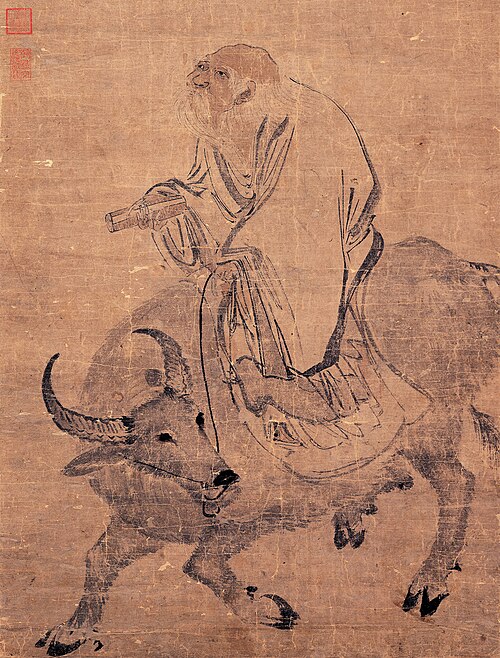
The story goes on: when Laozi saw that the kingdom was becoming weak and full of quarrels, he decided to leave. He rode away to the west, some say on a water buffalo. At a mountain pass, the gatekeeper stopped him and said, “Before you go, please write down your wisdom for us.” So Laozi wrote a short book of about 5,000 Chinese characters and then disappeared. Nobody knows where he went.
That little book is called the Daodejing, “the Book of the Way and its Power”. Its big idea is the Dao, or “the Way”: the quiet way that everything in nature grows and changes. Laozi said the Way is too big to fully explain with words.
Laozi loved water. Water is soft and gentle, and it always flows to the lowest places, yet over time it can wear away hard rock. He thought people could be like water: humble, calm and patient, but strong in their own way. He also said good leaders should not boss people around too much. A good leader works so quietly that when things go well, the people say, “We did it ourselves!”
Today, historians are not sure that Laozi was one real person. The book may have been put together by several people over many years. But whoever wrote it, it became one of the most famous books in the world, read in China, Korea, Japan and far beyond.
At a glance
- Dates
- Unknown. Tradition places him in the 6th century BCE as an older contemporary of Confucius; many modern scholars date the Daodejing text to roughly the 5th–4th centuries BCE
- Place
- Traditionally from Chu (Ku county, in present-day Henan) and an archivist at the Zhou royal court in Luoyi (modern Luoyang)
- Names
- Traditionally Li Er (李耳), styled Dan, also called Lao Dan (老聃)
- Work
- The Daodejing (道德經), also called the Laozi: about 5,000 characters in 81 short chapters in the received version
- Earliest manuscripts
- Guodian bamboo slips (tomb sealed c. 300 BCE); Mawangdui silk texts (copied before 168 BCE); a Western Han bamboo manuscript held by Peking University
- Tradition
- Regarded as the founder of philosophical Daoism and later deified in religious Daoism
- Key ideas
- Dao (the Way), de (power, virtue), wuwei (non-forcing action), ziran (naturalness), the uncarved block, softness overcoming hardness
Easy
Who was Laozi?
Laozi is the name of an ancient Chinese sage traditionally honoured as the author of the Daodejing (Tao Te Ching), one of the most influential books in world history. The name is not a personal name but a title: “Lao” means old and “zi” means master or teacher, so “Laozi” means the “Old Master”. The book itself is often simply called the Laozi, after him.
The oldest surviving life story of Laozi was written by the Han-dynasty historian Sima Qian in his Records of the Grand Historian (Shiji), completed around 100–90 BCE, several centuries after Laozi was supposed to have lived. Sima Qian says that Laozi’s family name was Li, his personal name Er, and that he was also called Lao Dan. He came from Chu, in the south, and served as a keeper of archives at the court of the Zhou kings.
Sima Qian himself was not sure of his facts. After telling the main story, he mentions two other men who might have been Laozi, and he reports rumours that Laozi lived for 160 or even 200 years. This honest uncertainty in our oldest source is the starting point of every modern discussion of Laozi. Many scholars today think “Laozi” is best understood as a name attached to a body of wisdom rather than as a single author we can know.
Easy
The famous stories: Confucius and the western pass
Two stories about Laozi became famous across East Asia. In the first, the young Confucius travels to the Zhou court to ask Laozi about ritual. Laozi gently scolds him for his pride and ambition. Afterwards Confucius tells his students that he understands birds, fish and animals, but Laozi is like a dragon riding on the wind and clouds: impossible to grasp. Versions of this meeting appear in several early texts, including the Zhuangzi, and it was often used to suggest that Daoist wisdom was deeper than Confucian learning. Historians generally treat it as a legend.
In the second story, Laozi sees the Zhou dynasty declining and decides to leave for the west. At the frontier pass the gatekeeper, Yin Xi, recognizes him as a sage and asks him to write a book before he goes. Laozi writes a work in two parts on the Way and virtue, of about 5,000 characters, and departs; “no one knows where he ended”, says Sima Qian. Later artists loved to paint the old sage riding an ox toward the pass.
These stories are important even if they are not literally true. They show how people in the Han dynasty and later imagined the origin of the Daodejing: as the last gift of a wise man leaving a disordered world.
Easy
The Daodejing: a small book with a big voice
The Daodejing is short, about 5,000 characters, which in English translation fits comfortably into a thin paperback. In the version most people read today it is divided into 81 short chapters, some only a few lines long. It is written mostly in rhythmic, often rhyming lines, closer to poetry than to argument. It rarely names people, places or events, so it is hard to date and easy to read in many different ways.
The book is traditionally divided into two parts. The first part (chapters 1–37) is called the Daojing, “Classic of the Way”, because it opens with the word dao. The second part (chapters 38–81) is the Dejing, “Classic of Virtue”, because it opens with the word de. Together they give the book its name: Dao-De-Jing, “Classic of the Way and Virtue”.
Its first lines are among the most famous in Chinese literature: “The way that can be told is not the constant Way; the name that can be named is not the constant name.” From the start, the book warns that its deepest subject cannot be fully captured in words. It then speaks in images: water, the valley, the infant, the uncarved block of wood, the empty hub of a wheel, the female, the root.
The Daodejing is also a book about government. Many chapters speak to the ruler, the “sage”, advising him to rule with a light hand, reduce desires and taxes, avoid war where possible, and let the people live simple, contented lives. It is both a book of personal wisdom and a guide to politics.
Intermediate
Core ideas: Dao, de, wuwei and naturalness
Dao (道) originally meant a road or path, and by extension a method or teaching; Confucians spoke of the Dao of the former kings. The Daodejing gives the word a new depth. Here the Dao is the nameless source from which all things come, “the mother of the ten thousand things”, which works without effort, claims no credit and cannot be seen or heard. It is the pattern and process of the world itself.
De (德), usually translated “virtue” or “power”, is the Dao as it shows itself in a particular thing or person: a potency or charisma that comes from being in tune with the Way. A ruler with true de influences others without force. The Daodejing distinguishes a “higher de” that does not display itself from a “lower de” that tries to be seen as virtuous.
Wuwei (無爲), literally “not doing” or “non-action”, is the book’s best-known ideal. It does not mean laziness. It means acting without forcing, without selfish striving and without meddling, the way plants grow or water finds its level. The Daodejing says that the Dao “does nothing, yet nothing is left undone”. For a ruler, wuwei means not piling up laws, punishments and ambitions, and trusting people to order their own lives.
Ziran (自然), “so of itself” or “naturalness”, describes things following their own course without outside pressure. Related images include pu (樸), the uncarved block, a symbol of simplicity before it is cut into tools and rank, and the infant, whose softness is full of life. The book praises the soft, low, empty and feminine over the hard, high, full and aggressive: “The softest thing under heaven overcomes the hardest.” It also teaches “reversal”: things that go to an extreme turn back into their opposites, so the wise stay humble and know when to stop.
Intermediate
The world of the Hundred Schools
Whenever the Daodejing was written, it belongs to the late Eastern Zhou period, the late Spring and Autumn and the Warring States eras (roughly the 6th to 3rd centuries BCE). The Zhou kings had lost real power, and rival states fought for survival and supremacy. Warfare grew larger and bloodier, governments grew more centralized, and rulers looked for advisers who could make their states rich and strong.
This crisis produced an extraordinary burst of thinking later called the “Hundred Schools of Thought”. Confucians argued for moral cultivation, ritual and the rule of virtuous gentlemen; Mohists for impartial care and practical benefit; later “Legalists” for strict laws and rewards and punishments. The Daodejing can be read as a response to all of them: it suggests that too much cleverness, too many rules, and too much talk of benevolence and righteousness are symptoms of a world that has lost the Way.
The label “Daoist school” (daojia) was invented later. Han-dynasty scholars, especially Sima Tan (the father of Sima Qian) and later the library catalogue of Liu Xiang and Liu Xin, sorted earlier thinkers into schools and placed Laozi and Zhuangzi together. The Zhuangzi, a very different and more playful book associated with Zhuang Zhou (4th century BCE), became the second great classic of philosophical Daoism.
Intermediate
Buried manuscripts: Mawangdui, Guodian and Peking University
For almost two thousand years readers knew the Daodejing only through versions transmitted by copying and printing, especially those attached to the commentaries of Wang Bi (226–249) and of the figure known as Heshang Gong. In the late twentieth century archaeology changed the picture.
In 1973 archaeologists excavating tomb 3 at Mawangdui, near Changsha in Hunan, found two copies of the Laozi written on silk, buried in a tomb closed in 168 BCE. One copy seems to have been written before about 195 BCE. Both are close to the received text but place the “Virtue” section before the “Way” section, so some scholars call them the Dedaojing. They show that the book existed in essentially its full form by the early Han.
In 1993 an even older find came from tomb 1 at Guodian, near Jingmen in Hubei, in the former state of Chu. The tomb was closed around 300 BCE. Among some 800 bamboo slips were three bundles containing material parallel to the Laozi: about 2,000 characters, roughly two-fifths of the received text, in a different order and without the division into “Way” and “Virtue”. Some of the sharpest anti-Confucian lines of the received text appear in milder form. The same bundle also contained an otherwise unknown cosmological text, the Taiyi shengshui (“The Great One Gives Birth to Water”).
A third important witness is a nearly complete Western Han bamboo manuscript acquired by Peking University in 2009, which is divided into two parts like the received text. Together these finds allow scholars to watch the Daodejing grow and stabilize, instead of treating it as a text that fell from the sky in finished form.
Intermediate
From sage to god: Laozi in religious Daoism
Over the Han dynasty Laozi was gradually transformed from a wise man into a divine being. The court of the Eastern Han emperor Huan offered sacrifices to Laozi in the 160s CE, and texts of the period describe him as an embodiment of the Dao who had appeared many times in history as a teacher of rulers. In the Celestial Masters movement, which began in the 2nd century CE and is often seen as the start of organized religious Daoism (daojiao), Laozi was revered as the deified Lord Lao (Laojun), and the Daodejing was recited as scripture.
The Tang dynasty (618–907), whose ruling house had the surname Li, claimed descent from Laozi. In 666 Emperor Gaozong gave him the imperial title “Supreme Emperor of Mysterious Origin”, and the Daodejing was for a time included in the state examinations. Rivalry with Buddhism also produced the polemical legend that Laozi, after leaving China, had gone to India and “converted the barbarians”, even becoming the Buddha; Buddhists strongly contested this claim, and the text promoting it was later banned.
It is important to distinguish these strands without ranking them. Philosophical readings (daojia) and religious practice (daojiao) were never completely separate in China, and today Laozi is still honoured in Daoist temples in China, Taiwan and elsewhere as a deity, while the Daodejing is read by others purely as philosophy.
Intermediate
Influence in East Asia and the world
In China the Daodejing influenced political thought (Han-dynasty rulers of the 2nd century BCE favoured a “Huang–Lao” style of minimal government), the “Profound Learning” (xuanxue) philosophy of Wang Bi and his contemporaries, Chan (Zen) Buddhism, poetry, painting and calligraphy, and ideas about health and longevity. Its language of emptiness, spontaneity and naturalness shaped the vocabulary in which Buddhism was first translated into Chinese.
The book travelled across East Asia. According to the Korean history Samguk sagi, the Tang court sent a Daoist teacher to the Korean kingdom of Goguryeo in 624, who lectured on the Laozi before the king. In Japan and Vietnam, too, the Daodejing became part of the classical learning shared by educated people.
Jesuit missionaries studied the book from the 17th and 18th centuries, and it was translated into French by Stanislas Julien in 1842 and into English by several translators later in the 19th century. In the 20th century it became one of the most translated books in the world, with hundreds of versions in many languages. Writers, philosophers, ecologists and management theorists have all found something in it, though popular versions sometimes stray far from the Chinese text.
Advanced
Did Laozi exist? Authorship and dating debates
The question of Laozi’s historicity has been debated in China at least since the Song dynasty and intensely since the “Doubting Antiquity” movement of the 1920s–30s. Sima Qian’s biography combines at least three candidates: Li Er (Lao Dan), a contemporary of Confucius; Lao Laizi, a man of Chu who wrote a book in fifteen sections; and Dan, a Grand Historian of Zhou who met Duke Xian of Qin in the 4th century BCE. It also includes a genealogy of Li Er’s descendants down to Sima Qian’s own time, which some scholars think reflects the claims of a Han-dynasty family.
Scholars have taken three main positions. A traditional view accepts a 6th-century BCE Lao Dan as the author. A second view, associated in different forms with scholars such as Qian Mu and, in the West, A. C. Graham, dates the text to the Warring States period (4th–3rd centuries BCE); Graham suggested that the figure of Lao Dan as teacher of Confucius was a legend that later became attached to a newly compiled book. A third, widely held “anthology” view, argued for example by D. C. Lau, sees the Daodejing as a collection of sayings and rhymed maxims that grew over time, whose chapters sometimes do not fit together and which cannot be traced to one author.
The Guodian manuscripts complicated all three positions. They proved that substantial parts of the text existed by around 300 BCE, which undermines very late datings. But because the Guodian material is partial and arranged differently, scholars disagree about what it means. Some think the Guodian bundles are selections from an already complete book; others think they represent an earlier stage before the full 81-chapter text had been assembled. The debate remains open, and many scholars prefer to speak of the “Laozi texts” in the plural for the pre-Han period.
Advanced
Reading the Daodejing: commentaries and interpretive problems
Because the Daodejing is so terse, interpretation has always depended on commentaries. The Heshang Gong commentary (its date is disputed, perhaps between the Han and the 4th century CE) reads the text partly as a guide to self-cultivation and longevity, connecting ruling the state with nourishing the body’s vital energy (qi). Wang Bi’s commentary, written by a prodigy who died in his early twenties, reads it metaphysically, emphasizing “non-being” (wu) as the root of all being. The Han Feizi chapters “Explaining Laozi” and “Illustrating Laozi” (3rd century BCE) had already read it as political strategy.
Modern scholars continue to disagree on basic questions. Is the Daodejing primarily a mystical text, a work of political philosophy addressed to rulers, a manual of strategy, or a guide to personal self-cultivation? Is the Dao a transcendent reality beyond the world, or simply the immanent way in which the world works? Different translators’ choices, for example whether to render wuwei as “non-action”, “effortless action” or “not forcing”, carry these interpretive decisions with them.
The manuscript finds add textual problems. Many famous lines read differently in the Mawangdui or Guodian versions, and scholars debate whether the received text “improved” or distorted the earlier versions. A well-known example is chapter 19, where the received text calls for abandoning “benevolence and righteousness”, while the Guodian version appears to criticize other targets, such as “artifice and deceit”. Such differences matter for understanding how hostile early Daoist thought was to Confucianism.
Advanced
Evidence and method: studying a sage without a biography
Studying Laozi requires separating three kinds of evidence. The first is the transmitted literary tradition: the Shiji biography, anecdotes in the Zhuangzi, the Lüshi chunqiu and the Liji (Book of Rites), and later hagiographies. These texts tell us how Laozi was remembered, but they are late and often have an agenda.
The second is the text itself. Linguistic features, rhyme patterns, vocabulary and the concepts the book responds to (for example its polemic against “benevolence and righteousness”, key Confucian terms, and its interest in large states and armies) are used to date its layers, though scholars weigh these clues differently.
The third is excavated manuscripts, which give fixed points: a text existed in a certain form before a tomb was sealed. Palaeographers must first transcribe unfamiliar Chu or early Han characters, and many readings remain uncertain. Methodologically, the manuscripts have encouraged a shift from asking “Who wrote the Daodejing and when?” to asking “How did a fluid body of sayings become a fixed classic?”, a question that links Laozi research to the study of other early texts in China and elsewhere.
Key ideas
- Dao (the Way)
- The nameless source and pattern of all things, which works quietly, without effort or claim, and cannot be fully captured in words.
- De (virtue, power)
- The potency that comes from being in harmony with the Dao; true de influences others without force or display.
- Wuwei (non-forcing action)
- Acting without coercion, selfish striving or meddling, so that things take their natural course; the ideal for sages and rulers.
- Ziran (naturalness)
- Being “so of itself”, following one’s own course without outside pressure.
- Softness overcomes hardness
- Images of water, the infant and the female show that the yielding and humble endure longer than the rigid and aggressive.
- Reversal
- Everything that goes to an extreme turns back; so the wise stay low, know contentment and know when to stop.
- Minimal government
- The sage-ruler governs lightly, reduces desires, taxes, laws and wars, and lets the people live simply.
Records
- c. 518 BCE — According to later tradition, Confucius visits Laozi at the Zhou court to ask about ritual (legendary; date uncertain).
- c. 300 BCE — Guodian tomb 1 in the state of Chu is sealed with bamboo slips containing Laozi material.
- 168 BCE — Mawangdui tomb 3 is closed with two silk manuscripts of the Laozi (168 BCE).
- c. 94 BCE — Sima Qian completes the Shiji, containing the earliest biography of Laozi.
- c. 166 CE — The Eastern Han court of Emperor Huan offers sacrifices to Laozi as a divine being.
- 249 CE — Death of Wang Bi, whose commentary shaped the standard received text.
- 624 CE — According to the Samguk sagi, a Daoist sent by the Tang court lectures on the Laozi in Goguryeo.
- 666 CE — Tang Emperor Gaozong grants Laozi the title “Supreme Emperor of Mysterious Origin”.
- 1842 — Stanislas Julien publishes a French translation of the Daodejing.
- 1973 — The Mawangdui silk manuscripts are excavated near Changsha, Hunan.
- 1993 — The Guodian bamboo slips are excavated near Jingmen, Hubei; published in 1998.
- 2009 — Peking University acquires a Western Han bamboo manuscript of the Laozi.
Glossary
- Daodejing (道德經)
- “Classic of the Way and Virtue”, the book attributed to Laozi; also called the Laozi.
- Shiji (史記)
- Records of the Grand Historian, the history by Sima Qian (c. 145–c. 86 BCE) that contains the earliest biography of Laozi.
- Zhou dynasty
- The Chinese royal dynasty (c. 1046–256 BCE) whose kings had lost real power by Laozi’s supposed lifetime.
- Hundred Schools of Thought
- The many competing philosophical traditions of the late Zhou period, including Confucians, Mohists, Daoists and Legalists.
- Daojia / Daojiao
- Two Chinese terms for Daoism: daojia, the philosophical “school of the Way”, and daojiao, the organized religion.
- Received text
- A version of a text handed down through copying and printing, as opposed to an excavated manuscript.
- Bamboo slips
- Thin strips of bamboo tied together with cord, the main writing material in early China.
- Guodian
- A Chu tomb site near Jingmen, Hubei, where the oldest known Laozi manuscripts were found in 1993.
- Mawangdui
- A Han tomb site near Changsha, Hunan, where two silk manuscripts of the Laozi were found in 1973.
- Uncarved block (pu 樸)
- An image of original simplicity, before things are shaped by desire, knowledge and social rank.
- Commentary
- An explanatory text written to accompany a classic; the Wang Bi and Heshang Gong commentaries shaped how the Daodejing was read.
Questions and answers
Was Laozi a real person?
Nobody knows for sure. Our oldest biography, written centuries later, already mixes several people and legends. Many scholars think the Daodejing was compiled over time, and that “Laozi” became the name attached to it.
Did Laozi really ride an ox?
That is a popular legend and a favourite subject of painters. The oldest biography only says he left through a pass to the west and that no one knows where he went.
What does wuwei mean? Is it doing nothing?
Not exactly. Wuwei means acting without forcing or meddling, the way water flows around obstacles. It is a skilful, relaxed kind of action rather than laziness.
Did Laozi and Confucius really meet?
Several early texts tell the story, but historians generally regard it as a legend, partly shaped by rivalry between Daoist and Confucian traditions.
How old is the Daodejing?
Parts of it existed by about 300 BCE, as the Guodian manuscripts show, and a near-complete form existed by the early 2nd century BCE. Tradition places it in the 6th century BCE; many scholars prefer the 5th–4th centuries BCE for its main composition.
What did the Guodian manuscripts change?
They showed that Laozi material circulated around 300 BCE in a shorter form with a different order and some milder anti-Confucian wording. Scholars still debate whether they are extracts from a complete book or an earlier stage of it.
Is Daoism a philosophy or a religion?
Both. The Daodejing is read as philosophy, but from the Han dynasty onward Laozi was also worshipped as a god in religious Daoism, which is still practised today.
Sources and further reading
- Laozi. Stanford Encyclopedia of Philosophy
- Laozi (Lao-tzu, fl. 6th cn. B.C.E.). Internet Encyclopedia of Philosophy
- Laozi. Wikipedia
- Tao Te Ching. Wikipedia
- Guodian Chu Slips. Wikipedia
- Mawangdui Silk Texts. Wikipedia
- Taoism. Wikipedia
- D. C. Lau (trans.), Lao Tzu: Tao Te Ching. Penguin Books, 1963
- A. C. Graham, Disputers of the Tao: Philosophical Argument in Ancient China. Open Court, 1989
- Robert G. Henricks, Lao Tzu’s Tao Te Ching: A Translation of the Startling New Documents Found at Guodian. Columbia University Press, 2000
Related
- ConfuciusTeacher from the state of Lu whose sayings, gathered in the Analects, shaped ethics and government across East Asia.
- ZhuangziA Chinese thinker associated with Daoism and with writings that question fixed judgments and conventional ambitions.
- MoziAn early Chinese thinker associated with Mohism, which advocated impartial concern and opposed aggressive war.
- Sima QianA Han dynasty historian who compiled the Records of the Grand Historian, a broad history of the ancient Chinese world.
- The Art of WarAn early Chinese treatise on warfare traditionally attributed to Sunzi; its authorship and date are debated.
- Siddhartha Gautama (the Buddha)Founder of Buddhism, who taught a path to liberation from suffering on the Ganges plain. His dates are disputed.
Written with AI assistance from the published sources listed above, and revised as new research appears.