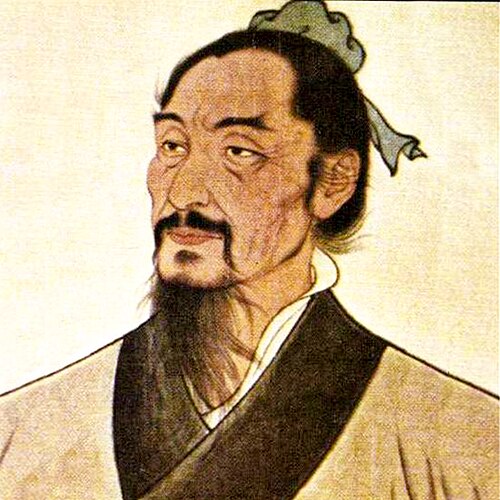
Start at the top for an easy introduction. Go further down for more detail and scholarship.
- Easy
- Intermediate
- Advanced
For young readers
Mozi lived in China about 2,400 years ago, around the same time as Socrates in Greece. China then was split into many kingdoms that often fought each other. Mozi thought: why do people steal, fight and make war? His answer was that people care only about themselves, their own family or their own country.
So he taught something simple and surprising: care about other people’s families as much as your own, and other people’s countries as much as your own. If everyone did this, he said, no one would attack anyone, and the whole world would be better off.
Mozi hated wars of conquest. He said that if killing one person is a crime, then killing thousands in a war is a much bigger crime, even if kings call it glorious. But he was not helpless against attackers. He and his followers became experts at defending cities, with walls, ladders, machines and clever plans.
There is a famous story. A great inventor named Gongshu Ban built giant siege ladders for the powerful kingdom of Chu so it could attack the small state of Song. Mozi walked for ten days and nights to Chu, and played a war game with Gongshu Ban using his belt as a city wall and small wooden sticks as machines. Every attack Gongshu Ban tried, Mozi defended against. In the end the king of Chu gave up the attack.
Mozi also said that rulers should not waste money on fancy funerals and huge music shows while ordinary people were hungry and cold. He wanted leaders chosen because they were good and able, not because of their family. His followers wrote down his ideas in a book, also called the Mozi.
At a glance
- Lived
- About 470–391 BCE (dates are estimates; some scholars place him 480–390 BCE)
- Place
- Warring States China; associated with the states of Lu and Song (modern Shandong and Henan)
- Personal name
- Mo Di (墨翟); “Mozi” means “Master Mo”
- School
- Founder of Mohism (墨家, Mojia), one of the leading schools of the Hundred Schools of Thought
- Key teachings
- Inclusive care (兼愛 jian ai), condemning aggressive war (非攻 fei gong), promoting the worthy, moderation in spending
- Text
- The Mozi, compiled by his followers; 71 chapters in the Han catalogue, 53 surviving
- Also known for
- Techniques of city defence; the later Mohist “Canons” on logic, optics, geometry and mechanics
- Contemporaries
- Lived after Confucius and before Mencius; roughly contemporary with Socrates
Easy
Who was Mozi?
Mozi, whose personal name was Mo Di, was a Chinese philosopher of the fifth century BCE. He lived during the early Warring States period, when the old Zhou kingdom had broken into rival states that fought constant wars. It was a time of suffering, but also of intellectual creativity, later called the age of the “Hundred Schools of Thought”.
He founded the Mohist school, which for about two centuries was one of the two most prominent schools of thought in China, alongside the Confucians. Later writers often mentioned “Confucians and Mohists” (儒墨) together as the leading rival teachings.
Mozi is best known for three ideas: that we should care for all people impartially, not only for those close to us; that wars of aggression are wrong; and that government should serve the benefit of ordinary people, not the luxury of rulers. He was also unusual in that he and his followers were organised almost like a disciplined order, and they put their beliefs into practice by helping small states defend themselves.
After the unification of China under Qin and Han, Mohism faded away and was almost forgotten for nearly two thousand years. It was rediscovered by scholars in the eighteenth and nineteenth centuries and is now seen as one of the most original traditions in Chinese thought.
Easy
Caring for everyone: jian ai
The most famous Mohist teaching is jian ai (兼愛). Jian means “together, including all”, and ai means “love” or “care”. It is often translated “universal love”, but many scholars today prefer “inclusive care” or “impartial caring”, because Mozi was not talking mainly about feelings. He meant being concerned for the welfare of others and acting to benefit them.
Mozi began with a question: where does disorder in the world come from? He answered that it comes from “partiality”: thieves love their own household and steal from others; nobles love their own clan and attack others; rulers love their own state and invade others. The cure is to replace partiality with inclusiveness: to regard others’ families as one’s own family and others’ states as one’s own state.
Critics said this was impossible. Mozi answered with practical examples. If you had to go on a long journey and leave your family in someone’s care, would you choose a friend who cares only for his own family, or one who cares for others as for his own? Everyone, he argued, would choose the inclusive friend, even those who say they reject inclusive care. And he pointed to ancient sage-kings, such as Yu, who had worked tirelessly for the benefit of all.
Mohists did not say that people must stop caring for their own parents. They argued that inclusive care is the best way to benefit one’s parents too: if I care for other people’s parents, they will care for mine.
Easy
Against war, but ready to defend
The second great Mohist teaching is fei gong (非攻), “condemning aggression”. Mozi pointed out a contradiction. If someone steals a peach from an orchard, everyone calls it wrong. If someone kills an innocent person, everyone calls it a crime. Yet when a ruler invades another state, killing thousands and seizing their land, people praise it as righteous and write it down in history. Mozi said this is like calling a little black “black” but a lot of black “white”.
He also argued that wars were bad even for the aggressor. They wasted grain, weapons, horses and lives, took farmers away from their fields and left widows and orphans behind. Any gains were small compared with the losses.
Mohists did not believe in simply giving in. They became specialists in defensive warfare, and several chapters of the Mozi describe how to fortify walls, build defensive machines, dig tunnels, organise the population and resist siege techniques. The idea was that if attacks always failed, aggression would stop paying.
The most famous story, in the chapter called “Gongshu”, tells how the engineer Gongshu Ban built “cloud ladders” for the state of Chu to attack Song. Mozi walked ten days and nights to the Chu capital, argued with Gongshu Ban and the king, and then held a mock battle with his belt as a wall and small tablets as machines. Gongshu Ban attacked nine times and Mozi repelled him nine times. Mozi added that his disciple Qin Guli and three hundred Mohists were already waiting on the walls of Song. The king called off the attack. The story ends with a gentle irony: on the way home through Song, Mozi was caught in the rain, and the gatekeepers of the city he had just saved would not let him in.
Intermediate
Life and times: what we know and do not know
Very little is securely known about Mozi’s life. The great Han historian Sima Qian did not write a biography of him; he added only one short sentence at the end of the biography of Mencius and Xunzi, saying that Mo Di was perhaps an official of Song, skilled in defence, who advocated economy in spending, and that some say he lived at the same time as Confucius and others later. Scholars today generally date him to the late fifth and early fourth centuries BCE, after Confucius (died 479 BCE) and before Mencius (born about 372 BCE).
His home state is also debated. Many place him in Lu, the home of Confucius; others connect him with Song, whose capital was near modern Shangqiu and where he may have served; a few have proposed other states. The book that bears his name shows him travelling to Qi, Chu, Wei and other states, advising rulers and sending disciples to serve in government.
According to the Han-era Huainanzi, Mozi first studied the teachings of the Confucians but rejected them, finding their rituals too complicated and their long mourning practices wasteful. Whether or not this is true, much of the Mozi is written in debate with Confucians.
Even his name is puzzling. Mo (墨) means “ink” and was also the name of a punishment, tattooing the face of a criminal. Some scholars have suggested that “Mo” was not a family name but a nickname for a group of convict labourers or craftsmen. Others think it was simply his surname. The text’s many comparisons with carpenters, wheelwrights and builders, and its technical knowledge, have led many to think that Mozi came from a background of artisans rather than from the aristocracy.
Intermediate
The ten core doctrines
The central part of the Mozi is organised around ten doctrines, each originally discussed in three essays. They are usually grouped in five pairs. Promoting the worthy (尚賢 shang xian) and identifying upward (尚同 shang tong): officials should be chosen for their ability and virtue, even if they are farmers or craftsmen, and everyone should follow the moral standards of their good superiors up to the Son of Heaven, and ultimately Heaven itself, so that society shares one set of norms.
Inclusive care (兼愛 jian ai) and condemning aggression (非攻 fei gong), explained above.
Moderation in use (節用 jie yong) and moderation in burial (節葬 jie zang): rulers should spend only on what is useful for people’s food, clothing, shelter and safety. Mohists attacked the elaborate funerals and three-year mourning periods that Confucians defended, arguing that they impoverished families and stopped people from working.
Heaven’s intent (天志 tian zhi) and understanding ghosts (明鬼 ming gui): Heaven (tian) desires righteousness and wants people to benefit one another; it rewards those who follow its will and punishes those who do not. Spirits and ghosts exist and also reward good and punish evil. Mohists used this to give ethics a firm, objective standard.
Condemning music (非樂 fei yue) and condemning fatalism (非命 fei ming): Mozi did not deny that music is pleasant, but he condemned costly court performances with great bells and orchestras, which took resources from the poor. He also rejected the belief that success and failure, wealth and poverty are fixed by fate, which he thought made people lazy and excused bad government.
Intermediate
How Mohists reasoned: standards and benefit
One of the Mohists’ great contributions was the idea that arguments should be tested against clear standards, like a carpenter’s compass and square. They proposed “three standards” (三表 san biao, also called 三法 san fa) for judging a claim: its root, whether it agrees with the deeds of the ancient sage-kings; its source, whether it agrees with what ordinary people have actually seen and heard; and its use, whether putting it into practice benefits the state and the people.
The most important test was benefit (利 li). Mohists judged actions, customs and policies by whether they promoted the benefit of the world and eliminated harm: specifically, whether they made the people wealthy, the population numerous and society orderly. Because of this, many modern scholars compare Mohist ethics with consequentialism or utilitarianism in Western philosophy, though the comparison has limits: Mohists focused on the welfare of the whole community rather than on individual pleasure.
Mohists also used the model of Heaven: Heaven is impartial, cares for all people and provides for them all, so it is the best standard (法 fa) for human conduct. In this way Mohist thought combined religious belief with a practical, public-minded ethics.
Their writing style reflects this. The core chapters are plain, repetitive and argumentative, built on analogies and examples rather than elegant style. Critics in ancient times found them dull; modern readers often see them as the first systematic argumentative essays in Chinese.
Intermediate
The Mohist community
Mohists were not just a school of ideas but an organised community. Members were expected to live simply, wear coarse clothes, work hard and obey their leader, who was called the juzi (鉅子), “grand master”. Mohists served as officials or defence specialists in various states and were expected to share part of their income with the group.
The Lüshi chunqiu, a third-century BCE compilation, tells stories that illustrate their discipline: a Mohist leader whose son had killed someone insisted that the son be executed according to Mohist law, even though the king offered a pardon; another leader and many followers are said to have died defending a city they had promised to protect. These stories may be idealised, but they show how Mohists were remembered.
After Mozi’s death the movement split. The legalist philosopher Han Feizi, writing in the third century BCE, says that the Mohists had divided into three factions, each claiming to be the true heirs of Mozi. Other texts mention Mohists in different regions who disputed doctrine and called each other heretics.
Intermediate
The book Mozi
The Mozi was not written by Mozi himself. It is a collection of writings by several generations of his followers, composed between the fifth and third centuries BCE. The Han imperial library catalogue listed it with 71 chapters (pian); 53 survive. The text was poorly preserved for centuries, because few people read it, and many passages are corrupt or difficult.
The book has several parts. A few opening chapters are short essays of mixed date. The core chapters present the ten doctrines, each originally in three versions (“upper”, “middle” and “lower”), though several are lost. Then come the Mohist “Canons” and related chapters on logic, ethics and science; dialogues and anecdotes about Mozi and his followers, including the Gongshu story; and finally a group of technical chapters on city defence.
Most core chapters begin with the words “Our master Mozi said”, showing that they were composed by disciples who presented their teachings in his name. The existence of three versions of each doctrine is one of the great puzzles of the text.
Advanced
The later Mohists: logic, language and science
In the fourth and third centuries BCE, later Mohists produced a remarkable set of texts known as the Mohist Canons (墨經 Mo jing), with their Explanations, and two further chapters, “Greater Pick” (Da qu) and “Lesser Pick” (Xiao qu). They are written in extremely compressed, often damaged form, and understanding them required modern textual reconstruction.
These texts contain the earliest systematic Chinese treatment of what we might call logic and philosophy of language. They discuss disputation (辯 bian), the practice of distinguishing “this” from “not this”; the relation between names (名 ming) and things (實 shi); different kinds of knowledge; and how analogical arguments can go wrong. The Lesser Pick examines patterns of inference and shows that sentences of the same form may not behave the same way.
They also include definitions and propositions in geometry (such as definitions of points, lines and circles), mechanics (levers, balance and pulleys) and optics. The optical canons describe shadows, plane and curved mirrors, and how light passing through a small hole forms an inverted image, which is why Mozi is often credited with the earliest known description of the principle of the camera obscura, though these passages were written by later Mohists.
The landmark modern study is A. C. Graham’s Later Mohist Logic, Ethics and Science (1978), which reconstructed and translated these chapters. Since then scholars such as Chris Fraser have explored how Mohist views of language and knowledge differ from Western logic, emphasising practical skill in drawing distinctions rather than abstract truth.
Advanced
Rivals, decline and scholarly debates
Mohism provoked strong reactions. Mencius, the great Confucian, said that Mozi’s inclusive care meant “not acknowledging one’s father” (無父), and that it and the teachings of Yang Zhu were dangerous doctrines that he must refute. Yet Mencius also admitted that Mozi would wear himself out from head to heel if it would benefit the world. Xunzi criticised Mozi for valuing utility and ignoring cultural refinement, and the Zhuangzi’s final chapter says his way was too harsh for human nature, though it praises him as a truly remarkable man.
Why did Mohism disappear? Proposed reasons include: the unification of China in 221 BCE ended the multi-state world in which defence specialists were needed; the Han state increasingly favoured Confucian learning; the Mohist organisation, with its strict discipline and independent loyalties, may have seemed threatening to imperial power; and some Mohist ideas, such as meritocracy and a unified standard of right, were absorbed into other traditions. Scholars disagree on how to weigh these factors.
The composition of the core chapters is another major debate. A. C. Graham suggested that the three versions of each doctrine represent the three factions mentioned by Han Feizi. Other scholars, including contributors to The Mozi as an Evolving Text (2013), argue that the versions reflect a developing tradition over time rather than rival sects. Translation matters too: “universal love” can suggest a Christian-sounding emotional love, while “inclusive care” or “impartial concern” stress practical benefit.
Finally, scholars debate how Mohist ethics should be classified. It has been called an early form of consequentialism, a divine command theory based on Heaven’s will, or a distinct ethics of social benefit. Many now think each label captures only part of the picture.
Intermediate
Rediscovery and legacy
For almost two thousand years the Mozi was rarely studied, but it was preserved in the Daoist canon. In the Qing dynasty, scholars interested in evidential research began to edit it. Bi Yuan published an annotated edition in 1783, and Sun Yirang’s Mozi xiangu (墨子閒詁), completed in the 1890s, became the standard commentary.
In the late nineteenth and early twentieth centuries, Chinese intellectuals such as Liang Qichao and Hu Shi found in Mohism an indigenous tradition of logic, science, equality and public-spiritedness, which they compared with Western thought. Mozi was celebrated as a thinker of the common people and, later in the twentieth century, as a model scientist and engineer.
Mozi’s name is honoured today in many ways. In 2016 China launched a quantum science satellite named Micius, the Latinised form of Mozi’s name, in recognition of his early work on optics. His opposition to aggressive war and his ideal of caring for all people are also often discussed in modern debates on ethics, international relations and the idea of an impartial moral point of view.
In Korea and Japan, Mohism was known mainly through Confucian criticism for most of history, but modern scholarship there, as elsewhere, has shown renewed interest in Mozi as a thinker of peace and social welfare.
Key ideas
- Inclusive care (jian ai)
- Being concerned for the welfare of all people impartially, regarding others’ families and states as one’s own.
- Condemning aggression (fei gong)
- Wars of conquest are crimes on a large scale and harm even the aggressor; defensive war is justified.
- Benefit (li)
- The key standard of right: whatever enriches the people, increases the population and brings order is good.
- Three standards (san biao)
- Tests of a claim by its roots in the sage-kings, its basis in people’s experience, and its practical benefit.
- Promoting the worthy (shang xian)
- Government positions should go to capable, virtuous people regardless of birth.
- Heaven as standard
- Heaven is impartial and caring; its will is the objective model for human conduct.
- Moderation
- Rulers should avoid lavish funerals, music and luxuries that waste the resources of the people.
- Disputation (bian)
- The later Mohists’ systematic study of drawing distinctions and making valid inferences.
Records
- 551 BCE — Confucius is born (551 BCE).
- 479 BCE — Confucius dies (479 BCE).
- 475 BCE — Conventional start of the Warring States period (475 BCE).
- c. 470 BCE — Mozi is born, probably in Lu or Song (about 470 BCE).
- c. 391 BCE — Mozi dies (about 391 BCE); his followers continue as an organised school.
- c. 372 BCE — Mencius, a fierce critic of Mohism, is born (about 372 BCE).
- c. 300 BCE — Later Mohists compose the Canons on logic, optics and mechanics (4th–3rd centuries BCE).
- c. 239 BCE — The Lüshi chunqiu records stories of Mohist leaders (about 239 BCE).
- 221 BCE — Qin unifies China (221 BCE); Mohism soon declines.
- 1783 — Bi Yuan publishes an annotated edition of the Mozi.
- c. 1894 — Sun Yirang completes Mozi xiangu, the standard commentary.
- 2016 — China launches the quantum science satellite Micius, named after Mozi.
Glossary
- Mohism (Mojia)
- The school of thought founded by Mozi and carried on by his followers.
- Warring States period
- The era (475–221 BCE) when rival Chinese states fought until Qin unified China.
- Hundred Schools of Thought
- The many competing philosophies of the Spring and Autumn and Warring States periods.
- Jian ai (兼愛)
- Inclusive or impartial care; often translated “universal love”.
- Tian (天)
- Heaven, understood by Mohists as a purposeful, caring and impartial power.
- Juzi (鉅子)
- The leader of a Mohist group.
- Li (利)
- Benefit or welfare, the Mohist criterion of right action.
- Bian (辯)
- Disputation; argument about which distinctions are correct.
- Mohist Canons (墨經)
- Technical chapters of the Mozi on logic, ethics, geometry, mechanics and optics.
- Consequentialism
- A family of ethical theories that judge actions by their results.
Questions and answers
Did Mozi say we should love strangers as much as our parents?
He said we should care for others’ families as for our own. Mohists argued this was also the best way to take care of our own parents, since others would do the same for them.
Was Mozi a pacifist?
Not exactly. He condemned wars of aggression but supported defence, and his followers were skilled in protecting cities from attack.
Did Mozi invent the camera?
No. But the later Mohist Canons describe how light through a small hole makes an upside-down image, the principle of the camera obscura. They are among the earliest known descriptions.
Why was Mohism forgotten for so long?
After China was unified, there was less need for defence experts, the state favoured Confucianism, and the Mohist organisation may have seemed a threat. Scholars still debate the reasons.
How did Confucians and Mohists disagree?
Confucians stressed graded love starting from family, ritual and music; Mohists stressed impartial care, frugality and practical benefit, and criticised costly rituals.
Why are there three versions of each core chapter?
No one is sure. A. C. Graham linked them to three Mohist factions; others see them as layers of a text that developed over time.
Is Mozi like Socrates?
They lived at about the same time and both argued about how to live, left no writings of their own and were known through followers. But their ideas and methods were quite different.
Sources and further reading
- Chris Fraser, Mohism. Stanford Encyclopedia of Philosophy
- Chris Fraser, Mohist Canons. Stanford Encyclopedia of Philosophy
- Hui-chieh Loy, Mozi (Mo-tzu, c. 400s–300s B.C.E.). Internet Encyclopedia of Philosophy
- Mozi. Wikipedia
- Mohism. Wikipedia
- 묵자. 위키백과
- Mozi (Chinese text with partial English translation). Chinese Text Project
- Micius (satellite). Wikipedia
- A. C. Graham, Later Mohist Logic, Ethics and Science. Chinese University Press, 1978
- Carine Defoort and Nicolas Standaert (eds.), The Mozi as an Evolving Text: Different Voices in Early Chinese Thought. Brill, 2013
Related
- ConfuciusTeacher from the state of Lu whose sayings, gathered in the Analects, shaped ethics and government across East Asia.
- MenciusA Confucian thinker who argued that people have the beginnings of moral goodness and that rulers must care for their subjects.
- LaoziTraditionally named author of the Daodejing. Whether he was a single historical person is still debated.
- ZhuangziA Chinese thinker associated with Daoism and with writings that question fixed judgments and conventional ambitions.
- SocratesAthenian philosopher who wrote nothing himself. Known through Plato and Xenophon, he was tried and executed in 399 BCE.
- The Art of WarAn early Chinese treatise on warfare traditionally attributed to Sunzi; its authorship and date are debated.
Written with AI assistance from the published sources listed above, and revised as new research appears.