Start at the top for an easy introduction. Go further down for more detail and scholarship.
- Easy
- Intermediate
- Advanced
For young readers
About 2,400 to 2,500 years ago, in the north of India near the mountains of Nepal, a boy named Siddhartha was born into an important family of the Shakya people. The old stories say his father wanted to keep him happy and gave him palaces, fine clothes and music, so that he would never see anything sad.
But when Siddhartha grew up, the stories say he went outside the palace and saw four things he had never seen: a very old man, a sick man, a dead body and a calm holy man who had given up everything. He realized that everyone gets old, gets sick and dies, even princes. He wanted to find out why people suffer and whether there is a way to be truly free.
So at about 29 years old he left his home and became a wandering seeker. For years he tried very hard things, like eating almost nothing, but that only made him weak. Then he chose a “middle way”: not too much comfort and not too much hardship. One night he sat under a big fig tree and meditated, calmly watching his mind. By morning, Buddhists say, he understood the truth and became “the Buddha”, which means “the one who woke up”.
For the next 45 years he walked from town to town, teaching anyone who wanted to listen, rich or poor, men and women. He taught that wanting things too much makes us unhappy, and that we can become free by being kind, telling the truth, not hurting living beings, and training our minds to be calm and clear.
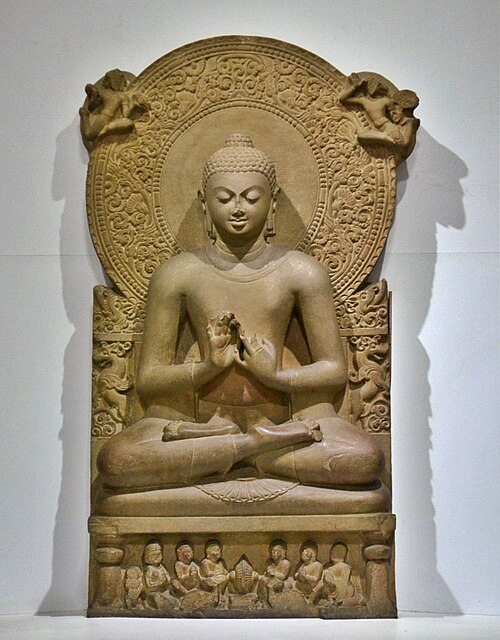
The Buddha died when he was about 80. His followers remembered his teachings by heart and later wrote them down. Today hundreds of millions of people around the world follow Buddhism, and statues of the Buddha sitting peacefully can be found from Sri Lanka and Thailand to China, Korea and Japan.
At a glance
- Dates
- Uncertain. Traditional “long chronology” c. 563–483 BCE; many modern scholars place his death around 400 BCE (lifespan c. 480–400 BCE)
- Born
- Lumbini, in present-day southern Nepal (by tradition, confirmed as a pilgrimage site by an inscription of Ashoka)
- People
- The Shakyas (Śākya), a community governed by a council of leading men, near the Himalayan foothills
- Awakening
- Under a pipal (fig) tree at Bodh Gaya, in Magadha (modern Bihar, India), at about age 35
- First teaching
- The Deer Park at Sarnath, near Varanasi
- Death
- Kushinagar (Kusinārā), at about age 80, an event Buddhists call the parinirvana
- Names and titles
- Siddhartha Gautama; Shakyamuni (“sage of the Shakyas”); Tathagata (“thus-gone one”); Buddha (“awakened one”)
- Teachings
- Four Noble Truths, Noble Eightfold Path, the Middle Way, non-self, impermanence, dependent origination
Easy
Who was the Buddha?
“Buddha” is not a name but a title. It comes from a Sanskrit and Pali word meaning “awakened” or “one who has woken up”. Buddhists use it for anyone who has fully understood the truth about suffering and freedom by themselves and teaches it to others. When people say “the Buddha” they usually mean the Buddha of our era: Siddhartha Gautama (in Pali, Siddhattha Gotama), who lived in northern India in the 5th century BCE, or perhaps a little earlier.
He is also called Shakyamuni, the “sage of the Shakyas”, after the people he was born among, and Tathagata, “the one who has thus gone”, a title he used for himself in the early texts. His followers regard him not as a god or a creator but as a human being who reached the highest possible understanding and showed others the way.
The Buddha founded a community of monks and nuns, the sangha, and a teaching, the Dharma. Together with the Buddha himself, these are called the “Three Jewels” in which Buddhists take refuge. From northern India his teaching spread across Asia and later the world, becoming one of the great religious and philosophical traditions of humanity.
Easy
The life story: from palace to awakening
The traditional life story, told in many versions, runs as follows. Siddhartha was born in the Lumbini grove to Queen Maya and Suddhodana, leader of the Shakyas, whose town was Kapilavastu. His mother died soon after his birth, and he was raised by her sister, Mahapajapati. He married Yasodhara and had a son, Rahula.
Later versions describe the “four sights”: an old man, a sick man, a corpse and a wandering ascetic. Deeply moved, Siddhartha left home at about 29, cutting his hair and putting on simple robes. He studied meditation with two teachers, Alara Kalama and Uddaka Ramaputta, and reached very high states of calm, but felt these were not final freedom. He then practised extreme austerities, fasting almost to death, with five companions.
Deciding that neither indulgence nor self-torture leads to freedom, he accepted food and turned to a balanced path, which he later called the Middle Way. Sitting in meditation under a pipal tree at Bodh Gaya, he faced the temptations and threats of Mara, a figure of death and desire, and, according to tradition, attained awakening (bodhi) at about 35. The tree is honoured as the Bodhi tree.
The oldest texts are more modest than the later legends. They contain few biographical details and hardly mention the four sights, which appear in full only in later biographies such as Ashvaghosha’s Sanskrit poem Buddhacarita (“Acts of the Buddha”, around the 1st–2nd century CE). Readers should enjoy the story while remembering that it grew over time.
Easy
Forty-five years of teaching
After his awakening the Buddha walked to the Deer Park at Sarnath, near Varanasi, and gave his first teaching to his five former companions. Buddhists call this event “setting the wheel of the Dharma in motion”. The five became the first monks.
For about 45 years he travelled on foot through the kingdoms and republics of the middle Ganges plain, especially Magadha and Kosala, staying in one place during the rainy season. Kings such as Bimbisara of Magadha and Pasenadi of Kosala, as well as merchants like Anathapindika, supported him and gave the community parks and monasteries. His followers included people of many backgrounds, from Brahmins and nobles to barbers, courtesans and outcasts.
According to the texts, his stepmother Mahapajapati asked to be ordained, and after initial hesitation the Buddha allowed women to become nuns (bhikkhunis). This made the Buddhist order one of the earliest known religious communities for women; how the later rules that placed nuns under monks came about is discussed by historians.
At about 80, weakened by illness after a meal, he died at Kushinagar. His last words, as recorded in the Pali text Mahaparinibbana Sutta, urged his followers to strive on with diligence, since all conditioned things are subject to decay. His body was cremated, and his relics were divided among several peoples, who built mounds called stupas over them.
Intermediate
The core teaching: the Four Noble Truths and the Eightfold Path
The Four Noble Truths are often compared to a doctor’s method. First, the illness: life is marked by dukkha, a word meaning suffering, pain, unsatisfactoriness or stress. Birth, ageing, sickness and death are dukkha; so is being separated from what we love and not getting what we want. Second, the cause: dukkha arises from craving (tanha), the thirst for pleasure, for existence and for non-existence. Third, the cure: when craving ceases, dukkha ceases; this is nirvana (Pali nibbana), literally the “blowing out” of the fires of greed, hatred and delusion. Fourth, the medicine: the Noble Eightfold Path.
The Eightfold Path has eight parts: right view, right intention, right speech, right action, right livelihood, right effort, right mindfulness and right concentration. They are traditionally grouped into three trainings: ethics (speech, action, livelihood), meditation (effort, mindfulness, concentration) and wisdom (view, intention). It is not a ladder of eight steps but a set of qualities to develop together.
For lay followers, the basic ethics are summarized in the Five Precepts: not killing, not stealing, not engaging in sexual misconduct, not lying, and not taking intoxicants that cloud the mind. Generosity (dana) and loving-kindness (metta) toward all beings are central virtues.
Intermediate
Big ideas: impermanence, non-self and dependent origination
The Buddha taught that all conditioned things share three marks: they are impermanent (anicca), they cannot give lasting satisfaction (dukkha), and they are not-self (anatta). A person, in this analysis, is made of five changing “aggregates” (khandhas): form, feeling, perception, mental formations and consciousness. Nowhere among them is there an unchanging, independent self or soul. This was a striking contrast with the teaching of some Upanishads, which identified the true self (atman) with the ultimate reality (brahman).
Dependent origination (paticca-samuppada) explains how dukkha arises through a chain of conditions, often presented as twelve links from ignorance to ageing and death. The general principle is simple: “when this exists, that comes to be; when this ceases, that ceases.” Nothing arises by itself or without causes.
The Buddha accepted the widespread Indian belief in rebirth and karma, but gave karma an ethical, psychological meaning: what matters is intention. He famously refused to answer certain metaphysical questions, such as whether the world is eternal or what happens to an awakened person after death, saying they were not useful for ending suffering. The parable of the man struck by a poisoned arrow, who refuses treatment until he knows who shot it, illustrates this practical attitude.
Intermediate
The world of the Ganges plain
The Buddha lived during a period of rapid change in northern India, often called the “second urbanization”. Towns and trade were growing along the Ganges; coins came into use; powerful kingdoms such as Magadha and Kosala were expanding at the expense of smaller states. The Shakyas themselves were not a kingdom but a gana-sangha, a community ruled by an assembly or council of leading families; Suddhodana was probably one such leader rather than a king, and was later remembered as a “king” as the legend grew.
Religious life was also changing. Brahmin priests performed Vedic sacrifices and claimed the highest status in society. At the same time many śramaṇas (wandering ascetics) rejected the authority of the Vedas and sought liberation through renunciation, meditation and austerity. The Jain teacher Mahavira and the Ajivikas were among the Buddha’s contemporaries and rivals. Johannes Bronkhorst has argued that the region of “Greater Magadha” had its own non-Vedic culture from which these movements grew.
The Buddha’s teaching engaged critically with all of these currents. He redefined the word “Brahmin” as someone noble in conduct rather than by birth, rejected animal sacrifice, and offered a path open to people of any class. Yet he also borrowed and reshaped much of the vocabulary of his time, such as karma, rebirth, dharma and yoga-like meditation.
Intermediate
How the teachings were preserved
The Buddha wrote nothing. His teachings were memorized and recited by monks and nuns, arranged into collections of discourses (suttas or sutras) and monastic rules (vinaya). Tradition says a first council of 500 senior monks met at Rajagriha soon after his death to recite them; a second council met at Vaishali about a century later. Historians regard these accounts as partly legendary but agree that oral recitation was highly organized.
The most complete early collection surviving in an Indian language is the Pali Canon, preserved by the Theravada tradition of Sri Lanka and Southeast Asia. According to Sri Lankan chronicles, it was first written down in Sri Lanka in the 1st century BCE. Parallel collections, called Agamas, survive mostly in Chinese translation, with fragments in Sanskrit, Gandhari and Tibetan. Birch-bark manuscripts from Gandhara, dating from about the 1st century BCE to the 3rd century CE, are among the oldest Buddhist manuscripts ever found.
When the Pali and Chinese versions agree closely, scholars think the shared material probably goes back to a very early stage, before the various schools split. This comparative method is the main tool for approaching what the Buddha himself may have taught.
Intermediate
Spread and legacy
About two centuries after the Buddha, the Mauryan emperor Ashoka supported Buddhism and sent envoys across and beyond India. Around 249 BCE he visited Lumbini and set up a stone pillar whose inscription records that “here the Buddha, sage of the Shakyas, was born” and that he reduced the village’s taxes. Buddhism reached Sri Lanka in Ashoka’s time, and later spread along trade routes to Central Asia, China (by the 1st century CE), Korea (from the 4th century), Japan (6th century), Tibet (7th–8th centuries) and Southeast Asia.
As it spread, Buddhism developed several great traditions: Theravada in Sri Lanka and much of Southeast Asia; Mahayana, which emphasizes the bodhisattva path and many Buddhas, in East Asia; and Vajrayana in Tibet, Mongolia and the Himalayas. In India itself Buddhism declined after about the 12th century, but was revived in the 20th century, notably through B. R. Ambedkar’s mass conversion of Dalits in 1956.
For centuries the Buddha was represented in art only by symbols, such as a footprint, an empty seat, a wheel or a tree. Images of the Buddha in human form appeared around the 1st century CE in Gandhara and Mathura and became one of the most recognizable images in world art. His birthday and awakening are celebrated as Vesak in South and Southeast Asia and as Buddha’s Birthday in East Asia. Lumbini and the Mahabodhi Temple at Bodh Gaya are UNESCO World Heritage Sites and major pilgrimage places.
Advanced
When did the Buddha live? The dating problem
No contemporary source dates the Buddha. All chronologies are calculated backwards from Ashoka, whose reign can be fixed approximately (he came to the throne around 268 BCE) through his inscriptions’ references to Hellenistic kings. The problem is how many years separate the Buddha’s death from Ashoka.
The “long chronology” of the Sri Lankan chronicles places the death 218 years before Ashoka’s consecration. Adjusted by Western scholars, this gave the familiar dates of about 563–483 BCE (or 566–486), which were standard for most of the 20th century. The Theravada tradition itself counts the Buddhist Era from 544/543 BCE, which is why the “2,500th anniversary” was celebrated in 1956–57. A “short chronology”, preserved in Sanskrit and Chinese sources of northern schools, places the death only about 100 years before Ashoka, around 368 BCE.
At a symposium in Göttingen in 1988, organized by Heinz Bechert, most participants placed the Buddha’s death within about twenty years of 400 BCE. Richard Gombrich has argued for a death around 404 BCE, and many handbooks now give approximately 480–400 BCE. The question is not settled, and arguments rest on how much weight to give lineage lists of monks, the reliability of the chronicles, and archaeological evidence for urbanization in the Ganges valley.
Advanced
The historical Buddha and the problem of sources
In the 19th century some European scholars, such as Émile Senart, suggested that the Buddha legend was largely a solar myth. Today almost all scholars accept that a historical teacher lay behind the tradition, but they differ widely on how much can be known about him. The early texts were transmitted orally for centuries and edited by communities with their own interests; supernatural elements multiply in later layers.
Some specialists are relatively optimistic. They argue that the early discourses show a consistent, distinctive philosophy that is likely to go back to a single creative mind, and that they preserve realistic details of places and social conditions. Others are more sceptical, stressing that the surviving canons were shaped by later sectarian disputes and monastic interests. Gregory Schopen, for example, has emphasized that inscriptions and archaeology sometimes reveal a monastic life quite different from the ideals described in the texts.
Archaeology offers important but limited evidence. Ashoka’s Lumbini pillar (discovered in 1896) shows that by the 3rd century BCE Lumbini was venerated as the birthplace. A relic casket found at Piprahwa in 1898 bears an early Brahmi inscription that many read as referring to relics of the Buddha of the Shakyas, though its date and reading are debated. Whether ancient Kapilavastu lay at Tilaurakot in Nepal or Piprahwa in India is also disputed. Excavations beneath the Maya Devi temple at Lumbini, published in 2013 by a team including Robin Coningham, reported traces of an early timber structure that they dated to around the 6th century BCE; the interpretation of these findings for the Buddha’s dates is contested.
Advanced
What did the Buddha originally teach? Interpretive debates
Scholars and Buddhist traditions disagree on several core questions. Was the teaching of non-self a metaphysical denial that any self exists, or a practical strategy for letting go of attachment without making a claim about ultimate reality? Different Buddhist schools and modern philosophers defend both readings. Mark Siderits, among others, reads it as a reductionist account of persons; others see the Buddha as deliberately avoiding metaphysics.
Another debate concerns the relation between meditation and insight. Scholars such as Lambert Schmithausen and Johannes Bronkhorst have argued that the early texts contain tension between liberation through deep meditative absorption and liberation through discriminating insight, perhaps reflecting different strata. Richard Gombrich has emphasized how the Buddha’s ideas respond to, and often ironically reinterpret, Brahmanical terms, which he sees as evidence of a single original thinker.
Finally, Mahayana traditions hold that the Buddha taught at different levels for different audiences and that sutras such as the Lotus Sutra represent his fuller teaching, while historical scholarship places those texts centuries after his death. These perspectives answer different questions, historical and religious, and both are important for understanding how the Buddha has been understood across Asia.
Key ideas
- Four Noble Truths
- Suffering exists; it arises from craving; it can cease; the Eightfold Path leads to its cessation.
- Middle Way
- A path between sensual indulgence and harsh self-torture; also, in philosophy, between eternalism and annihilationism.
- Noble Eightfold Path
- Right view, intention, speech, action, livelihood, effort, mindfulness and concentration, developed together as ethics, meditation and wisdom.
- Non-self (anatta)
- No permanent, independent self is found among the changing parts of a person.
- Impermanence (anicca)
- Everything that arises from conditions changes and passes away.
- Dependent origination
- Everything arises in dependence on conditions; suffering arises through a chain of causes and ends when they end.
- Nirvana
- The ending of craving and suffering, the “blowing out” of greed, hatred and delusion.
- Karma as intention
- Actions have consequences, and what matters morally is the intention behind them.
Records
- c. 563 BCE — Traditional (long chronology) date for Siddhartha’s birth at Lumbini, c. 563 BCE.
- c. 544 BCE — Theravada tradition dates the Buddha’s parinirvana to 544/543 BCE, the start of the Buddhist Era.
- c. 480 BCE — Birth c. 480 BCE, according to the chronology favoured by many modern scholars.
- c. 400 BCE — Death at Kushinagar around 400 BCE, according to many modern scholars.
- c. 249 BCE — Emperor Ashoka visits Lumbini and erects an inscribed pillar marking the birthplace (in his 20th regnal year).
- c. 29 BCE — According to Sri Lankan chronicles, the Pali Canon is written down in Sri Lanka.
- c. 100 CE — Ashvaghosha composes the Buddhacarita; human images of the Buddha appear in Gandhara and Mathura.
- 1896 — The Ashokan pillar at Lumbini is uncovered, confirming the site of the birthplace tradition.
- 1898 — An inscribed relic casket is excavated at Piprahwa, India.
- 1956 — The 2,500th anniversary of the parinirvana (by Theravada reckoning) is celebrated; B. R. Ambedkar converts to Buddhism with many followers.
- 1988 — Göttingen symposium on the date of the historical Buddha; most participants favour a death near 400 BCE.
- 2002 — The Mahabodhi Temple at Bodh Gaya is inscribed on the UNESCO World Heritage List (Lumbini in 1997).
Glossary
- Buddha
- “Awakened one”; a title for someone who has fully realized the truth and teaches it.
- Dharma (Pali dhamma)
- The Buddha’s teaching; also the truth or law it describes.
- Sangha
- The community of Buddhist monks and nuns, and more broadly of all followers.
- Dukkha
- Suffering, stress or unsatisfactoriness; the first Noble Truth.
- Nirvana (Pali nibbana)
- Liberation; the extinguishing of craving and the end of rebirth.
- Parinirvana
- The final passing of a Buddha at death.
- Śramaṇa
- A wandering ascetic in ancient India who sought liberation outside Vedic ritual.
- Stupa
- A mound-shaped monument containing relics, a focus of Buddhist devotion.
- Pali Canon
- The collection of early Buddhist scriptures in the Pali language preserved by the Theravada tradition.
- Agamas
- Early Buddhist discourse collections of other schools, mostly preserved in Chinese translation.
- Bodhisattva
- A being on the way to buddhahood; in Mahayana, one who vows to free all beings.
Questions and answers
Is the Buddha a god?
In the early teachings, no. He is a human being who became fully awakened and taught others. Some later traditions describe Buddhas in more cosmic terms, but they are not creator gods.
Was the Buddha really a prince?
He came from a leading family of the Shakyas, but the Shakyas were probably governed by a council rather than a king. The picture of a royal prince in a palace grew over time.
Why is the Buddha often shown sitting with crossed legs?
It shows him in meditation, the practice through which he reached awakening. Hand gestures, such as touching the earth, recall particular moments in his life.
Why are the Buddha’s dates so uncertain?
No record from his lifetime survives. Scholars count backwards from Emperor Ashoka, but ancient traditions disagree about how long before Ashoka the Buddha died, by up to about a century.
Did the Buddha write any books?
No. His teachings were memorized and recited for centuries before being written down, in the Pali Canon and in other collections preserved mainly in Chinese.
What is the difference between Theravada and Mahayana?
Theravada, strong in Sri Lanka and Southeast Asia, preserves the Pali Canon and focuses on the path to liberation. Mahayana, strong in East Asia, adds many later sutras and emphasizes the bodhisattva ideal of freeing all beings.
Can we know what the historical Buddha actually taught?
Only approximately. Scholars compare parallel texts in Pali, Chinese and other languages; what they share probably goes back very early, but how close it is to the Buddha’s own words is debated.
Sources and further reading
- Mark Siderits, Buddha. Stanford Encyclopedia of Philosophy
- The Buddha. Wikipedia
- Four Noble Truths. Wikipedia
- Pāli Canon. Wikipedia
- Lumbini pillar inscription. Wikipedia
- Mahabodhi Temple. Wikipedia
- Rupert Gethin, The Foundations of Buddhism. Oxford University Press, 1998
- Richard F. Gombrich, What the Buddha Thought. Equinox, 2009
- Johannes Bronkhorst, Greater Magadha: Studies in the Culture of Early India. Brill, 2007
Related
- AshokaA Mauryan emperor whose inscriptions describe his commitment to dhamma after a devastating conquest of Kalinga.
- Early UpanishadsTexts that ask what the self (ātman) is and how it relates to ultimate reality (brahman) — a foundation of later Indian philosophy.
- NāgārjunaA Buddhist philosopher associated with the Madhyamaka school and its analysis of emptiness.
- Ajanta CavesA group of Buddhist rock-cut caves in western India, known for monasteries, shrines and paintings.
- BorobudurLarge Buddhist monument in Central Java, built around the eighth and ninth centuries.
- SeokguramEighth-century Buddhist grotto near Gyeongju, known for its granite Buddha and surrounding sculptures.
Written with AI assistance from the published sources listed above, and revised as new research appears.