Start at the top for an easy introduction. Go further down for more detail and scholarship.
- Easy
- Intermediate
- Advanced
For young readers
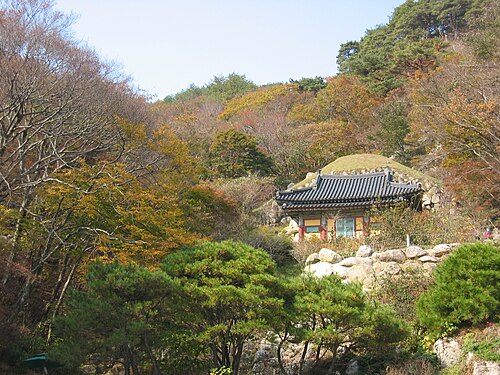
Most cave temples in the world were dug into a cliff. Seokguram is different: the people of the kingdom of Silla in Korea built their cave from the outside in, like building an igloo out of stone. They cut hundreds of granite blocks, fitted them together into a round room with a dome for a roof, and then covered the whole thing with earth so it looked like a cave inside a mountain.
Inside sits a big stone Buddha, taller than two grown-ups. His face is peaceful, with his eyes half closed as if he is thinking deeply. His right hand touches the ground. Buddhists tell the story that when the Buddha became enlightened, he touched the earth to call it as his witness.
All around him, carved on the walls, stand his helpers: fierce guardians with muscles and swords at the entrance, kings in armour who protect the four directions, gentle bodhisattvas, and ten of the Buddha’s students, each with a different face. Behind the Buddha is a goddess of kindness with eleven faces, so she can see everyone who needs help.
An old book tells how a man named Kim Daeseong built Seokguram for his parents from a past life. It also says that when the workers were making the round stone for the top of the dome, it cracked into three pieces, and in the night heavenly spirits came down and put it back together.
Seokguram sits high on Mount Toham near the old capital city of Gyeongju. Its Buddha faces east toward the sea, and people climb the mountain early in the morning to watch the sunrise.
At a glance
- Built
- Mid-8th century, Unified Silla; traditionally begun 751 and completed after 774 (planning may have begun as early as the 740s)
- Place
- Eastern slope of Tohamsan (Mount Toham), Gyeongju, North Gyeongsang Province, South Korea
- Patron
- Traditionally Kim Daeseong (d. 774), a Silla high official; completed by the royal court
- Original name
- Seokbulsa (石佛寺, “Stone Buddha Temple”)
- Structure
- Artificial grotto of cut granite: rectangular antechamber, corridor and round main chamber (about 6.6–6.8 m across) under a stone dome, covered by earth
- Sculpture
- 38 Buddhist figures today, centred on a seated Buddha making the earth-touching gesture
- Status
- National Treasure of Korea (designated 1962); UNESCO World Heritage with Bulguksa, 1995
- Significance
- A peak of East Asian Buddhist sculpture and a masterpiece of Silla engineering and geometry
Easy
What is Seokguram?
Seokguram is a Buddhist cave shrine on the eastern side of Tohamsan, a mountain just east of Gyeongju, the capital of the Korean kingdom of Silla. The name means “stone cave hermitage”; its earlier name, recorded in the Samguk yusa, was Seokbulsa, “Stone Buddha Temple”. It is linked administratively and historically with Bulguksa, the large temple on the western slope of the same mountain, about 3 km away by road.
What makes Seokguram unique is that it is an artificial grotto. In India, Central Asia and China, cave temples were usually carved directly into cliffs of soft rock. Korea’s mountains are made mostly of very hard granite, which is difficult to hollow out. Silla builders therefore constructed the “cave” from dressed granite blocks and slabs, roofed it with a stone dome, and heaped earth over it, creating the effect of a cave inside the mountain.
Inside, a monumental seated Buddha is surrounded by relief sculptures of guardians, gods, bodhisattvas and disciples arranged in a strict hierarchy. Together, the architecture and sculpture form one of the most admired ensembles in Buddhist art anywhere in Asia.
Seokguram was designated a National Treasure of Korea in 1962 and inscribed on the UNESCO World Heritage List together with Bulguksa in 1995. Today visitors view the interior from behind a glass partition that protects the sculptures.
Easy
How to “read” the grotto: a path from the world to enlightenment
The grotto has three parts arranged along a single east–west axis. First comes a rectangular antechamber, now covered by a wooden building added in the 1960s. Next is a short, narrow corridor. Finally the visitor reaches the circular main chamber (rotunda), about 6.6–6.8 m in diameter, under a hemispherical dome. This sequence, from a square space to a round one, is often read as a movement from the human world to the realm of enlightenment; in East Asian thought the square is associated with earth and the circle with heaven.
The sculptures are arranged by rank. In the antechamber stand the Eight Guardian Deities (palbujung), protectors of Buddhism drawn from Indian mythology, four on each side. At the entrance to the corridor, two muscular Vajra guardians (geumgang yeoksa) threaten evil with raised arms. In the corridor itself, the Four Heavenly Kings (sacheonwang), armoured and treading on demons, guard the four directions.
Inside the rotunda, fifteen tall granite panels line the wall. Nearest the entrance are the Indian gods Brahma and Indra (Beomcheon and Jeseokcheon), then the bodhisattvas Manjusri and Samantabhadra, then ten disciples of the Buddha, five on each side, each shown with an individual face and posture. Directly behind the main Buddha, in the place of honour, stands the Eleven-headed Avalokitesvara, the bodhisattva of compassion, whose many heads symbolize her ability to see and help all beings.
Above the panels, ten small niches ring the dome; eight still hold seated figures of bodhisattvas and the lay devotee Vimalakirti. At the centre of the dome is a large lotus-shaped capstone. All the relief figures turn toward the central Buddha, so that the whole room focuses the eye, and the mind, on him.
Easy
The main Buddha
The main Buddha is carved from a single huge block of granite and is the only sculpture in the grotto made fully in the round; all the others are reliefs. The Buddha is more than 3 m tall and sits cross-legged on a lotus pedestal about 1.6 m high. His robe leaves the right shoulder bare, and his right hand reaches down over his knee to touch the ground. This is the bhūmisparśa mudrā, the earth-touching gesture, which recalls the moment of the historical Buddha’s enlightenment under the Bodhi tree, when he called the earth to witness his victory over the demon Mara.
The sculpture is admired for its balance of strength and serenity: broad shoulders and a full chest, a softly modelled face with long arched eyebrows, lowered eyes and a faint smile, and a thin robe whose folds reveal the body underneath. These features show the influence of the High Tang style of Chinese sculpture, reinterpreted with a Silla sense of restraint.
A clever optical design adds to the effect. The halo is not attached to the statue; it is a round stone carved with lotus petals set high on the back wall of the rotunda. When a worshipper stands at the entrance and looks at the Buddha, the halo appears to frame his head exactly. The pedestal is also placed slightly behind the centre of the room, so that from the entrance the Buddha seems to sit in the middle.
The Buddha faces east-southeast, toward the East Sea. Some scholars have argued that the axis is aligned with the sunrise at the winter solstice; others connect the view toward the sea with the underwater tomb of King Munmu, the seventh-century king who, according to legend, became a dragon to protect Silla. These alignments are debated.
Intermediate
Engineering: geometry, granite and the stone dome
Building Seokguram required advanced mathematical planning. Studies begun in the colonial period by the architect Yoneda Miyoji and continued by Korean architectural historians have shown that the plan is based on a module: the Tang foot (a Chinese unit of about 30 cm), and specifically a length of 12 Tang feet, which matches the diameter of the Buddha’s pedestal. Many dimensions of the antechamber, rotunda, dome and statue appear to relate to one another by simple ratios, including 1 : √2. Some researchers link this knowledge to Chinese mathematical texts such as the Nine Chapters on the Mathematical Art. Other scholars have questioned how precise and intentional some of these ratios are.
The dome is built of curved granite slabs laid in rings that grow smaller toward the top. Between them, long stones called dolmot (stone nails or tenons) project outward into the surrounding earth fill like the spokes of a wheel. The weight of the earth pressing on these tenons helps lock the dome in place, a technique for which there is no close parallel elsewhere. The dome is closed at the top by a large lotus capstone weighing many tonnes.
The Samguk yusa preserves a legend about this capstone: while it was being carved, it split into three pieces; Kim Daeseong fell asleep in despair, and during the night heavenly spirits came and set it back in place. Cracks are indeed visible in the capstone today, which suggests the story grew up around a real feature of the building.
How the original grotto controlled humidity is one of its great puzzles. Granite rooms in a mountain are prone to condensation, which damages sculpture. One widely discussed hypothesis is that a spring flowing beneath the floor kept the floor cooler than the walls, so that moisture condensed on the floor rather than on the sculptures, while the earth cover and gaps in the stonework allowed the structure to “breathe”. Twentieth-century repairs disturbed this system before it could be properly studied, so the original mechanism remains uncertain.
Intermediate
Historical context: Silla at its height
In the 660s Silla, allied with Tang China, defeated its rival kingdoms Baekje and Goguryeo, and then drove Tang forces out of most of the peninsula by 676. The following period, often called Unified Silla, was one of political stability and cultural brilliance centred on Gyeongju. Buddhism, which had been adopted as a state religion in the sixth century, was patronized lavishly by the court and aristocracy.
Seokguram was built under King Gyeongdeok (r. 742–765), a time Korean historians regard as the peak of Silla culture. According to the Samguk yusa, a thirteenth-century collection of histories and legends compiled by the monk Iryeon, Kim Daeseong began building Bulguksa for his parents in his present life and Seokbulsa for his parents in a previous life in 751. When he died in 774, the state completed the work. Because the project was so vast, many scholars think it was effectively a royal and state undertaking, not just a private act of filial piety.
The date 751 has recently been reconsidered. Documents found inside the Seokgatap pagoda at Bulguksa, recording repairs in 1024 and 1038 and fully deciphered only in recent years, state that work on Bulguksa’s pagodas began in 742, the year of King Gyeongdeok’s accession, and was finished under his successor King Hyegong. They do not mention Seokguram, but they suggest that the Bulguksa–Seokguram project may have been planned earlier than 751.
The mid-eighth century was a time of intense connection across Asia. Silla monks and envoys travelled to Tang China and some reached India; the Korean monk Hyecho wrote an account of his pilgrimage to India in the 720s. In Japan the Great Buddha of Tōdai-ji was dedicated in 752; in Central Asia the Abbasid Caliphate and Tang armies clashed at the Battle of Talas in 751; a few years later the An Lushan rebellion shook Tang China. Seokguram reflects this international Buddhist world while remaining distinctly Korean.
Intermediate
Religious meaning: a Buddha land on earth
Silla Buddhists believed that their land could be a Buddha land (bulguk), a realm sanctified by the Buddha’s presence; the name Bulguksa itself means “Temple of the Buddha Land”. Seokguram makes this idea concrete: stepping into the rotunda is like entering the presence of the enlightened Buddha, surrounded by his assembly.
Seokguram is associated with the Hwaeom (Chinese Huayan, Sanskrit Avataṃsaka) school, which taught that all phenomena are interconnected. The Samguk yusa records that after completion, Kim Daeseong invited the monk Pyohun, a follower of the Hwaeom master Uisang, to reside at Seokbulsa. The site on Tohamsan, the “Eastern Peak” among Silla’s five sacred mountains and a place overlooking the sea from which Japanese raiders might come, also suggests a role in “state-protection Buddhism” (hoguk bulgyo), the belief that Buddhist devotion protected the kingdom.
The rotunda has space for circumambulation, walking around the Buddha clockwise with the right shoulder toward him, a basic act of Buddhist worship. The hierarchy of figures, from fierce guardians at the entrance to disciples and bodhisattvas near the centre, gives visible form to the Buddhist cosmos.
Seokguram remains an active Buddhist site belonging to Bulguksa, the head temple of the 11th district of the Jogye Order of Korean Buddhism. For many visitors it is both an artistic monument and a place of prayer.
Intermediate
Later history: from Silla to the Joseon dynasty
When Goryeo (918–1392) moved the capital to Gaegyeong (modern Kaesong), Gyeongju became a provincial city and Seokguram a relatively minor hermitage. Apart from the Samguk yusa, almost no Goryeo-period records mention it, and even the great official geographies of the early Joseon dynasty (1392–1897) are silent about it.
From the seventeenth century, however, Seokguram reappears in literature. The scholar Yi Chae visited around 1670, and Jeong Si-han’s travel diary Sanjung ilgi records a visit in 1688, describing the statues in the front and rear chambers as upright and complete, with an arched gateway at the entrance. Poems by Joseon literati show that Bulguksa and Seokguram had become famous sights visited by monks, scholars and pilgrims from across the country.
A chronicle of Bulguksa records repairs to Seokguram by the monk Jonghwang in 1703, including stone steps, and another restoration in 1718. A wooden plaque found during the 1960s work records a repair in 1891 sponsored by a regional military official. These records show that the site was known and cared for during the Joseon period, even if Confucian rule had reduced state support for Buddhism.
By the early twentieth century, however, the grotto was in poor condition, with part of the dome collapsed and earth falling inside.
Intermediate
Colonial “discovery”, repairs and controversy
Japanese accounts later claimed that Seokguram was “discovered” around 1907–09, variously crediting a Japanese postman or Resident-General Sone Arasuke. Korean historians point out that the site was known to local people and recorded in Korean sources; the discovery story served to present Japan as the saviour of Korean heritage. In 1912 Governor-General Terauchi Masatake even ordered the grotto to be moved to Seoul, a plan that was abandoned after opposition.
The Government-General carried out three major repairs, in 1913–15, 1917 and 1920–23. In the first, the grotto was completely dismantled and rebuilt, and its dome was encased in a thick shell of concrete, then considered the most advanced material. The concrete stopped the structure from “breathing” and trapped moisture; leaks and condensation appeared within two years. Later repairs added drainage, lime mortar and asphalt, but moss, mould and staining spread, and the sculptures were at one point cleaned with steam.
After liberation, a major restoration by the Korean government in 1961–64 attempted to solve the humidity problem. It added further concrete work around the dome, built a wooden antechamber with a tiled roof over the front, and later installed mechanical ventilation and air-conditioning to control temperature and humidity; a glass partition was added in the 1970s to separate visitors from the interior. These measures stabilized conditions but made the grotto dependent on machines.
The 1960s work also sparked lasting debates about the grotto’s original form. Critics argue that the wooden antechamber is not supported by evidence and blocks the view and airflow; that the Eight Guardian Deities, which were rearranged in straight lines, originally stood in a bent arrangement; and some argue there was once a light window above the entrance. The official report on the 1960s repairs was published in 1967. Because every change is effectively irreversible, many experts favour careful monitoring over further large interventions.
Intermediate
Influence and legacy
The Seokguram Buddha became a model for Korean Buddhist sculpture. Seated Buddhas making the earth-touching gesture, clearly modelled on it, were made widely in late Silla and Goryeo, in stone and in iron.
In modern times Seokguram has become a symbol of Korean cultural achievement. It has been featured in school textbooks, stamps and tourist imagery, and the sunrise seen from Tohamsan is a classic Korean experience. At the same time its colonial history, as a monument celebrated by Japanese scholars and repaired by the Government-General, has made it a focus for reflection on how heritage was defined under colonial rule.
Seokguram’s joint World Heritage listing with Bulguksa in 1995, alongside the Tripitaka Koreana depositories at Haeinsa and the Jongmyo Shrine in the same year, marked Korea’s first entries on the World Heritage List.
Advanced
Scholarly debates and open questions
Which Buddha? Because the earth-touching gesture can be used for several Buddhas, the identity of the main image has been debated. One early view held that it is Amitabha, the Buddha of the Western Paradise, citing a reported signboard reading “Sugwangjeon” (Hall of Eternal Light) and comparisons with the Amitabha at Buseoksa. Another view, based on Hwaeom doctrine, identified it as Vairocana, the cosmic Buddha of the Avataṃsaka Sutra. Today the dominant view is that it is Shakyamuni at the moment of enlightenment. Some scholars have argued that its posture, orientation and proportions reproduce those of the famous enlightenment image at Bodh Gaya in India described by the Chinese pilgrim Xuanzang, which would make Seokguram a re-creation of the holiest Buddhist site in Silla’s own land.
When was it built? The traditional date of 751 comes from the Samguk yusa, written about five centuries later. The Seokgatap documents push the start of Bulguksa back to 742 and suggest that planning for Seokguram may also have started in the 740s. Whether Kim Daeseong’s role was that of an individual patron or of an official managing a royal project is also debated.
What did the original look like? The questions of the wooden antechamber, the arrangement of the Eight Guardians, a possible light window and the original ventilation system all turn on limited evidence: a few seventeenth- and eighteenth-century texts and paintings, early twentieth-century photographs taken before the dismantling, surviving stones, and engineering analysis. A painting of 1733 by Jeong Seon labelled “Golgul Seokgul”, once used as evidence for a wooden front building, may in fact show the Golgulam grotto instead.
How precise is the geometry? The √2 and module hypotheses remain influential, but some recent studies propose different underlying methods, such as the traditional East Asian right-triangle rule (gougu), and caution against reading exact ratios into measurements of a hand-built structure that was rebuilt in the twentieth century.
Advanced
Evidence and methods
Written sources. The key text is the Samguk yusa (compiled by Iryeon, 1206–1289), especially the story of Kim Daeseong. It mixes history with Buddhist legend and was written long after the events, so it must be read critically. The Seokgatap documents of 1024 and 1038 are much closer in time and more reliable for Bulguksa’s chronology. Joseon travel diaries, poems and temple chronicles document later centuries.
Physical evidence. The structure itself is the richest source: surveys of its measurements, the tool marks and joints of the stones, the style of the sculptures compared with dated Tang and Silla works, and fragments recovered during repairs (such as the pieces of the small pagoda held by one of the Heavenly Kings, found in the 1960s). Photographs and drawings made before and during the 1913–15 dismantling are indispensable for distinguishing original from reconstructed elements.
Colonial-era scholarship. Much early research was carried out by Japanese scholars and officials, whose work contains valuable data but also reflects colonial agendas. Recent Korean scholarship, for example Kang Hee-jung’s study of colonial-period discourse on Seokguram (2012), examines how the monument was interpreted and presented under Japanese rule.
Conservation science. Modern monitoring of temperature, humidity, microbial growth and structural movement, together with the question of how earthquakes might affect the grotto, now forms a major field of research. The central methodological lesson of Seokguram is that restoration decisions become part of the evidence, and future researchers must be able to tell which features are eighth-century and which are twentieth-century.
Key ideas
- Artificial grotto
- A cave temple built from cut stone and covered with earth rather than carved into a cliff; Seokguram is the outstanding example.
- Buddha land (bulguk)
- The Silla belief that their country could be a land sanctified by the Buddha, embodied in Bulguksa and Seokguram.
- Earth-touching gesture
- The hand position recalling the Buddha’s enlightenment, when he called the earth to witness; the main Buddha makes this gesture.
- Hierarchical arrangement
- Figures are placed by rank, from guardians at the entrance to bodhisattvas and disciples around the Buddha.
- Modular geometry
- The design uses a unit based on the Tang foot and proportional ratios, showing advanced mathematical planning.
- State-protection Buddhism
- The idea that Buddhist devotion and monuments protected the kingdom; Seokguram’s site facing the East Sea is often linked to it.
- Restoration as history
- Twentieth-century repairs changed Seokguram so much that understanding them is essential to understanding the monument.
Records
- 676 CE — Silla expels Tang forces, completing the unification of most of the Korean peninsula.
- 742 CE — King Gyeongdeok accedes; according to the Seokgatap documents, work on Bulguksa’s pagodas begins.
- 751 CE — According to the Samguk yusa, Kim Daeseong begins building Bulguksa and Seokbulsa (Seokguram).
- 774 CE — Kim Daeseong dies; the Silla state completes the project.
- c. 1281 — The monk Iryeon compiles the Samguk yusa, the oldest text to mention Seokguram.
- 1688 — Jeong Si-han visits and describes the grotto in his diary Sanjung ilgi.
- 1703 — The monk Jonghwang repairs Seokguram and builds stone steps.
- 1891 — A repair is carried out with support from a regional military official.
- 1913 — The Japanese Government-General begins dismantling and rebuilding the grotto (to 1915), encasing the dome in concrete.
- 1961 — Major Korean government restoration begins (to 1964), including a wooden antechamber and later mechanical climate control.
- 1962 — Seokguram is designated a National Treasure of Korea.
- 1995 — Seokguram Grotto and Bulguksa Temple are inscribed on the UNESCO World Heritage List.
Glossary
- Unified Silla
- The period (668–935) when Silla ruled most of the Korean peninsula after defeating Baekje and Goguryeo.
- Grotto
- A cave, natural or artificial, often used as a shrine.
- Rotunda
- A round room, usually covered by a dome; here, the main chamber.
- Mudrā
- A symbolic hand gesture in Buddhist and Hindu art.
- Bodhisattva
- In Mahayana Buddhism, an enlightened being who helps others reach enlightenment.
- Avalokitesvara (Gwaneum)
- The bodhisattva of compassion; at Seokguram shown with eleven heads.
- Four Heavenly Kings
- Armoured guardian deities who protect the four directions of the Buddhist world.
- Relief
- Sculpture carved so that figures project from a flat background.
- Hwaeom
- A school of East Asian Buddhism based on the Avataṃsaka (Flower Garland) Sutra, influential in Silla.
- Circumambulation
- Walking around a sacred object, usually clockwise, as an act of worship.
- Tang foot
- A unit of length used in Tang China, about 30 cm, which appears to underlie Seokguram’s design.
Questions and answers
Is Seokguram a real cave?
No. It is an artificial cave built from granite blocks and covered with earth, so it looks like a cave in the mountain.
How old is Seokguram?
About 1,250 years old. It was built in the mid-eighth century; tradition says work began in 751 and finished after 774.
Who built Seokguram?
Tradition credits the Silla official Kim Daeseong, who built it for his parents from a previous life; after his death in 774 the royal court completed it.
Which Buddha is the main statue?
Most scholars today identify it as Shakyamuni, the historical Buddha, at the moment of enlightenment, though Amitabha and Vairocana have also been proposed.
Why can’t visitors go inside?
Breath, body heat and humidity from millions of visitors would damage the sculptures, so since the 1970s the interior has been viewed from behind glass with climate control.
What went wrong with the Japanese colonial-era repairs?
In 1913–15 the grotto was dismantled and its dome covered with concrete, which trapped moisture and caused leaks, condensation and staining.
What is the relationship between Seokguram and Bulguksa?
They were built as a pair on the same mountain, traditionally by Kim Daeseong, and were inscribed together as a World Heritage Site in 1995. Seokguram belongs to Bulguksa.
Does the Buddha face the winter solstice sunrise?
Some researchers argue the axis is aligned with the winter solstice sunrise over the East Sea, but this and other proposed alignments are still debated.
Sources and further reading
- Seokguram Grotto and Bulguksa Temple. UNESCO World Heritage Centre
- 강희정 (Kang Hee-jung), 경주 석굴암 석굴 (Seokguram Grotto, Gyeongju). Encyclopedia of Korean Culture, Academy of Korean Studies, 2024
- 국보 경주 석굴암 석굴. Korea Heritage Service, National Heritage Portal
- Seokguram. Wikipedia
- Bulguksa. Wikipedia
- Samguk yusa. Wikipedia
- Kim Daeseong. Wikipedia
- 강희정 (Kang Hee-jung), 나라의 정화, 조선의 표상: 일제강점기 석굴암론. 서강대학교 출판부 (Sogang University Press), 2012
- 석굴암수리공사보고서 (Report on the Repair of Seokguram). 문화공보부 문화재관리국 (Office of Cultural Properties, Ministry of Culture and Public Information), 1967
Related
- Siddhartha Gautama (the Buddha)Founder of Buddhism, who taught a path to liberation from suffering on the Ganges plain. His dates are disputed.
- BorobudurLarge Buddhist monument in Central Java, built around the eighth and ninth centuries.
- Ajanta CavesA group of Buddhist rock-cut caves in western India, known for monasteries, shrines and paintings.
- Hōryū-jiA Buddhist temple complex in Japan traditionally founded in 607 CE and home to some of the world's oldest surviving wooden buildings.
- Battle of TalasBattle in 751 between forces of the Abbasid Caliphate and Tang China, with Central Asian groups taking part.
Written with AI assistance from the published sources listed above, and revised as new research appears.