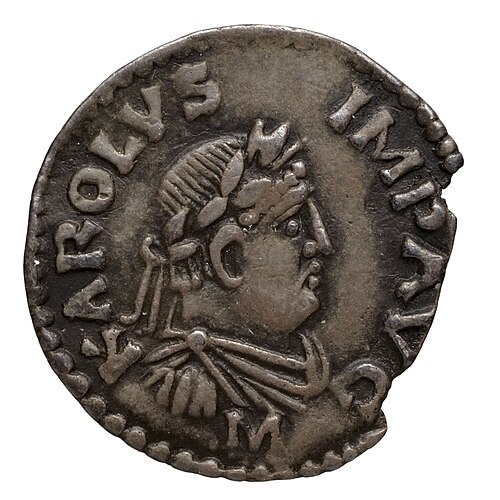
Start at the top for an easy introduction. Go further down for more detail and scholarship.
- Easy
- Intermediate
- Advanced
For young readers
More than 1,200 years ago, a powerful king named Charles ruled the Franks, a people living in what is now France, Germany, the Netherlands, Belgium, Switzerland and northern Italy. He was so famous that people later called him Charles the Great, or Charlemagne.
On Christmas Day in the year 800, Charlemagne went to pray in the great church of St Peter in Rome. As he rose from prayer, Pope Leo III, the leader of the Church in the West, placed a crown on his head. The people in the church shouted three times, wishing “life and victory” to Charles, the great and peace-bringing emperor crowned by God.
Why was this such a big deal? Long before, the Roman Empire had ruled all around the Mediterranean Sea. In the west, the last Roman emperor lost his throne in 476. After that there was still a Roman emperor, but he lived far away in Constantinople, a city now called Istanbul. Now, suddenly, the west had an emperor of its own again.
The pope had his own reasons. A year before, enemies in Rome had attacked him in the street and tried to cut out his eyes and tongue. He escaped and asked Charlemagne for help. By crowning Charlemagne, the pope gained a strong protector.
Charlemagne’s biographer later wrote that the king did not know what the pope was planning and would not have gone to church that day if he had known. Historians still argue about whether that is true. The coronation became a model for European rulers for a thousand years.
At a glance
- Date
- 25 December 800 (Christmas Day)
- Place
- Old St Peter’s Basilica, Rome (the 4th-century church later replaced by the present basilica)
- Main figures
- Charlemagne (Charles I), king of the Franks and of the Lombards; Pope Leo III (pope 795–816); Charles the Younger, Charlemagne’s son
- What happened
- The pope crowned Charles, the Romans acclaimed him emperor, and the pope honoured him with a gesture of reverence; the pope also anointed Charles the Younger as king
- Title adopted
- From 801: “Charles, most serene Augustus, crowned by God, great and peaceful emperor, governing the Roman Empire, and by the mercy of God king of the Franks and the Lombards”
- Byzantine response
- Initially seen as usurpation; Byzantine envoys recognised Charlemagne as emperor (basileus) in 812
- Main sources
- Royal Frankish Annals, Liber Pontificalis (Life of Leo III), Annals of Lorsch, Einhard’s Life of Charlemagne, Theophanes’ Chronicle
- Long-term significance
- Revived a western Roman imperial title; model for the later Holy Roman Empire and for centuries of debate on the powers of popes and emperors
Easy
What happened on Christmas Day 800?
On 25 December 800, Charles, king of the Franks, attended Christmas Mass in the Basilica of St Peter in Rome, the church built over the traditional tomb of the apostle Peter. According to the official Frankish annals, as he rose from praying before the tomb, Pope Leo III placed a crown on his head. The Roman people present shouted: “To Charles Augustus, crowned by God, great and peace-giving emperor of the Romans, life and victory!” Then, the annals say, the pope honoured him in the manner used for the ancient emperors.
The church where this happened no longer stands. It was Old St Peter’s, a huge basilica built in the fourth century under Emperor Constantine. It was demolished in the sixteenth century and replaced by the present St Peter’s Basilica in Vatican City.
With this ceremony, Charles, whom later ages called Charlemagne (from the Latin Carolus Magnus, “Charles the Great”), became the first person in western Europe to hold the title of emperor since Romulus Augustulus was deposed in 476. The event has been remembered ever since as one of the turning points of European history.
Easy
Who was Charlemagne?
Charlemagne was born around 748 into the Carolingian family, which had become the real power in the Frankish kingdom. His father Pippin became king in 751. When Pippin died in 768, the kingdom was divided between Charles and his brother Carloman; after Carloman’s death in 771, Charles ruled alone.
He spent most of his reign at war. He conquered the Lombard kingdom in northern Italy in 774 and took the title king of the Lombards. For more than thirty years (772–804) he fought the Saxons in northern Germany, forcing them to accept Christianity. He also campaigned in Spain, Bavaria and against the Avars in the Danube region. By 800 his realm stretched from the Pyrenees to the Elbe and from the North Sea to central Italy.
Charlemagne was also a patron of learning. He gathered scholars at his court, such as the Englishman Alcuin of York, and encouraged the copying of books, the reform of schools and the improvement of Latin. This “Carolingian Renaissance” preserved many works of ancient Latin literature that might otherwise have been lost. His favourite residence, from the 790s, was Aachen, where he built a palace and a chapel that still stands today.
Easy
A pope in danger
Leo III became pope in December 795. He was not from Rome’s leading aristocratic families, and relatives and supporters of his predecessor, Pope Hadrian I, turned against him. On 25 April 799, during a religious procession, a group of armed men led by two high papal officials, Paschalis and Campulus, attacked him in the street. They tried to put out his eyes and cut out his tongue, and accused him of crimes including perjury and adultery.
Leo escaped and fled north across the Alps. In the summer of 799 he met Charlemagne at Paderborn in Saxony, where the king was campaigning. A Latin poem written at this time, often called the Paderborn Epic, describes their meeting in glowing terms and already calls Charlemagne the “father of Europe”.
Charlemagne sent Leo back to Rome in late 799 with an escort of Frankish nobles and bishops, who began to investigate the charges. A year later, Charlemagne himself came to Rome to settle the matter. The pope’s safety, and his authority, now depended on the Frankish king.
Intermediate
Background: the alliance between the Franks and the popes
The coronation was the climax of half a century of cooperation. In 751 Charlemagne’s father Pippin deposed the last Merovingian king and made himself king of the Franks, with the approval of Pope Zachary. In 754 Pope Stephen II crossed the Alps, anointed Pippin and his sons, including the young Charles, and gave them the title “patrician of the Romans”, making them protectors of Rome. In return, Pippin fought the Lombards, who were threatening Rome, and granted the pope lands in central Italy. This grant, often called the Donation of Pippin (756), is traditionally seen as the origin of the Papal States.
When the Lombard king Desiderius again threatened Rome, Charlemagne invaded Italy, took the Lombard capital Pavia in 774 and became king of the Lombards himself. He visited Rome at Easter 774 and confirmed his father’s promises to the pope. From then on, Frankish power dominated northern and central Italy, and the popes looked north, not east, for protection.
At the same time, relations between Rome and Constantinople had become strained. The popes had long been subjects of the Byzantine (Eastern Roman) emperor, but Byzantine power in Italy had weakened, and the two sides were divided by theological disputes, especially over the use of religious images (Iconoclasm). The Franks, too, disagreed with the Byzantines on these questions; Charlemagne’s court produced a long treatise, the Libri Carolini, criticising the Byzantine Council of Nicaea of 787.
Intermediate
Background: an empress in Constantinople
For people of the time, the Roman Empire still existed: its capital was Constantinople, and its emperor claimed to be the one Christian emperor on earth. Historians call this state the Byzantine Empire, but its people called themselves Romans.
In 797 the empress Irene deposed and blinded her own son, Emperor Constantine VI, and began to rule alone, the first woman to do so in her own name. Some western writers argued that a woman could not hold the imperial office, and that the throne was therefore empty. The Annals of Lorsch, written close to the events, give this as one reason why Charlemagne should become emperor: since the title of emperor had lapsed among the Greeks, it seemed right that Charles, who held Rome and the old imperial seats in Italy, Gaul and Germany, should be given it.
In June 799 Alcuin wrote a famous letter to Charlemagne describing three highest powers in the world: the papacy, now humiliated in Rome; the imperial dignity, whose holder in Constantinople had been deposed by his own family; and the royal dignity of Charles, which surpassed the others in power and wisdom. The letter shows that Charlemagne’s circle was already thinking of him in quasi-imperial terms before the coronation.
Intermediate
The events of 800 step by step
Charlemagne travelled to Italy in the autumn of 800. In late November Leo met him at Mentana, about 20 km from Rome, the traditional place where the city received emperors, and the next day the king made a formal entry into Rome. On 1 December an assembly of Franks and Romans met in St Peter’s to consider the charges against the pope. According to the papal account, the bishops declared that they could not judge the apostolic see.
On 23 December Leo solemnly swore on the Gospels that he was innocent of the charges. Envoys from the patriarch of Jerusalem arrived the same day, bringing Charlemagne the keys of the Holy Sepulchre and a banner, a symbolic gesture of respect.
Two days later came the Christmas Mass and the coronation. The Frankish and papal sources differ on the order of events. The Royal Frankish Annals place the crowning first, then the acclamation and then the pope’s adoratio, the gesture of reverence traditionally offered to emperors. The Life of Leo III in the Liber Pontificalis stresses that the pope crowned Charles with his own hands, that the acclamation came by the will of God and of St Peter, and that the pope then anointed Charles’s son, Charles the Younger, as king.
The coronation was followed by justice. The conspirators against Leo were tried and condemned to death under Roman law, but at the pope’s request the sentence was changed to exile. Charlemagne stayed in Rome until after Easter 801 and then returned north, never to see Rome again.
Intermediate
Aftermath: two emperors
The new title raised a difficult question: could there be two Roman emperors? In 801 Charlemagne adopted a carefully worded style: “Charles, most serene Augustus, crowned by God, great and peaceful emperor, governing the Roman Empire, and by the mercy of God king of the Franks and the Lombards.” He did not call himself “emperor of the Romans” outright, perhaps to avoid a direct challenge to Constantinople, and perhaps because he wanted to remain first of all a Frankish king.
Constantinople regarded the coronation as a usurpation. The Byzantine chronicler Theophanes, writing in the early ninth century, reports that Charlemagne even proposed marriage to Irene, which would have united the two empires; the plan, if real, came to nothing when Irene was overthrown by Nikephoros I in 802. Frankish and Byzantine forces clashed over Venice and the Dalmatian coast. In 812 envoys of Emperor Michael I, meeting Charlemagne at Aachen, acclaimed him as basileus, emperor, in exchange for the return of Venice. This settlement is often called the Pax Nicephori, after the negotiations begun under Nikephoros.
Relations with other powers also reflected Charlemagne’s new standing. The Abbasid caliph Harun al-Rashid exchanged embassies with him; a Frankish envoy returned in 802 with an elephant named Abul-Abbas, which lived at Aachen for several years. These exchanges are recorded in Frankish sources but, as far as is known, not in Arabic ones.
In 813 Charlemagne crowned his son Louis the Pious as co-emperor himself, at Aachen, without the pope. This suggests that he did not regard papal coronation as necessary for imperial authority. Charlemagne died at Aachen on 28 January 814. Louis was crowned again by Pope Stephen IV in 816, a sign that the papal role was not so easily set aside.
Intermediate
Long-term impact: empire, papacy and Europe
Charlemagne’s empire did not last long as a single state. His grandsons divided it by the Treaty of Verdun in 843, and the western imperial title lost much of its power. But the idea survived. In 962 the German king Otto I was crowned emperor in Rome by Pope John XII, consciously following Charlemagne’s example. The empire that grew from Otto’s coronation later came to be called the Holy Roman Empire, and it lasted until 1806.
The ceremony of 800 raised a question that shaped medieval politics: who gives the empire? Popes later argued that the papacy had transferred the empire from the Greeks to the Franks (translatio imperii), which implied that popes could grant, judge or even withdraw imperial authority. Emperors argued that their power came directly from God and from their election. This rivalry lay behind many medieval conflicts, including the Investiture Controversy of the eleventh and twelfth centuries.
The coronation also deepened the separation between the Latin West and the Greek East. Two rival claimants to the Roman imperial title, with different languages, churches and political traditions, now existed side by side. Many historians see the coronation as one step in the long process that led to the division between Catholic and Orthodox Christianity.
Later rulers kept returning to Charlemagne. Emperor Frederick Barbarossa had him proclaimed a saint by his antipope Paschal III in 1165. Napoleon, who crowned himself emperor in 1804 in the presence of Pope Pius VII, deliberately invoked Charlemagne. In the twentieth century, Charlemagne became a symbol of European unity; since 1950 the city of Aachen has awarded the Charlemagne Prize for contributions to European unification.
Intermediate
Different perspectives and memories
Frankish writers presented the coronation as the fitting reward for a king who already ruled most of the Christian West. Papal writers presented it as an act of the pope, acting for St Peter. Byzantine writers saw an illegitimate barbarian king taking a title that belonged to their own emperor. Each perspective shaped how the event was recorded, and modern historians must read them side by side.
In the nineteenth and early twentieth centuries, France and Germany both claimed Charlemagne as a national founder: “Charlemagne” to the French, “Karl der Große” to the Germans. His coronation was read as the birth of the French monarchy or of the German empire, depending on the author. After the Second World War, the same figure was reimagined as a “father of Europe” standing above national rivalries.
Not everyone experienced Charlemagne’s rule as a golden age. The Saxons were conquered after decades of war and forced to convert; Frankish annals report that at Verden in 782 some 4,500 Saxons were executed in one day, a figure some historians think may be exaggerated or misread, but which reflects real brutality. Laws imposed on Saxony prescribed death for refusing baptism. Modern accounts increasingly include these perspectives when assessing the empire that the coronation celebrated.
Advanced
The sources and their agendas
The Royal Frankish Annals are a year-by-year record of events from 741 to 829, compiled at or near the Carolingian court. They give the fullest Frankish account of the coronation, including the acclamation formula and the pope’s adoratio. A revised version, produced after 814 and once attributed to Einhard, smooths the Latin and adds detail. Historians such as Rosamond McKitterick have emphasised that the annals are not neutral records but a carefully constructed narrative of Carolingian success.
The Liber Pontificalis, the collective biography of the popes compiled in Rome, includes a Life of Leo III written soon after the events. It narrates the attack of 799 in dramatic terms, presents Leo as miraculously healed, and emphasises the pope’s initiative in the coronation and the anointing of Charles the Younger. The Annals of Lorsch, a Frankish text close in time, provide the argument that the imperial title was vacant because a woman ruled in Constantinople.
Einhard, a courtier who knew Charlemagne personally, wrote his Life of Charlemagne probably in the 820s, modelled on Suetonius’ Lives of the Caesars. He claims that Charlemagne at first disliked the imperial title so much that he said he would not have entered the church that day, even though it was a great feast, if he had known the pope’s plan. He adds that Charlemagne bore the indignation of the Byzantine emperors with great patience. The Byzantine chronicler Theophanes the Confessor, writing in Greek in the 810s, reports that the pope anointed Charles from head to foot with oil, a detail absent from western sources, and recounts the marriage proposal to Irene.
No single source is a neutral eyewitness report. The Frankish annals, the papal biography, Einhard and Theophanes each served a patron or a point of view, and even the basic sequence of crowning, acclamation and anointing differs between them.
Advanced
Debates: who planned it, and what did it mean?
Did Charlemagne know? Einhard’s claim that Charlemagne was surprised has been read in several ways. Some historians take it as evidence of genuine displeasure, perhaps not with the title but with the pope’s leading role, which could imply that popes made emperors. Others see it as a conventional literary motif of modesty, the ruler who reluctantly accepts honour, borrowed from Roman models. Most modern scholars think the coronation was prepared in advance: the gathering of Frankish and Roman leaders, the timing on Christmas Day, and Alcuin’s earlier letter all suggest planning. Roger Collins has argued that it was agreed as early as the Paderborn meeting in 799, and Johannes Fried that Charlemagne was aiming at the imperial title by 798.
Whose empire? Historians disagree about what the title meant to the different participants. For the pope it may have been a Roman title, tying the emperor to the city of Rome and its bishop. For the Frankish court it may have expressed Charlemagne’s rule over a Christian people, an imperium christianum, as Alcuin put it, more than a revival of ancient Rome. Charlemagne’s cautious title, “governing the Roman Empire”, and his decision to crown Louis himself in 813 have been read as signs that he wanted to keep the papal and Roman elements at a distance.
The wider frame. The Belgian historian Henri Pirenne, in his Mohammed and Charlemagne (published 1937), argued that the Arab conquests broke the unity of the Mediterranean and pushed the centre of the West northward, so that Charlemagne’s empire was a new, northern and landlocked order. His thesis has been heavily criticised, especially on archaeological and economic grounds, but it put the coronation in a global context that later historians have continued to explore, including the connections between the Carolingians, Byzantium and the Abbasid caliphate.
Recent biographies, such as those by Rosamond McKitterick (2008) and Janet L. Nelson (2019), tend to place the coronation within Charlemagne’s whole life and reign rather than treating it as the single defining moment, stressing how contingent it was on the crisis of 799 and on the circumstances in Constantinople.
Key ideas
- Revival of the western empire
- For the first time since 476, a ruler in western Europe held the title of emperor.
- Frankish–papal alliance
- The popes relied on Frankish kings for protection, and the Franks gained religious legitimacy from the popes.
- Problem of two emperors
- Constantinople also claimed the Roman imperial title, creating rivalry until a compromise in 812.
- Who makes the emperor?
- The pope’s role in the ceremony fed centuries of debate between popes and emperors about the source of imperial authority.
- Translatio imperii
- The medieval idea that the Roman Empire had been transferred from the Greeks to the Franks, and later to the Germans.
- Christian empire
- Charlemagne’s circle saw the empire as the political form of the Christian people, not simply a restored ancient Rome.
- Contested memory
- France, Germany, the papacy, Byzantium and modern Europe have each told the story in their own way.
Records
- 476 CE — Romulus Augustulus, the last western Roman emperor, is deposed.
- 751 CE — Pippin, Charlemagne’s father, becomes king of the Franks with papal approval.
- 754 CE — Pope Stephen II anoints Pippin and his sons, including Charles.
- 768 CE — Charles and his brother Carloman succeed Pippin; Charles rules alone from 771.
- 774 CE — Charlemagne conquers the Lombard kingdom and becomes king of the Lombards.
- 797 CE — Empress Irene deposes her son Constantine VI and rules Byzantium alone.
- 799 CE — Pope Leo III is attacked in Rome (25 April) and flees to Charlemagne at Paderborn.
- 800 CE — Leo swears an oath of innocence (23 December) and crowns Charlemagne emperor in St Peter’s (25 December).
- 812 CE — Byzantine envoys acclaim Charlemagne as emperor at Aachen.
- 813 CE — Charlemagne crowns his son Louis the Pious as co-emperor at Aachen.
- 814 CE — Charlemagne dies at Aachen (28 January).
- 962 CE — Otto I is crowned emperor in Rome, beginning the line of the Holy Roman Empire.
Glossary
- Franks
- A Germanic people whose kingdom, based in Gaul, became the dominant power in western Europe.
- Carolingians
- Charlemagne’s family, named after him (Carolus), which ruled the Franks from 751.
- Pope
- The bishop of Rome, head of the Latin (Western) Church.
- Byzantine Empire
- Modern name for the eastern Roman Empire, ruled from Constantinople, whose people called themselves Romans.
- Acclamation
- A formal shout of approval by an assembly, part of Roman and Byzantine ceremonies of making an emperor.
- Anointing
- Applying holy oil to a person to consecrate them as king or priest.
- Adoratio
- A ceremonial gesture of reverence, such as bowing or prostration, offered to Roman emperors.
- Papal States
- Lands in central Italy ruled by the popes, traditionally traced to the grant of Pippin in 756.
- Holy Roman Empire
- The western empire revived under Otto I in 962 and lasting until 1806; the name “Holy Roman” came into use later.
- Carolingian Renaissance
- The revival of learning, book copying and education under Charlemagne and his successors.
Questions and answers
Did Charlemagne crown himself?
No. Pope Leo III put the crown on his head. Later, in 813, Charlemagne crowned his own son Louis himself, without the pope.
Why did the pope crown Charlemagne?
The pope needed a strong protector after being attacked by enemies in Rome, and Charlemagne already ruled most of the Christian West. The crowning honoured him and tied him closely to Rome.
Was Charlemagne really surprised?
His biographer Einhard says so, but most historians think the ceremony was planned in advance and see Einhard’s story as a way of showing the king’s modesty or his dislike of the pope’s leading role.
Is the church where it happened still there?
No. Old St Peter’s was demolished in the sixteenth century and replaced by the present St Peter’s Basilica on the same site.
How did Constantinople react?
At first it saw the coronation as usurpation, since the Byzantine ruler claimed to be the only Roman emperor. In 812 Byzantine envoys recognised Charlemagne as emperor, though as a western emperor alongside their own.
Was this the start of the Holy Roman Empire?
It was a model and a starting point, but historians usually date the Holy Roman Empire from Otto I’s coronation in 962; the name came into use later still.
How reliable are the accounts of the coronation?
Each main source had an agenda: the Frankish annals praised the king, the papal biography stressed the pope’s role, and the Byzantine chronicle was hostile. They even disagree about the order of events.
Sources and further reading
- Coronation of Charlemagne. Wikipedia
- Charlemagne. Wikipedia
- Pope Leo III. Wikipedia
- Irene of Athens. Wikipedia
- Royal Frankish Annals. Wikipedia
- Liber Pontificalis. Wikipedia
- Vita Karoli Magni. Wikipedia
- Old St. Peter’s Basilica. Wikipedia
- Rosamond McKitterick, Charlemagne: The Formation of a European Identity. Cambridge University Press, 2008
- Janet L. Nelson, King and Emperor: A New Life of Charlemagne. Allen Lane, 2019
Related
- Fall of the Western Roman EmpireThe removal of the western emperor Romulus Augustulus in 476 CE, often used as a marker for the end of the Western Roman Empire.
- Hagia SophiaA monumental church built for the Byzantine emperor Justinian I in Constantinople between 532 and 537 CE.
- Augustine of HippoA Christian bishop and thinker whose writings shaped Western theology and philosophy.
- House of WisdomName associated with Abbasid scholarly collections and translation activity in Baghdad.
- Founding of RomeRome's traditional founding is dated to 753 BCE, but the date and the story of Romulus belong to later legend.
Written with AI assistance from the published sources listed above, and revised as new research appears.