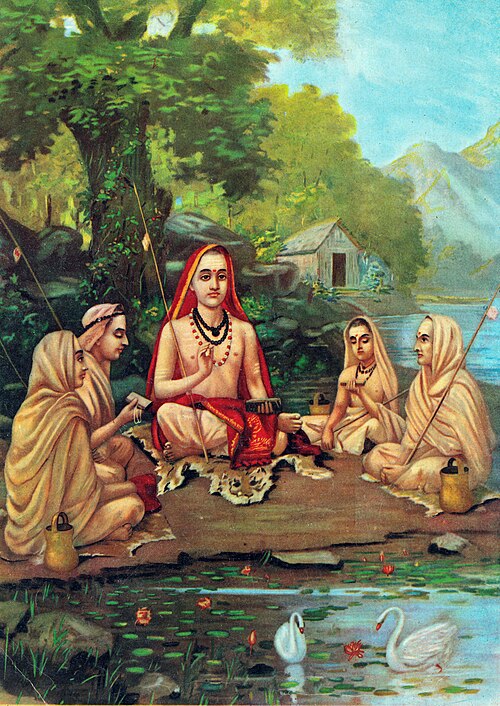
Start at the top for an easy introduction. Go further down for more detail and scholarship.
- Easy
- Intermediate
- Advanced
For young readers
Imagine walking home at dusk and seeing a snake on the path. You jump back, your heart pounding. Then someone brings a lamp, and you see it was only a coiled rope. The snake was never there. Shankara used this story again and again. He said that we make a similar mistake about ourselves and the world.
Shankara taught that there is one great reality behind everything, which Hindu scriptures call brahman. He also taught that your true self, deep inside, which the scriptures call atman, is exactly that same reality. We feel small and separate only because we do not see clearly, like the person who sees a snake instead of a rope.
Stories say that Shankara was born in a village called Kalady in Kerala, in the south of India. His father died when he was little. As a boy he wanted to become a monk, a person who gives up home and possessions to seek wisdom. One story says that a crocodile grabbed his leg in the river and would not let go until his mother agreed that he could become a monk.
Shankara wrote long explanations, called commentaries, of very old holy books such as the Upanishads and the Bhagavad Gita. Stories say he walked all over India, debating with other thinkers and teaching students, and that he died young, at only 32.
Today many Hindus honour Shankara as a great teacher, and monasteries in several parts of India say that he founded them. Historians are careful, though: most of the stories about his life were written down hundreds of years after he died.
At a glance
- Lived
- Disputed. The traditional chronology is 788–820 CE; many scholars today prefer the first half of the 8th century (c. 700–750). Monastic lineages give dates in the 5th century BCE, which historians do not accept.
- Birthplace (traditional)
- Kalady, on the Periyar River in present-day Kerala, India (one hagiography says Chidambaram)
- Language
- Sanskrit
- School
- Advaita Vedanta (“non-dual” Vedanta), one of the schools of Hindu philosophy based on the Upanishads
- Core teaching
- The individual self (ātman) is identical with brahman, the single ultimate reality; the experience of separateness comes from ignorance (avidyā)
- Main works (generally accepted)
- Commentary on the Brahma Sutras (Brahmasūtrabhāṣya); commentaries on principal Upanishads; commentary on the Bhagavad Gita; the Upadeśasāhasrī (“Thousand Teachings”)
- Teacher (traditional)
- Govinda Bhagavatpāda, said to be a pupil of Gauḍapāda
- Died (traditional)
- At about 32; Kedarnath in the Himalayas is the most often named place, but traditions differ
Easy
Who was Adi Shankara?
Adi Shankara (Ādi Śaṅkara, “the first Shankara”) is the most famous teacher of Advaita Vedanta, a school of Hindu philosophy. The word Advaita means “not two”, and the school teaches that reality is ultimately one: the deepest self of every living being is not different from brahman, the infinite ground of everything. He is often called Shankaracharya, “Shankara the teacher”; the title “Adi” distinguishes him from the later heads of monasteries who also carry the title Shankaracharya.
Shankara wrote in Sanskrit, the classical language of Indian learning. He did not present his ideas as new inventions. Instead he wrote commentaries (bhāṣya) that explain the meaning of older sacred texts: the Upanishads, the Bhagavad Gita and the Brahma Sutras. In Indian tradition these three are called the prasthānatraya, the “three starting points” of Vedanta, and any serious Vedanta teacher was expected to explain them.
What we know securely about Shankara comes mainly from these works. The colourful stories of his life, including his childhood, his journeys and his debates, come from later biographies written centuries afterwards. So there are really two Shankaras to learn about: the philosopher who speaks through his commentaries, and the saint and hero remembered in legend and in living religious practice.
Easy
His life as tradition tells it
According to the traditional biographies, Shankara was born into a family of Nambudiri Brahmins in Kalady, a village on the Periyar River in Kerala. Tradition names his parents Shivaguru and Aryamba. His father died when he was a small child, and his mother saw to his education. He is said to have mastered the Vedas as a boy.
The most famous childhood story tells how the young Shankara was bathing in the river when a crocodile seized his leg. He called to his mother that he would die unless she allowed him to renounce the world and become a sannyāsin, a wandering monk. She agreed, the crocodile let go, and Shankara left home, promising to return when she was dying. Stories say he kept that promise and performed her funeral rites himself, even though monks were not expected to do so.
Shankara then travelled north and found his teacher, Govinda Bhagavatpada, most often said to have lived on the banks of the Narmada River. Govinda is said to have been a pupil of Gaudapada, an earlier Advaita thinker. After his studies, Shankara went to Varanasi (Kashi), the holy city on the Ganges, where he began to teach and write, and gathered disciples. Four of them became famous: Padmapada, Sureshvara, Hastamalaka and Totaka.
The biographies then describe a digvijaya, a “conquest of the directions”: Shankara travels across India, from Kashmir to the far south and from Gujarat to Bengal, defeating Buddhists, Jains, ritualists and followers of rival Hindu schools in public debate. He founds monasteries and dies young, at about 32. Many places claim the honour of his death, but Kedarnath, a Himalayan pilgrimage site, is the one most often named.
Easy
The big idea: the self and the universe are one
Shankara’s central teaching can be put simply. There is only one ultimate reality, brahman. It is pure being, pure consciousness and pure bliss, without parts and without change. Your innermost self, the ātman, the awareness that watches your thoughts, is not a small piece of brahman. It is brahman.
Why, then, do we feel like separate people in a world full of separate things? Shankara says it is because of avidyā, ignorance, a kind of basic misunderstanding. We mix up the true self with things that are not the self: the body, the senses, the mind and its moods. He called this mix-up adhyāsa, “superimposition”, like placing the image of a snake on top of a rope.
The goal of life, for Shankara, is mokṣa, liberation from the cycle of birth and death. Liberation does not come from doing more good deeds or performing more rituals, because actions can only produce new results inside the world of change. It comes from knowledge (jñāna): the direct realisation, awakened by the teachings of the Upanishads, that “I am brahman”. When the rope is seen clearly, the fear of the snake simply disappears.
Shankara loved certain short sentences from the Upanishads, later called the “great sayings” (mahāvākya). One is “You are that” (tat tvam asi) from the Chandogya Upanishad, in which a father teaches his son that the subtle essence of all things is his own self. Another is “I am brahman” (ahaṃ brahmāsmi) from the Brihadaranyaka Upanishad.
Intermediate
India in Shankara’s time
If Shankara lived in the eighth century, as most scholars think, he worked in a subcontinent divided among regional kingdoms, such as the Chalukyas and Pallavas in the south and the Pratiharas and Palas in the north. It was a world of great temples, royal patronage of learning and lively competition between religious communities.
Buddhism was still a major intellectual force. The great Buddhist philosophers Nagarjuna, Dignaga and Dharmakirti had developed powerful arguments against the existence of a permanent self and against the authority of the Vedas. Jain thinkers were equally sophisticated. Within the Brahmanical tradition, the Mīmāṃsā school, whose leading figure Kumarila Bhatta lived in the seventh century, argued that the Veda was essentially a set of commands for ritual action.
At the same time, devotional (bhakti) movements to Shiva and Vishnu were growing, especially in the Tamil country, and new forms of tantric practice were spreading. Shankara’s writings respond to this crowded field. He argued against Buddhists, Jains, Sankhya and Nyaya philosophers and, above all, against Mimamsa ritualists, insisting that the true aim of the Veda is knowledge of brahman, not ritual.
Intermediate
How Advaita works: levels of reality, maya and liberation
If only brahman is real, what is the status of the world we see? Advaita answers with a theory of levels. From the highest standpoint (pāramārthika), only brahman exists. From the everyday or practical standpoint (vyāvahārika), the world of people, gods, rivers and duties is fully valid and must be taken seriously. Below that is the merely illusory level (prātibhāsika), such as dreams or the snake seen in a rope. Later Advaitins systematised these three levels; Shankara himself works mainly with the contrast between the highest truth and ordinary experience.
The world, then, is neither simply real nor simply unreal. Later Advaitins called it anirvacanīya, “indescribable” as either being or non-being. The term māyā, often translated “illusion”, names the power by which the one appears as many. Shankara uses the word less often than later writers, and he prefers to speak of avidyā, ignorance, as the cause of our bondage. Brahman does not really turn into the world, as milk turns into curd; it only appears as the world, as the rope appears as a snake. Later writers call this vivarta, “apparent transformation”.
This allowed Shankara to keep the whole of ordinary religious life in place. Worship of a personal God (Īśvara), ethical duties and ritual are real and useful at the practical level; they purify the mind and prepare it for knowledge. But they are not themselves liberation. For those ready for it, Shankara recommended renunciation and a disciplined study of the Upanishads under a teacher: hearing (śravaṇa), reflection (manana) and deep contemplation (nididhyāsana).
A distinctive feature of Advaita is the idea of jīvanmukti, liberation while still alive. Once knowledge has dawned, the liberated person may continue to live, act and teach until the body falls away, like a potter’s wheel that goes on spinning for a while after the potter stops pushing it. This image is traditional in Advaita literature.
Intermediate
His writings: what is genuine?
More than three hundred texts have been attributed to Shankara, from dense philosophical commentaries to beautiful devotional hymns. Most scholars think only a small group is genuinely his. The core is the Brahmasūtrabhāṣya, his commentary on the Brahma Sutras of Badarayana, a collection of very short aphorisms summarising the teaching of the Upanishads. Its famous opening discussion of superimposition (adhyāsa) is one of the classic passages of Indian philosophy.
His commentaries on the principal Upanishads are also accepted, though scholars differ on some of them; the commentaries on the Brihadaranyaka and Taittiriya Upanishads are the most secure. The commentary on the Bhagavad Gita is widely accepted. The Upadeśasāhasrī (“Thousand Teachings”), a mix of prose and verse that explains how a teacher should guide a pupil, is the only independent treatise that nearly all scholars accept as his.
Many famous works are now considered later. The Vivekacūḍāmaṇi (“Crest-Jewel of Discrimination”), beloved by modern readers, is doubted by most specialists. Popular hymns such as the Bhaja Govindam and the Saundaryalahari are traditionally credited to him, but their authorship is uncertain or rejected. The German Indologist Paul Hacker and the Japanese scholar Sengaku Mayeda developed criteria, based on vocabulary, doctrine and the titles used in manuscript colophons, for deciding which works are authentic. Their approach remains influential, although it is still debated.
The problem matters. Much of the popular picture of Shankara as a devotional poet of the goddess or of Vishnu, or as a teacher of yoga and tantra, rests on works whose authorship is disputed. The Shankara of the secure commentaries is above all a rigorous interpreter of scripture and a debater.
Intermediate
Debates with Buddhists, ritualists and others
Shankara’s commentaries are full of arguments against other schools. Against Sankhya he argued that unconscious matter cannot be the cause of an ordered world. Against the Buddhists he attacked both the Yogacara view that only consciousness exists and the Madhyamaka view that everything is empty, insisting on a permanent, self-luminous witness-consciousness that no argument can deny, because every argument already presupposes it.
His sharpest disagreement within the Vedic tradition was with Mimamsa, which held that the Veda is about action, especially ritual. Shankara agreed that the ritual portion of the Veda commands actions, but he argued that the Upanishads, the “end of the Veda” (vedānta), reveal an already existing reality, brahman, which cannot be produced by any action. Knowledge of it is therefore the Veda’s highest purpose.
The most famous legend of the digvijaya describes a debate with Mandana Mishra, a great Mimamsa scholar, judged by Mandana’s learned wife, Ubhaya Bharati. Defeated, Mandana becomes a monk and Shankara’s disciple under the name Sureshvara. Historians doubt this story. Mandana was a real and important thinker who wrote an Advaita work, the Brahmasiddhi, which was as influential as Shankara’s writings in the following centuries; whether he is the same person as Sureshvara is widely doubted.
Ironically, later Hindu critics, especially Vaishnava theologians, accused Shankara of being a “Buddhist in disguise” (pracchanna bauddha), because his idea of a world that is ultimately not real seemed close to Buddhist teaching. Many scholars see real influence from Gaudapada, whose verses on the Mandukya Upanishad show Buddhist vocabulary. Advaitins reply that the difference is fundamental: Buddhism denies a permanent self, while Advaita affirms that the self is the only reality.
Intermediate
Monasteries, followers and later influence
Tradition says Shankara founded four great monasteries (maṭha) at the four corners of India: Sringeri in the south, Dvaraka in the west, Puri in the east and Jyotirmath near Badrinath in the north. A fifth, at Kanchipuram, also claims to have been founded by him. The heads of these institutions carry the title Shankaracharya and remain important religious leaders today. He is also credited with organising the Dashanami (“ten names”) orders of renunciant monks.
Historians are cautious about these claims. The earliest firm evidence for this system comes much later, and the German scholar Paul Hacker argued that it took shape in the fourteenth century, associated with Vidyaranya, a scholar-monk of Sringeri and adviser to the rulers of the Vijayanagara empire. What is certain is that in and after this period Shankara’s fame grew enormously, and the most widely read hagiography, the Śaṅkaradigvijaya attributed to Madhava, was composed in this later world.
Shankara’s pupils and their successors built a rich scholastic tradition. Two main sub-schools grew up: the Bhamati school, named after Vachaspati Mishra’s ninth- or tenth-century commentary, and the Vivarana school, based on a work by Prakashatman developing Padmapada’s commentary. They debated questions such as where ignorance resides: in the individual self or in brahman.
Advaita also provoked powerful responses. Ramanuja (traditionally 1017–1137) founded Vishishtadvaita, “qualified non-dualism”, holding that the world and souls are real parts of a personal God. Madhva (13th century) founded Dvaita, “dualism”, which insists on real and eternal difference between God, souls and matter. Much later Indian philosophy is a conversation with Shankara, whether in agreement or opposition.
Intermediate
Shankara in the modern world
In the nineteenth and twentieth centuries Advaita Vedanta gained a new prominence. Western Orientalists such as Paul Deussen and Max Müller admired it as a counterpart to European idealist philosophy. Indian reformers, above all Swami Vivekananda, presented a modernised “Neo-Vedanta” as the philosophical heart of Hinduism and a universal spirituality, and Sarvepalli Radhakrishnan, philosopher and later President of India, wrote about Shankara for a global readership.
This modern image gave Advaita a place in world philosophy and inspired writers, scientists and spiritual seekers far beyond India. It also sometimes gave the impression that Advaita is the only “real” Hindu philosophy, whereas most Hindus historically followed devotional and theistic traditions, many of which disagreed sharply with Shankara.
Shankara remains a living presence. Pilgrims visit Kalady and the monasteries associated with him; his hymns are sung; and in recent years large statues of him have been unveiled at Kedarnath (2021) and near Omkareshwar on the Narmada (2023). As with many national heroes, historians note that the modern Shankara is shaped by the needs of the present as well as by the past.
Advanced
The dating problem and the reliability of the biographies
No inscription or contemporary document mentions Shankara. His dates must therefore be inferred. The traditional chronology of 788–820 CE was proposed by the Dutch scholar Cornelis Tiele in the nineteenth century and was accepted by Max Müller, Paul Deussen and many others. It was the standard date for most of the twentieth century and is still widely quoted.
More recent scholarship tends to place Shankara in the first half of the eighth century (roughly 700–750). The reasoning combines an earliest limit and a latest limit. Shankara discusses and criticises Buddhist and Mimamsa thinkers of the sixth and seventh centuries, including positions associated with Dharmakirti, so he cannot be earlier than about 650. Vachaspati Mishra, who wrote a sub-commentary on Shankara’s Brahmasūtrabhāṣya, is usually dated to the ninth or tenth century, providing a latest limit. The relative chronology of Mandana Mishra and Shankara also bears on the question. Hajime Nakamura was among the scholars who argued for an earlier eighth-century date.
The monasteries themselves preserve lists of succession that place Shankara in the fifth or even sixth century BCE; some lineages give an exact year such as 509 BCE. These dates are part of religious tradition and are not accepted by historians, partly because Shankara quotes and refutes authors who lived more than a thousand years later.
The biographies (Śaṅkaravijaya or Śaṅkaradigvijaya) are a separate problem. About fourteen are known. They were written roughly two hundred to a thousand years after Shankara and contradict one another on many points: where he was born, where he died, whom he debated and which temples he founded. The Madhaviya Shankaradigvijaya, the most influential, is usually dated to the fourteenth century or later. One version by Anandagiri appears to combine stories about several different people named Shankara. Historians use these texts mainly as evidence for how later communities remembered and used Shankara.
Advanced
Debates in modern scholarship
How important was Shankara in his own time? The modern assumption that he was the towering figure of Indian thought has been questioned. Scholars such as Richard King have pointed out that Shankara is rarely mentioned by other philosophers of the ninth and tenth centuries, and that Mandana Mishra’s Brahmasiddhi seems to have been at least as influential in early Advaita. On this view, Shankara’s dominance is partly a product of later developments, especially the institutional and literary activity of the fourteenth century and the enthusiasm of modern Neo-Vedanta.
Was Shankara an “illusionist”? Older Western scholarship often described Advaita as “illusionism”, reading māyā as a flat denial of the world. Several scholars, including Paul Hacker, argued that this reading owes more to later Advaita than to Shankara himself, who uses the term māyā sparingly and speaks mainly of ignorance and superimposition. Others see real continuity between Shankara and his successors. The question affects how we understand his realism about the practical world and his ethics.
Philosopher or theologian? Some interpreters read Shankara primarily as a philosopher who argues from experience, especially the undeniable witness-consciousness present in waking, dreaming and deep sleep. Others, including scholars in the line of Hacker, stress that for Shankara liberating knowledge arises only from scripture (śruti) taught by a teacher, making him first of all an exegete. His relationship to Buddhism, to Gaudapada and to Mandana remains an open field of research.
The textual basis for these debates is still being improved. Critical editions of many works attributed to Shankara are lacking, and the authenticity criteria developed by Hacker and Mayeda, based on terminology and colophons, continue to be refined and challenged. The multi-volume Encyclopedia of Indian Philosophies edited by Karl Potter, and Mayeda’s edition and translation of the Upadeśasāhasrī, are standard starting points.
Key ideas
- Non-duality (advaita)
- Reality is ultimately one; the self and brahman are not two.
- Brahman
- The single, infinite, unchanging reality, described as being, consciousness and bliss.
- Ātman
- The innermost self or pure witness-consciousness, identical with brahman.
- Ignorance and superimposition
- We wrongly mix the self with body and mind (adhyāsa); this ignorance (avidyā) is the root of suffering and rebirth.
- Two standpoints
- The world is valid from the practical standpoint but not ultimately real from the highest standpoint.
- Liberation through knowledge
- Mokṣa comes from realising the identity of self and brahman through the teachings of the Upanishads, not from ritual or action alone.
- Liberation while living
- A person can be fully liberated while still alive (jīvanmukti).
Records
- c. 650 CE — Buddhist philosopher Dharmakirti and Mimamsa thinker Kumarila Bhatta active; Shankara later engages their ideas.
- c. 700 CE — Start of the period (c. 700–750) to which many modern scholars assign Shankara’s life.
- 788 CE — Traditional date of Shankara’s birth at Kalady (traditional chronology 788–820).
- 820 CE — Traditional date of Shankara’s death at the age of about 32.
- c. 900 CE — Vachaspati Mishra writes the Bhamati, a sub-commentary on Shankara’s Brahma Sutra commentary (dated 9th or 10th century).
- c. 1100 — Ramanuja develops Vishishtadvaita, a major theistic critique of Advaita.
- c. 1250 — Madhva founds the Dvaita (dualist) school, opposing Advaita.
- c. 1380 — Vidyaranya heads the Sringeri monastery; Shankara’s institutional and legendary prominence grows under Vijayanagara patronage.
- 1893 — Swami Vivekananda speaks at the World’s Parliament of Religions in Chicago, spreading a modern Vedanta worldwide.
- 2021 — A statue of Shankara is unveiled at his reconstructed samadhi shrine at Kedarnath.
Glossary
- Vedanta
- “End of the Veda”: the Upanishads, and the schools of philosophy that interpret them.
- Upanishads
- Philosophical texts at the end of the Vedic literature that discuss the self and ultimate reality.
- Brahma Sutras
- A compact collection of aphorisms by Badarayana summarising Upanishadic teaching; the basic text of Vedanta.
- Bhāṣya
- A commentary explaining a sacred or philosophical text line by line.
- Māyā
- The power by which the one reality appears as the many; often translated “illusion”.
- Mokṣa
- Liberation from the cycle of birth, death and rebirth.
- Sannyāsin
- A renunciant monk who has given up home, family and ritual duties.
- Maṭha
- A Hindu monastery and centre of learning.
- Mahāvākya
- One of the “great sayings” of the Upanishads, such as “You are that”.
- Mīmāṃsā
- A school that interprets the Veda mainly as a guide to ritual action.
- Hagiography
- A biography of a saint, often containing legends, written to inspire devotion.
Questions and answers
Did Shankara think the world is fake?
Not exactly. He said the world is real enough for everyday life and duties, but it is not the final truth. Only brahman is ultimately real, and the world is how brahman appears to us when we do not see clearly.
When did Shankara live?
Nobody knows for sure. The traditional dates are 788–820 CE, but many scholars now prefer the early eighth century, around 700–750.
Did he really die at 32?
That is what the traditional biographies say, and it is widely repeated, but those biographies were written centuries later and cannot be checked.
Did Shankara found the four great monasteries?
Tradition says so, and the monasteries honour him as their founder. Many historians think the organised system of four monasteries took shape later, especially in the fourteenth century.
Did he write the Vivekachudamani?
Most specialists doubt it. The works most securely his are the commentaries on the Brahma Sutras, several Upanishads and the Bhagavad Gita, and the Upadeśasāhasrī.
Was Shankara influenced by Buddhism?
His opponents said he was a Buddhist in disguise, and many scholars see Buddhist influence on earlier Advaita, especially Gaudapada. But Shankara argued hard against Buddhist views, especially the denial of a permanent self.
How is Advaita different from other Vedanta schools?
Advaita holds that self and brahman are strictly identical. Ramanuja’s Vishishtadvaita sees souls and the world as real parts of God, and Madhva’s Dvaita insists that God, souls and matter are eternally distinct.
Sources and further reading
- Adi Shankara. Wikipedia
- Sangeetha Menon, Advaita Vedanta. Internet Encyclopedia of Philosophy
- Advaita Vedanta. Wikipedia
- Brahma Sutras. Wikipedia
- Maṇḍana Miśra. Wikipedia
- Gaudapada. Wikipedia
- Sringeri Sharada Peetham. Wikipedia
- Sengaku Mayeda, A Thousand Teachings: The Upadeśasāhasrī of Śaṅkara. University of Tokyo Press, 1979
- Karl H. Potter (ed.), Encyclopedia of Indian Philosophies, Vol. III: Advaita Vedānta up to Śaṃkara and His Pupils. Princeton University Press, 1981
Related
- Early UpanishadsTexts that ask what the self (ātman) is and how it relates to ultimate reality (brahman) — a foundation of later Indian philosophy.
- RigvedaThe oldest collection of Vedic Sanskrit hymns, handed down orally for centuries before it was written down.
- MahabharataA vast Sanskrit epic centered on a conflict between related royal families, with the Bhagavad Gita among its parts.
- NāgārjunaA Buddhist philosopher associated with the Madhyamaka school and its analysis of emptiness.
- Siddhartha Gautama (the Buddha)Founder of Buddhism, who taught a path to liberation from suffering on the Ganges plain. His dates are disputed.
Written with AI assistance from the published sources listed above, and revised as new research appears.