Start at the top for an easy introduction. Go further down for more detail and scholarship.
- Easy
- Intermediate
- Advanced
For young readers
Long before printing machines, every book had to be written by hand. About 1,200 years ago, monks on the islands of Britain and Ireland spent years copying holy books with feather pens on pages made from calfskin.
The Book of Kells is the most famous of these books. It contains the four Gospels, the parts of the Christian Bible that tell the story of Jesus. It is written in Latin, the language of the Church at that time.
What makes it special is the art. Almost every page has painted letters, tiny animals, twisting knots and swirling spirals in red, yellow, green and purple. On some pages the decoration is so thick that you can hardly find the words.
If you look closely you can find hidden surprises: cats and mice, peacocks, lions, snakes and angels. Some patterns are so small and exact that people once said they looked like the work of an angel, not a human being.
The book is named after the monastery of Kells in Ireland, where it was kept for hundreds of years. It may have been started on the Scottish island of Iona, where Viking raiders attacked the monks. Once, about a thousand years ago, thieves stole the book for its golden cover and threw it away. It was found under a patch of earth.
Today the Book of Kells is in the library of Trinity College in Dublin, the capital of Ireland. It is now bound in four volumes, and visitors can see two of its pages at a time, behind glass.
At a glance
- What
- Illuminated (painted) Gospel book in Latin: the four Gospels with prefaces, summaries and canon tables
- Date
- Around 800 CE (dated by style and script; some scholars place it somewhat earlier)
- Made by
- Monks of the community of St Columba (Columcille), probably begun at Iona and continued at Kells; the exact place is debated
- Size
- 340 vellum leaves (680 pages), trimmed to about 330 × 250 mm; bound in four volumes since 1953
- Script
- Insular majuscule, by at least three scribes
- Art
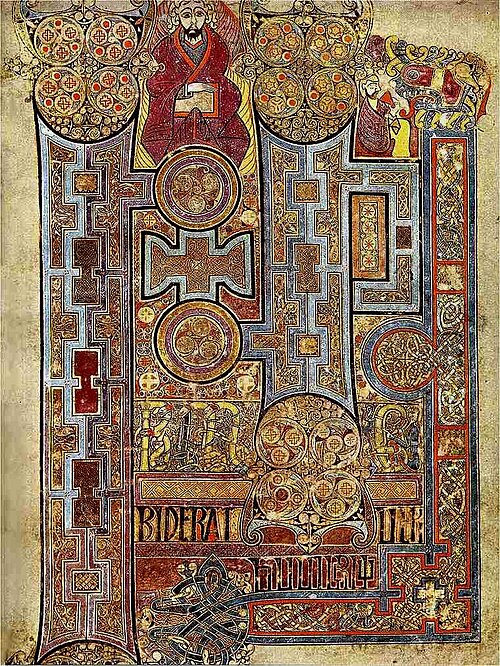
- Ten full-page illustrations, including the famous Chi Rho page, the Virgin and Child and portraits of Christ and the Evangelists
- Kept at
- Library of Trinity College Dublin since 1661 (the Old Library)
- Recognition
- Added to UNESCO’s Memory of the World Register in 2011
Easy
What is the Book of Kells?
The Book of Kells is a hand-written and hand-painted copy of the four Gospels of the New Testament, Matthew, Mark, Luke and John, in Latin. Books like this are called Gospel books, and when they are decorated with paint they are called illuminated manuscripts, because the colours seem to light up the page.
It was made around the year 800 by monks who belonged to the network of monasteries founded by the Irish saint Columba, also known as Columcille. It takes its name from the Abbey of Kells in County Meath, Ireland, where it was kept for centuries. Since 1661 it has belonged to Trinity College Dublin, where it is displayed in the Old Library.
The Book of Kells is regarded as the high point of Insular art, the style of Britain and Ireland in the early Middle Ages, and as one of the masterpieces of Western calligraphy. No other surviving Gospel book of its time is decorated so fully or so boldly.
Easy
What is inside the book?
Today the manuscript has 340 leaves, or folios, which makes 680 pages when both sides are counted. It contains the full texts of Matthew, Mark and Luke, and the Gospel of John up to chapter 17, verse 13; the end of John and some other pages are lost. Before the Gospels come preliminary texts: lists of Hebrew names, the canon tables of Eusebius, short summaries of the Gospels (Breves causae) and short lives of the Evangelists (Argumenta).
The Gospel text mostly follows the Vulgate, the Latin translation made by Jerome around the end of the 4th century, but mixes in readings from older Latin translations known as the Vetus Latina. The scribes sometimes seem to have written from memory. There are some famous slips: at Matthew 10:34, instead of gladium (“sword”), the book reads gaudium (“joy”), so that Jesus seems to say he came to bring not only peace but joy.
The book was never quite finished. On some pages the planned decoration exists only as an outline, and scholars think the original book had about 370 leaves. Many of the missing ones were probably lost when thieves ripped off its precious cover in the early 11th century.
Easy
How to read a decorated page
Thirty-three pages are decorated so heavily that the ornament fills the whole page. Ten of these are full-page pictures: the Virgin Mary and the Christ Child, pages of the four Evangelist symbols, portraits of Matthew and John, Christ enthroned, a single “carpet page” covered entirely in pattern, and scenes of the Arrest of Jesus and the Temptation of Christ.
The most famous page is the Chi Rho (folio 34r). Medieval scribes shortened the name Christ by writing the first two Greek letters, chi (X) and rho (P). At Matthew 1:18, where the story of Jesus’s life begins, the makers of the Book of Kells turned these letters into a giant design that fills the page. The X sweeps across with long curving arms, and the space around it is packed with spirals, knots and hidden creatures: three angels rise from one arm of the X, and cats, mice and other small animals and insects are tucked into the ornament.
The beginnings of each Gospel get the same treatment. Matthew opens with just two words, Liber generationis (“The book of the generation”), and the first letters grow into a huge monogram. John begins In principio erat verbum verum, “In the beginning was the true Word,” adding the word verum, “true,” to the usual text.
Even ordinary text pages are alive with small painted capital letters, animals and human figures twisted into letter shapes. Only two pages in the whole book have no coloured decoration at all.
Intermediate
Columba, Iona and the Vikings
In 563 the Irish monk Columba sailed with twelve companions to Iona, a small island off the west coast of Scotland, and founded a monastery there. Iona became the head of a family of Columban monasteries in Ireland and Scotland and an important centre of learning and book production. Monks from Iona founded Lindisfarne in Northumbria, another great centre of Insular art.
From the late 8th century, Viking raiders began to attack coastal monasteries. Iona was raided in 795 and again in 802, 806 and 825. In the raid of 806, sixty-eight monks were killed. In response the community built a new monastery at Kells in Ireland, between 807 and the consecration of its church in 814. Iona nevertheless remained the main Columban house for several decades; Columba’s relics were moved to Ireland only in 878.
These events frame the most widely accepted theory of the book’s origin: that it was begun on Iona, perhaps to honour Columba, and then carried to Kells and continued there when the community moved. Some Irish scholars have linked it to the 200th anniversary of Columba’s death in 597; others to the enshrining of his relics. None of these links can be proved.
Intermediate
Insular art: where the style came from
The Book of Kells belongs to a group of manuscripts made from the late 6th to the early 9th century in the monasteries of Ireland and Britain and in continental houses founded by Irish and Anglo-Saxon missionaries. Earlier members of the group include the Cathach of St Columba, the Book of Durrow (second half of the 7th century), the Lindisfarne Gospels and the Lichfield Gospels (early 8th century). The Book of Kells, with its fully developed ornament, comes late in the series.
Insular art combines several traditions. Spirals, triskeles and curving shapes come from late Iron Age Celtic art; interlaced animals come largely from Germanic metalwork of the kind found at Sutton Hoo; and the book format, the canon tables framed by arches and the Evangelist portraits come from the Christian Mediterranean. The Insular artists did not try to show depth or perspective. Instead they covered the flat surface with dense, energetic pattern.
The Swedish art historian Carl Nordenfalk described Insular initials as elastic forms that expand and contract with a pulsating rhythm, their energy escaping into spirals that generate new curves. In the Book of Kells, this tendency reaches its most extreme form.
Intermediate
How the book was made
The pages are vellum, fine calfskin that was cleaned, stretched and scraped. Sheets were folded in half to make pairs of leaves and nested into gatherings called quires; the surviving leaves form 38 quires. Guide lines were ruled for the text, and tiny prick marks for the ruling can still be seen on some pages. The vellum varies from thick, almost leathery leaves to very thin ones.
The text is written in Insular majuscule, a large rounded script, in iron gall ink. The art historian Françoise Henry identified at least three scribes, whom she called Hands A, B and C, and a fourth has been suggested. She also distinguished three main artists: the “Goldsmith,” who painted the Chi Rho page with colours imitating metal; the “Illustrator,” who painted the Temptation and the Arrest; and the “Portrait Painter,” who painted Christ and the Evangelists. As many as twelve people may have worked on the book.
The colours include red and yellow ochres, a green copper pigment, orpiment (a yellow arsenic mineral), and blues and purples made from plants and lichens such as woad and orcein. No gold or silver leaf was used, as was usual for Insular manuscripts. It was once believed that expensive lapis lazuli from Afghanistan and Mediterranean murex purple were used, but modern analysis has shown they were not.
Intermediate
A thousand years of survival
The first probable mention of the book is in the Annals of Ulster, in an entry usually given under 1007 (some accounts say 1006). It records that “the great Gospel of Columkille, the chief relic of the Western world,” was stolen at night from the great stone church at Kells because of its decorated shrine. The book was found months later “under a sod,” without its jewelled cover. This violent removal may explain why leaves are missing at the beginning and end.
In the 12th century, charters recording land grants to the abbey were copied onto blank pages of the book, which proves it was at Kells by then. The book stayed at Kells even after the abbey was dissolved and its church became a parish church. In 1654, when Oliver Cromwell’s cavalry were quartered in the church, the governor of the town sent it to Dublin for safety. In 1661 Henry Jones, Bishop of Clogher and Vice-Chancellor of the University of Dublin, gave it to Trinity College.
Later owners and readers left their marks. In 1568 Geralde Plunket added chapter numbers and notes; in 1621 the scholar James Ussher counted 344 leaves; a 19th-century rebinding cropped the margins and lost small parts of some pictures. In 1953 the bookbinder Roger Powell rebound the manuscript in four volumes. Today one volume is always on show in the Old Library, open at two pages, which are changed several times a year to protect them from light.
Intermediate
Fame and influence
The book’s worldwide fame began in the 19th century. It became a symbol of early Irish Christian culture and national pride. Queen Victoria and Prince Albert signed it in 1849. Its designs fed the Celtic Revival: knots, spirals and animal patterns copied from its pages appeared in metalwork, embroidery, furniture and pottery, and they remain popular in Irish design today.
Reproductions have spread its images far beyond Dublin. A first facsimile was published in Bern in 1951, a colour edition with commentary by Françoise Henry in 1974, and a full-colour facsimile in 1990 using a method that photographed each page without touching it. The whole manuscript can now be seen online through Trinity College’s digital collections. In 2011 UNESCO added it to its Memory of the World Register.
The 2009 animated film The Secret of Kells, directed by Tomm Moore, imagines a young monk helping to finish the book as Vikings threaten his monastery. The film was nominated for an Academy Award.
Advanced
Where and when? The origin debate
The medieval tradition that Columba himself wrote the book was abandoned long ago on palaeographical and stylistic grounds. Scholars place the book late in the Insular series, in the late 8th or early 9th century, mainly by comparing its script and ornament with other manuscripts, since there is no colophon or inscription giving its date or makers.
There are at least four theories about its place of origin: begun at Iona and finished at Kells; made entirely at Iona; made entirely at Kells; or made in a monastery in Pictish eastern Scotland such as Dunkeld. The first is the most widely accepted. The Pictish theory has little direct support, partly because no manuscripts survive from Pictland, although Isabel Henderson and others have explored links between Pictish art and the book, and the use of plant-based blues and purples has been taken by some as pointing to Scotland. Paul Meyvaert’s 1989 article “The Book of Kells and Iona” is one important contribution to this debate.
What is not in doubt is that the book was made by Columban monks closely connected with Iona. Its unfinished state is often explained by the disruption of Viking raids, but this remains an inference, not a documented fact.
Advanced
A book for the altar, not the library
Several features show that the Book of Kells was made to be seen and venerated rather than studied. The canon tables, which should let a reader find the same story in different Gospels, are unusable: they were squeezed from twelve pages into ten, and the matching section numbers were never added to the Gospel text. Many copying mistakes were never corrected, and words left over at the end of a line were sometimes squeezed into a gap in the line above so as not to spoil the layout.
The Annals say the book was stolen from the sacristy, where the vessels for the Mass were kept, not from a library. Scholars therefore think it lay on the altar and was carried in procession and opened for the reading of the Gospel at Mass, with the reader reciting largely from memory. In this sense it was a sacred object, even a relic associated with Columba, as much as a text. Carol Farr’s The Book of Kells: Its Function and Audience (1997) explores how its images might have worked for monastic viewers.
This also explains its lavishness. The book’s pictures and ornament carry theological meaning: the four Evangelist symbols appear together again and again to stress the unity of the Gospels, and peacocks, whose flesh ancient writers such as Augustine believed did not decay, stand for Christ and the Resurrection.
Advanced
A remote island in a connected world
The Book of Kells shows that early medieval Ireland and Scotland were not isolated. Ireland had never been part of the Roman Empire, yet its monks read and wrote Latin, copied texts from the Mediterranean and knew designs such as carpet pages and arched canon tables that have parallels in Coptic and Greek Christian books. The manuscript historian Christopher de Hamel has stressed that its pigments include orpiment, a mineral probably brought from Italy, which suggests trade routes that are otherwise unknown to us.
The Virgin and Child miniature (folio 7v), the earliest surviving image of the Virgin Mary in a Western manuscript, seems to draw on Byzantine, Armenian or Coptic models, and it has been compared with the image carved on the lid of St Cuthbert’s coffin of 698 at Durham. The book thus sits at a crossroads of Irish, Pictish, Anglo-Saxon and Mediterranean art.
Modern debate also concerns national ownership. The book has been used as a symbol of Irish identity since the 19th century, while its probable beginnings on Iona make it part of Scotland’s history as well. Many scholars now prefer to see it as a product of a Gaelic Christian network that crossed today’s borders.
Key ideas
- Illumination
- Decorating a manuscript with colour, pictures and ornament. In Insular books, decoration often grows out of the letters themselves.
- The Word made visible
- For the monks the Gospel text was holy. Making its opening words enormous and glorious was a way of honouring the Word of God.
- Unity of the four Gospels
- The symbols of the four Evangelists (man, lion, calf and eagle) appear together throughout the book to show that the four Gospels tell one message.
- Pattern over depth
- Insular art does not imitate three-dimensional space. It covers flat surfaces with interlace, spirals and animal forms full of movement.
- Book as relic
- Associated with Columba and kept in a jewelled shrine, the book was treated as a sacred object for the altar more than as a book for study.
- Hidden details
- Tiny animals and figures tucked into the ornament reward close looking and may carry symbolic meanings, such as peacocks standing for the Resurrection.
- Networks of monasteries
- The book was produced by a community spread across Ireland and Scotland that shared people, books and artistic ideas.
Records
- 563 CE — Columba and twelve companions found the monastery on Iona.
- 597 CE — Columba dies on Iona.
- c. 675 CE — The Book of Durrow, an earlier Insular Gospel book, is made (second half of the 7th century).
- 795 CE — Vikings raid Iona for the first time.
- c. 800 CE — The Book of Kells is made, probably begun on Iona.
- 806 CE — Sixty-eight monks are killed in a Viking raid on Iona.
- 807 CE — Building of the new Columban monastery at Kells begins (church consecrated 814).
- 1007 — The Annals of Ulster record the theft of “the great Gospel of Columkille” from Kells; it is found without its cover.
- 1654 — With Cromwell’s troops in Kells, the book is sent to Dublin for safekeeping.
- 1661 — Henry Jones presents the book to Trinity College Dublin.
- 1953 — Roger Powell rebinds the manuscript in four volumes.
- 2011 — UNESCO adds the Book of Kells to the Memory of the World Register.
Glossary
- Illuminated manuscript
- A hand-written book decorated with colours, pictures and ornament, sometimes including gold (though not in the Book of Kells).
- Gospel book
- A book containing the four Gospels of Matthew, Mark, Luke and John, used in Christian worship.
- Vellum
- Fine parchment made from calfskin, used as the writing surface of medieval manuscripts.
- Folio
- A single leaf of a manuscript. Its front is the recto (r) and its back the verso (v), so “folio 34r” means the front of leaf 34.
- Insular art
- The art of Ireland and Britain from about 600 to 900, famous for interlace, spirals and animal ornament.
- Insular majuscule
- A large, rounded style of handwriting used for important books in Ireland and Britain.
- Chi Rho
- The first two letters of “Christ” in Greek (X and P), used as a monogram; the Chi Rho page is the book’s most famous page.
- Canon tables
- Tables devised by Eusebius of Caesarea that show which passages appear in which Gospels.
- Carpet page
- A page covered entirely in ornament, like a carpet, typical of Insular manuscripts.
- Scriptorium
- The room or workshop in a monastery where books were copied and decorated.
Questions and answers
Is there any gold in the Book of Kells?
No. Like other Insular manuscripts, it uses no gold or silver leaf. Its shining effects come from bright pigments such as yellow orpiment, placed next to each other with great skill.
Who made it?
We do not know their names. Several scribes and artists worked on it, probably monks of the Columban community of Iona and Kells. The old idea that Columba himself wrote it cannot be true, because he died about two hundred years earlier.
Can I see the book?
Yes. It is on display in the Old Library of Trinity College Dublin, with the pages turned several times a year. The whole manuscript can also be viewed online.
Why is some of the decoration unfinished?
Some pages exist only in outline. Many scholars link this to disruption caused by Viking raids and the move from Iona to Kells, but there is no written record explaining it.
How do scholars date a manuscript without a date written in it?
By comparing its handwriting, decoration and text with other manuscripts whose dates are better known. This places the Book of Kells late in the Insular series, around 800.
Did Gerald of Wales see the Book of Kells?
In the 12th century he described an astonishing Gospel book he saw at Kildare, full of knots and links so delicate that it seemed the work of an angel. It may have been the Book of Kells, or another, now lost, book of similar quality.
Why did the thieves throw the book away?
They wanted its gold and jewelled cover, which was never recovered. The book itself, without the cover, was left and later found under a sod of earth.
Sources and further reading
- Book of Kells. Wikipedia
- 켈스의 서. Wikipedia (Korean)
- The Book of Kells Experience. Trinity College Dublin
- Insular art. Wikipedia
- Iona Abbey. Wikipedia
- Kells Abbey. Wikipedia
- Lindisfarne Gospels. Wikipedia
- Bernard Meehan, The Book of Kells. Thames & Hudson, 2012
- Carol Farr, The Book of Kells: Its Function and Audience. The British Library, 1997
Related
- BeowulfAnonymous Old English heroic poem of 3,182 lines about a Geatish hero who kills the monster Grendel, Grendel’s mother and, in old age, a dragon.
- Coronation of CharlemagneCoronation of the Frankish king Charlemagne as emperor by Pope Leo III on Christmas Day 800.
- Gutenberg BibleLatin Bible printed in Mainz in the 1450s using movable metal type.
- JikjiKorean anthology of Seon (Zen) Buddhist teachings printed in 1377 at Heungdeoksa, the oldest surviving book printed with movable metal type.
- Hildegard of Bingen12th-century Benedictine abbess on the Rhine who wrote visionary theology, composed liturgical music and wrote on nature and medicine.
Written with AI assistance from the published sources listed above, and revised as new research appears.