Start at the top for an easy introduction. Go further down for more detail and scholarship.
- Easy
- Intermediate
- Advanced
For young readers
Imagine a palace so big that it was really a small walled city, with halls, gardens, offices, a lake with an island, and wide stone squares where thousands of people could stand. That was the Daming Palace, the “Palace of Great Brightness”, in the city of Chang’an, which is called Xi’an today.
It was built for the emperors of the Tang dynasty, who ruled China about 1,300 years ago. The first part was started in the year 634 by Emperor Taizong as a cool summer home for his old father. Later emperors made it much bigger and moved in to live and rule there.
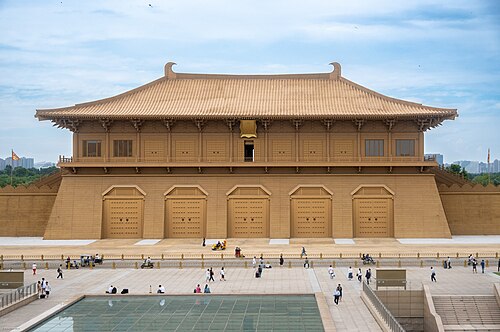
The front hall, called Hanyuan Hall, stood on a huge platform about as tall as a five-storey building. To reach it, visitors walked across a giant open square more than half a kilometre long. Ambassadors from faraway kingdoms, like Silla in Korea and Japan, came here on New Year’s Day to greet the emperor.
Behind the halls of government lay a garden with a big pond called Taiye Pool. There were pavilions for feasts, music and poetry. Famous poets such as Li Bai once worked in an office inside the palace, writing documents for the emperor.
Sadly, the palace was burned during wars, and in 904 a warlord tore down the city and carried its wood away. For a thousand years the place was farmland and houses. Archaeologists began digging there in 1957, and today the ruins are a big park where you can walk along the old outlines of the halls.
At a glance
- Built
- Begun 634 (Emperor Taizong); greatly enlarged 662–663 (Emperor Gaozong)
- Used until
- 904, when the capital was dismantled on the orders of the warlord Zhu Wen
- Place
- Longshou Plateau, north-east of Tang Chang’an (modern Xi’an, Shaanxi, China)
- Names
- Yong’an Palace (634) → Daming Palace (635) → Penglai Palace (662) → Hanyuan Palace (670) → Daming Palace again (701)
- Main halls
- Hanyuan Hall (outer court), Xuanzheng Hall (middle court), Zichen Hall (inner court); Linde Hall for banquets; Taiye Pool garden
- Residents
- Seventeen Tang emperors lived and governed here
- Excavation
- Systematic archaeology from 1957 by the Institute of Archaeology, Chinese Academy of Social Sciences
- Status today
- Daming Palace National Heritage Park (opened 2010); part of the UNESCO World Heritage property “Silk Roads: the Routes Network of Chang’an–Tianshan Corridor” (2014)
Easy
What was the Daming Palace?
The Daming Palace (大明宮, “Palace of Great Brightness”) was the principal imperial palace of the Tang dynasty (618–907) for most of the dynasty’s history. It stood on the Longshou Plateau, a slight rise just outside the north-eastern corner of the walled capital Chang’an, the city known today as Xi’an in Shaanxi Province. From this raised ground the emperor’s halls looked down over the grid of the city.
It was not a single building but a walled precinct containing dozens of halls, gates, offices, residences, gardens and a large artificial lake. Archaeologists have identified the remains of more than forty halls and pavilions. The palace was divided, in the traditional Chinese way, into an outer court for great ceremonies, a middle court for daily government and an inner court where the emperor and his family lived.
Chinese sources and modern scholars agree that it was the largest and most splendid palace of its time in China. The heritage authorities in Xi’an often compare its area with famous palaces elsewhere: it is several times larger than the Forbidden City in Beijing. Such comparisons are rough, but they give a sense of scale.
The palace was the centre of Tang government for roughly 240 years. Emperors received foreign envoys here, held New Year audiences, announced reforms, and in some cases were enthroned or overthrown here. It was destroyed in 904, three years before the Tang dynasty itself ended.
Easy
From a father’s summer home to the seat of an empire
The story begins with a family matter. In 634, the eighth year of the Zhenguan reign, Emperor Taizong ordered a palace to be built for his father, the retired founding emperor Gaozu (Li Yuan). The older imperial residence, the Taiji Palace, lay in the low, damp northern part of the city, and the new site on higher ground promised cooler, drier air in summer. The palace was first called Yong’an Palace, “Palace of Eternal Peace”, and was renamed Daming Palace the next year. Gaozu died in 635 before it was finished, and work slowed.
The decisive phase came under Taizong’s son, Emperor Gaozong. In 662 he resumed large-scale construction, reportedly partly because he suffered from rheumatism in the damp Taiji Palace. The great halls Hanyuan and Xuanzheng were completed, and in 663 the court moved in. Gaozong renamed the complex Penglai Palace, after a mythical island of immortals, and later Hanyuan Palace; in 701 the name Daming returned for good.
From then until the end of the ninth century, the Daming Palace was the main stage of Tang politics. It saw the strong rule of Empress Wu Zetian (who, however, spent much of her reign in Luoyang), the brilliant early court of Emperor Xuanzong, and later the growing power of palace eunuchs, who controlled the inner guard and sometimes decided who would become emperor.
Easy
How to “read” the palace: a walk along the central axis
The best way to understand the palace is to walk its main north–south line, as a visiting envoy would have done. You enter from the south through Danfeng Gate, the principal gate, which had five doorways. The central doorway was reserved for the emperor. Excavations have confirmed this five-passage plan.
Beyond the gate lay a vast open square, more than 600 metres long, leading to Hanyuan Hall. The hall stood on a raised platform about 15 metres high, roughly 200 metres wide and 100 metres deep. Visitors climbed long sloping ramps to reach it, so the building seemed to float above the crowd. Two tall towers, Xiangluan and Qifeng, stood forward on either side like outstretched arms. This was the outer court, used for New Year audiences, great amnesties and the reception of foreign embassies.
Further north came Xuanzheng Hall, the middle court, where the emperor held regular audiences with officials, and then Zichen Hall, the inner court, where he met a smaller circle of ministers. Each step northward was a step into a more private, more restricted world. Government offices, including the Secretariat and Chancellery, were placed beside Xuanzheng Hall.
North of the halls of state, the ground drops to Taiye Pool, a large lake with an island called Penglai Mountain, again named after the island of immortals. Around the lake stood pavilions, galleries and religious buildings, including a Daoist hall called Sanqing Hall. On the western side, Linde Hall, a huge complex of joined halls, was used for banquets for officials and foreign guests.
Intermediate
The palace and the city of Chang’an
The Daming Palace cannot be understood apart from Chang’an. The Sui and Tang capital was one of the largest planned cities in the world: a walled rectangle of about 8.6 by 9.7 kilometres, laid out on a strict grid of broad avenues and walled residential wards. Around 750, estimates place the population within the walls at up to a million, with more people living in the suburbs. Two great markets, the East Market and the West Market, handled trade; the West Market in particular was home to merchants from Central Asia and Iran.
In the original plan the imperial palace (Taiji Palace) sat in the middle of the northern edge, with the government offices of the Imperial City immediately south of it, so that the ruler faced south over the city like the Pole Star over the heavens. Building the Daming Palace outside the north-eastern corner shifted the political centre of gravity. Officials now lived and worked in the eastern part of the city, and the eastern wards became more fashionable. Emperor Xuanzong added a third palace, the Xingqing Palace, near the eastern wall.
Chang’an was cosmopolitan. Sogdian traders, Persian refugees, Buddhist monks from India and Korea, students from Silla and Japan, and envoys from Tibet and the Turkic peoples all passed through. Several religions had places of worship in the city, including Buddhist monasteries, Daoist temples, and temples of Zoroastrians, Manichaeans and the Church of the East. The palace was the point at which this whole world came to meet the emperor.
Intermediate
Ritual, government and power inside the walls
Tang government was built on ritual. Regular court audiences, the New Year reception, the announcement of new reign names and the proclamation of amnesties were staged in the halls of the Daming Palace, and the architecture was designed for these occasions. The height of Hanyuan Hall and the long approach across the square were meant to display the emperor’s position at the centre of the world order.
The palace also housed working institutions. Scholars of the Hanlin Academy, whose remains have been partly excavated, drafted edicts and served the emperor as literary advisers. The poet Li Bai was briefly attached to the emperor’s service in the early 740s, and many Tang poems describe dawn audiences in the palace, the sound of bells and the smell of incense in the halls.
In the later Tang period, after the An Lushan Rebellion (755–763), power inside the palace shifted. Eunuchs commanded the Palace Army (Shence Army) and controlled access to the emperor. Several emperors were placed on the throne, and at least one was murdered, through palace intrigue. In 835 an attempt by officials to destroy eunuch power, known as the Sweet Dew Incident, ended in a massacre of officials within the palace grounds. The splendid architecture thus also witnessed the weakening of imperial authority.
Intermediate
An East Asian stage: envoys, students and monks
For the kingdoms around China, a visit to the Daming Palace was the high point of diplomacy. Envoys from Silla, Balhae, Japan, Tibet, the Uyghurs, the Arabs and many Central Asian states attended the New Year audience in Hanyuan Hall and were feasted in Linde Hall. For the Tang court these visits confirmed the emperor’s claim to universal rule; for the visitors they brought trade, titles, books and recognition.
Japan sent official embassies to Tang China from 630 until the last one sailed in 838; a further mission planned in 894 was cancelled. Students and monks who travelled with them, such as Kibi no Makibi, Abe no Nakamaro (who served as a Tang official and never returned home) and later the monks Kūkai and Saichō, carried Chinese law, Buddhism, literature and architecture back to Japan. One estimate says that about a third of those who set out never returned to Japan: the voyages were dangerous, and some travellers also stayed abroad.
A well-known episode from 753 illustrates the rivalry among visitors. According to the Japanese chronicle Shoku Nihongi, at the New Year audience in the Daming Palace the Japanese deputy envoy Ōtomo no Komaro protested that Japan had been seated below Silla, and the Tang official in charge switched their places. The story is famous in Japan, but it is recorded only on the Japanese side, and historians treat its details with caution.
Silla sent envoys and students in large numbers, especially after the Silla–Tang war of the 670s had ended and relations were repaired in the eighth century. Some Silla scholars passed the special Tang examination for foreigners; the most famous, Choe Chiwon, passed it in 874 and served in China before returning to Silla.
Intermediate
Meanwhile in the world
The years when the Daming Palace was built and filled with life were a time of dramatic change across Eurasia. In 634, when Taizong ordered the first buildings, Muslim Arab armies were beginning their campaigns beyond Arabia after the death of the Prophet Muhammad in 632. Within twenty years the Sasanian Persian Empire had fallen. Its last king’s son, Peroz III, fled east and was given the title “King of Persia” by the Tang court in 662, the same year Gaozong began rebuilding the Daming Palace. A statue of Peroz is among the stone figures of foreign dignitaries at the tomb of Gaozong and Wu Zetian. Through him the palace is linked to the world of Khosrow I and the Sasanian kings.
On the Korean Peninsula, Tang and Silla allied to destroy Baekje (660) and Goguryeo (668), and then fought each other until 676. The Tang generals who led these campaigns received their orders from the court that had just moved into the Daming Palace. In Japan, the Taika Reform of 645 began a long effort to build a Chinese-style state with written law codes, and Japanese capitals such as Heijō-kyō (Nara, from 710) copied Chang’an’s grid plan and the idea of a great audience hall facing south over a broad courtyard.
Further west, Constantinople’s Hagia Sophia, finished in 537, was already a century old and still the greatest domed building of the Christian world. In 751 Tang and Abbasid forces met at the Battle of Talas in Central Asia, and in 762 the Abbasid caliph al-Mansur founded Baghdad as a round city, a rival capital of learning and trade on the other side of the Silk Roads. In 800 Charlemagne was crowned emperor in Rome. Placed side by side, Chang’an, Baghdad and Constantinople were the three great imperial capitals of the eighth-century world.
Intermediate
Burning and dismantling: the end of the palace
Chang’an suffered repeatedly in the late Tang wars. Rebel forces under An Lushan occupied the city in 756, a Tibetan army briefly held it in 763, and the rebel Huang Chao captured and sacked it in 881. Parts of the Daming Palace were damaged and burned in these episodes and in later fighting between regional warlords.
The final blow came in 904. The warlord Zhu Wen, who controlled the last Tang emperors, forced Emperor Zhaozong to move the capital east to Luoyang and ordered the buildings of Chang’an torn down, their timber floated down the rivers to be reused. The Daming Palace ended with the city. Three years later, in 907, Zhu Wen deposed the last Tang emperor and founded his own Later Liang dynasty.
After that the site was never rebuilt as a palace. For more than a thousand years its earthen platforms stood in fields. In the twentieth century, as Xi’an grew, the area north of the Longhai Railway became crowded with refugees and railway workers, and a dense neighbourhood of makeshift housing covered much of the ruins.
Intermediate
Rediscovery, archaeology and the heritage park
Chinese archaeologists of the Institute of Archaeology of the Chinese Academy of Social Sciences began exploring the site in October 1957. Over the following decades they mapped the palace walls, located the main halls and excavated key buildings: Linde Hall, the Hanyuan Hall complex, Sanqing Hall, Qingsi Hall, parts of the Hanlin Academy, a number of gates, the Taiye Pool and, in 2005–2006, Danfeng Gate.
Conservation began in the 1980s with work on Linde Hall. In the early 1990s UNESCO, the Japanese government and the Chinese government agreed to protect the site of Hanyuan Hall, using funds from a Japanese trust fund at UNESCO and from the city of Xi’an. After a full excavation in 1995–1996, the conservation project ran from 1998 to 2003. A further Japanese-funded project added an exhibition hall and a protective building over an ancient brick kiln.
In 2007 Xi’an launched a far more ambitious plan: a national heritage park covering the whole palace area. According to one study of the project, about 3.5 square kilometres were cleared and around 100,000 people from some 25,000 households were relocated. The Daming Palace National Heritage Park opened on 1 October 2010, with a museum, landscaped outlines of the halls and a large new structure over the excavated Danfeng Gate. In 2014 the site was inscribed on the UNESCO World Heritage List as part of the transnational Silk Roads property.
Advanced
Scholarly questions: reconstructing a lost palace
Because no building of the Daming Palace survives above ground, everything we know about its appearance comes from three kinds of evidence: excavated foundations, tiles and building components; written sources such as the Old and New Books of Tang, later topographical works on Chang’an, and poetry; and comparison with surviving buildings of the Tang period and with Japanese palaces modelled on Tang forms. Each has limits. Texts describe ceremonies and names more often than structures, and poems exaggerate. Foundations show plans but not heights or roof forms.
Reconstructions of Hanyuan Hall are therefore interpretations. Architectural historians have proposed different versions of its roof, the arrangement of its flanking towers and the form of the ramps, and the published excavation reports of the 1990s revised earlier assumptions about the hall’s layout. Reconstruction drawings shown in books and museums should be read as scholarly hypotheses, not as photographs of the past.
A second debate concerns chronology. The historical texts give the dates 634, 662–663 and 904, but the palace was rebuilt and altered many times in between. Separating Gaozong’s original halls from later repairs after fires or wars is difficult, and the dating of many excavated features depends on typologies of tiles and bricks rather than on inscriptions.
A third question concerns influence. It is widely held that the plan of Japanese palaces such as Heijō Palace, with a great hall on a raised platform facing a broad courtyard, echoes Hanyuan Hall. How direct that borrowing was, and whether Japanese builders knew the Daming Palace itself or older Chinese models, remains a matter for comparative study.
Advanced
Different perspectives: heritage, displacement and memory
The heritage park is admired by many as a model for protecting a large earthen site inside a modern city, and it has given the ruins a clear, readable presence. Others have raised concerns. Critics in the conservation field point to the scale of the relocation of residents, the commercial development planned around the park, and the construction of large new structures such as the building over Danfeng Gate, which some regard as too close to reconstruction and too far from the principle of minimal intervention in international conservation charters. Supporters answer that the structures protect fragile earthen remains and that residents gained better housing.
Memory of the palace also differs by viewpoint. In Chinese historical writing the Daming Palace often stands for the confidence of the “High Tang” and the idea of China as a centre of civilization. In Japanese history it appears mainly through the embassies, as the place where Japanese envoys and students met the wider world, and episodes like the 753 seating dispute are remembered from a Japanese perspective. Korean historians approach it through Silla’s relations with the Tang, including both the wartime alliance and the conflict of the 670s, and through Silla students who studied in Chang’an.
Modern historians also caution against seeing Tang “tribute” diplomacy only through the Tang court’s own language. Chinese records describe foreign envoys as bringing tribute to a superior ruler, but the visiting states often had their own reasons and their own descriptions of equal or mutually beneficial relations. Reading the palace as a stage of diplomacy means listening to all these voices.
Key ideas
- Outer, middle and inner court
- The traditional three-part division of a Chinese palace: ceremonies (Hanyuan Hall), daily government (Xuanzheng Hall) and the private sphere (Zichen Hall), arranged from south to north.
- Central axis
- The main gates and halls were lined up on a single north–south line, so every visitor moved step by step toward the emperor.
- Architecture as ritual
- The raised platforms, ramps and huge square were designed for audiences and ceremonies that displayed the emperor’s authority.
- Cosmopolitan capital
- Chang’an drew merchants, monks, students and envoys from across Asia, and the palace was where they met the Tang ruler.
- East Asian state model
- Silla and Japan adopted Tang law, bureaucracy and capital planning, and the Daming Palace was a key reference point.
- Earthen-site conservation
- Protecting rammed-earth foundations in the open is technically difficult, and the Daming Palace became a test case for large heritage parks in China.
Records
- 634 CE — Emperor Taizong begins Yong’an Palace for his retired father Gaozu.
- 635 CE — Renamed Daming Palace; Gaozu dies the same year.
- 662 CE — Emperor Gaozong resumes large-scale construction; the palace is renamed Penglai Palace.
- 663 CE — The court moves from the Taiji Palace into the new palace.
- 701 CE — The name Daming Palace is restored.
- 753 CE — According to Japanese records, a seating dispute between Japanese and Silla envoys takes place at the New Year audience.
- 756 CE — An Lushan’s rebel forces occupy Chang’an.
- 835 CE — Sweet Dew Incident: a failed plot against the eunuchs ends in a massacre of officials.
- 881 CE — The rebel Huang Chao captures and sacks Chang’an.
- 904 CE — Zhu Wen moves the court to Luoyang and has Chang’an’s buildings dismantled.
- 1957 — Systematic archaeological exploration begins.
- 2010 — Daming Palace National Heritage Park opens (1 October).
- 2014 — Inscribed as part of the UNESCO World Heritage property “Silk Roads: the Routes Network of Chang’an–Tianshan Corridor”.
Glossary
- Tang dynasty
- Chinese dynasty that ruled 618–907, with its capital at Chang’an.
- Chang’an
- The Sui and Tang capital, on the site of modern Xi’an; its name means “Perpetual Peace”.
- Hanyuan Hall
- The front and largest hall of the Daming Palace, used for great ceremonies and foreign audiences.
- Linde Hall
- A large banquet complex on the west side of the palace.
- Taiye Pool
- The artificial lake in the northern part of the palace, with an island named after the mythical Penglai.
- Danfeng Gate
- The main southern gate of the palace, with five doorways.
- Rammed earth
- Soil pounded in layers to make hard walls and platforms; the main material of Tang foundations.
- Eunuch
- A castrated male palace servant; in the late Tang, eunuchs commanded the palace army and held great political power.
- Kentōshi
- Japanese official embassies to Tang China (630–838).
- Silk Roads
- The network of overland and sea routes linking East Asia, Central Asia, the Middle East and Europe.
Questions and answers
Can I still see the Daming Palace?
You can visit the site. No original buildings survive, but the Daming Palace National Heritage Park in Xi’an shows the foundations, outlines of the halls, a museum and a modern structure over Danfeng Gate.
Why did the Tang build a new palace outside the city walls?
The old Taiji Palace lay on low, damp ground. The new site on the Longshou Plateau was higher, cooler and drier, and it looked out over the city. It was first built for Emperor Gaozu, and Emperor Gaozong later made it the main palace, reportedly also for health reasons.
How big was it?
It was far larger than the later Forbidden City in Beijing. Hanyuan Hall alone stood on a platform about 15 m high, 200 m wide and 100 m deep, facing a square more than 600 m long.
Did Koreans and Japanese really visit?
Yes. Envoys from Silla, Balhae and Japan attended audiences, and students and monks from those countries lived in Chang’an. Japanese embassies went to Tang China from 630 to 838.
Who destroyed it?
It was damaged in several wars and finally dismantled in 904, when the warlord Zhu Wen moved the capital to Luoyang and had Chang’an’s buildings pulled down.
How reliable are the reconstruction drawings?
They are informed hypotheses. Foundations reveal plans, but roofs and heights must be inferred from texts, surviving Tang-period buildings and Japanese palaces modelled on Tang ones, so scholars disagree on details.
Why is the heritage park controversial?
The project involved relocating a very large number of residents and building large new structures on the site. Some experts see this as successful protection; others think it went too far toward reconstruction and commercial development.
Sources and further reading
- Daming Palace. Wikipedia
- 대명궁. Wikipedia (Korean)
- 大明宮. Wikipedia (Japanese)
- Wang Ziqi (School of Archaeology and Museology, Peking University), The Present State of the Daming Palace National Heritage Park. Kanazawa University (ISAC publication)
- Mark Cartwright, Chang'an. World History Encyclopedia, 2017
- Chang'an. Wikipedia
- Japanese missions to Tang China. Wikipedia
- Peroz III. Wikipedia
Related
- Imperial examinationChina's system of written civil service examinations, begun under the Sui around 605 and abolished in 1905, which chose officials by tested learning rather than birth.
- Silla's wars of unificationWars of 660–676 in which Silla, first allied with Tang China and then fighting it, saw Baekje and Goguryeo destroyed and came to rule the peninsula south of the Taedong River.
- Taika ReformA programme of political reforms launched after the palace coup of 645, which aimed to turn Japan’s alliance of powerful clans into a centralised state on the model of Tang China.
- KūkaiMonk of early Heian Japan who studied esoteric Buddhism in Tang China and founded the Shingon school, revered as Kōbō Daishi.
- Li BaiTang poet celebrated for vivid imagery and poems about friendship, travel, wine and the natural world.
- Khosrow ISasanian king of Persia (r. 531–579), called Anushirvan, who reformed taxation and the army, rivalled Justinian, and was later remembered as the model of a just king.
Written with AI assistance from the published sources listed above, and revised as new research appears.