Start at the top for an easy introduction. Go further down for more detail and scholarship.
- Easy
- Intermediate
- Advanced
For young readers
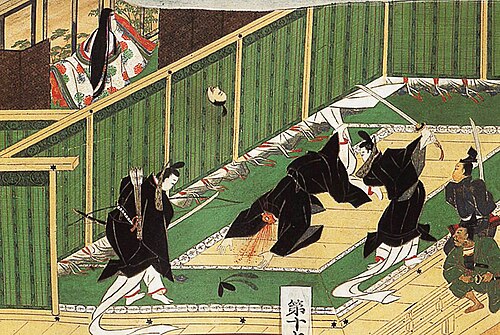
In the year 645, something shocking happened at the Japanese royal palace in Asuka. During an important ceremony in front of the empress, a young prince named Naka no Ōe and his friend Nakatomi no Kamatari attacked and killed Soga no Iruka, the most powerful man at court. The next day Iruka’s father set fire to his own house and died.
For a long time the Soga family had been more powerful than the rulers themselves. The prince and his friends wanted to change that. They wanted a country where the emperor was at the top and where officials, not rich families, ran things.
The new government gave the years a name for the first time — Taika, meaning “great change”. Then, in 646, it announced big plans: land and farmers would no longer belong to powerful families but to the state, the country would be divided into provinces and districts, every family would be written down in a register, and everyone would pay taxes in the same way.
The new leaders took many of these ideas from China, which was then ruled by the mighty Tang dynasty. Some of their advisers had lived in China for more than thirty years and had seen how its government worked.
Changing a whole country is slow. Many of the plans took fifty years or more to come true. Historians still argue about how much really changed in 646 and how much was added later by the people who wrote the history books.
At a glance
- Date
- Coup in the 6th month of 645 (Isshi incident); Reform Edict issued on New Year’s Day 646; reforms continued into the 650s
- Place
- Coup at the Asuka Itabuki Palace; new government moved to Naniwa (Osaka), where the Naniwa Nagara-Toyosaki Palace was completed in 652
- Leaders
- Prince Naka no Ōe (later Emperor Tenji), Nakatomi no Kamatari (later Fujiwara no Kamatari), Emperor Kōtoku
- Advisers
- Takamuko no Kuromaro and the monk Min, who had studied in Sui and Tang China, appointed “national scholars” (kuni no hakase)
- Main aims
- End private ownership of land and people, create provinces and districts, household registers and land allotment, a uniform tax system
- First era name
- Taika (大化, “great change”), the first Japanese era name
- Main source
- Nihon Shoki (720); checked against wooden tablets (mokkan) and palace excavations
- Outcome
- A first step towards the ritsuryō state completed by the Taihō Code (701)
Easy
What was the Taika Reform?
The Taika Reform is the name historians give to a series of political changes in Japan that began with a coup in 645. The word Taika (大化) means “great change” and was the name of the new era proclaimed that year — the first time Japan used era names in the Chinese way. The reforms aimed to replace a system in which great clans held their own land and people with a system in which a single ruler, the tennō (emperor), governed through officials, laws and registers.
Most of what we know comes from the Nihon Shoki (Chronicles of Japan), the court history completed in 720. It describes the coup in dramatic detail and quotes a long Reform Edict said to have been issued on the first day of 646. Because the Chronicles were written seventy years later by the heirs of the reformers, historians have spent a century testing their account against other evidence, especially wooden tablets and the remains of palaces.
The reform did not create a new state overnight. It was the start of a long process that continued through the reigns of Tenji (668–671) and Tenmu (673–686) and was completed with the Taihō Code of 701. But the events of 645 became the traditional starting point of the Japanese imperial state.
Easy
Before 645: the Soga and the clans
In the sixth and early seventh centuries, the Yamato king ruled together with powerful clans (uji). Each clan had hereditary titles, its own lands and groups of dependent workers (be) who produced goods or services for it. The greatest of these clans in the early seventh century was the Soga. Soga leaders had married their daughters into the royal family, championed Buddhism, built Asuka-dera, and dominated the choice of rulers.
Under Empress Suiko (r. 593–628), Soga no Umako shared power with Prince Shōtoku. After their deaths, Umako’s son Emishi and grandson Iruka became even more dominant. In 643 Iruka attacked Prince Yamashiro no Ōe, Shōtoku’s son and a possible heir to the throne, at Ikaruga; Yamashiro and his family died. According to the Chronicles, the Soga were also building grand tombs and residences in a style that looked like royal privilege.
At the same time, students who had gone to China with the embassies of Shōtoku’s time were coming home. They had watched the Sui dynasty fall and the Tang rise, and they knew how a Chinese-style state worked: officials ranked by merit, registers of households, taxes on every adult and land given out by the state. For ambitious young royals, these ideas offered a way to break the Soga.
Easy
The coup of 645
The conspiracy was led by Prince Naka no Ōe, a son of Empress Kōgyoku, and Nakatomi no Kamatari, a member of a clan of court ritualists. The Chronicles tell a famous story of how they met: at a game of kemari (kickball) at Asuka-dera, the prince’s shoe flew off, and Kamatari picked it up and returned it, beginning their friendship.
On the twelfth day of the sixth month of 645, at the Asuka Itabuki Palace, a ceremony was held in front of the empress in which, according to the Chronicles, tribute from the Korean kingdoms was being presented. The conspirators had arranged for swordsmen to strike; when they hesitated, Naka no Ōe himself attacked Iruka, and the guards finished him. The next day Soga no Emishi set fire to his residence and died. The fire is said to have destroyed royal records, including the histories compiled by Shōtoku and Umako.
Empress Kōgyoku abdicated — the first recorded abdication in Japan. Her brother became Emperor Kōtoku, and Naka no Ōe became crown prince. New ministers were appointed, Kamatari became the chief adviser (uchi no omi), and Takamuko no Kuromaro and the monk Min were named national scholars. Later in 645 the court moved to Naniwa, on Osaka Bay, the gateway to the sea routes to Korea and China.
Intermediate
The Reform Edict of 646
According to the Nihon Shoki, the Reform Edict was proclaimed on New Year’s Day 646. It had four main articles. The first abolished the private ownership of land and people by royal princes, ministers and local chiefs; in return, high officials were to receive allowances in the form of the produce of a number of households. The second set up a capital region and a system of provinces and districts, with officials, checkpoints, post horses and relay stations. The third ordered household registers and tax registers to be made, and a system for allotting rice land. The fourth abolished the old levies and introduced new, uniform taxes on rice fields and households, paid in silk, cloth and other goods, along with contributions of horses, weapons, labourers and palace servants.
In the same period other edicts regulated burials — the so-called Hakusō-rei, which limited the size of tombs according to rank — sent new officials to the eastern provinces to count people and weapons, and changed the rank system. The limit on tomb size helps explain why the great keyhole-shaped mounds, symbols of clan power, were no longer built.
The ideas behind the edict came from China. Tang government rested on the equal-field system, which in principle gave land to each household and taxed each adult; on the household register; and on a hierarchy of provinces and counties run by appointed officials. Japan’s later system of handen shūju (periodic allotment of rice fields) and the taxes known as so, yō and chō were modelled on these institutions.
Intermediate
Naniwa: a new palace for a new state
The move to Naniwa was more than a change of address. Naniwa was the port through which envoys, monks and goods came and went, and a new palace there — the Naniwa Nagara-Toyosaki Palace, completed in 652 — gave the reform government a stage. The map point for this page marks that palace.
Excavations in central Osaka, begun in 1954 under Yamane Tokutarō, found two superimposed palaces. The earlier one shows traces of fire and is identified with the palace that burned in 686; its construction is attributed to Emperor Kōtoku after the reform. It was very large for its time, with a spacious court and halls, including octagonal buildings, laid out on a Chinese-style plan. For many historians, the sheer scale of this palace suggests that the government of the 650s really did have ambitions to rule through a large bureaucracy.
The unity of the reformers did not last. In 653 Naka no Ōe returned to Asuka with most of the court, leaving Kōtoku at Naniwa, where he died in 654. Kōgyoku returned to the throne as Empress Saimei, and Naka no Ōe continued to hold real power.
Intermediate
Meanwhile in the world
The coup of 645 happened in the middle of an East Asian crisis. In 642 the general Yeon Gaesomun seized power in Goguryeo in a bloody coup, killing the king and many nobles; in the same year Baekje captured Silla’s western fortresses, and Silla’s Kim Chunchu went to Goguryeo in search of help and was detained. In 645, the very year of the Japanese coup, Emperor Taizong of Tang invaded Goguryeo; his army was stopped at the siege of Ansi fortress and had to withdraw. Many historians see the concentration of power in Japan as part of the same pattern: in Goguryeo, Baekje, Silla and Yamato, rulers or strongmen were centralising power to face the threat of the Tang empire.
Korean diplomacy reached Japan directly. In 647, according to the Nihon Shoki, Kim Chunchu himself came to Yamato as an envoy; the next year he went to the Tang court and secured an alliance against Baekje. That alliance destroyed Baekje in 660. Japan sent a large army to help restore Baekje, but it was crushed by the Tang and Silla at the Battle of Baekgang in 663. The defeat pushed the Yamato court to build fortresses in western Japan, welcome Baekje refugees — many of them officials and scholars — and speed up the building of a centralised state.
Further afield, 645 is also the year the Chinese pilgrim Xuanzang returned to Chang’an after sixteen years in India, where he had studied at Nalanda; the Tang capital was the centre of an empire reaching into Central Asia, and the Daming Palace, begun in 634, would soon become its seat. In the west, Arab armies had defeated the Byzantines and the Sasanian Persians in the 630s and 640s; the last Sasanian king died in 651. The Islamic caliphate was becoming a centralised empire at the same time as Japan’s reformers were trying to build theirs.
Intermediate
From reform to ritsuryō state
After Baekgang, Naka no Ōe moved the capital to Ōmi, by Lake Biwa, in 667 and was formally enthroned as Emperor Tenji in 668. In 669 Kamatari, on his deathbed, received the new surname Fujiwara; his descendants would dominate the court for centuries. In 670 the first nationwide household register (the Kōgo-nen-jaku) was compiled — a key step towards the census the Reform Edict had promised.
After Tenji’s death, the Jinshin War of 672 brought his brother to the throne as Emperor Tenmu, who strengthened the central government further. Codes were compiled, a large grid-plan capital was built at Fujiwara (694), and in 701 the Taihō Code established a full system of penal and administrative law. It was only then that the programme announced in 646 — provinces and districts, registers, land allotment and uniform taxes — was fully set out in law.
For this reason many historians describe the Taika Reform less as a single event than as the opening phase of half a century of state-building, driven both by internal rivalry and by the shock of war with Tang and Silla.
Advanced
Did the reform really happen as described?
The text of the Reform Edict in the Nihon Shoki uses terms that match the Taihō Code of 701 very closely. This raised a suspicion: had the compilers of 720 rewritten the edict in the language of their own laws? The most famous test case was the word for “district”. The Chronicles use kōri written 郡, the term of the Taihō Code. If the reform government had really used this word in 646, documents from the late seventh century should show it.
This question, the “kōri debate” (gunpyō ronsō), divided historians in the mid-twentieth century. Sakamoto Tarō defended the essential authenticity of the edict, while Inoue Mitsusada argued that its text had been heavily revised. The answer came from archaeology: in 1967, wooden tablets from the Fujiwara palace site, including one dated to the year 699, used a different character, 評 (hyō), for district. This showed that before 701 districts were called hyō and that the Nihon Shoki’s text of the edict had been at least partly rewritten in later terms.
In the 1960s and 1970s some scholars went further and doubted that there had been any major reform in 645–646 at all, treating the “Taika Reform” as a later invention. More recent finds have moved opinion back towards a qualified acceptance. Wooden tablets from the Naniwa palace area include one dated 648, and tablets from other sites in Asuka dated 665 show administrative units already in use; together with the size of the early Naniwa palace, they suggest that real reforms were under way in the 640s and 650s. The current mainstream view — sometimes called a “new affirmative theory” — accepts that the reform government pursued centralisation, while regarding the edict’s wording as edited by later compilers.
Advanced
Different perspectives
Japanese interpretations of the reform have changed with Japan’s own politics. In the Meiji period (1868–1912), when a new government claimed to be restoring direct imperial rule, the Taika Reform was often held up as its ancient precedent, and the killing of Iruka was told as a loyal act against a usurping clan. After 1945, historians stressed instead social and economic questions — land, labour, taxation — and became more sceptical of the Chronicles’ heroic narrative, which culminated in the debates over whether the reform happened at all.
Another line of interpretation emphasises the international setting. Historians in both Japan and Korea have compared the coup of 645 with Yeon Gaesomun’s coup in Goguryeo (642), the political upheavals in Baekje in the same years and Silla’s turn to Tang, reading them as parallel responses to Tang expansion. Korean scholarship in particular stresses the role of immigrants and refugees from Baekje and Goguryeo, and of Korean state models, in building Japan’s administration — especially after 663, when many Baekje officials entered Japanese service.
From the viewpoint of Chinese history, the reforms are usually seen as part of the spread of Tang institutions — codes, examinations, registers, Buddhism, the Chinese script — across a “Sinosphere” that included Silla, Japan and later Vietnam. That view is broadly correct but can hide how selectively Japan borrowed: it did not adopt the examination system in any lasting way, kept hereditary court families at the top, and combined Chinese law with native kami ritual.
A fair summary is that the Taika Reform was both a court coup in a clan struggle and part of a region-wide transformation. The Nihon Shoki made it a founding legend; archaeology has shown that there was real substance behind the legend, but less, and later, than the Chronicles claim.
Advanced
Sources and how to read them
The Nihon Shoki remains the only continuous narrative. It was compiled under the patronage of Tenmu’s descendants, and Kamatari’s son Fujiwara no Fuhito was one of the most powerful men at court when it was finished. Both families had good reasons to present the coup of 645 as a righteous act and the reform as a success, so its account must be read with that in mind.
Independent checks come from outside the Chronicles. Wooden tablets (mokkan), used as labels for tax goods and as official notes, preserve the actual vocabulary of administration year by year. Palace excavations at Naniwa and Asuka show the scale of building. Chinese histories of the Tang record Japanese embassies (for example in 653 and 654) and give an outside view. Korean sources, especially the Samguk sagi, provide the peninsular side of events such as Kim Chunchu’s travels and the fall of Baekje.
Reading these together is the method modern historians use: not accepting the Chronicles wholesale, not rejecting them wholesale, but testing each claim against material that the compilers could not edit.
Key ideas
- Public land and people (kōchi kōmin)
- The principle that land and cultivators belong to the state rather than to clans, announced in the first article of the edict.
- Provinces and districts
- A territorial administration run by appointed officials instead of hereditary local chiefs.
- Household registers
- Lists of every household and person, the basis for land allotment, taxation and labour service.
- Uniform taxation
- Replacing clan-specific levies with standard taxes on land and households, paid to the state.
- Era names
- Naming years by reign eras, a Chinese practice that Japan began with Taika and still uses today.
- Response to Tang
- The reform was part of a wider East Asian drive to centralise power when the Tang empire threatened its neighbours.
- Edited history
- The edict’s text in the Nihon Shoki was partly rewritten in later legal terms, as wooden tablets have shown.
Records
- 607 CE — Embassy to Sui; students who later advise the reformers go to China the following year.
- 618 CE — The Tang dynasty replaces the Sui.
- 642 CE — Yeon Gaesomun’s coup in Goguryeo; Baekje takes Silla fortresses; Empress Kōgyoku accedes in Japan.
- 643 CE — Soga no Iruka destroys Prince Yamashiro no Ōe and his family at Ikaruga.
- 645 CE — Isshi incident: Iruka is killed and Emishi dies; Kōtoku becomes emperor; era name Taika; move to Naniwa. Tang invades Goguryeo.
- 646 CE — The Reform Edict is proclaimed on New Year’s Day.
- 647 CE — Kim Chunchu of Silla visits Japan as an envoy.
- 652 CE — The Naniwa Nagara-Toyosaki Palace is completed.
- 660 CE — Tang and Silla conquer Baekje.
- 663 CE — Japanese and Baekje restoration forces are defeated at the Battle of Baekgang.
- 670 CE — The first nationwide household register (Kōgo-nen-jaku) is compiled.
- 701 CE — The Taihō Code completes the ritsuryō system.
Glossary
- Isshi incident
- The coup of 645, named after the year’s place in the sixty-year cycle (kinoto-mi).
- Uji
- Powerful clans of the Yamato court, each with hereditary titles and dependants.
- Be
- Groups of workers attached to the court or to clans, producing goods or services.
- Kuni no hakase
- “National scholars”, advisers appointed in 645 from among those who had studied in China.
- Handen shūju
- The system of periodically allotting rice fields to households according to the registers.
- So, yō, chō
- The rice tax, labour tax (often commuted to cloth) and tax in local products of the ritsuryō system.
- Mokkan
- Inscribed wooden tablets used for labels and documents, a key source for checking the Chronicles.
- Ritsuryō
- The system of penal (ritsu) and administrative (ryō) codes adopted from China.
- Hyō and kōri
- Two words for “district”: 評 was used before 701, 郡 after, which helps date documents.
Questions and answers
Why did the prince kill Soga no Iruka?
The Soga had become more powerful than the royal family. The prince and his allies wanted to end their control and make the ruler truly supreme.
What does “Taika” mean?
“Great change”. It was the name of the era that began in 645, and the first era name ever used in Japan.
Did farmers have to give up their land?
In principle, land and people became the state’s, and rice fields were to be handed out to households according to registers. In practice this took decades to organise.
Where did the ideas come from?
Mostly from Sui and Tang China, often via Korean kingdoms, and from Japanese students and monks who had lived in China.
Is the Reform Edict in the Nihon Shoki genuine?
Partly. Wooden tablets show that some of its wording, such as the character for “district”, comes from after 701, so the compilers edited it. Most historians still think real reforms took place.
How is the Taika Reform connected with Korea?
It happened during a crisis in which Goguryeo, Baekje and Silla were all centralising power against the Tang threat, and it was followed by Japan’s war to restore Baekje in 663.
What happened to Nakatomi no Kamatari?
He became the leading adviser and, just before his death in 669, received the surname Fujiwara, founding the family that dominated the Heian court.
Sources and further reading
- Taika Reform. Wikipedia
- 大化の改新. Wikipedia (Japanese)
- Isshi incident. Wikipedia
- Soga clan. Wikipedia
- The Reform Edict of Taika (from D. J. Lu, Japan: A Documentary History). Asia for Educators, Columbia University
- 府内の史跡公園等の紹介【難波宮跡(難波宮跡公園)】. Osaka Prefectural Government
- Japanese missions to Sui China. Wikipedia
- Goguryeo–Tang War. Wikipedia
- 태종 무열왕. Wikipedia (Korean)
- Battle of Baekgang. Wikipedia
- About Asuka-Fujiwara: component properties. Ancient Capitals of Asuka and Fujiwara Council
- W. G. Aston (trans.), Nihongi: Chronicles of Japan from the Earliest Times to A.D. 697. Kegan Paul, Trench, Trübner (Japan Society of London), 1896
Related
- Yeon GaesomunA Goguryeo aristocrat and general who seized power in a coup in 642 and led the kingdom's resistance to the Tang until his death in the mid-660s.
- Silla's wars of unificationWars of 660–676 in which Silla, first allied with Tang China and then fighting it, saw Baekje and Goguryeo destroyed and came to rule the peninsula south of the Taedong River.
- Daming PalaceThe main palace of the Tang emperors, begun in 634 on the Longshou Plateau outside the north-east corner of Chang’an and the seat of government until it was dismantled in 904.
- Imperial examinationChina's system of written civil service examinations, begun under the Sui around 605 and abolished in 1905, which chose officials by tested learning rather than birth.
- Asuka-deraJapan’s first full-scale Buddhist temple, built in 588–596 by Soga no Umako with craftsmen sent from Baekje; its bronze Great Buddha still sits on the original spot.
Written with AI assistance from the published sources listed above, and revised as new research appears.