Start at the top for an easy introduction. Go further down for more detail and scholarship.
- Easy
- Intermediate
- Advanced
For young readers
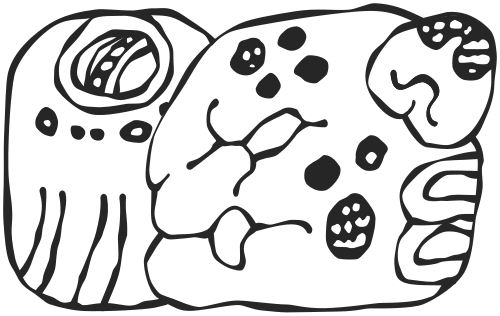
Long ago, in the rainforests and cities of southern Mexico, Guatemala, Belize and Honduras, the Maya people carved and painted a beautiful kind of writing. Each little square picture is called a glyph. Some glyphs look like faces, animals, hands or tiny objects, all squeezed together into neat blocks.
Maya writing works a bit like a puzzle. Some glyphs stand for a whole word: a jaguar’s head can mean “jaguar”. Other glyphs stand for a sound, like “ba” or “la” or “ma”. A scribe could write the word for jaguar, balam, with the jaguar head, or with the three sound signs ba-la-ma, or with a mix of both. That made writing fun and creative.
The Maya wrote on tall stone monuments, on temple walls and stairways, on painted cups and plates, on bones and jade, and in folding books made of bark paper. They recorded when kings were born, when they became rulers, the wars they fought and the gods they honoured. They also kept amazing calendars and tracked the movements of Venus and the Moon.
When Spanish priests arrived in the 1500s, some of them burned Maya books because they thought the books were against their religion. Only four old Maya books survive today. For hundreds of years nobody could read the glyphs.
Then, in the twentieth century, a team of detectives from many countries, including a Russian scholar who never visited the Maya lands until he was old, cracked the code. Today experts can read most Maya texts, and Maya people themselves are learning to read and write the glyphs of their ancestors again.
At a glance
- Type
- Logosyllabic writing system: word signs (logograms) combined with syllable signs (syllabograms)
- Period
- Earliest texts c. 300–200 BC (San Bartolo, Guatemala); flourished c. 250–900 AD; used in books until the Spanish conquest (the last independent Maya kingdom fell in 1697)
- Region
- Maya lowlands and highlands: southern Mexico (Chiapas, Tabasco, Yucatán Peninsula), Guatemala, Belize, western Honduras and El Salvador
- Language
- Mainly Classic Maya, a prestige literary language related to Chʼoltiʼ and Chʼortiʼ; some texts show Yucatecan and other Mayan languages
- Media
- Stone stelae, altars, lintels and stairways; murals; painted and carved ceramics; jade, bone and shell; bark-paper codices
- Surviving books
- Four codices: Dresden, Madrid, Paris, and the Maya Codex of Mexico (formerly Grolier)
- Decipherment
- Major breakthroughs 1952–1990s (Knorozov, Berlin, Proskouriakoff, the Palenque Round Tables and others); over 90% of texts can now be read with reasonable accuracy
- Map location
- Shown at Palenque, one of the richest centres of Classic Maya inscriptions
Easy
What is Maya script?
Maya script is the writing system of the ancient Maya civilization of Mesoamerica, the cultural region that includes much of Mexico and Central America. It is the best-understood of the several writing systems that developed in Mesoamerica, and the only one in which long texts, recording history, politics, religion and astronomy, can now be read in detail.
The script is made up of hundreds of distinct signs called glyphs. Many look like pictures of heads, animals, hands, plants or objects, but they are not simply pictures. Like Egyptian hieroglyphs or Chinese characters, they form a full writing system capable of recording spoken language, including grammar, names and poetry.
Maya writing was used for about two thousand years. The oldest texts that are clearly Maya date to around 300–200 BC. The script flourished during the Classic period (about 250–900 AD), when dozens of kingdoms such as Tikal, Calakmul, Palenque, Copán and Yaxchilan raised carved monuments covered with inscriptions. After the collapse of many southern lowland cities in the ninth and tenth centuries, writing continued, especially in books, in Yucatán and the Petén until Spanish conquest.
For centuries after the conquest the script could not be read. Its decipherment, achieved step by step between the 1950s and the 1990s, is one of the great intellectual achievements of the twentieth century and transformed our understanding of Maya history.
Easy
How Maya writing works: words, syllables and blocks
Maya script is logosyllabic. This means it uses two kinds of signs together. Logograms stand for whole words or meaningful parts of words. Syllabograms stand for syllables, usually a consonant plus a vowel, such as ba, ka, la or ma. Modern Japanese, which mixes kanji (word signs) with kana (syllable signs), is a useful comparison.
Scribes had many ways to write the same word. The word for jaguar, bʼalam, could be written with a single logogram showing a jaguar’s head; with the logogram plus a syllable sign as a hint to the pronunciation, such as bʼa-BʼALAM or BʼALAM-ma; or entirely with syllables, as bʼa-la-ma. When a word ended in a consonant, the scribe added a syllable whose vowel was usually silent. These phonetic hints, called phonetic complements, helped readers choose the right reading when a logogram had more than one possible meaning.
Glyphs were grouped into roughly square glyph blocks, each usually containing a main sign with smaller signs attached above, below or at the sides. Texts were normally read in pairs of columns: left to right and top to bottom across two columns, then on to the next pair. This arrangement fits the tall rectangular shape of stelae and the pages of the codices.
The same sign could be drawn in many ways. Scribes could use a simple geometric form, a “head variant” showing a face, or even a full-figure version in which the sign becomes a whole character. This playful variety, a matter of artistry as much as spelling, is one reason Maya inscriptions are so beautiful and also one reason they were so difficult to decipher.
Easy
What the Maya wrote about
The most visible texts are on public monuments. Tall carved stone slabs called stelae, often showing a ruler in rich costume, record key events in royal lives: birth, accession to the throne, marriages, rituals, wars, captives taken and deaths. Palenque’s great king Kʼinich Janaabʼ Pakal, who came to the throne in 615 and died in 683, is known in detail from the long inscriptions in the Temple of the Inscriptions, where he was buried.
Almost every inscription is anchored by dates. The Maya used several interlocking calendars: a 260-day ritual calendar, a 365-day solar year, and the Long Count, which counted days from a mythical starting point corresponding to 11 August 3114 BC in the most widely used correlation. A Long Count date such as 9.12.11.5.18 tells how many periods of 144,000, 7,200, 360, 20 and 1 days have passed since that beginning.
Writing appears on everyday objects of the elite too. Painted cylinder vases often carry a band of glyphs, known as the Primary Standard Sequence, that dedicates the vessel, names its type, says what it held (often chocolate drinks) and names its owner. Some pots are even signed by the artist who painted them. Jade jewellery, bone, shell and wooden objects also carry texts.
The folding books, or codices, contained almanacs for divination, tables for predicting eclipses and the cycles of Venus, and guides to rituals and ceremonies. These books were made of bark paper, called huun in Mayan languages, coated with a fine layer of lime plaster and painted with brushes.
Intermediate
Origins and history of the script
Writing in Mesoamerica is older than the Maya script. Earlier signs are known from Olmec-period objects, and several early scripts developed in the region, including Zapotec and the so-called Epi-Olmec or Isthmian script. Some of the earliest Long Count dates come from outside the Maya area, such as Stela 2 at Chiapa de Corzo (36 BC) and Stela C at Tres Zapotes (32 BC). The Maya script therefore grew within a shared Mesoamerican tradition of writing and calendar-keeping.
The oldest texts that are identifiably Maya come from San Bartolo in Guatemala, where a painted text found in 2005 dates to about 300 BC, and fragments published in 2022 include a date in the 260-day calendar (“7 Deer”) from around 300–200 BC. San Bartolo is also famous for murals painted around 100 BC that show the maize god and creation myths, accompanied by short captions.
During the Classic period, writing became closely tied to kingship. Kings called themselves kʼuhul ajaw, “holy lord”, and used carved monuments to proclaim their descent, their alliances and their victories over rival kingdoms. Skilled scribes, some from noble families, held high status; a few are known by name, and some rulers themselves may have been literate.
The last known Long Count dates on monuments were carved in 909 AD at Toniná and nearby sites, reflecting the collapse of the Classic kingdoms. But writing did not end. In northern Yucatán and in the Petén, books continued to be produced and used. Three of the four surviving codices are thought to come from this Postclassic period (roughly 900–1500s).
Intermediate
Conquest and loss: the burning of books
The Spanish conquest of the Maya was long and uneven, lasting from the 1520s into the late seventeenth century. Franciscan missionaries saw the hieroglyphic books as works of idolatry. The most notorious episode took place at Maní in Yucatán on 12 July 1562, when the Franciscan friar Diego de Landa held an auto-da-fé, a public ceremony of punishment, at which dozens of books and thousands of sacred images were burned. His investigation also involved the torture of Maya people suspected of continuing their traditional religion.
Landa himself later wrote that the books contained “superstition and lies of the devil” and that the Maya grieved deeply at their loss. Ironically, the same man wrote the most important early description of Maya culture, the Relación de las cosas de Yucatán (about 1566), which includes a list of signs that Landa believed were a Maya “alphabet”. A later copy of this text was rediscovered and published by the French scholar Charles Étienne Brasseur de Bourbourg in 1862.
Maya writing continued in secret or in remote places for some time. The Itza kingdom, with its island capital of Nojpetén in Lake Petén Itzá in Guatemala, remained independent until a Spanish assault on 10 March 1697. The Itza may have been among the last communities to keep hieroglyphic books; after the conquest of the Petén, the knowledge of reading the glyphs appears to have died out.
Maya people did not stop writing, however. From the sixteenth century onward they wrote their languages in the Latin alphabet, producing important works such as the Popol Vuh of the Kʼicheʼ and the Books of Chilam Balam of Yucatán. These texts preserve history, myth and prophecy, in some cases perhaps transcribed from older glyphic books.
Intermediate
The four surviving books
The Dresden Codex, kept in the state library of Dresden in Germany, is the most elaborate: 78 pages of astronomical tables, almanacs and ritual instructions. Its tables predict solar and lunar eclipses and track the cycle of Venus with remarkable accuracy. Between about 1880 and 1900 the librarian Ernst Förstemann used it to work out the Maya number system and the Long Count, the first major step in understanding the script.
The Madrid Codex, with 112 pages, is the longest. It was found in Spain in the 1860s in two separate parts, once known as the Troano and Cortesianus codices. It consists mainly of almanacs and horoscopes used by priests and was painted by several scribes.
The Paris Codex, only 22 pages and badly worn, was found in 1859 in the French national library in a basket of old papers. It includes prophecies for cycles of years and a set of constellations sometimes called a Maya zodiac.
The fourth, long called the Grolier Codex and renamed the Maya Codex of Mexico in 2018, is a fragment of 11 pages with a Venus calendar. Its authenticity was long doubted, but scientific tests led Mexican authorities to recognize it as genuine, dating it to about 1021–1154 AD, which may make it the oldest surviving book of the Americas. It is the only Maya codex held in the Americas, in the National Museum of Anthropology in Mexico City.
Intermediate
Cracking the code
Early progress came through numbers and calendars. Förstemann’s work on the Dresden Codex, and studies of monuments by scholars such as Joseph Goodman, revealed the Long Count and the structure of dates. By the mid-twentieth century scholars could read the dates on Maya monuments but not the words around them. The dominant figure in the field, the British Mayanist J. Eric S. Thompson, argued that the glyphs were largely ideographic and mystical, and dismissed Landa’s “alphabet” as nonsense.
In 1952 the Soviet linguist Yuri Knorozov, working in Leningrad, proposed that Landa’s list was not an alphabet but a set of syllables: Landa had asked his Maya informants to write the Spanish letters “a”, “be”, “ce” and so on, and they had written signs for the sounds they heard. Knorozov showed that Maya script, like other early writing systems, combined logograms with phonetic signs. Thompson attacked his work, and Cold War politics made it hard for his ideas to be accepted in the West.
Other breakthroughs revealed the content of the texts. In 1958 Heinrich Berlin identified “emblem glyphs”, royal titles containing the name of a kingdom. In 1960 Tatiana Proskouriakoff, an architect-turned-archaeologist, showed from patterns of dates at Piedras Negras that the monuments recorded the lives of historical rulers, a sequence of seven kings over two hundred years, not only gods and astronomy.
In 1973, at the first Mesa Redonda (Round Table) of Palenque, a small group including Linda Schele, Peter Mathews and Floyd Lounsbury worked out most of the dynastic history of Palenque in a single afternoon, reading the names and life histories of six kings. From the late 1970s onward, a new generation, including David Stuart, who began making discoveries as a teenager, combined Knorozov’s phonetic approach with Proskouriakoff’s historical method, and the pace of decipherment accelerated dramatically.
Intermediate
Maya writing today
The Maya are not a vanished people. Millions of people in Mexico, Guatemala, Belize and Honduras speak around thirty Mayan languages today, including Kʼicheʼ, Qʼeqchiʼ, Kaqchikel, Mam, Yucatec Maya and Chʼortiʼ, the modern language most closely related to the Classic inscriptions. For most of the last five centuries they have written these languages in the Latin alphabet.
In recent decades there has been a revival of the glyphs among Maya communities. Workshops led by epigraphers and Maya teachers have taught the script to Maya speakers, who read the ancient texts in the light of their own languages and traditions and create new texts in glyphs. For many participants this is a way of reclaiming a heritage that colonial rule took from them.
The revival also changes who interprets Maya history. For much of the twentieth century decipherment was led by foreign scholars. Maya epigraphers and educators now contribute to research, public education and the protection of sites, and their knowledge of living languages, place names and ceremonies can illuminate ancient texts.
The script is also being prepared for digital use. A proposal to encode Maya hieroglyphs in Unicode, the international standard for computer text, has been under development, with a tentative block reserved. Because Maya writing combines signs into blocks in complex ways, encoding it is a technical challenge.
Advanced
Scholarly debates and open questions
The language of the inscriptions. Most specialists hold that Classic inscriptions were written in a prestige language, often called Classic Maya or Classic Chʼoltiʼan, ancestral to Chʼoltiʼ (now extinct) and Chʼortiʼ. It may have functioned like Latin in medieval Europe, a written standard used across kingdoms whose people spoke various Mayan languages. Regional features of Yucatecan and other languages appear in some texts, and how far the written language reflected everyday speech is debated.
Spelling rules. Scholars disagree on how far Maya spelling encoded features such as vowel length and glottal stops. One influential proposal holds that the choice of a “silent” final vowel that matches or differs from the preceding vowel signalled such distinctions (harmony and disharmony rules). Others consider the system less regular. These debates affect how Classic Maya words are transcribed.
Decipherment and its history. The story of the decipherment has itself been debated. Michael D. Coe’s Breaking the Maya Code (1992) presented Thompson as a major obstacle and Knorozov as a vindicated outsider. Other historians note that Thompson made real contributions, that Knorozov’s early readings contained errors, and that progress depended on many researchers, including Proskouriakoff, Berlin and later generations. The role of the Palenque Round Tables, informal workshops open to amateurs and students as well as professionals, is often highlighted as a model of collaborative research.
What remains unread? Although most texts can now be read, some signs remain undeciphered or uncertain, and many readings are provisional. Interpreting a readable sentence is also different from understanding it: royal titles, ritual terms and mythological names can be read aloud yet remain obscure in meaning. New discoveries, such as early texts from San Bartolo or monuments found through lidar surveys, continue to add material.
Advanced
Evidence and methods: how a lost script was read
Bilingual keys. Unlike Egyptian with the Rosetta Stone, Maya had no true bilingual inscription. Landa’s list, a flawed record of a Maya scribe responding to a Spanish friar, served as a partial substitute. Colonial-era dictionaries and grammars of Mayan languages, and the living languages themselves, provided the vocabulary against which phonetic readings could be tested.
Internal analysis. Researchers used structural methods: tracking which signs substitute for each other in the same word, which appear with particular dates or images, and how signs combine. Proskouriakoff’s work showed the power of analysing patterns of dates without reading the words. Substitution patterns, such as a logogram alternating with a syllabic spelling of the same word, provide strong evidence for readings.
Context and images. Maya texts often accompany images: captions naming a figure on a vase, or a monument showing a ruler seated on a throne next to a text describing an accession. Matching text and image, and comparing hundreds of examples, allowed scholars to identify verbs such as “was born”, “was seated (as king)” and “died”.
Corpus building. Systematic documentation, including Ian Graham’s Corpus of Maya Hieroglyphic Inscriptions project at Harvard’s Peabody Museum and photographic archives of painted vases, made it possible for scholars around the world to compare texts. Today digital databases and 3D scanning extend this work. The methodological lesson of Maya decipherment is that progress came from combining linguistics, archaeology, art history and the knowledge preserved in living Maya languages.
Key ideas
- Logosyllabic writing
- A system combining word signs with syllable signs, allowing the same word to be spelled in several ways.
- Phonetic complement
- A syllable sign added to a logogram to indicate its pronunciation and avoid ambiguity.
- Writing and kingship
- Classic Maya kings used monumental inscriptions to record their births, accessions, alliances and wars.
- Calendar and cosmos
- Interlocking calendars, including the Long Count, anchored history and ritual in precise time.
- Colonial destruction
- The burning of books and suppression of Maya religion cut the chain of transmission for centuries.
- Collaborative decipherment
- The script was read through the combined work of linguists, archaeologists and art historians across many countries.
- Living heritage
- Maya communities today are reclaiming the glyphs as part of their cultural identity.
Records
- c. 300 BCE — Earliest identifiably Maya texts at San Bartolo, Guatemala.
- 36 BCE — Stela 2 at Chiapa de Corzo carries one of the earliest known Long Count dates (outside the Maya area).
- 615 CE — Kʼinich Janaabʼ Pakal becomes king of Palenque; his reign is recorded in detail in inscriptions.
- 909 CE — The last known Long Count dates on monuments are carved at Toniná and nearby sites.
- c. 1100 — The Maya Codex of Mexico (Grolier) is made (dated c. 1021–1154).
- 1562 — Diego de Landa burns Maya books and sacred images at Maní, Yucatán (12 July).
- c. 1566 — Landa writes the Relación de las cosas de Yucatán, including his “alphabet”.
- 1697 — The Itza capital Nojpetén falls to Spanish forces (10 March), ending the last independent Maya kingdom.
- 1862 — Brasseur de Bourbourg publishes Landa’s Relación.
- 1952 — Yuri Knorozov publishes his phonetic interpretation of the script.
- 1960 — Tatiana Proskouriakoff shows that Maya monuments record historical rulers.
- 1973 — The first Palenque Round Table reconstructs Palenque’s royal dynasty.
Glossary
- Glyph
- A single sign in the Maya script.
- Glyph block
- A roughly square group of signs read as a unit, usually one word or phrase.
- Logogram
- A sign that represents a whole word or meaningful unit.
- Syllabogram
- A sign that represents a syllable, usually a consonant plus a vowel.
- Stela
- An upright carved stone slab, often showing a ruler and an inscription.
- Codex
- A folding book; the Maya made them of bark paper coated with lime plaster.
- Long Count
- A Mesoamerican calendar counting days from a starting point in 3114 BC.
- Emblem glyph
- A royal title including the name of a kingdom, identified by Heinrich Berlin in 1958.
- Kʼuhul ajaw
- “Holy lord”, the title of Classic Maya kings.
- Epigraphy
- The study of inscriptions.
- Auto-da-fé
- A public ceremony of penance and punishment held by the Inquisition or church authorities.
Questions and answers
Is Maya writing made of pictures?
Many glyphs look like pictures, but they are not just pictures. They form a full writing system with word signs and sound signs that can record any sentence in the language.
How many Maya books survive?
Only four: the Dresden, Madrid and Paris codices, and the Maya Codex of Mexico. Thousands of others were lost, many burned by Spanish missionaries.
Did the Maya predict the end of the world in 2012?
No. 21 December 2012 marked the end of a large cycle in the Long Count calendar. Maya inscriptions treat such endings as moments of renewal, and at least one text refers to dates far beyond 2012.
Who deciphered Maya script?
No single person. Key figures include Ernst Förstemann, Yuri Knorozov, Heinrich Berlin, Tatiana Proskouriakoff, Linda Schele, Peter Mathews, Floyd Lounsbury and David Stuart, among many others.
Why was Knorozov’s work resisted?
The leading authority, J. Eric S. Thompson, rejected the idea that Maya writing was largely phonetic, and Cold War politics made Western scholars suspicious of Soviet research.
What language are the inscriptions in?
Mostly Classic Maya, a literary language related to Chʼoltiʼ and modern Chʼortiʼ, used across many kingdoms.
Do Maya people still use the glyphs?
Everyday writing in Mayan languages uses the Latin alphabet, but many Maya people now study the glyphs in workshops and use them to express cultural identity.
Sources and further reading
- Maya script. Wikipedia
- Maya codices. Wikipedia
- Yuri Knorozov. Wikipedia
- Tatiana Proskouriakoff. Wikipedia
- Diego de Landa. Wikipedia
- San Bartolo (Maya site). Wikipedia
- Kʼinich Janaabʼ Pakal. Wikipedia
- Mesoamerican Long Count calendar. Wikipedia
- Nojpetén. Wikipedia
- Michael D. Coe, Breaking the Maya Code. Thames & Hudson, 1992
Related
- Popol VuhK'iche' Maya narrative of origins, divine figures and ancestral history.
- Chichén ItzáA major Maya city on the Yucatán Peninsula, with monuments built and used across several centuries.
- TeotihuacanA major ancient city in central Mexico, known for its monumental avenues, pyramids and extensive residential compounds.
- CuneiformOne of the world’s earliest writing systems, made by pressing a reed into wet clay; invented in southern Mesopotamia and used for more than 3,000 years to write many languages.
- Rosetta StoneGranodiorite stele fragment inscribed in 196 BC with a priestly decree honouring Ptolemy V in hieroglyphic, Demotic and Greek; the parallel texts became the key to deciphering ancient Egyptian writing.
- HunminjeongeumThe Korean alphabet promulgated by King Sejong in 1446, and the title of the text explaining it.
Written with AI assistance from the published sources listed above, and revised as new research appears.