Start at the top for an easy introduction. Go further down for more detail and scholarship.
- Easy
- Intermediate
- Advanced
For young readers
Long ago, in the green mountains of what is now Guatemala, lived the K'iche' Maya people. They had wise storytellers and writers who kept a very special book about where everything came from. Today we call it the Popol Vuh, which can mean 'Book of the Community' or 'Book of the Council'. K'iche' people still treasure it today.
The book says that at first there was only calm sea and quiet sky. The makers talked together, and the Earth rose up with mountains, trees and animals. Then the makers wanted beings who could talk and say thank you. They tried making people out of mud, but the mud people melted. They tried wood, but the wooden people had no hearts and forgot their makers. At last they made people from yellow and white corn (maize), and those people were just right.
The most exciting part is about two brave twin brothers, Hunahpu and Xbalanque. They love playing a ball game, bouncing a heavy rubber ball with their hips. The lords of the Underworld, a scary place called Xibalba, invite them down to play, hoping to trick and defeat them. The lords make the twins spend nights in a house full of knives, a house of jaguars, a house of fire and a house of bats.
The twins are clever. They use tricks, help from animals, and even magic shows to outsmart the lords. In the end they win, and they rise into the sky to become the Sun and the Moon.
The last part of the book tells about the first K'iche' families, their long journey, and the kings who ruled their cities. After Spanish soldiers came in the 1500s, K'iche' writers wrote the stories down using letters so that they would not be lost. Thanks to them, we can still read this amazing book.
At a glance
- People and tradition
- K'iche' Maya of the highlands of Guatemala; a sacred text for many K'iche' people today
- Written down
- c. 1554–1558 in the Latin alphabet (estimate based on the royal genealogies in the text); drawing on much older traditions
- Place
- Probably Santa Cruz del Quiché, near the former K'iche' capital Q'umarkaj (Utatlán)
- Language
- Classical (colonial-era) K'iche', a Mayan language
- Authors
- Anonymous K'iche' nobles, probably of the leading lineages; identity debated
- Oldest surviving copy
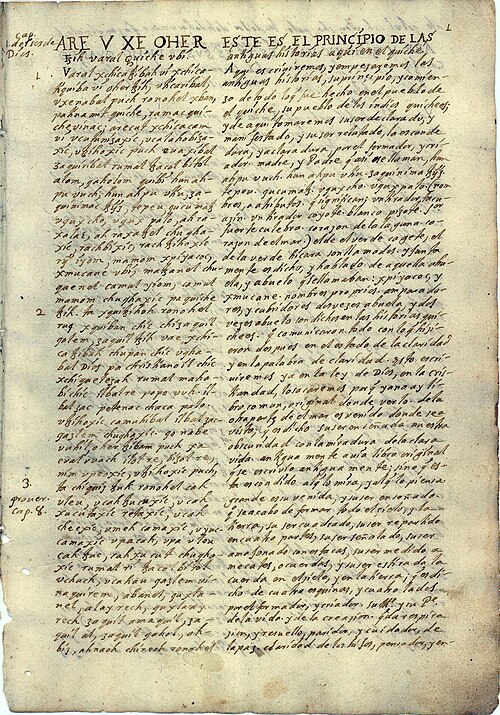
- Copy with Spanish translation by the Dominican friar Francisco Ximénez, c. 1701–1703, Chichicastenango; now in the Newberry Library, Chicago
- Contents
- Creation of the world and of humans, the Hero Twins cycle, migration and history of the K'iche' lineages to the 1550s
- Recognition
- Declared intangible cultural heritage of Guatemala in 2012
Easy
What is the Popol Vuh?
The Popol Vuh (in modern K'iche' spelling, Popol Wuj) is the most important surviving narrative of the K'iche' Maya, one of the Maya peoples of the highlands of present-day Guatemala. It combines a sacred account of how the world and humanity were created, a cycle of heroic myths about divine twins, and a historical record of the K'iche' ruling lineages from their legendary origins down to the time of the Spanish conquest.
The name is usually translated as 'Book of the Council', 'Book of the Community' or 'Book of the People'. Popol refers to a mat, and by extension to a council or assembly (leaders sat on woven mats), while vuh or wuj means 'book' or 'paper'. The authors say they are writing it anew because an earlier book, the original 'Popol Vuh', can no longer be seen. This suggests that a pre-conquest book, perhaps a painted screenfold codex, once existed, together with a long tradition of oral performance.
The text that survives was written in the K'iche' language using the Latin alphabet in the colonial period, most likely in the 1550s, by K'iche' nobles whose names are not given. It is often compared to foundational works like the Hebrew Bible or the Greek epics, but it is best understood in its own terms: as a Mesoamerican (Mexican and Central American) cosmological and historical charter, and as a living sacred text for many K'iche' people today.
Easy
The story, part 1: the making of the world and the first people
The Popol Vuh begins in stillness: only the sea lying calm under the empty sky. The creator deities, including Tepew and Q'ukumatz (often translated 'Sovereign' and 'Plumed Serpent'), and Heart of Sky, also called Juraqan, talk and think together. Through their word, the Earth rises from the water, mountains and valleys take shape, and the forests and animals appear.
The gods want beings who will speak, keep the days and honour their makers. The animals cannot speak properly, so they are left to live in the forest and be eaten. The gods then shape a person from mud, but it crumbles, dissolves and cannot think. Next, after consulting the elderly diviners Xpiyacoc and Xmucane, they carve people from wood. These wooden people multiply and speak, but they have no hearts, blood or memory of their creators. The gods send a flood, and even the people's own tools, pots, grinding stones and dogs rise up against them for their cruelty. Their survivors, the text says, are the monkeys of the forest.
Only much later, after the Hero Twins' adventures have prepared the world, do the gods succeed. Using yellow and white maize (corn) brought from a place called Paxil and Cayala, ground by Xmucane, they form the first four men, Balam Quitze, Balam Acab, Mahucutah and Iqui Balam, and then their wives. These maize people speak, give thanks and at first see everything, near and far. The gods, worried that humans might become their equals, cloud their vision 'like breath on a mirror'. The idea that humans are made of maize remains central to Maya identity today.
Easy
The story, part 2: the Hero Twins and the lords of Xibalba
Before the dawn of the present world, the twins Hunahpu and Xbalanque first defeat a boastful bird-being called Seven Macaw (Vucub Caquix), who pretends to be the sun and the moon, and then his arrogant sons Zipacna and Cabracan. These episodes show the clearing away of false powers before the true dawn.
The story then goes back a generation. The twins' father and uncle, One Hunahpu and Seven Hunahpu, were great ballplayers whose noisy games disturbed the lords of Xibalba, the underworld. The lords, led by One Death and Seven Death, summoned them below, tricked them and killed them. One Hunahpu's head was hung in a calabash tree. When a young woman of Xibalba named Xquic (Lady Blood) came to see the tree, the skull spat into her hand and she became pregnant. Fleeing the underworld, she went to the house of Xmucane, the twins' grandmother, and after tests proving who she was, gave birth to Hunahpu and Xbalanque.
When the twins grow up, they find their father's ball-game gear and are, in turn, summoned to Xibalba. There they pass a series of deadly tests: the Dark House, the Razor House, the Cold House, the Jaguar House, the Fire House and the Bat House, where a bat cuts off Hunahpu's head (Xbalanque replaces it with a squash to trick the lords). Knowing the lords plan to kill them, the twins arrange their own deaths: they leap into an oven, and their ground bones are thrown into a river. They return as poor wandering performers whose miracles include sacrificing and reviving each other. The fascinated lords demand to be sacrificed too, and the twins kill them and do not bring them back, breaking the power of Xibalba.
Afterward the twins try to restore their father, who remains honoured at the ballcourt, and then they rise into the sky as the sun and the moon. The victory of cleverness, loyalty and self-sacrifice over death is one of the great themes of Mesoamerican storytelling.
Intermediate
The story, part 3: migration, dawn and the K'iche' kings
The final part turns from myth to history. The first maize people and their descendants multiply in the darkness of the east and travel to a place called Tulan Zuyva, where they receive their patron gods, including Tohil, a god associated with fire. The lineages speak different languages after leaving Tulan, a way of explaining the diversity of highland peoples.
They wander, fast and wait in the mountains until the first dawn, when the sun rises and the world as humans know it begins. The text then tells how the K'iche' lineages settled, fought with neighbours, built fortified towns and finally founded Q'umarkaj, their great capital. It describes the great lords, especially the powerful ruler K'iq'ab, under whom the K'iche' kingdom expanded, and it lists the titles and houses of the ruling families.
The book ends with genealogies of the Kaweq, Nijaib and Ajaw K'iche' lineages, generation by generation, down to the rulers who lived under Spanish rule in the mid-sixteenth century, and a mention of the Spanish conquest. This historical section served as a charter: it showed which families held authority and why, which mattered greatly in colonial disputes over land and status.
Intermediate
Historical context: the K'iche' kingdom and the Spanish conquest
Maya civilisation has a history of more than two thousand years. The great lowland cities of the Classic period (c. 250–900 CE), such as Tikal and Palenque, used a sophisticated hieroglyphic script. The highland K'iche' kingdom rose much later, in the Postclassic period. Around the fifteenth century it dominated much of the Guatemalan highlands from Q'umarkaj, before rival peoples, including the Kaqchikel, broke away.
In 1524 the Spanish conquistador Pedro de Alvarado invaded the highlands with Spanish soldiers and large numbers of allied Indigenous warriors from central Mexico. After battles near present-day Quetzaltenango, the K'iche' kings were captured and burned, and Q'umarkaj was destroyed. The Spanish then founded the town of Santa Cruz del Quiché nearby. Epidemics, forced labour and missionary campaigns followed, and many Indigenous books were destroyed as idolatrous.
It was in this setting that K'iche' nobles, some of whom had learned the Latin alphabet from missionaries, began writing documents in their own language. Several related K'iche' texts from the same period survive, such as the Title of Totonicapán (1554), which contains versions of some of the same historical traditions. Writing the Popol Vuh was an act of preservation and of self-assertion: the authors note that they are writing 'within Christianity', yet they carefully record the old gods, rites and royal history.
On a world scale, the 1550s were a period of rapid globalisation: Spain was consolidating its American empire, silver from Potosí was beginning to flow across the Atlantic and Pacific, and Indigenous writers across Mesoamerica, including Nahua authors in Mexico, were recording their histories in alphabetic scripts.
Intermediate
Key ideas and themes
Creation by word and dialogue. The world comes into being through the gods' conversation, thought and speech. Creation is a collaborative, trial-and-error process rather than a single act, and humans exist in order to speak, remember and nourish the gods with praise and offerings.
Maize and humanity. People are literally made of maize dough. This expresses the deep bond between Mesoamerican peoples and the crop they domesticated thousands of years ago, and it links the human life cycle to planting, growth, harvest and rebirth. The death and return of the twins' father, and the twins' own death and revival, resonate with the cycle of the maize plant.
Duality, balance and the calendar. Pairs appear everywhere: sky and earth, grandmother and grandfather, two generations of twins, day and night. Many names contain numbers and day-names from the 260-day ritual calendar (for example Hun, 'one', and Vucub, 'seven'). The text also reflects the work of daykeepers (ajq'ij), K'iche' ritual specialists who still keep the calendar today.
Trickery against arrogance. The heroes overcome stronger opponents through wit, disguise and knowledge rather than brute force. Boastful or cruel figures, from Seven Macaw to the lords of Xibalba, fall because of their pride. The ball game, a real Mesoamerican ritual sport played with a solid rubber ball, becomes a stage on which the struggle between life and death is played out.
Intermediate
How the text survived: from oral tradition to the Newberry Library
The original alphabetic manuscript of the 1550s is lost. The text survives because, around 1701–1703, the Dominican friar Francisco Ximénez, parish priest of Santo Tomás Chichicastenango, was shown a K'iche' manuscript by members of the community. He copied it in K'iche' and set a Spanish translation alongside it in parallel columns. Ximénez was interested in the language and also regarded the text through a missionary lens, but his careful copy is the reason we have it at all.
After Ximénez's death his manuscripts remained with the Dominicans and passed in 1829–1830 to the University of San Carlos in Guatemala City. There the Austrian traveller Carl Scherzer found them in 1854 and published Ximénez's Spanish translation in Vienna in 1857. In 1855 the French priest and antiquarian Charles Étienne Brasseur de Bourbourg acquired the manuscript and took it to France; in 1861 he published the K'iche' text with a French translation, introducing the name 'Popol Vuh' to the wider world and dividing the text into four books.
After Brasseur's death the manuscript was sold, eventually entering the collection of the American collector Edward E. Ayer, who gave it to the Newberry Library in Chicago. It was largely forgotten there until the Guatemalan scholar Adrián Recinos located it in 1941; his Spanish translation of 1947 became a classic. The Newberry has since made digital images available, and many Guatemalans and K'iche' leaders have discussed the question of where the manuscript should ultimately reside.
Important modern translations include Munro Edmonson's verse translation (1971), Dennis Tedlock's English translation (1985, revised 1996), made in consultation with the K'iche' daykeeper Andrés Xiloj, the edition by the K'iche' scholar Luis Enrique Sam Colop (Popol Wuj, 1999, and a Spanish translation in 2008), and Allen J. Christenson's literal and poetic translations (2003 and after). The text has also been translated into modern K'iche' and many other languages.
Intermediate
Legacy and living tradition
For many K'iche' and other Maya people, the Popol Vuh is not a relic but part of a living spiritual and cultural heritage. Daykeepers, teachers and activists draw on it in ceremonies, education and the movement for Indigenous rights and language revitalisation that grew after Guatemala's civil war (1960–1996) and the 1996 peace accords. Out of respect, readers should remember that its gods, places and rites are sacred to living communities.
In Guatemala the book is a national symbol. Nobel laureate Miguel Ángel Asturias, who studied Maya texts in Paris, drew heavily on it in his novel Hombres de maíz ('Men of Maize', 1949). In 2012 the Guatemalan Ministry of Culture declared the Popol Vuh part of the nation's intangible cultural heritage. Its images, from maize people to the Hero Twins, appear in murals, theatre, music, children's books and films.
For scholars, the Popol Vuh transformed the understanding of ancient Maya art. From the 1970s, researchers such as Michael D. Coe recognised that scenes painted on Classic-period Maya ceramic vessels, made some 700 years before the Popol Vuh was written down, depicted versions of the same heroes and underworld lords. The discovery of the San Bartolo murals in Guatemala (painted around the first century BCE), which show a maize god narrative, pushed related mythic themes back further still.
Advanced
Scholarly debates and open questions
Date and authorship. The date c. 1554–1558 rests on internal evidence: the last generation of lords named in the genealogies can be matched with K'iche' rulers documented in Spanish colonial records of the 1550s. The authors identify themselves only as members of the K'iche' nobility. Some scholars have proposed specific individuals, such as Diego Reynoso, a signer of the Title of Totonicapán, or nobles holding lineage titles like 'Great Steward' of the Kaweq, but no candidate is proven.
Pre-Hispanic core or colonial synthesis? The text's authors wrote under Spanish rule, and scholars debate how far Christian ideas shaped it. Some episodes, such as the miraculous conception of Xquic or the flood, have been compared with biblical stories. Most specialists now emphasise that the core narratives have deep Mesoamerican roots, confirmed by Classic-period imagery and parallels in other highland sources, while recognising that the authors also consciously framed their text for a colonial world. Recent scholarship tends to see the Popol Vuh as a creative Indigenous response to colonialism rather than either a 'pure' pre-conquest survival or a missionary-influenced invention.
The 'original book'. What was the earlier Popol Vuh the authors mention? It may have been a painted screenfold book used by specialists as a basis for oral performance, as with surviving Postclassic Maya and central Mexican codices, but none from the K'iche' highlands survives. How closely the alphabetic text follows such a book, versus recorded recitation, is unknown.
Continuity with the Classic Maya. The identification of the Hero Twins with figures on Classic vases (often called Hun Ajaw and Yax Balam in Classic Maya inscriptions) and of the twins' father with the Classic maize god, associated especially with the work of Karl Taube and others, is widely accepted in outline. But scholars caution against reading the sixteenth-century highland text as a direct key to all Classic lowland iconography, since the two are separated by centuries and different regions and languages.
Advanced
Primary sources, translation and methodological notes
There is one principal manuscript witness: Ximénez's copy (Newberry Library, Ayer MS 1515), containing the K'iche' text and his Spanish translation. Ximénez also produced a second Spanish version included in his history of the Dominican province. Scholars compare these with related K'iche' and Kaqchikel documents, including the Title of Totonicapán and the Annals of the Kaqchikels, with colonial land titles, and with archaeological evidence from Q'umarkaj and other highland sites.
Translation is especially difficult. Classical K'iche' differs from the modern language; Ximénez's orthography was not standardised; and the text is composed largely in parallel couplets (semantic parallelism), a feature of Mesoamerican formal speech in which each idea is expressed twice in slightly different words. Translators must decide whether to present it as prose or poetry, how to render names (for example Juraqan, the source of the word 'hurricane' via Caribbean languages according to a common but debated etymology), and how much to rely on modern K'iche' speakers' interpretations.
A methodological principle now widely accepted is to work with K'iche' speakers and ritual specialists, as Tedlock did with Andrés Xiloj and Christenson with elders in Momostenango and elsewhere. Their knowledge of living practice has clarified passages that puzzled earlier philologists. At the same time, scholars stress the need to distinguish between the sixteenth-century meaning of the text and its later reinterpretations, and to avoid treating Maya culture as unchanging.
Key ideas
- Creation through word
- The gods create by speaking and thinking together; the world is the result of dialogue and trial and error.
- People of maize
- True humans are made from maize dough, uniting human identity with the staple crop and its cycles.
- Death and rebirth
- The Hero Twins die and return, echoing the planting and sprouting of maize and the daily journey of the sun.
- Wit over pride
- Clever heroes defeat boastful and cruel powers through trickery, patience and self-sacrifice.
- Gratitude and reciprocity
- Humans exist to remember and honour their makers; forgetting them brings destruction, as with the wooden people.
- History as charter
- The genealogies establish the legitimacy of K'iche' lineages, linking cosmic origins to political order.
- Writing as survival
- The text was written in the alphabet after conquest to preserve knowledge that could otherwise be lost.
Records
- c. 100 BCE — Approximate date of the San Bartolo murals in Guatemala, depicting a maize god narrative related to later myths.
- c. 700 CE — Classic Maya painted vessels depict the Hero Twins and underworld lords (c. 600–900 CE).
- c. 1400 — The K'iche' capital Q'umarkaj is established and the kingdom expands in the highlands (15th century).
- 1524 — Pedro de Alvarado's forces conquer the K'iche'; the kings are executed and Q'umarkaj is burned.
- c. 1554 — Anonymous K'iche' nobles write the Popol Vuh in the Latin alphabet (c. 1554–1558).
- c. 1701 — Francisco Ximénez copies and translates the manuscript in Chichicastenango (c. 1701–1703).
- 1857 — Carl Scherzer publishes Ximénez's Spanish translation in Vienna.
- 1861 — Brasseur de Bourbourg publishes the K'iche' text with a French translation in Paris.
- 1941 — Adrián Recinos rediscovers the Ximénez manuscript in the Newberry Library.
- 1947 — Recinos's Spanish translation is published.
- 1985 — Dennis Tedlock's English translation is published.
- 2012 — Guatemala declares the Popol Vuh intangible cultural heritage of the nation.
Glossary
- K'iche'
- A Maya people of highland Guatemala, and their language, one of the most widely spoken Mayan languages today.
- Xibalba
- The underworld in K'iche' belief, ruled by lords of death and disease; literally 'place of fear'.
- Hero Twins
- Hunahpu and Xbalanque, the divine twins who defeat the lords of Xibalba and become the sun and moon.
- Mesoamerica
- The cultural region covering much of Mexico and Central America, home to Olmec, Maya, Zapotec, Aztec and other civilisations.
- Mesoamerican ball game
- A ritual sport played with a heavy rubber ball, hit mainly with the hips, in long I-shaped courts.
- Codex
- Here, a folding book of bark paper or deerskin painted with images and glyphs, used in pre-Hispanic Mesoamerica.
- Daykeeper (ajq'ij)
- A K'iche' ritual specialist who keeps the 260-day sacred calendar and performs ceremonies and divination.
- Q'umarkaj
- The Postclassic capital of the K'iche' kingdom, destroyed in 1524; also known by the Nahuatl name Utatlán.
- Parallelism
- A poetic style in which an idea is stated twice in paired lines with slightly different words.
Questions and answers
What does 'Popol Vuh' mean?
Roughly 'Book of the Council' or 'Book of the Community'. Popol means mat, and by extension council, and vuh (wuj) means book or paper.
Who are the Hero Twins?
Hunahpu and Xbalanque, twin brothers who defeat a false sun, outwit the lords of the underworld in a ball game and a series of tests, and finally become the sun and moon.
Is the Popol Vuh older than the Spanish conquest?
The written text dates from the 1550s, after the conquest, but its stories are much older; related scenes appear in Maya art made many centuries earlier.
Who wrote the Popol Vuh?
Anonymous K'iche' nobles. They did not give their names. Scholars have proposed candidates, but none is certain.
Where is the original manuscript?
The 1550s original is lost. The oldest surviving copy, made by Francisco Ximénez around 1701–1703, is in the Newberry Library in Chicago.
Why were people made of corn in the story?
Maize was the most important food of Mesoamerica. Saying humans are made of maize expresses the close bond between people, the land and the crops that sustain them.
Is the Popol Vuh still sacred today?
Yes. Many K'iche' and other Maya people regard it as sacred and use it in ceremonies, education and cultural revival, so it should be read with respect.
Sources and further reading
- Popol Vuh. Wikipedia
- Allen J. Christenson, Popol Vuh: Sacred Book of the Quiché Maya People (translation and commentary; electronic version of the 2003 University of Oklahoma Press edition). Mesoweb Publications, 2007
- Maya Hero Twins. Wikipedia
- Xibalba. Wikipedia
- Qʼumarkaj. Wikipedia
- Kʼicheʼ people. Wikipedia
- Francisco Ximénez. Wikipedia
- Charles Étienne Brasseur de Bourbourg. Wikipedia
- Mesoamerican ballgame. Wikipedia
- Dennis Tedlock (translator), Popol Vuh: The Definitive Edition of the Mayan Book of the Dawn of Life and the Glories of Gods and Kings. Simon & Schuster, 1985 (revised 1996)
Related
- Chichén ItzáA major Maya city on the Yucatán Peninsula, with monuments built and used across several centuries.
- TeotihuacanA major ancient city in central Mexico, known for its monumental avenues, pyramids and extensive residential compounds.
- TenochtitlanCapital of the Mexica, founded on an island in Lake Texcoco and conquered in 1521.
- Olmec Colossal HeadsMonumental basalt heads made by Olmec communities on Mexico's Gulf Coast, probably depicting rulers.
- Columbus's First VoyageChristopher Columbus's 1492 Atlantic voyage for the Spanish Crown reached islands inhabited by Indigenous peoples.
Written with AI assistance from the published sources listed above, and revised as new research appears.