Start at the top for an easy introduction. Go further down for more detail and scholarship.
- Easy
- Intermediate
- Advanced
For young readers
Long ago, in a powerful African kingdom called Benin, in what is now Nigeria, there was a king called the Oba. His palace was huge, with many courtyards and tall wooden pillars.
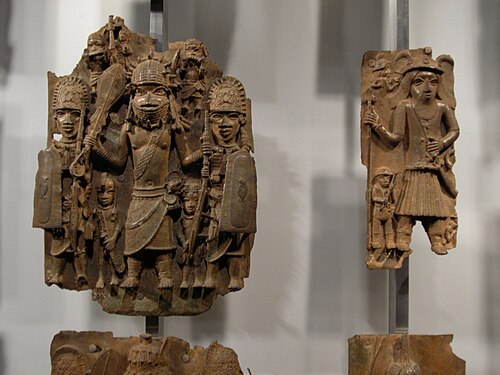
Special artists who worked only for the king made shining metal pictures called plaques to hang on the palace pillars. The plaques show the Oba, his soldiers, chiefs, musicians, animals like leopards and fish, and even Portuguese traders who came by ship. Together, they were like a history book made of metal.
The artists also made metal heads of past kings and of the Queen Mother. These heads were placed on special altars where the new king honoured his ancestors. The artists used the “lost-wax” method: they shaped the art in wax, covered it in clay, melted the wax out and poured in hot metal.
In 1897 a British army attacked Benin City, burned the palace and took thousands of these artworks away. Many were sold, and they ended up in museums in Britain, Germany, the United States and other countries.
Today many people in Nigeria want the artworks to come home. Some museums have already given objects back, while others, like the British Museum, still hold large collections. People disagree about exactly how, when and to whom they should be returned. Meanwhile, bronze casters in Benin City still make metal art today, carrying on the old tradition.
At a glance
- Made by
- Artists of the Edo people, especially the royal guild of brass casters (Igun Eronmwon), working for the Oba of Benin
- Where
- The royal palace in Benin City, capital of the Kingdom of Benin, in today’s Edo State, Nigeria (not the modern Republic of Benin)
- When
- From about the 13th–14th century to 1897; the bulk dates from the 15th–16th centuries, with later ‘golden ages’ associated with Oba Esigie (16th century) and Oba Eresoyen (18th century)
- What
- Rectangular relief plaques (several hundred), commemorative heads of Obas and Queen Mothers, figures, bells, altar pieces and jewellery, plus related ivory and wood carvings
- Material
- Mostly brass (copper, zinc and lead in varying proportions), cast by the lost-wax method; much metal came from European manillas
- Looted
- In February 1897 during the British ‘punitive expedition’; official figures speak of about 2,500 objects sent to Britain, and some estimates of looted objects reach 10,000
- Held today
- Over 130 institutions in about 20 countries; the largest holdings are the British Museum (around 900 objects) and Berlin’s Ethnological Museum, with major collections in Nigeria
- Restitution
- Germany, the Netherlands, several UK and US institutions and others have transferred ownership since 2021–2022; the British Museum’s collection is restricted by an act of Parliament
Easy
What are the Benin Bronzes?
The Benin Bronzes are the royal art of the Kingdom of Benin, a powerful West African state centred on Benin City in what is now Edo State, southern Nigeria. The name is a little misleading. It does not refer to the modern Republic of Benin, a neighbouring country, and most of the objects are made of brass rather than bronze. The collection also includes objects in ivory, wood, coral, iron and other materials.
The best-known works are hundreds of rectangular metal plaques that were once nailed to the wooden pillars of the Oba’s palace, and the commemorative heads that stood on royal ancestral altars. There are also statues of court officials and musicians, figures of leopards and roosters, bells, ceremonial swords, bracelets and many other items. They were made from roughly the thirteenth or fourteenth century until 1897, though most of the famous pieces date from the fifteenth and sixteenth centuries.
Most were taken by British forces when they conquered Benin City in 1897. Since then they have become both a symbol of African artistic genius and a symbol of colonial violence, and their future is at the heart of an international debate about who should own the heritage of other peoples.
Easy
The kingdom and its king
The Kingdom of Benin had a long history before Europeans arrived. According to Edo tradition, an earlier line of rulers called the Ogiso was followed by a new dynasty whose kings bore the title Oba. Tradition links the first Oba, Eweka, to Oranmiyan, a prince from the Yoruba city of Ife, around the thirteenth century. The current royal family traces its descent to that dynasty.
In the fifteenth century Oba Ewuare, remembered as Ewuare the Great, expanded the kingdom and rebuilt Benin City with deep moats and earthen walls. In the early sixteenth century Oba Esigie extended Benin’s power further and gave his mother, Idia, the new title of Iyoba, or Queen Mother. Portuguese sailors reached Benin in 1485, and trade in pepper, ivory, cloth and enslaved people grew alongside the kingdom’s wider African trade.
The Oba was a sacred ruler. The welfare of the kingdom was believed to depend on his wisdom and spiritual power. Only he could own objects of brass and ivory, although he could grant their use to high-ranking chiefs. Coral beads were also royal. Art at the court was therefore not decoration in a simple sense: it expressed and strengthened the Oba’s authority.
Easy
How to “read” a plaque
A typical Benin plaque is a rectangle of brass about three millimetres thick with figures raised in high relief. Look first at the centre: the most important person is usually placed there and made larger than the others. Often this is the Oba, flanked by two attendants who support his arms. This “royal triad” shows that a king rules with the support of trusted helpers.
Next, look at clothing and objects. Rank and role were shown through dress, coral beads, weapons and emblems, so a viewer at court could recognise a war chief, a musician, a priest or a foreign trader. Portuguese men appear with long hair, hats and sometimes guns. Individual names are rarely possible to identify, and modern attempts to link plaques to specific historical people remain speculative.
Then look at the background. Most plaques are covered with small incised leaf patterns called ebe-ame, “river leaves,” associated with healing rites of priestesses of Olokun, the god of the sea. Fish, crocodiles and other water creatures appear too, linking the Oba to Olokun’s realm. The leopard, a powerful and dangerous animal, is the Oba’s symbol and appears again and again.
Finally, think about how the plaques were displayed. They were nailed to pillars in the palace, probably in sets and patterns that visitors walked past. Some depict battles from the sixteenth-century wars of expansion, but most show court ceremonies. Together they formed a visual record of the kingdom’s history and hierarchy.
Easy
Heads, altars and the Queen Mother
When a new Oba came to the throne, one of his duties was to set up an altar for his predecessor. Cast brass heads of the dead king were placed on these altars, and later heads had an opening at the top into which a carved elephant tusk was set. Carved tusks, perhaps from the eighteenth century, show scenes from a deceased king’s reign. At annual festivals the living Oba made offerings at these altars to strengthen his reign.
The heads are not portraits in the modern sense. They show an idealised, recognisable type of royal person, with coral bead collars and headdresses. The style changed over time, with collars growing higher and headdresses more elaborate. Because these changes follow a sequence, art historians use the heads to build a chronology of Benin art.
The Queen Mother (Iyoba) also had commemorative heads, with a distinctive tall, pointed beaded crown. The famous ivory pendant masks, often associated with Idia, the first Iyoba, were carved in the early sixteenth century; two almost identical examples are in the British Museum and the Metropolitan Museum of Art. A replica of the British Museum mask became the emblem of FESTAC 77, the great pan-African festival held in Lagos in 1977, and it remains a symbol of Nigerian cultural pride.
Intermediate
The casters’ guild and the lost-wax technique
Brass casting in Benin was controlled by a royal guild whose members lived in a special quarter of the city under the Oba’s direct authority. Today their descendants still work in Igun Street (Igun Eronmwon) in Benin City, and they revere Igue-Igha as the person who introduced casting to the kingdom. Edo tradition says the technique came from Ife in the thirteenth century, sent by the Ooni at the request of the Oba.
Works were made by lost-wax casting. The artist modelled the figure in wax over a clay core, incised the details into the wax, covered the model with clay and heated it so that the wax ran out. Molten metal was poured into the resulting hollow. Benin casters were able to make plaques only about three millimetres thick, an achievement that impressed European observers. The quality of work tended to be highest when the Oba was powerful enough to support many specialists.
Chemical analysis shows that most “bronzes” are brass: copper alloyed with zinc and lead in varying proportions. From the late fifteenth century, much of the metal came from manillas, horseshoe-shaped brass or copper bracelets that Portuguese and later Dutch traders brought in huge quantities as currency. Isotope studies suggest that much of this brass came from the Rhineland in Germany. In this way, Benin’s art was bound up with the Atlantic economy, including the trade in enslaved people, for which manillas were also used.
Intermediate
Benin, Ife and the Portuguese
Late nineteenth-century British scholars such as Charles Hercules Read and O. M. Dalton assumed that Benin must have learned metalworking from the Portuguese. This was wrong. Casting in Benin predates Portuguese contact, and both Edo tradition and scholarship link it to the older sculptural tradition of Ife. The discovery of naturalistic heads at Ife in 1938–1939 strengthened the view that Benin’s art had deep West African roots.
At the same time, contact with the Portuguese left clear traces. Portuguese figures appear on many plaques, and their trade brought large quantities of metal. Some scholars suggest that European illustrated books, Indian ivory caskets or other imported objects may have influenced the rectangular plaque format or certain motifs. Others, such as the art historian Babatunde Lawal, point to relief carving in southern Nigerian traditions to argue that the plaques are an indigenous development.
Portuguese and Dutch visitors also described Benin City. Around 1500 Duarte Pacheco Pereira mentioned its earthworks, and around 1600 the Dutch visitor Dierick Ruiters also described the city’s defences. European printed books included images of the city and palace from the early seventeenth century. These accounts show that Benin was known in Europe as a major city long before 1897.
Intermediate
1897: the British expedition and the looting
By the 1890s Benin was one of the few remaining independent kingdoms in the region. The Oba controlled trade in his territory, which British merchants and officials of the Niger Coast Protectorate saw as an obstacle, especially to the palm oil trade. In 1892 a treaty was signed with Oba Ovonramwen that the British interpreted as granting free trade; the Oba continued to demand customs duties, and in 1896 he halted the supply of palm produce to certain middlemen.
In late December 1896 the acting consul-general, James Phillips, set out for Benin City with about 250 people, mostly African porters, before receiving approval from London. The Oba sent word that he could not receive visitors during the Igue festival and asked the party to wait. Phillips continued. On 4 January 1897 the party was attacked near Ugbine; most of the British officials and many porters were killed, and only two Europeans survived. Historians still debate Phillips’s intentions: British accounts presented it as a peaceful mission, while others, including the Nigerian historian Philip Igbafe, argue it was effectively a reconnaissance for an invasion Phillips had already advocated.
Britain responded with what it called a “punitive expedition.” About 1,200 marines, sailors and protectorate troops under Rear-Admiral Harry Rawson invaded in February 1897 and captured Benin City on 18 February. Eight members of the British force were recorded killed; Benin losses were not counted but are thought to have been very high. The palace and much of the city were burned. Oba Ovonramwen was captured, deposed and exiled to Calabar, where he died in 1914, and six chiefs were hanged. Benin was absorbed into the British protectorate.
British officers and journalists reported scenes of human sacrifice in the city, which they used to justify the conquest. Historians agree that sacrifice was practised in Benin but, as Robin Law and others note, the subject is highly sensitive and European accounts may have exaggerated its extent to legitimise intervention.
Intermediate
From palace to museums around the world
The expedition removed the contents of the palace and of chiefs’ houses: plaques, heads, ivories, bells, figures and more, accumulated over centuries. Official figures mention about 2,500 objects sent to Britain; the archaeologist Dan Hicks has estimated that up to 10,000 objects may have been taken in total. The Admiralty auctioned much of the loot to pay for the expedition, beginning in London in May 1897, while officers kept pieces as souvenirs and the Foreign Office gave hundreds of plaques to the British Museum.
Many objects were bought by museums in Germany, which acquired large collections, and others went to Austria, the Netherlands, the United States and elsewhere. By 1988, one count suggested that only about fifty pieces remained in Nigeria while about 2,400 were in European and American collections. Between 1950 and 1972 the British Museum sold more than thirty plaques it considered duplicates to the Nigerian government, a policy a later curator regretted.
In Europe the objects caused a sensation. Their skill forced many observers to rethink racist assumptions about African art, and Benin sculpture influenced collectors and modernist artists. At the same time, museums often displayed them as trophies or ethnographic curiosities, with little attention to the violence of their removal.
In Benin City, Oba Eweka II, who took the throne in 1914, rebuilt the palace, restored the craft guilds and commissioned new objects to replace those that had been taken. The casting tradition survives today, and contemporary Benin casters continue to produce works in the old manner and in new styles.
Intermediate
The restitution movement
Since independence in 1960 Nigeria has asked for the return of the Bronzes on several occasions. The Royal Court of Benin has also pressed its claim. For decades most museums refused, pointing to legal limits and their role as “universal museums” that show world cultures to wide audiences. The Benin Dialogue Group, formed by European museums, the Royal Court, the Edo State government and Nigeria’s National Commission for Museums and Monuments (NCMM), agreed in 2018 on loans to a planned museum in Benin City.
Around 2020–2022 the situation changed rapidly. Germany announced in 2021 that it would return looted Benin objects, and in 2022 it signed an agreement with Nigeria transferring ownership of about 1,130 objects from several museums, some of which remain in Germany on loan. The Horniman Museum in London, the University of Aberdeen, Jesus College Cambridge and the University of Cambridge transferred ownership of objects. In the United States the Smithsonian’s National Museum of African Art signed over 29 bronzes in 2022, and the Metropolitan Museum of Art returned two plaques that had been illegally removed from a Nigerian museum after 1960. The Netherlands returned 119 objects in June 2025.
The British Museum, which holds around 900 objects, has not returned its collection. It says it is legally prevented from permanently disposing of objects by the act of Parliament that governs it, and it has discussed loans instead. Critics argue that the law could be changed and that loans imply that the museum remains the owner. In 2021 the Benin Kingdom’s traditional prime minister unveiled a large new plaque offered to the British Museum in exchange for the looted works.
In November 2022 the Digital Benin online platform was launched, bringing together information on more than 5,000 objects in over 130 institutions in some 20 countries. For researchers and for the people of Benin, it made the scale of the dispersal visible for the first time.
Advanced
Debates over ownership: state, Oba and descendants
Restitution raised a question that many European supporters had not expected: to whom exactly should the objects be returned? Before 2023 most agreements were made with Nigeria’s federal NCMM, and a new Museum of West African Art (MOWAA), designed by David Adjaye and partly funded by Germany, was planned in Benin City. In March 2023, however, outgoing president Muhammadu Buhari declared by decree that all repatriated Benin objects belong to the Oba of Benin, who announced plans to keep them in a royal museum near his palace.
Supporters of the decree argue that the objects were taken from the palace, that they belong to the Oba as heirs of the court that commissioned them, and that many are sacred items of a living institution. Critics, including some European commentators, argue that the decree turned public cultural property into private property and ignored conditions that donor states had expected about public access. MOWAA opened its first phase without any Benin Bronzes, and in 2025 its opening was disrupted by protests amid disputes between the Oba, the Edo State government and the museum over control and naming.
Other voices complicate the picture further. The Restitution Study Group, an African-American organisation, argued in US courts that descendants of enslaved people have an interest in the Bronzes because the kingdom took part in the slave trade and much of the metal came from manillas used in that trade; its petitions to stop the Smithsonian’s return failed. Supporters of restitution reject this reasoning, stressing the claim of the living community from which the objects were taken. These debates show that restitution is not a single act but a process involving law, politics, memory and competing ideas of community.
Advanced
Interpreting 1897 and the objects: historiography and method
The conventional British account of 1897 presented the expedition as a justified response to the killing of Phillips’s party and as a liberation from human sacrifice. From the 1960s historians, notably Philip Igbafe, emphasised economic motives, the treaty dispute and the protectorate’s earlier plans for invasion. Dan Hicks’s The Brutish Museums (2020) went further, describing the expedition as part of a series of premeditated colonial attacks and arguing that museum display of the loot prolongs an “enduring brutality.” Some reviewers have questioned parts of his interpretation and tone while accepting that the looting was violent. Readers should recognise that the characterisation of 1897 remains contested, even if the basic facts of invasion and looting are not.
The objects themselves pose methodological problems. Because most were removed in a single episode without records of where they stood, their original arrangement, dates and meanings must be reconstructed from style, from Edo oral history, and from scientific analysis. Art historians have built chronologies from the evolution of royal heads; metallurgists use alloy composition and lead isotopes to separate earlier pieces from those cast with European manilla brass. Such methods have shifted assumptions: for example, the manillas’ brass was once thought to be Dutch but now appears to be mostly Rhenish.
Finally, the Bronzes challenge the categories in which they have been placed. Called “primitive art,” then “ethnography,” then “masterpieces of world art,” they are for the Royal Court of Benin records of dynastic history and sacred objects of ancestral cult. Many scholars now argue that interpretation should centre Edo knowledge, including the continuing guild of casters and palace historians, rather than only the perspectives of the museums that acquired them.
Key ideas
- Court art
- The Bronzes glorified the sacred Oba, recorded court life and served royal ancestral altars rather than being made for sale or display in the modern sense.
- Royal monopoly
- Brass, ivory and coral were controlled by the Oba, and a hereditary guild cast brass only under royal authority.
- Lost-wax mastery
- Benin casters produced thin, detailed plaques and heads using wax models and clay moulds.
- Atlantic entanglement
- European manillas supplied much of the brass, linking the art to Atlantic trade, including the slave trade.
- Colonial loot
- The 1897 British conquest removed thousands of objects, scattering them across museums and private collections worldwide.
- Restitution
- Returning the objects has become a test case for how museums address colonial-era acquisitions.
- Living tradition
- The casters’ guild in Benin City continues to work, and the Oba’s court remains a living institution.
Records
- c. 1200 — Edo tradition places the start of the Oba dynasty, linked to Oranmiyan of Ife, and later the arrival of casting from Ife.
- 1440 — Oba Ewuare the Great comes to power and rebuilds Benin City with walls and moats.
- 1485 — Portuguese sailors under João Afonso de Aveiro reach Benin; trade in manillas grows.
- c. 1520 — Under Oba Esigie, court art flourishes; ivory masks associated with Queen Mother Idia are carved.
- 1735 — Reign of Oba Eresoyen (1735–1750), a second ‘golden age’ of Benin metalwork, begins.
- 1892 — The Gallwey Treaty between Oba Ovonramwen and British officials is signed.
- 1897 — Phillips’s party is attacked (4 January); British forces capture and burn Benin City (18–21 February) and loot the palace.
- 1914 — Ovonramwen dies in exile; Eweka II becomes Oba, rebuilds the palace and restores the guilds.
- 1977 — A replica of the Idia ivory mask becomes the emblem of FESTAC 77 in Lagos.
- 2022 — Germany agrees to transfer about 1,130 objects; the Horniman, Smithsonian and Cambridge transfer ownership; Digital Benin launches.
- 2023 — A presidential decree vests returned Benin objects in the Oba of Benin.
- 2025 — The Netherlands returns 119 objects; the Museum of West African Art’s opening is disrupted by disputes.
Glossary
- Oba
- The title of the king of Benin, a sacred ruler at the centre of court life.
- Iyoba
- The Queen Mother of Benin, a title first given to Idia in the early sixteenth century.
- Edo
- The people and language of the Kingdom of Benin; also the old name of Benin City.
- Plaque (ama)
- A rectangular brass relief that was nailed to the palace pillars.
- Lost-wax casting
- A method of casting metal using a wax model that is melted out of a clay mould.
- Manilla
- A horseshoe-shaped metal bracelet used as currency in West African trade with Europeans.
- Igun Eronmwon
- The quarter (Igun Street) of Benin City where the royal guild of brass casters lives and works.
- Restitution
- Returning cultural objects to the people or state from whom they were taken.
- Punitive expedition
- The British term for a military attack justified as punishment; its use for 1897 is itself debated.
- Provenance
- The documented history of an object’s ownership and location.
Questions and answers
Are the Benin Bronzes from the country called Benin?
No. They come from the old Kingdom of Benin, whose capital, Benin City, is in Nigeria. The modern Republic of Benin is a different country next door.
Are they really made of bronze?
Mostly not. Most are brass, a mix of copper, zinc and lead. The collection also includes ivory, wood and coral objects.
Why did the British take them?
After a British party was attacked in January 1897, Britain invaded Benin City. Soldiers took the art as spoils of war, and much of it was sold to pay for the expedition. Historians debate whether the attack was simply retaliation or part of a longer plan to conquer the kingdom.
Have any been returned?
Yes. Germany, the Netherlands, the Smithsonian, the Horniman Museum, Cambridge and others have transferred ownership of objects since 2021. The British Museum has not returned its large collection.
Who owns returned Bronzes now?
A 2023 Nigerian presidential decree gave ownership of returned objects to the Oba of Benin. This has caused debate in Nigeria and among returning countries about public access and museums.
What did the heads on the altars do?
They honoured dead kings and Queen Mothers. Each new Oba set up an altar for his predecessor and made offerings there at festivals.
Is Benin bronze casting still alive?
Yes. The casters’ guild in Igun Street, Benin City, still makes brass works today.
Sources and further reading
- Benin Bronzes. Wikipedia
- Benin Expedition of 1897. Wikipedia
- Kingdom of Benin. Wikipedia
- Benin ivory mask. Wikipedia
- Idia. Wikipedia
- Manilla (money). Wikipedia
- Museum of West African Art. Wikipedia
- Bronze Head from Ife. Wikipedia
- Dan Hicks, The Brutish Museums: The Benin Bronzes, Colonial Violence and Cultural Restitution. Pluto Press, 2020
Related
- Ife headsNaturalistic copper-alloy and terracotta heads made in the Yoruba city of Ife, among the most celebrated sculptures of Africa.
- Rosetta StoneGranodiorite stele fragment inscribed in 196 BC with a priestly decree honouring Ptolemy V in hieroglyphic, Demotic and Greek; the parallel texts became the key to deciphering ancient Egyptian writing.
- Bust of NefertitiPainted limestone-and-stucco portrait of Queen Nefertiti, wife of the pharaoh Akhenaten, made in the workshop of the sculptor Thutmose at Amarna and found by a German expedition in 1912.
- ParthenonA temple dedicated to Athena on the Athenian Acropolis, built during the fifth century BCE.
- Great ZimbabweRemains of a major southern African city built and occupied by ancestors of the Shona people.
- Nzinga of Ndongo and MatambaMbundu queen who ruled Ndongo and Matamba for nearly forty years, resisting Portuguese conquest through diplomacy, war and shifting alliances.
Written with AI assistance from the published sources listed above, and revised as new research appears.