Start at the top for an easy introduction. Go further down for more detail and scholarship.
- Easy
- Intermediate
- Advanced
For young readers
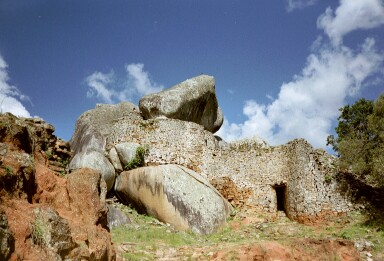
Picture a wall as tall as a three-storey building that curves around like a giant stone snake, made of thousands of flat grey stones stacked one on top of another without any cement at all. That wall is part of Great Zimbabwe, an old city in the hills of the country now called Zimbabwe, in southern Africa.
About 700–900 years ago, this was the home of powerful kings and a busy town where thousands of people lived. Most families lived in round houses made of earth with thatched roofs. The kings and important people lived behind the tall stone walls, which were a way of showing how powerful they were.
The people of Great Zimbabwe were farmers and cattle herders, but they were also traders. They sent gold and ivory to the coast of the Indian Ocean, and in return got glass beads, cloth and even pottery that had travelled all the way from China. Archaeologists have dug up pieces of those Chinese bowls at the site.
On a hill above the city, people found eight beautiful birds carved from soft green-grey stone, each sitting on top of a tall stone pillar. Today one of these birds is on Zimbabwe’s flag.
For a long time, some European visitors refused to believe that Africans had built such a great city, and made up stories about faraway builders. Archaeologists proved them wrong: Great Zimbabwe was built by the ancestors of the Shona people who still live there today.
At a glance
- Period
- Settled from around 1000 CE; stone building mainly c. 1100s–1400s; peak c. 1300–1450; declined in the 15th–16th centuries
- Place
- Near Masvingo, southeastern Zimbabwe, on the southern edge of the Zimbabwe plateau
- Builders
- Bantu-speaking ancestors of the Shona people (Kingdom of Zimbabwe)
- Materials
- Local granite split into blocks, laid as dry-stone walls (no mortar); houses of daga (earth)
- Main parts
- Hill Complex, Great Enclosure, Valley Complex; the whole site covers about 7 km²
- Great Enclosure
- Outer wall about 250 m long and up to about 11 m high; the largest precolonial stone structure south of the Sahara
- UNESCO
- “Great Zimbabwe National Monument”, World Heritage Site since 1986
- Significance
- Capital of a major southern African state linked to Indian Ocean trade; national symbol of Zimbabwe
Easy
What is Great Zimbabwe?
Great Zimbabwe is the ruined capital of a southern African kingdom, located about 25 km southeast of the modern town of Masvingo in Zimbabwe. It is famous for its massive walls of dressed granite, built without mortar, which curve over hills and across a valley. It is the largest of hundreds of similar stone-walled sites (often called “zimbabwes”) spread across the region between the Zambezi and Limpopo rivers.
The word zimbabwe comes from Shona, the language of the majority of people in the country today. It is usually explained as dzimba dza mabwe, “houses of stone”, or as dzimba woye, “venerated houses”, a term used for the houses or graves of chiefs. The Portuguese recorded the name as early as 1531, as “Symbaoe”, meaning a royal court. The adjective “Great” distinguishes this site from smaller ones.
The city grew from a farming village around the eleventh century into a capital of perhaps 10,000 people or more by the fourteenth century. It was the centre of a state whose wealth came from cattle, farming and control of the trade in gold and ivory that flowed to the Swahili coast and across the Indian Ocean. By the sixteenth century it had lost its central role, and power in the region shifted north and west.
Great Zimbabwe is a UNESCO World Heritage Site and the most important national monument of Zimbabwe, which took its name from the site when it became independent in 1980. It remains a sacred place for many local communities.
Easy
Walking through the site: hill, enclosure and valley
The ruins form three main groups. The Hill Complex sits on a steep granite hill about 80 m above the valley. Here, walls were built between and on top of huge natural boulders, so that rock and masonry merge. It is the oldest part of the site, with stone building beginning there by around the twelfth century, and it contains a series of enclosures, including the Eastern Enclosure, where most of the famous soapstone birds were found. Many scholars see the hill as a place of royal and ritual importance.
Below the hill lies the Great Enclosure, the most impressive single building. An outer wall about 250 m long, up to about 11 m high and up to about 5 m thick at the base, forms a rough oval. Along part of its top runs a decorative band of stones laid in a zigzag (chevron) pattern. Inside is an older, inner wall, and between the two runs a narrow, high-walled passage, the Parallel Passage, which leads toward the Conical Tower.
The Conical Tower is a solid cone of stone about 9 m high and more than 5 m across at the base. It has no door or inner chamber. Its meaning is unknown: suggestions include a symbolic grain bin (a sign of a ruler’s generosity and wealth), a phallic or fertility symbol, or a monument whose form echoes the towers found at other zimbabwe sites.
Between and around these two main groups lie the Valley Complex ruins, a series of smaller enclosures built mostly in the fourteenth and fifteenth centuries. Beyond the stone walls, the city extended over a large area where most people lived in round houses of daga (a mixture of earth and gravel) with thatched roofs. Only the stone parts survive clearly today, so it is easy to forget that the walls were the elite core of a much larger town.
Easy
How the walls were built
The builders used the granite of the surrounding hills. In this area, granite domes naturally peel off in thin, even layers as the rock heats up by day and cools at night, a process called exfoliation. The slabs could be broken into brick-sized blocks and carried to the building site. Some scholars think builders speeded up the process by heating the rock with fire and then cooling it with water, but direct evidence for this is limited.
All the walls are dry-stone: the blocks are laid in courses (horizontal rows) without mortar, held in place by their own weight and careful fitting. Each course is set slightly back from the one below, so the wall leans gently inward, which makes it more stable. The walls have no foundations in the modern sense and were often built directly on bedrock or packed earth. Doorways were rounded, and some had wooden lintels and steps.
Building techniques changed over time. Archaeologists, following a classification introduced by Anthony Whitty in the mid-twentieth century, distinguish an early style of roughly shaped, uneven stones; a later, highly regular style with neat, even courses, seen at its best in the outer wall of the Great Enclosure; and a still later, less regular style. These styles help to date different parts of the site relative to each other.
The scale of the work was enormous. The outer wall of the Great Enclosure alone is often estimated to contain around 15,000 tonnes of stone. There are no written records of how the work was organized, but it must have required many workers over long periods, probably organized through the authority of rulers and the labour obligations of communities, as in later Shona states.
Intermediate
The people and the state: cattle, gold and kingship
Great Zimbabwe belongs to a long history of Bantu-speaking farming communities in southern Africa. Farmers who worked iron and grew crops such as sorghum and millet lived in the area from the first millennium CE. Around the eleventh century, communities archaeologists call Gumanye began building at the site; their pottery and way of life lead directly to the Great Zimbabwe culture.
The immediate forerunner of Great Zimbabwe was Mapungubwe, a kingdom centred in the Limpopo valley (in present-day South Africa, near the borders of Botswana and Zimbabwe), which flourished in the thirteenth century and was abandoned around 1300. At Mapungubwe, the ruling class already lived on a hilltop above commoners, and traded gold and ivory with the coast. Great Zimbabwe’s rise at about the time of Mapungubwe’s decline suggests that the centre of power and trade shifted north.
Wealth at Great Zimbabwe was measured above all in cattle. Animal bones from the site show that the elite ate large amounts of beef, and cattle were used to form alliances, pay bridewealth and reward followers. The rulers also controlled long-distance trade. Gold was mined on the Zimbabwe plateau, mostly to the west, and exported through intermediaries to Swahili towns on the coast, such as Sofala and Kilwa, together with ivory. Imports included glass beads, cloth, Persian pottery and Chinese celadon (green-glazed stoneware) of the thirteenth to fifteenth centuries.
Estimates of the population at its height range from about 10,000 to 18,000 people, most of them living outside the stone walls. Only a few hundred members of the elite are thought to have lived inside the great enclosures. The state centred on the city may have controlled a region of tens of thousands of square kilometres, although its borders and structure are not known in detail.
In world context, Great Zimbabwe was contemporary with the Mali Empire in West Africa (Mansa Musa made his famous pilgrimage in 1324), the Swahili city-states of the East African coast, the Yuan and early Ming dynasties in China and late medieval Europe. It was part of the Indian Ocean trading world that linked Africa, Arabia, India and China.
Intermediate
Religious and cultural meaning; the Zimbabwe Birds
Great Zimbabwe was not only a political centre but also a sacred place. In later Shona tradition, the king (mambo) held authority through his connection to royal ancestors and to God, Mwari, and spirit mediums spoke for the ancestors of the land. Many scholars think the Hill Complex, with its caves, boulders and enclosures, was associated with such ritual roles, perhaps including rain-making, although this is interpretation based on later ethnography rather than direct evidence.
The most famous objects from the site are eight birds carved from soapstone (a soft, greenish stone also called steatite), each around 40 cm tall and mounted on top of a stone column about a metre high. Most were found in the Eastern Enclosure of the Hill Complex. They are not realistic portraits of a single species; they combine features of birds of prey, such as the bateleur eagle or the fish eagle, with human-like details such as toes in place of talons. A common interpretation is that they represent royal ancestors or messengers between the living, the ancestors and the divine.
The birds had a turbulent modern history. In 1889 a hunter removed one and sold it to Cecil Rhodes; it remains at his former house, Groote Schuur, in Cape Town. Others were taken to South Africa and Germany. South Africa returned four birds in 1981, and the lower part of a bird held in Berlin was returned in the early 2000s. The bird became the emblem of Rhodesia and then of independent Zimbabwe, and appears on its flag, coat of arms and currency.
For local communities today, Great Zimbabwe is a place of the ancestors, where ceremonies are still held. Traditional leaders and spirit mediums have at times been in tension with heritage managers over access, rituals and the right to act as custodians of the site, and neighbouring clans have competing claims. Respecting these living relationships is now part of how the monument is managed.
Intermediate
Decline and later history
From the fifteenth century Great Zimbabwe lost its central role, and by around 1550 it was no longer a major capital, although people continued to live at the site. The causes are debated. Possible factors include exhaustion of local resources (grazing, farmland and firewood) around a large population, shifts in the gold trade toward the Zambezi valley in the north, and political competition within the ruling family.
Shona oral traditions describe a prince, Nyatsimba Mutota, leaving to the north in search of salt and founding what became the Mutapa state. Oral tradition must be used with care as historical evidence, but the story fits the archaeological picture of power moving north to the Mutapa state, which the Portuguese encountered in the sixteenth century, and west to the Torwa state centred at Khami (another World Heritage Site), later succeeded by the Rozvi.
Portuguese writers based on the coast recorded information about the stone buildings in the early sixteenth century. Captain Vicente Pegado of Sofala wrote in 1531 of a fortress “built of stones of marvellous size” without mortar, which local people called Symbaoe. The historian João de Barros repeated such accounts in the mid-sixteenth century. None of these writers visited the site themselves; their information came from African and Swahili informants.
Intermediate
The “Zimbabwe controversy”: colonial denial and archaeological proof
In 1871 the German geologist Karl Mauch, guided to the site after a hunter named Adam Render had come across it, declared that it could not have been built by Africans. He speculated that it was a copy of the Queen of Sheba’s palace and that a wooden lintel was cedar brought by Phoenicians. These ideas, echoing earlier Portuguese legends about the biblical land of Ophir, fitted the needs of European colonizers, who were about to occupy the region.
After the British South Africa Company of Cecil Rhodes took control of the territory in 1890, Rhodes funded James Theodore Bent to excavate in 1891. Bent, who had no archaeological training, concluded that the builders were Phoenicians or Arabs and dug destructively near the Conical Tower. Between 1895 and about 1901, the Rhodesia Ancient Ruins Company licensed prospectors to dig for gold in the ruins, and in 1902–04 Richard Nicklin Hall, appointed curator, cleared metres of archaeological deposits from the Great Enclosure to remove what he considered “Kaffir” (a racist term) occupation debris. Much of the evidence that could have dated the site was destroyed.
The first professional archaeologist to work there, David Randall-MacIver, excavated in 1905 and concluded in his book Medieval Rhodesia (1906) that the buildings were medieval and African. In 1929, Gertrude Caton Thompson led excavations for the British Association and confirmed his conclusion with careful stratigraphic work: every datable object pointed to Bantu-speaking builders and a medieval date. Her findings were rejected by many settlers, and she herself described the buildings in condescending terms, but the scientific case was clear.
Radiocarbon dating from the 1950s onward confirmed the medieval chronology, and by then African origin was the consensus among archaeologists. Yet the white-minority government of Rhodesia, especially after its unilateral declaration of independence in 1965, pressured museums and guidebooks to present the origins as uncertain or foreign. Archaeologists who publicly stated the truth faced censorship; Peter Garlake, the government’s inspector of monuments, left the country in 1970, and Roger Summers of the national museum also departed. The controversy is now a textbook case of how racism and politics can distort the interpretation of the past.
Intermediate
Conservation today
Great Zimbabwe is managed by National Museums and Monuments of Zimbabwe and was inscribed on the UNESCO World Heritage List in 1986. The walls face many threats: collapse caused by the loss of supporting deposits removed by early diggers, the growth of trees and roots, water damage and erosion, lichens, and visitors climbing on the walls.
Some earlier reconstructions have themselves been criticized. In the twentieth century, collapsed sections were sometimes rebuilt without careful documentation, making it hard to tell original masonry from later work. Modern conservation practice emphasizes monitoring, minimal intervention, documentation of every repair, and the use of traditional dry-stone techniques by trained local masons.
Community involvement is a key issue. After independence the site was managed as a national monument and tourist attraction, which sometimes limited access for local people who regard it as sacred. Heritage professionals, including the Zimbabwean archaeologist Webber Ndoro, have argued that conservation should recognize the site’s spiritual significance and involve local communities, not only protect its stones.
Intermediate
Legacy: a name for a nation
For African nationalists fighting white-minority rule in Rhodesia, Great Zimbabwe became a powerful symbol of African achievement and self-government. When the country gained independence in 1980, it took the name Zimbabwe, and the soapstone bird was placed on the new flag. Few archaeological sites anywhere have played such a direct role in the identity of a modern state.
The site has also been used politically after independence, for example to support different ideas of national history favoured by the government of the day. Historians note that both colonial and nationalist writers used Great Zimbabwe to support their own visions of the present, which is a reminder that heritage is always interpreted.
In scholarship, Great Zimbabwe changed ideas about the African past. It is a key example of the development of complex states and urban centres in sub-Saharan Africa without influence from outside conquerors, and of African participation in a trade network that linked the continent to Asia centuries before European colonialism.
Advanced
Scholarly debates and open questions
Chronology. The standard sequence places the Hill Complex first (from around the eleventh or twelfth century), the Great Enclosure in the thirteenth to fifteenth centuries, and the Valley Complex in the fourteenth and fifteenth centuries. This was built from radiocarbon dates, imported goods and wall styles. However, because early digging destroyed so much stratigraphy, the sequence rests on limited evidence. In the 2010s Shadreck Chirikure and colleagues re-examined the radiocarbon dates with Bayesian statistical modelling and argued that the parts of the site were occupied more simultaneously than the simple “hill, then enclosure, then valley” model assumes.
What was the Great Enclosure for? Two broad interpretations have dominated. In one, associated with the historian David Beach and others, the different complexes reflect a succession of rulers moving their residences over time. In a “structuralist” interpretation developed by the archaeologist Thomas Huffman using later Shona and Venda ethnography, the complexes had different contemporaneous functions: the Hill Complex as the king’s residence and ritual centre, and the Great Enclosure as a residence for royal wives and a place of initiation. Critics object that projecting modern ethnography back several centuries is risky and that the dates do not clearly support it.
Who exactly were the builders? Archaeologists agree that Great Zimbabwe was built by Bantu-speaking Africans whose culture continues among the Shona. More specific attributions are debated: most link the builders to the ancestors of the Karanga (a Shona group), while some traditions also claim connections to Venda-speaking communities, and the Lemba have oral traditions associating themselves with the site. These are questions about the relationship between modern identities and an ancient population, not about African origin.
Why did it decline, and how big was it? Population estimates depend on how many houses are assumed outside the walls, where little has been excavated. Recent modelling suggests lower figures (under about 10,000) than earlier estimates of up to 18,000. The relative importance of environmental stress, trade shifts and political fission in the decline remains open.
Advanced
Evidence and methods
No writing. The people of Great Zimbabwe did not use writing, so there are no inscriptions or chronicles from the city itself. Knowledge comes from archaeology, from external written sources (Swahili-coast, Arabic and Portuguese texts that mention inland gold and kingdoms), from oral traditions recorded later, and from comparison with later Shona societies. Each kind of evidence has limits, and good interpretations combine them carefully.
Dating methods. Radiocarbon dating measures the decay of carbon-14 in organic material such as charcoal or wood; more than two dozen dates have been obtained for the site, although the earliest measurements from the 1950s are now regarded as unreliable. Imported objects of known date, especially Chinese ceramics of the fourteenth and fifteenth centuries and glass beads of known types, provide cross-checks. Relative dating uses stratigraphy (the order of layers of deposits) and wall styles.
The damaged record. The destruction caused by treasure-hunters and early excavators in the 1890s–1900s is a central methodological problem. Archaeologists must work with disturbed deposits, reinterpret old excavation records, and often study less damaged nearby sites and other zimbabwes to understand the capital.
Historiography. The history of research at Great Zimbabwe shows how scholarly questions are shaped by their political context. Early theories were driven by colonial ideology, the scientific refutation was delayed by settler politics, and post-independence narratives have sometimes simplified the past for national purposes. Modern researchers, many of them Zimbabwean, seek to write the site’s history from African perspectives while keeping to the evidence.
Key ideas
- Dry-stone architecture
- Walls built of carefully fitted stone without mortar; at Great Zimbabwe the technique reached a monumental scale and a high degree of refinement.
- Zimbabwe culture
- The archaeological tradition of stone-walled elite centres on the Zimbabwe plateau, from Mapungubwe to Great Zimbabwe, Khami and later sites.
- Wealth in cattle and gold
- Elite power rested on control of cattle herds and of the gold and ivory trade to the Indian Ocean coast.
- Sacred kingship
- Rulers’ authority was tied to ancestors and the divine; the walls separated and displayed the ruling elite.
- The Zimbabwe controversy
- The colonial-era denial that Africans built the site, refuted by archaeology but politically sustained in Rhodesia until 1980.
- Heritage and identity
- The site gave its name and emblem to modern Zimbabwe and remains sacred to local communities.
- Indian Ocean connections
- Chinese and Persian ceramics and glass beads show that inland southern Africa was part of a trade network stretching to Asia.
Records
- c. 300 CE — Early iron-working farming communities live in the region.
- c. 1000 — Farming settlement begins on and around the hill at Great Zimbabwe.
- c. 1150 — First stone walls are built in the Hill Complex.
- c. 1300 — Mapungubwe is abandoned; Great Zimbabwe becomes the leading centre of the region.
- c. 1350 — The outer wall of the Great Enclosure and the Conical Tower are built around this time.
- c. 1450 — Decline begins as power moves north (Mutapa) and west (Torwa, Khami).
- 1531 — Vicente Pegado, Portuguese captain at Sofala, records a description of “Symbaoe”.
- 1871 — Karl Mauch visits and claims foreign builders, launching the “Zimbabwe controversy”.
- 1891 — J. Theodore Bent excavates for Cecil Rhodes and attributes the site to Phoenicians or Arabs.
- 1905 — David Randall-MacIver excavates and concludes that the site is medieval and African.
- 1929 — Gertrude Caton Thompson’s excavations confirm African construction and a medieval date.
- 1986 — Great Zimbabwe National Monument is inscribed on the UNESCO World Heritage List (six years after Zimbabwe’s independence in 1980).
Glossary
- Shona
- The largest language and ethnic group in Zimbabwe, descendants of the builders of Great Zimbabwe.
- Bantu
- A large family of related languages spoken across central, eastern and southern Africa, including Shona.
- Dry-stone wall
- A wall made of stones fitted together without mortar.
- Exfoliation
- The natural peeling of rock into thin sheets as it heats and cools, which provided the builders with flat slabs.
- Daga
- A building material of earth mixed with gravel, used for houses, floors and platforms.
- Chevron pattern
- A decorative zigzag pattern made by setting stones at angles, seen along part of the Great Enclosure wall.
- Soapstone (steatite)
- A soft stone that is easy to carve, used for the Zimbabwe Birds.
- Celadon
- Chinese green-glazed stoneware, fragments of which were found at Great Zimbabwe.
- Mambo
- A Shona title for a king or ruler.
- Stratigraphy
- The study of layers of soil and deposits; lower layers are usually older, which helps date finds.
- Radiocarbon dating
- A method that dates organic remains by measuring the decay of carbon-14.
Questions and answers
Who built Great Zimbabwe?
Bantu-speaking Africans who were the ancestors of the Shona people of modern Zimbabwe. Archaeology has proved this beyond doubt.
How old is Great Zimbabwe?
People lived there from around 1000 CE; most of the stone walls were built between about the twelfth and fifteenth centuries, so they are roughly 600–900 years old.
Why is there no cement or mortar in the walls?
The builders used a dry-stone technique: flat granite blocks are fitted closely and each layer is set slightly back, so the wall holds together by its own weight.
What was Great Zimbabwe used for?
It was the capital of a kingdom: a royal residence, a religious centre and a town. Exactly which parts served which purposes is still debated.
Why did people claim foreigners built it?
Nineteenth-century European colonizers held racist beliefs that Africans could not build such monuments, and the idea supported colonial rule. Archaeologists refuted it from 1905 onward.
What are the Zimbabwe Birds?
Eight soapstone birds on tall columns found at the site, probably symbols linked to royalty and ancestors. One appears on Zimbabwe’s flag.
Why was Great Zimbabwe abandoned?
No single cause is known. Likely factors are pressure on local resources, shifts in the gold trade and political splits, as power moved to the Mutapa and Torwa states.
Is the country Zimbabwe named after it?
Yes. At independence in 1980, the former Rhodesia took the name Zimbabwe from the site.
Sources and further reading
- Great Zimbabwe National Monument. UNESCO World Heritage Centre
- Great Zimbabwe. Wikipedia
- Kingdom of Zimbabwe. Wikipedia
- Kingdom of Mapungubwe. Wikipedia
- Zimbabwe Bird. Wikipedia
- Gertrude Caton Thompson. Wikipedia
- Department of the Arts of Africa, Oceania, and the Americas, Great Zimbabwe (11th–15th Century). The Metropolitan Museum of Art, Heilbrunn Timeline of Art History, 2001
- Peter Garlake, Great Zimbabwe. Thames and Hudson, 1973
- Innocent Pikirayi, The Zimbabwe Culture: Origins and Decline of Southern Zambezian States. AltaMira Press, 2001
- Gertrude Caton-Thompson, The Zimbabwe Culture: Ruins and Reactions. Clarendon Press, 1931
Related
- Mansa MusaRuler of the Mali Empire remembered for its wealth, his pilgrimage to Mecca and support for Islamic learning.
- Ibn BattutaMoroccan traveler whose account describes journeys across Africa, Asia and parts of Europe.
- Obelisk of AxumA carved stone funerary monument from the ancient kingdom of Aksum in present-day Ethiopia.
- Pyramids of MeroëRoyal funerary pyramids of the Kushite kingdom at Meroë in present-day Sudan.
- Angkor WatMonumental temple complex built in the Khmer Empire under King Suryavarman II.
Written with AI assistance from the published sources listed above, and revised as new research appears.